
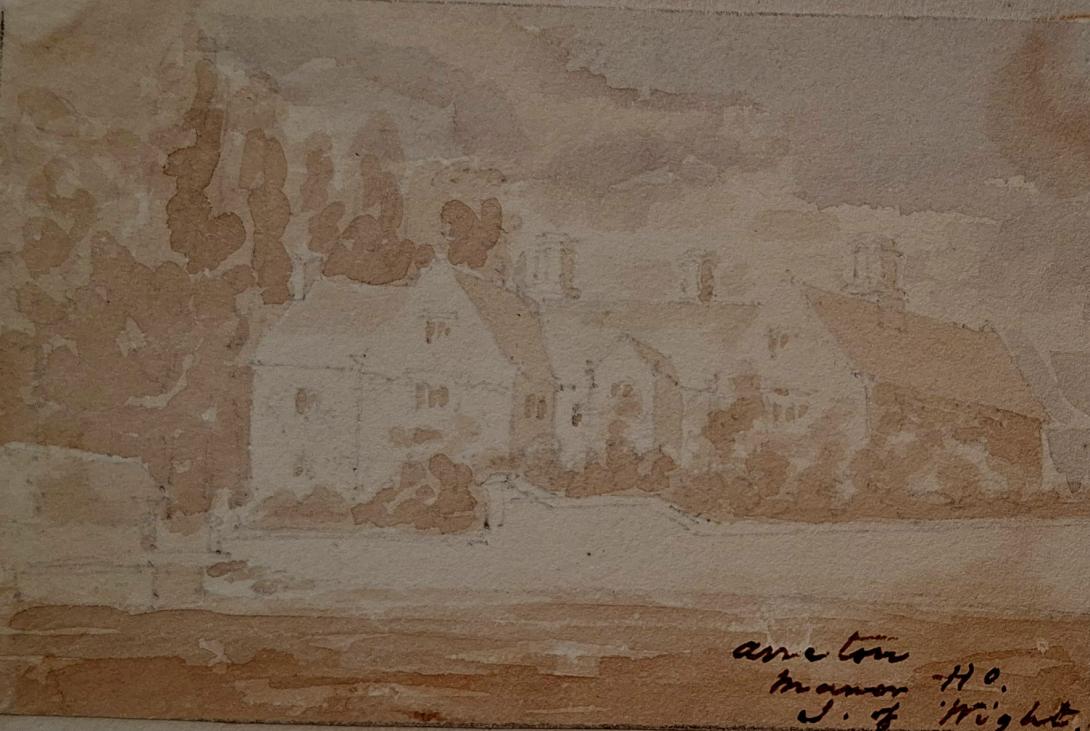
inscribed and dated " Arreton Manor Ho I of Wight / 1829"
By Descent from the Architects and Artists Family
Arreton Manor is a manor house in Arreton, Isle of Wight, England. Its history is traced to 872 AD to the time of King Alfred the Great and his parents. It was left by King Alfred by his will to his youngest son Aethelweard. Once owned by William the Conqueror, as mentioned in the Domesday Book in 1086, in the 12th century it became part of Quarr Abbey and was used by the monks for over 400 years. In 1525, it was leased to the Leigh family. The manor was rebuilt between 1595 and 1612. Built in Jacobean style, it is in the shape of a "H".
History
Early history
Arreton Manor's history dates back to at least 872 AD. In his will, King Alfred the Great bequeathed the manor of Arreton to his youngest son, Aethelweard, in 885. Previously, it had been owned by his mother, Osburga, and her father Oslac, Chief Butler of England. The manor was owned by King Edward before the Norman conquest.
After 1086, it was owned by William the Conqueror. In 1100, it was granted to Richard de Redvers, and was part of an endowment given to the monks of the Quarr Abbey by his son Baldwin in 1131. It was confirmed to the convent by Isabel de Fortibus in 1278. The manor was farmed by the monks in Quarr Abbey for about 400 years until 1525.
16th–17th centuries
In 1525, it was leased by Abbot William Rippon to a parish landholder, John Leigh. The manor was rebuilt between 1595 and 1612. Charles I visited the manor several times. Sir Thomas Bennet added the new porch and oak panelling in the major rooms. The original manor house was far older, however. It is claimed that Queen Mary often visited Arreton Manor.
Arreton Manor was leased to several different farmers until 1628, when it was granted by the king to trustees to settle the king's debts to the City of London. It was then bought by two merchants from the trustees. It was later bought by Thomas Colepeper, 2nd Baron Colepeper, Governor of the Isle of Wight. On Lord Culpeper's death, his daughter Lady Katherine, acquired the property. Lady Katherine married Lord Fairfax and it stayed in the Fairfax family for 230 years. Its history then followed that of the island community, and the manor was farmed by the abbot's steward till 1525, when it was leased by the last Abbot William Rippon to John Leigh, who already held land in the parish. After the Dissolution, it was granted to various farmers by the Crown until 1628, when it was granted by the king by trustees for the payment of his debts to the City of London. The manor then followed the same descent as that of Newport to the Wykeham-Martin family, in whose hands it remained until the 20th century. Queen Victoria supposedly planted a conifer on the manor's south lawn.
20th century
The house was purchased from Count Slade de Pomeroy by Jeanne Schroeder in 1987. She sold it to a family named Clark, who closed the house to the public in 1999. It was subsequently bought by Andy and Julia Gray-Ling in 2004, and re-opened to the public, during which time it displayed a Living History display by the Church, State and Household group every August before it was closed and made a private residence again. In August 2017, the manor was purchased by Nathalie Pulford and the manor is still a private residence.
Architecture

Style
Arreton is a typical example of the Jacobean manor house of the old Isle of Wight. It was rebuilt over an older house between 1637 and 1639 by Humphrey Bennett. He had purchased the old house in 1630. The manor was built as a two storied structure in an "H" layout; such a centre block with projecting wings was common in the 17th century. The extended portion on the left side, which was added in 1832 in the same architectural style, has disturbed the structure's symmetry. The interior woodwork is elaborate, but the exterior is plain.
Interior
The original inner door with its knocker still remains. The plan has a central hall with rooms on either side; the western portion is comparatively modern. In the room to the right of the hall, the panelling is noteworthy, though some of it has evidently been brought from elsewhere. The cornice is supported by well-proportioned turned columns, with square pilasters below the mantelshelf. Also seen is a frieze of the foliage and garlands suspended from the lions’ mouths. The house has 17th century panelling with Ionic pilasters which have decorations of vine stems, particularly on the west wall. The windows in the manor house are "mullioned in the range of three to five". On the east wall, there is pilaster of "stylized figure under cocked hat". The hall has panelling of simple design with fluted pilasters. The east side of the hall has the staircase (with rounded newels and widely spaced balustrades) concealed by an ordinary looking screen. On the first floor, in the bedroom, is an oak mantelpiece with a curious carved panel above, representing the offering up of Isaac. It is Flemish in character, and it is doubtful if it belongs to the rest of the chimney piece. The cellar of the house contains concrete block bearing a Rosy Cross, and such a cross was previously included in a stained glass window. This may suggest that Rosicrucians met at Arreton, probably within living memory.[citation needed]
Percy Stone’s Antiquities of the Isle of Wright illustrates many manor house chimney designs; Arreton Manor had two such chimneys, one in-situ in the manor house while the other has been shifted to Priory Bay Hotel in St Helens.[5] This chimney piece, located in the west wing of the hall, reaching from floor to ceiling, is an excellent specimen of the work of the period. In the centre is a shield of arms: Gules a bezant between three demi-lions argent with the difference of a crescent, which are the coat of arms of Bennet in an arched frame, impaling a fess with three trefoils in the chief; on either side are panels cross patterned representing Peace and War or "Mars and the Goddess of Plenty" (small carvings in relief). The stone fireplace here is simple.
Exterior
The building was constructed with "limestone rubble with freestone dressings". It has gabled roofs with a symmetrical front elevation. The porch is double storied and the hall on the southeast is entered through this porch. The porch, with its date tablet of 1639, is an addition put up soon after the house was finished.

Grounds
Arreton Manor House lies under the south slope of the chalk down. The manor is close to the church. To the east of the house is a 16th–17th century dovecote with a four-centred arched opening and stone mullioned windows, and to the south stands a 17th-century barn of noble proportions, with a chestnut roof worthy of notice.
Cultural references
Arreton Manor, fictionalised as "Arden Manor", is a central location of the 1889 Maxwell Gray novel, The Reproach of Annesley.
Richard Suter (1797–1883).
Richard Suter was born in Greenwich, Kent on 30th March 1798, to William Suter and his wife Sarah Knights. On 7th January 1825 he married Anne Ruth Burn.
English architect. As Surveyor to The Fishmongers' Company he designed the severe Presbyterian churches for Ballykelly (1825–7) and Banagher (1825) on the Company's Estate in County Londonderry, drawings of which were exhibited at the Royal Academy in 1827. He was also responsible for the Model Farm (1823–4), the Lancasterian Schools (1828–30), the Company Agent's House (1830–2—now a hotel, much altered), a range of houses on the south side of the main road (1823–4), the lodge in the Presbyterian churchyard (1828), and the Dispensary (1829), all at Ballykelly, and all Classical. As Surveyor to Trinity House Corporation, he designed houses that were erected by Thomas Cubitt in 1821–3 on a site adjoining Trinity House. For The Fishmongers' Company he designed St Peter's Almshouses, Wandsworth, London (1849–51), and The Old School-House, Gresham's School, Holt, Norfolk(1859), in an Elizabethan style.
On the 1841 Census Richard, an architect and lawyer, can be found living in London with his wife Ann (listed as Ruth) and their two children, Richard George and Andrew Burn. Living with them is Edward D Suter. 1851 finds the family living in Tottenham Court in London, by this time Andrew had left the home, but I am unable to trace him on the 1851 Census. In 1860 Andrew marries Amelia Damaris Harrison. Both Richard George and Andrew were to become ordained ministers, with Andrew later becoming a Bishop and emigrating to New Zealand. Sadly in 1854 Anne Ruth was to pass away. In 1861, widowed Richard, Justice of the Peace for Maidenhead, is living at Castle Hill, Maidenhead, Berkshire. In 1862 he married Elizabeth Anne Pocock. In 1871 and 1881 Richard and Elizabeth are still living in Castle Hill. Richard was to pass away on 1st March1883.
Richard Suter & Annesley Voysey, architects, had their office at number 35 Fenchurch Street, but they did not have it all to themselves as they shared the premises with W.C. Franks, a tea broker, who will get a separate post some other time. The earliest mention I found of Richard Suter in Fenchurch Street is in 1832 when he is listed at that address in a list of contributing members of the Society for the Propagation of the Gospel in Foreign Parts. It says that he had been a member since 1829, but that does not mean he was already at 35 Fenchurch Street in that year.(1) In fact, that seems unlikely as the Sun Fire Office records give Messrs. Short and Co., merchants, as paying the insurance premium on the premises in May 1830. The Directory of British Architects 1834-1914 give the year 1827, but I do not know on what evidence. When Suter and Voysey became partners is also uncertain, but they had known each other since at least 1825 as Suter is named as one of the executors of Voysey’s will which was dated 22 July, 1825. The address given for Suter in the will is Suffolk Street, Southwark. Voysey then lives at Conway Street, Fitzroy Square.