
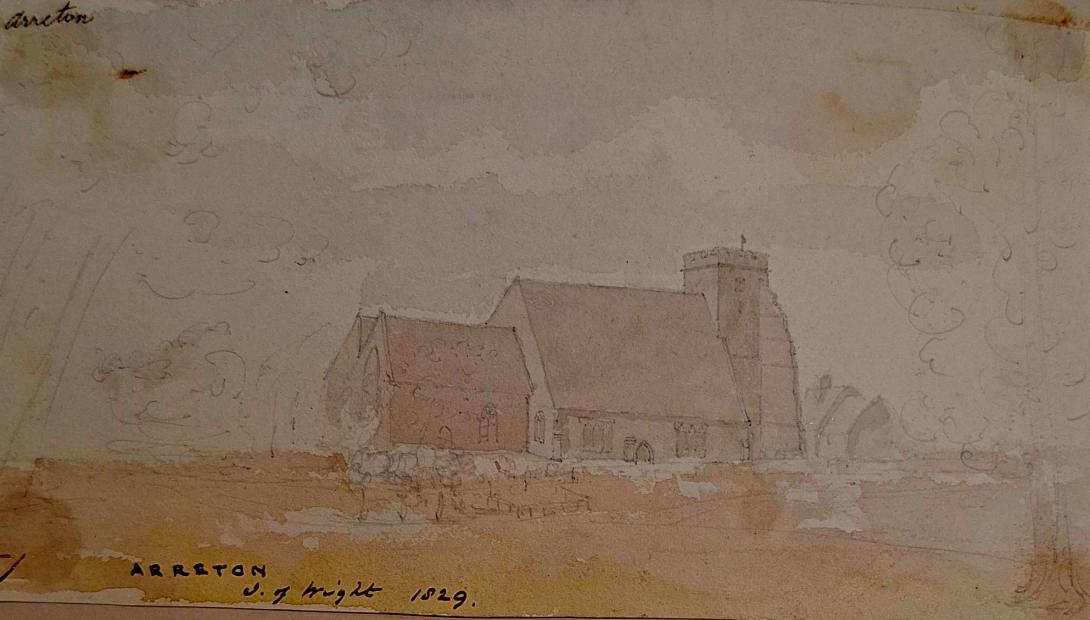
inscribed and dated " ARRETON I of Wight 1829"
The church is medieval and the earliest traces are from the Norman period.Part of the church dates from the 12th century. The church has a Saxon wall and a Burma Star window. The short tower with its unique buttresses contains a ring of 6 bells, the oldest of which was cast in 1589.
In this parish lived a devout young woman, Elizabeth Wallbridge, made famous as "The Dairyman's Daughter" in an early nineteenth-century poem by Legh Richmond. The war memorial was designed by local architect, Percy Stone (1856–1934). The church has an historic organ dating from 1888 by the organ-builder William Hill. A specification of the organ can be found on the National Pipe Organ Register.
St George’s Arreton was the original Minster Church of the Isle of Wight with its parish stretching from the north to the south coast of the Island and is regarded as one of the most historically important churches in Hampshire and the Isle of Wight. With some remaining evidence of its pre-Norman origins, it is a fine example of a Norman Church built in the eleventh Century and developed thereafter - the latest addition being ecologically friendly heating at no cost to the church when, in 2013, a local benefactor (Mr John Smith) installed radiators fed from a Biomass boiler located within the grounds of the Old Vicarage
The following is extracted from the Quinquennial Report published in October 2011 by the Church Architect, Mr Ian G Smith
Standing tall in the lower reaches of the Arreton valley, with views across towards Arreton Down, the Church of St George with its’ massive square tower, has been a beacon of Christianity for over a thousand years, and is certainly one of the most important Churches on the Island.
Arreton was one of six churches given by William I to the Abbey of Lyre in Normandy; at that time it consisted of the main Nave, together with a short Chancel; subsequently in 1140 the Church was ceded to the Abbey at Quarr, and in 1160, the addition of the north Aisle, which entailed the construction of the three Early English arches and columns, was completed.
The addition of a south Aisle in the 13th Century gave back symmetry to the Church, at the same time the Chancel was extended to the east with larger windows, and in 1299 the massive Tower was constructed, which effectively partly obscured the two Saxon west windows.
The 15th Century saw the introduction of further immense buttresses for the tower, which was increased in height, and the height of the side Aisle roofs were lifted in the 16th Century; around this time (following the dissolution of Quarr Abbey) the Church was sold to Sir Thomas Fleming.
The Victorian era saw the introduction of choir stalls in the Chancel, with new roof timbers; the Nave plaster ceiling taken down and the rafters exposed, traces of the lathing can still be seen; and the organ being installed.
In 1992 the Countess of Mountbatten of Burma dedicated the Burma Star window, designed by Alan Younger, made by David Knowles, which commemorates the close association with St George and the Burma Star Association.
Richard Suter (1797–1883).
Richard Suter was born in Greenwich, Kent on 30th March 1798, to William Suter and his wife Sarah Knights. On 7th January 1825 he married Anne Ruth Burn.
English architect. As Surveyor to The Fishmongers' Company he designed the severe Presbyterian churches for Ballykelly (1825–7) and Banagher (1825) on the Company's Estate in County Londonderry, drawings of which were exhibited at the Royal Academy in 1827. He was also responsible for the Model Farm (1823–4), the Lancasterian Schools (1828–30), the Company Agent's House (1830–2—now a hotel, much altered), a range of houses on the south side of the main road (1823–4), the lodge in the Presbyterian churchyard (1828), and the Dispensary (1829), all at Ballykelly, and all Classical. As Surveyor to Trinity House Corporation, he designed houses that were erected by Thomas Cubitt in 1821–3 on a site adjoining Trinity House. For The Fishmongers' Company he designed St Peter's Almshouses, Wandsworth, London (1849–51), and The Old School-House, Gresham's School, Holt, Norfolk(1859), in an Elizabethan style.
On the 1841 Census Richard, an architect and lawyer, can be found living in London with his wife Ann (listed as Ruth) and their two children, Richard George and Andrew Burn. Living with them is Edward D Suter. 1851 finds the family living in Tottenham Court in London, by this time Andrew had left the home, but I am unable to trace him on the 1851 Census. In 1860 Andrew marries Amelia Damaris Harrison. Both Richard George and Andrew were to become ordained ministers, with Andrew later becoming a Bishop and emigrating to New Zealand. Sadly in 1854 Anne Ruth was to pass away. In 1861, widowed Richard, Justice of the Peace for Maidenhead, is living at Castle Hill, Maidenhead, Berkshire. In 1862 he married Elizabeth Anne Pocock. In 1871 and 1881 Richard and Elizabeth are still living in Castle Hill. Richard was to pass away on 1st March1883.
Richard Suter & Annesley Voysey, architects, had their office at number 35 Fenchurch Street, but they did not have it all to themselves as they shared the premises with W.C. Franks, a tea broker, who will get a separate post some other time. The earliest mention I found of Richard Suter in Fenchurch Street is in 1832 when he is listed at that address in a list of contributing members of the Society for the Propagation of the Gospel in Foreign Parts. It says that he had been a member since 1829, but that does not mean he was already at 35 Fenchurch Street in that year.(1) In fact, that seems unlikely as the Sun Fire Office records give Messrs. Short and Co., merchants, as paying the insurance premium on the premises in May 1830. The Directory of British Architects 1834-1914 give the year 1827, but I do not know on what evidence. When Suter and Voysey became partners is also uncertain, but they had known each other since at least 1825 as Suter is named as one of the executors of Voysey’s will which was dated 22 July, 1825. The address given for Suter in the will is Suffolk Street, Southwark. Voysey then lives at Conway Street, Fitzroy Square.