
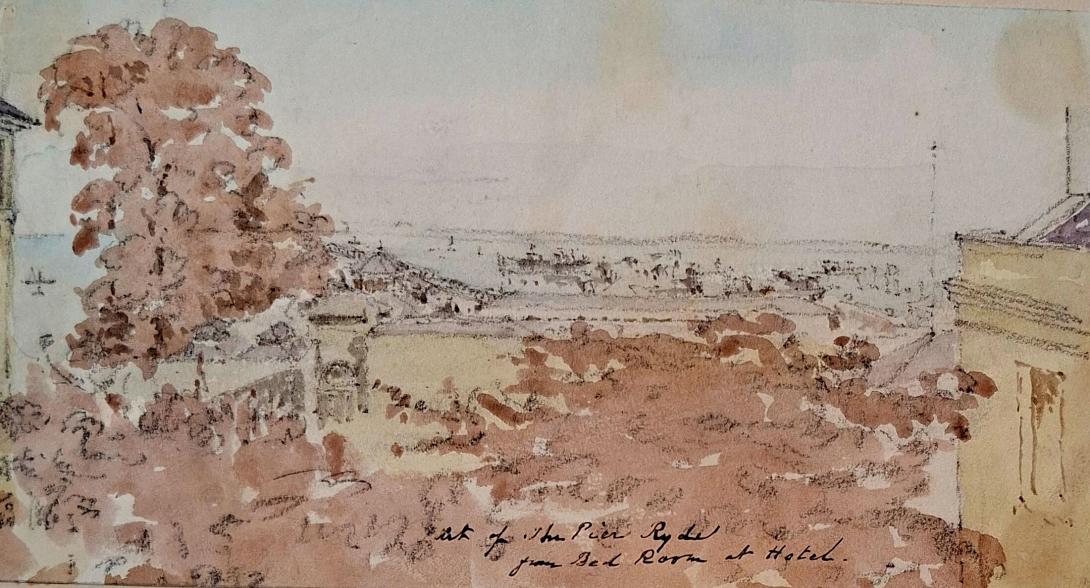
" at of the Pier Ryde/ from Bedroom at Hotel 1829"
Ryde Pier is an early 19th century pier serving the town of Ryde, on the Isle of Wight, off the south coast of England. It is the world's oldest seaside pleasure pier.Ryde Pier Head railway station is at the sea end of the pier, and Ryde Esplanade railway station at the land end, both served by Island Line trains.
Before the pier
Before the pier was built, passengers had the uncomfortable experience of coming ashore on the back of a porter and then, depending on the state of the tide, having to walk as far as half a mile across wet sand before reaching the town. The need for a pier was obvious, especially if the town was to attract the wealthy and fashionable visitors who were beginning to patronise other seaside resorts.
The original pier
The pier was designed by John Kent of Southampton. It was authorised by the Ryde Pier Act 1812 (52 Geo. 3. c. cxcvi), and its foundation stone laid on 29 June 1813. The pier opened on 26 July 1814,[3] with, as it still has, a timber-planked promenade. The structure was originally wholly timber and measured 576 yards (527 m). By 1833, extensions took the overall length to 745 yards (681 m). It is this pre-Victorian structure that has, with some modifications, carried pedestrians and vehicles ever since.

A second 'tramway' pier was built next to the first, opening on 29 August 1864. Horse-drawn trams took passengers from the pier head to the esplanade. The Ryde Pier Tramways Act 1865 (28 & 29 Vict. c. cccxlvi) authorised the Ryde Pier Company to extend the tramway to the Isle of Wight Railway's St John's Road station.
The Ryde Station Act 1866 (29 & 30 Vict. c. ccciii) created the Ryde Station Company, and authorised the construction of a railway from the Isle of Wight Railway to St. John's Road. The Ryde Pier Railways Act 1867 (30 & 31 Vict. c. lix) and the Ryde Pier Railway Extension Act 1870 (33 & 34 Vict. c. cxxxvi) combined the two schemes into a single extension of the tramway, and permitted conversion to mechanically-powered vehicles. The extension was abandoned a decade later following construction of the railway pier. From 1886 to 1927, the trams were powered by electricity from a third rail, and from then until 1969 were petrol-powered.
Ryde is an English seaside town and civil parish on the north-east coast of the Isle of Wight. The built-up area had a population of 24,096 according to the 2021 Census. Its growth as a seaside resort came after the villages of Upper Ryde and Lower Ryde were merged in the 19th century, as can still be seen in the town's central and seafront architecture. The resort's expansive sands are revealed at low tide. Their width means the regular ferry service to the mainland requires a long listed pier – the fourth longest in the United Kingdom, and the oldest surviving.
History
The name Ryde derives from the Old English meaning a 'small stream'.
In 1782 numerous bodies of men, women and children from HMS Royal George, which sank suddenly at Spithead, were washed ashore at Ryde. Many were buried on land that is now occupied by the Esplanade. A memorial to them was erected in June 2004.
There are a series of Regency and Victorian buildings in the town with important buildings such as All Saints' Church, designed by the eminent George Gilbert Scott, and Ryde Town Hall, which was completed in 1831. Up until the pier was opened in 1814, ferry passengers landing at low tide were brought almost half a mile into the shore by horse and cart.