
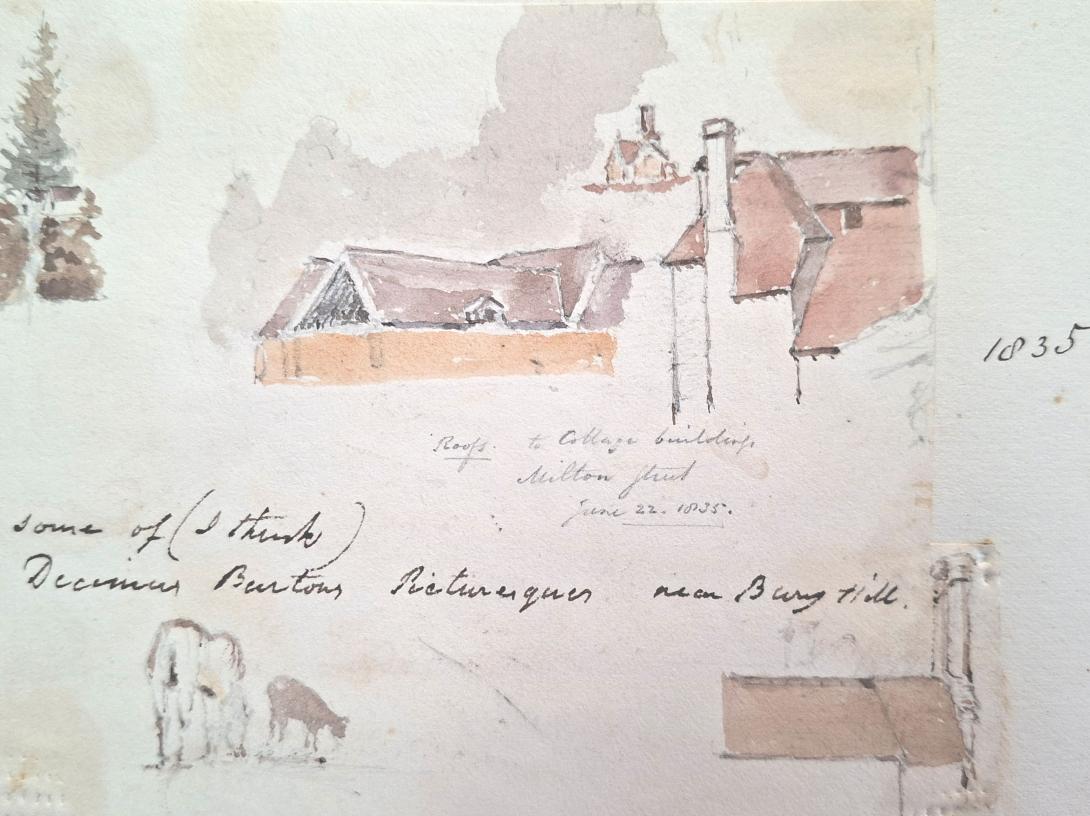
inscribed and dated " Roofs to cottage buildings / Milton Street/ june 22 1835 / some of (I think) Decimus Burtons picturesques near Bury Hill"
The Manor of Milton The name ‘Milton’ comes from the Anglo-Saxon word Midletone which means ‘Middle farm’. This was the spelling used when the Manor of Milton was recorded in the Domesday Survey of 1086. By 1210 it was spelt Middleton, subsequently Meddelton and later Mylton, in 1501. (Source – ‘The Place-names of Surrey’ by Glover, Mawer & Stanton, The English Place-name Society). The Domesday Survey of 1086 shows that the Lord of the Manor of Milton was a Norman knight, William Fitz-Ansculf, and that a man called Baldwin held it for him. The Survey also states that before the Normans conquest, a man called Uluric held it for the King, who was then Edward the Confessor The Domesday entry and its translation are at Annex A. Fitz-Anculf’s stronghold was at Dudley Castle in the Midlands. After he died the Manor passed through the Paganel family and others until around 1230 when it came to the Priory of Kilburn. The Priory held it until Henry VIII abolished the monasteries some 300 years later. The Manor of Milton then seems to have become a political football. Henry kept it for himself at and it stayed with the Crown until Mary Tudor came to the throne. Mary reversed Henry’s policies and gave the Manor back to the Church; it went to the Convent of Shene. After Mary’s death Queen Elizabeth I took it back again. She intended to give it to a man named Ralph Latham, but changed her mind and in 1599 granted it to George Evelyn. Why the Queen changed her mind over Latham is a mystery. Whatever the reasons, George Evelyn must have been in her favour. He had brought the process for making gunpowder from Flanders to England in the 1580s - a step which must have been of considerable strategic importance - and by 1599 he was making gunpowder at mills in the Tillingbourne valley and at Thames Ditton. He already held the Manor of Wotton; the Manor of Westcott came to the Evelyns later, in 1629. 'The Evelyns were the Lords of the Manor of Milton until 1873 when it was sold to Mr Lachlan Mackintosh Rate on his purchase of Milton Court. The Manor then remained with the owners of Milton Court - until 1967 when Dorking Council bought the Lordship from the then owners, the National Employers' Life Assurance Company (NEL). The Manor of Milton continues to be held by Mole Valley District Council. Wotton and Westcott remain with the Evelyns.' A detailed history of the Manor of Milton is in ‘The History & Antiquities of the County of Surrey’ by Manning & Bray (1804) and a shorter version in more modern language is in ‘The Victoria History of Surrey’ of 1911. Extracts from both these publications are at Annex B.
History of Milton Street The precise origins of Milton Street are not known. Manning & Bray suggests that the district, ‘called in Domesday Book Mildetone, but more properly, Midleton, takes its name from an Hamlet so called, and probably from its situation in the middle way between the Maners of Dorking and Westcote. The Hamlet of Milton Street lyes a little to the South of the high road’. The earliest of the present houses in Milton Street date from the first half of the 17th Century, but it was probably a settlement long before then. The earliest evidence of Milton as a distinct place is Speed’s map of Surrey published in 1610 (Annex C) which shows ‘Milton’ as well as ‘Wescot’. Interestingly the two places are named ‘Milton Street’ and ‘Westgate Street’ in Rocque’s map of 1762 (Annex D), suggesting both may have been just a single street at that time. The latter became Westcott as the village expanded, but Milton Street remained as it was – Friday Street and Thorncombe Street are similar examples elsewhere in Surrey. Eight of the present buildings in Milton Street were constructed before 1700. These were houses in various ownerships, some possibly let to tenants. This situation changed dramatically in 1753 with the arrival of Edward Walter who created the Bury Hill estate. This event was to have a lasting effect on the character of Milton Street through to the present day. Walter was a wealthy Somerset MP who visited the area, liked it and decided it was where he wanted to live . He first bought Chadhurst Farm and lived there while he bought land piecemeal to form the estate, built Bury Hill House as his home and created the Bury Hill lake. All this was certainly completed by 1762 as the house and lake feature on Rocque’s map of that date. The estate eventually comprised some 2000 acres including 10 farms and a corn-mill. There were two immediate changes in Milton Street. The first was that Edward Walter bought the properties along the street which would be used as homes for estate workers. The second was his construction of the stables and the walled kitchen garden at the northern end of the street. In 1756 Edward Walter had his estate surveyed by Thomas Crews and a copy of his map is held in the Surrey History Centre (SHC) (Accession 6006, Bundle 48). This is the earliest detailed map of Milton Street and is of special value to historians as it has a key listing the properties bought for the estate, and the people they were purchased from. A copy is at Annex E. Edward Walter died in 1780 and his estate passed to his sole surviving daughter Harriot who had married James Bucknall , later 3rd Viscount Grimston. They lived at Gorhambury House, near St Albans, and Bury Hill House was let, first to James Richardson and then George Shum. Harriot died quite young, in 1786, and left the estate in trust for her three children. Bury Hill House continued as a letting until 1811 when the entire estate was put up for sale. The sale particulars are at Annex F. Robert Barclay was tenant of the house at the time and he bought the estate which remained with the Barclays for the next 140 years. They were a successful Quaker family who did much for the wellbeing of their employees. In Milton Street a house was converted to become a school which remained in use until 1854 when it was replaced by the present village school, also built by the Barclays - they had a strong philanthropic tradition and did a great deal for the Westcott community. The 1811 sale particulars (extract Annex F) include a map which shows Milton Street and its houses which were mainly let under tenancies. The Barclays subsequently had three maps made of their estate – in 1838, 1856 and 1896 which are now held in the Surrey History Centre.The first of these, drawn by Bushell and Vine, is particularly fine with trees and buildings shown in relief. These three maps show how the street developed through the 19th Century and it is immediately apparent how little in fact changed. Although work was done on the provision of services, only three new buildings were constructed. At the end of the 19th Century all the houses were occupied by estate workers on tied tenancies. A map at Annex E, drawn by the Surrey DBRG, shows the houses as they were about 1900 and the occupations of the residents. In 1913 Lt Col Robert Wyvill Barclay succeeded his father and in 1914 put the entire estate up for sale. The sale, probably to meet death duties, must have come as a shock to the people of Milton Street. The sale particulars (extract at Annex F) show the majority of houses having ‘Gas laid on for cooking purposes, and Water laid on throughout the Hamlet from the Dorking Company’s main.’ The sale was due to take place by auction on 23 July 1914, but with war looming the sale was cancelled. Col & Mrs Barclay let Bury Hill House and moved to a new house in Logmore Lane; this continued until 1927 when the letting ended and the Barclays returned. The house was requisitioned during the war and later sold. The rest of the estate, including Milton Street, remained with the Barclays. This situation continued for until 1952 when Col Barclay died and the estate then had to be sold to meet death duties. The Milton Street houses were sold as separate lots (sale particulars at Annex G). The economic difficulties of the time are indicated by the fact that only five properties remained occupied by estate workers or pensioners - these were sold subject to covenants allowing the occupants and their wives to remain for the rest of their lives. The sale was by auction held in the Martineau Hall on 23 July 1952 and the press reported it as ‘a sad day for Dorking’. The auctioneer began the sale by saying that “it is no wish of the family to have to break up the estate but, as with so many others in the country, this has been forced upon them by heavy death duties. The vendors will be only too happy if the tenants can buy their holdings and stay where they are.” Twenty-seven of the 35 lots were sold for a total of £42,380; many prices were felt to be extremely low. A press report of the sale is at Annex H.
Being within the Bury Hill estate, Milton Street had been protected from outside housing pressures. Houses had been built to meet the needs of the estate and no more. The result was that Milton Street had changed very little over a period of 150 years. Surrey County Council decided it should be preserved and in 1974 made the street a conservation area to give it long-term protection. ‘The gently winding lane in the stream valley and the informal scattering of buildings along it make for an interesting and unusual conservation area.’ (‘Antiquities and Conservation Areas of Surrey’- Surrey County Council, 1976). Houses & People The numbering of the houses in Milton Street begins furthest away from the main road, at the southern end. The descriptions of the houses follow the numbering order. 1 - Keepers Cottage This house dates from the 17th century and its early history has been traced from manorial rolls and other records in the Surrey History Centre. The earliest transaction is dated 1693 when Jane Carpenter, a Spinster sold the house to Richard Beaman. After Richard’s death, his widow Mary married John Denyer, a yeoman of Dorking. The couple later became guardians of John’s orphaned nephew William Denyer. There were no children from either of Mary’s marriages and after her death in 1733, William obtained the property through the Courts. In 1762 he sold it to Edward Walter; a copy of the transfer document is at Annex I. The oldest part of the house is timber framed and was described in the 1811 sale as a ‘Dairy and Garden’ of 34 perches. A sketch of 1837 shows the house then comprised just a single room on the ground floor with two rooms above, and a lean-to outshot. The 1841 census shows John Comfort, an agricultural labourer, living there with his wife Mary and seven children. In 1855 a tragic accident occurred outside the house when Charles Barclay was thrown from his horse which had bolted after being startled by a stag. He was an elderly man and sadly died some days later. In the following years the house was substantially altered. By 1880 a two-storey extension had been added at the rear and a porch built on the front. The first floor had been tile-hung with an unusual diamond pattern on the end fronting the street. These features are still there today. Water was drawn from a well which remained in use to the 1950s. Surrey DBRG surveyed the house in 1978 (report no 1574). The house was further extended in 1991. The 1871 census shows a gamekeeper, William Freemantle, living in the house which was referred to as Keepers Lodge. From then on it remained the gamekeeper’s house. Pheasants for the estate shoots were raised in pens located in the woods beyond the brook. The longest serving gamekeepers were William Still (1877-1916) and William Johns (1926-52). The house was Lot 3 in the 1952 sale but was held back to be sold to William Johns’ family. The house has been called Keepers Cottage since 188
2 - The Hedgerow This was the butler’s house and the first occupants were Samuel Langsdale and his wife Lucy. It was probably built soon after 1891 when the census showed Samuel married but living in Bury Hill House without his wife. He was highly regarded by the Barclay family and served as the butler until the early 1930s. The house was wellappointed, appropriate to the butler’s status and conveniently close for his duties at the main house. By the time of the 1952 sale the house was occupied by Mr Killick, the estate forester, and the house (Lot 4) was sold subject to covenant. A two-storey wing was added on the south end of the house in the 1960s. For some years it was called ‘Westaway’ but re-named as ‘The Hedgerow’ in the early 1980s. 3 & 4 - Oddman’s House Set at right angles to the road this is a two bay timber-framed house built in the 17th Century, tile-hung with fine chimney stacks at each end. A sketch of 1838 shows the house to be very much as it is today. Grade II listed, it bears SCC Building of Historical Interest plaque no 436 and is the subject of DBRG Report No.320 (1973). Walter’s map of 1756 shows this property as having been purchased from a Mr Woods. For many years the house comprised two cottages. The 1851 census shows one of them occupied by Ann Peacock, a School Mistress, who would almost certainly have been employed at the Milton Street school next door. The two cottages were sold as one lot (Lot 6) in the 1952 sale after which they became one house. The DBRG map c1900 shows one of the cottages occupied by the ‘Oddman’; this was a term commonly used at that time to describe a man who did a variety of skilled maintenance tasks and is the origin of the modern name of the house. 5 -The Old Laundry & The Old Schoolhouse This building has a varied history. It is a central chimney house built in the mid 17th Century. The exact construction date is not known although an IOU of 1651 was found in a wall joint. Walter’s map describes it as ‘a House, Orchard, Barn & Stables on the West of Milton Street called Winns’, but does not name the previous owner. The 1811 sale particulars describe the property as ‘Bond’s Tenement’, rented to a Mrs Bond for £24 pa comprising ‘a Brick and Tile House, a Barn, Stable for Four Horses, Hovel, Dairy, Brewhouse, Pigstie etc’. The holding included land to the south of Milton Street which today is known as ‘Bond’s Field’. In the 1830s the Barclays converted the building for use as a school. Two school wings with porches for each were added to the original building and it was probably at this stage that the house gained its elaborate glazing bars in the windows and tilehanging to the first floor. However Westcott was expanding fast and in 1854 the Barclays paid for a new village school, the one in use today, to meet the needs of a growing population No.5 Milton Street was then converted to a laundry. Work was completed in 1857 when Harriott Barclay, in a letter of 23 July to her brother reported that ’the laundry is now established in the village. Papa had an American washing machine to try which entirely failed, so we shall continue washing on the old plan’. After conversion, the laundry comprised three separate premises, the laundry itself taking up under half the building at the end with washing and ironing rooms downstairs and a drying room on the first floor. The rest of the building became two cottages which housed the laundress and laundry maids. The building was still equipped as a laundry when it was sold (Lot 7) in the 1952 sale after which the laundry premises were converted to the cottage now called ‘The Old Laundry’. The two former staff cottages were later combined under one owner to become what is now ‘The Old Schoolhouse’, with the studded front door of the middle cottage being retained. DBRG surveyed the house in 1976 (Report No.265). 6 - Peppermint Cottage This 17th century house is shown on Walters map of 1756, but not mentioned in the list of purchases; Walters must have acquired it later. It was in the 1811 sale to Robert Barclay when it was described as ‘A Cottage and Garden’, let to Thos Nye, senior’. The 1851 census return is not definitive in this part of the street but suggests a Hannah Hooker and her six children were living there with a lodger, Sarah Coe, an Infant School Mistress who presumably taught in the school opposite. In 1861 William Burgess (aged 63), a Labourer, was there with his children, Ann (29) and Daniel (25). Ann was still there in 1901 when she ran the house as the village sweet shop. Between the wars a Mr and Mrs Shepherd were in the house. Mrs Shepherd was the Nanny for the Barclay children, and when the estate was broken up she was given the house as a token of the family’s affection. The house has had mixed fortunes in recent years. Photographs show it in good condition in the 1970s, but the house fell into disrepair and by the 1990s was in a ruinous state. Fortunately it was bought just in time by Tony and Jenny Kensett and fully restored. They had it surveyed by DBRG – Report no 4524. 7 & 8 - Crooked Acre A three bay timber-framed house, part of which may have been built as early as the 16th century, it has a half-hipped roof and there is evidence that it had a smoke bay before the central chimney was built. It is a Grade II Listed building and one of the oldest in Milton Street. Crooked Acre is not identified on Walter’s map of 1756 and it therefore appears to be one of the properties he acquired later. It is shown on the 1811 sale which describes it as a ‘Cottage in Two Tenements and Garden’ let to James Constable and William Wheeler. It remained as two cottages until 1952.
The 1841 census suggests that Crooked Acre was occupied by the Marshall and Weller families. William Weller,aged 40, was a sawyer and probably employed in the sawmill which was located across the street. In 1851 Mary Marshall and her two daughters were shown as laundresses – this was before the Milton Street laundry was set up and they may have been employed at the main house. By 1861 John Comfort and his family had moved into the house from Keepers Cottage; in 1871 he was still there in as a widower of 74 with his grand-daughter and a housekeeper. Their neighbours were George Ansell, a labourer and his wife Jane who was the village midwife. In the 1952 sale the house (Lot 8) was described as a pair of semi-detached period cottages let to Mr Philpot and Mr Way at 5s per week each. In 1958 a lean-to at the back of the house was removed and at the northern end extended by 2-storey tile-hung wings. DBRG surveyed the house in 1977 (Report No.547). 9 & 10 Milton Street This is a pair of semi-detached houses which were built about 1896 on the site of the former stock-yard. The 1901 census shows them occupied by Edward Arthur, Bricklayer and Alfred J Mitchell, estate builder. They were the last houses to be built on the estate and probably compared well with equivalent houses outside. They were Lot 9 in the 1952 sale. A photograph of the stock-yard taken around 1880 shows it being used possibly for the storage and maintenance of farm carts. The three barns surrounding the yard were demolished to make way for the houses, but parts of the stock-yard wall remain as the front boundary of 9&10. Carpenters This single-storey L-shaped house was formerly the workshop in the carpenter’s yard. It originally comprised a joiner’s shop, paint shop, wood store and a small office. At the back of the yard was a small sawmill driven by a gas engine. A picture of the yard c1890 shows large stocks of timber stacked near the sawmill. This would have been a busy place, probably meeting all the carpentry needs of the estate. The yard and buildings were sold as Lot 11 in the 1952 sale. Some years later the property again changed hands and the workshops were converted to the present house. A stable now stands on the site of the sawmill. 11 - Little Brook One of the earliest houses in Milton Street, Little Brook has been much altered over the years. The house was originally timber-framed and the structure indicates it was an open hall. One interior wall has been partly exposed to show wattle-and-daub construction. It is Grade II listed and described in DBRG Report No 545. Edward Walter’s map of 1756 describes the property as ‘An Orchard on the east of Milton Street with a House, Barn and Carthouse formerly belonging to a Mr Dendy’.
The 1811 sale described it as ‘a House, Stable, Carpenters Workshop, Garden and Orchard. It clearly also embraced the land occupied now by Carpenters. Thomas Moor was the tenant paying £3 a year. The 1841 census shows William Mitchell (age 45), a Carpenter, and his family occupying the house. His eldest son, Alfred (13) was described as a Carpenter’s Apprentice. Alfred was to succeed his father as the estate carpenter and the 1861 census records him as a Builder’s Surveyor. By the he was the Steward, responsible for all the properties on the estate and their maintenance. Alfred Mitchell served the Barclay family all his life and they held him in very high esteem; this is shown clearly by a poem written in his memory after he died in 1915 (Annex J). His son, Alfred John Mitchell, succeeded him as steward and the house remained with the same family for almost a century. The 1952 sale shows that the house, then known as Milton Cottage, had been recently divided into two dwellings (Lot 10). The property was converted back to one house after the sale. For some years was known as ‘Little Waters’ before becoming ‘Little Brook’. 12, 13 & 14 - Little Trinity This Grade II listed property first comprised three service cottages and was built by the Barclays, possibly in the period 1820-1830. The property has attractive porches and doors in gothic style. The windows have gothic lights, some of which open within the frame. Nos.13 and 14 have a shared chimney stack and porches on the front; no.12 has its own stack with its porch on the south end. The 1841 census shows the cottages occupied by the Raven, Ledger and Yarnley families. Samuel Raven was a manservant at the main house; George Ledger and James Yarnley were agricultural labourers. The same families were still there in 1861 but Samuel Raven’s son Thomas had by then become a sawyer, probably working in the nearby mill. He was still serving as a carpenter in 1901. In the 1952 sale the property (Lot 12) still comprised three cottages. Some years after the sale nos.12 and 13 were turned into one house. While changes were made internally, all the external features remained. DBRG surveyed the house in 1975 (Report No. 1199). Mrs Win Smithers lived at no 14; she was born at Oddman’s House, spent most of her life in Milton Street and lived to the age of 102. 15. Wyvern Cottage This is a Grade II listed 17th century house that bears SCC Building of Historic Interest plaque no.100. It stands sideways to the street, of mellow brick with a fine chimney stack in the centre of the roof and lean-tos at each end. It retains most of its original features which include a cellar and a bread oven built out through the north wall. Some years ago two mid 17th century German ‘good luck’ tokens were found among the roof timber It appears the house was not bought by Edward Walter when he first put the estate together. His map of 1756 shows the house standing, with the neighbouring Malthouse, on a piece of land described as an ‘Orchard at Milton belonging to Mrs Wm Martyr’. However Walter did buy it later because it is in the 1811 sale as ‘A Cottage and Garden at Milton (Freehold) let to Thomas Knight’. Wyvern Cottage census returns give a good insight into the way people moved around within Milton Street. The 1841 census shows Thomas Nye, an Agricultural Labourer, living in the house with his wife and six children. By 1851 Hugh Walford, a Bricklayer was living there; ten years later he and his wife, Mary Ann, had moved to the recently opened Laundry where she was the Laundress. The 1861 census shows that the Razzell family had moved into Wyvern Cottage. They were still there in 1871 (recorded as Russell) and caring for three infant members of the Raven family from no.13. By 1881 Henry Brett, a gardenerer, had moved in with his family and was still there in 1901 – he appears in photographs of the gardeners taken at that time. The 1952 sale shows the cottage occupied by an estate pensioner, Mr Tupper, and the sale (Lot 13) was subject to covenant. The house has remained almost unchanged except for the addition of a quaint figure of a Wyvern set against the front wall. This appears to be extremely old, but was in fact carved in the 1950s by John Peters who owned the house at that time. The house was surveyed by DBRG in 1975 (Report No 287). 16, 17 & 18 - The Malthouse This is a three-bay timber-framed 17th century house, listed Grade II, which was occupied over many years by maltsters who carried on their trade in the barns behind the house. The house seems to have been much extended in its early life as it has a fascinating roofscape. The most interesting external feature, however, is that the front is clad in mathematical tiles; one dated 1724 is the earliest in Surrey. At the back are bricks dated 1717 and 1738/9; the latter was the year when the calendar was adjusted. Clowser, Martyr, Cheesman and Tanner are the names of maltsters recorded as living here. The Dorking parish register of 1753 records ‘Ann Clowser of Malthouse, Milton Street, married William Martyr, Maltster of Dorking’. Walter’s 1756 map shows the Malthouse and Wyvern Cottage on land described as ‘An Orchard at Milton belonging to Mrs Wm Martyr’. She clearly hung on to her property after her marriage! Although Edward Walter later bought Wyvern Cottage to add to his estate, he did not acquire The Malthouse. It was not recorded in the estate when sold in 1811 and was not acquired until many years later. The malting business seems to have carried on there with James Tanner, maltster, being there from 1841 to 1861 It appears the house was bought by the Barclays sometime between 1861 and 1871 when the census shows it as three separate dwellings. One was still occupied by James Tanner, perhaps by now a tenant. The other two were occupied by estate employees. The building remained as three cottages until the 1952 sale when it was sold as Lot 14 and restored to a single home. Despite these changes the house has altered very little over the years. 18a - Blandings Blandings is the only house built in Milton Street since the 1952 sale. It was built in 1957 on the site of a property described in the sale particulars as ‘The Bungalow’ (Lot 15) which was let to a Mr Moore at 5s a week. We do not yet know the origins of The Bungalow. The 1952 sale map shows the layout of the buildings to be the same as those in the estate map of 1896. The Bungalow may therefore have been a conversion of one of the former barns behind the Malthouse. Two of these still remain in the grounds of Blandings. Bury Hill Gardens Like all estate owners Edward Walter required a reliable source of food and somewhere for his transport. To meet these needs he created a kitchen garden, stables and a conservatory all on this one site at the northern end of Milton Street. They are the only buildings in the street put up by Edward Walter. The 1811 sale particulars describe the buildings as ‘Hothouses; Conservatory, &c., adjoining thereto is a substantial Brick and Tile Building, comprising a double Coachhouse; Stabling for Sixteen Horses’. These buildings were integrated in an ingenious way. The central block had stables on the northern side, cool for the horses, and a conservatory on the warmer southern side, best for plants. The houses for the Head Gardener and Head Coachman at the east and west ends may have been added later. The coach houses were across the stable yard on the northern side. On the southern side lay the kitchen garden, conveniently close to the stables, and sheltered by high enclosing walls to create the ideal conditions for growing the produce required at the house. Heated glasshouses produced such fruits as grapes and peaches, as well as flowers for the house. The Head Coachman had a lot of responsibility. As well as driving, he was in charge of the grooms and had to ensure horses were properly trained and carriages and harness kept in good order. William Griffin served for some 20 years to be succeeded around 1881 by William Johns who was still serving at the end of the century. In 1913 the estate’s carriages included a Landau, a Sociable, a Worcester, a Stanhope and a Brougham, by then all but obsolete in the new motoring age. Robert Barclay was a leading collector of plants so Head Gardeners had to know what they were about. Messrs Cameron (1830) and Whitehead (1865) both earned plaudits in the horticultural press. In the 1900s William Graysmark had 15 gardeners under his control to look after the pleasure garden, grounds and hothouses as well as the production of fruit and vegetables; he regularly took the prizes for his own exhibits at the village shows. In 1946 the stables were let to Peter Rice-Stringer who trained horses under National Hunt rules. With up to ten horses training he had much success. Notable winners were Hipparchus (Grand Annual Chase at Cheltenham) and The Pills (Imperial Cup at Sandown). Others included Crowbeg, Loophole, Red Hat and Tudor Knight. Training gallops were at Logmore Lane and Mickleham. One stable lad, David Elseworth, later became a leading trainer – with Grand National winner Rhyme n’Reason and the legendary Desert Orchid. In the early 1970’s Major Rice-Stringer ceased training to breed Dorset Downs sheep at Bury Hill, again winning – at the 1977 Royal Show. When the estate was sold in 1952, William Graysmark and his wife were still living in the Head Gardener’s house. Bury Hill Gardens were sold as Lot 16. The buildings have changed little over the years. The stableyard with its pump is much as it was and the stables are in full use, as is the Victorian post-box set in the wall outside. The buildings are listed Grade II and have been surveyed by DBRG (Report No 1570). Westcott Sports Club The sports ground opposite Bury Hill Gardens has been the home of Westcott Cricket Club since the 1900s. It later also became the ground for Westcott FC. It featured in the 1914, but was excluded in 1952. The ground, now called Stable Meadow, is still leased to the Westcott Sports Club by the Barclay Estate. Bury Hill Edward Walter An early description of Bury Hill was that it was ‘part of the waste of the Manor of Milton’. It was probably typical heathland – heather, gorse and a few pines - when Edward Walter first set eyes on it around 1750. He was 23 and MP for Milborne Port in Somerset He was also very rich, having inherited wealth from his grandfather, Peter Walter, who had been estate steward for the Duke of Newcastle. He decided Bury Hill was where he wished to live and seems to have had a clear vision of what he wanted. His first lived at Chadhurst Farm and then bought up the land he needed to create the estate. In 1754 he married Harriot Forrester, in Dorking, and by 1756 the estate was almost complete, with his house under construction. His 1756 survey map (Annex E) shows Bury Hill House as a rectangle described in the key as ‘The Ichnography of the new House now erecting’. The new lake is a finger of water building up behind a dam. By 1762 the work was completed. Rocque’s map of that year (Annex D) shows the house with paths around the grounds, the stables and the lake all in being. The lake alone was an astonishing achievement; digging it out and creating the retaining bank must have required a great deal of labour. The house seems to have been relatively modest at that time (fig. ). Two other buildings probably put up by Walter were the lodges on the approach road from Milton Heath, now known as Bracken Cottage and Bury Hill Lodge. The 1901 census shows the latter occupied by Emily Shearcroft whose occupation was described as a Biblewoman – she acted as a welfare and social worker on the estate.
Edward and Harriot had two sons, who died young, and a daughter, Harriot, who was born in 1755. The Walters were in Rome in 1771 and it was here that Harriot met James Bucknall, son of Viscount Grimston. Three years later they married. James had by then succeeded as 3rd Viscount Grimston on the death of his father and the couple moved in to the family home, Gorhambury House, near St Albans. The Grimstons Edward Walter died in 1780 and Bury Hill passed to Harriot as his only child. By that time James and Harriot had three children – James Walter, Harriot and Charlotte, born in 1775, 1776 and 1778. Sadly, Harriot’s health declined and she died in 1786. Her three children inherited Bury Hill and her mother moved up to Gorhambury to look after them; this she did until her own death in 1795. Bury Hill House was let to James Richardson, then George Shum and, finally, Robert Barclay. A feature which seems to date from this time is the ice-house in Rock Lane. Built into the side of the hill facing north and in deep shade, it stored ice taken from the lake each winter. Kept between layers of straw, it remained frozen for use in the house through the summer months. The ice-house is entered through a short passage and is about 20 feet deep. There are tally marks on the walls and a header brick dated 1808. What they did for ice before then is a mystery. James Walter had a very different character to his father, who he succeeded in 1806. He was extravagant and passionate about racing. He was a close friend of the Prince Regent, later George IV, and in 1808 married Charlotte Jenkinson, only daughter of the 1st Earl of Liverpool. In 1811 they decided to sell the entire Bury Hill estate which was bought by Robert Barclay, who at that time was renting the house. The Barclays Robert Barclay (1751-1830) was born in Philadelphia, where his father had been sent to help with the family export business. At the age of 12 Robert came to school in England and later went in to the family brewing business which was later to become Barclay, Perkins & Co. He married Rachel Gurney and they had 15 children. Rachel died in 1794. Ten years later Robert married Margaret Hodgson. The Barclays were a successful Quaker family and Robert was a wealthy man when he became the owner of Bury Hill. He was a philanthropist and a strong supporter of William Wilberforce in his campaign to end slavery. Closer to home, he set up the Dorking Emigrants’ Scheme and founded schools for the poor; he may have started the idea of a school in Milton Street. Apart from these interests Robert Barclay was also a renowned botanist. Specimen plants were sent to him from all parts of the world and he built hot-houses to display his collection. He employed an artist to make drawings of his rarities and he had one of the finest collections of natural history books in the country. The Barclaya species of water-lily was named after him. He also started the collection of trees at Bury Hill. It was these interests that brought changes in the house and grounds. After Robert’s death an obituary in Curtis’s Botanical Magazine describes the changes he made. The range of hot-houses was extended and ‘Near the mansion, and communicating with it by an arcade, in which stood oranges, lemons etc…was another conservatory’. This is shown in a print c1830 (fig ) which shows a house very different to the earlier structure. The obituary is at Annex K. Robert was succeeded by his eldest son, Charles (1780-1855). He was an MP and also prominent in the anti-slavery campaign. He ran the brewery from 1812 and after taking over the estate did a great deal to improve the farms. He paid for the new village school to replace the one in Milton Street, built the vicarage and was one of the main contributors to the costs of the village church. Sadly he died after being thrown from his horse when it was startled by a stag in Milton Street.. Arthur Kett Barclay (1806-1869) was interested in geology and chemistry, but above all he was a keen astronomer and was made FRS for his astronomical work. He had the Bury Hill observatory built to the design of Decimus Burton, who had designed the Palm House at Kew. Apart from his scientific interests Arthur Kett also ran the brewery and was one of the trustees of the Great Exhibition in 1851. The Bury Hill observatory had a 5.9 inch refractor telescope in the tower and a transit instrument in the adjoining transit house. At 400 feet above sea level with clear allround views it was ideally sited. Arthur Kett was paralysed in his final years, but had a sled made so that footmen could tow him up the steep slope to the observatory each night to make his observations. The observatory remained very much as it was until after the second world war when the instruments were removed. The building gradually fell into decay but was restored as a house in 1990. The original dome remains a feature of the property. Arthur Kett’s eldest son was Robert Barclay (1837-1913). He was a good athlete and a fine shot. After an education at Harrow and Cambridge he joined the brewery, and became Master of the Brewers’ Company in 1871 He made major alterations to Bury Hill House, rebuilding and heightening the wings which substantially enlarged the house and brought to its final form. He was later much involved with the restoration of Southwark Cathedral. Robert had married Laura Wyvill; they had 4 sons and a daughter and a big event during this period was the coming of age in 1901 of their eldest son, Robert Wyvill Barclay. The celebrations lasted a week with balls, dinners, a childrens’ party and fireworks. All the events with their speeches and toasts were recorded in a souvenir (Annex L) which gives a vivid picture of the convivial atmosphere of the occasion. Robert Barclay died in 1913 and the following year Lt Col Robert Wyvill Barclay put Bury Hill up for sale. The auction took place on 23 July 1914 but no acceptable bids were made, possibly because war was looming. However, the sale particulars (Annex M) give a good picture of what the estate was like. The house had six reception rooms and 31 bedrooms, a far cry from the house of 1811 which had just seven bedrooms. It also described the grounds with a list of the principal trees including a Douglas Fir, 114 feet high, planted in 1832.
The sale also included Milton Street and the Nower, but not the farms. Interestingly the Nower was described as ‘A Very Valuable Area of Building Land’, ‘An Exceedingly Fine Site for one or more Important Residences’. It was fortunate for Dorking that the sale did not go ahead; seventeen years later Col Barclay gave the Nower to the town as a permanent open space. The reason for the sale is not known; it was probably the need to meet death duties. Although the sale was cancelled, the Barclays were nevertheless able to let Bury Hill and move to a new house they had built in Logmore Lane. The letting, to Sir Spencer Maryon-Wilson, ended in 1927 when the Barclays returned to their old home. In 1940 Col Barclay offered to sell Bury Hill House to Dorking Council for use as a cottage hospital. The idea was still being considered when the house was requisitioned and taken over by the Army; estate workers had to have passes to get in and out. By 1944 the house was being used by the Canadian Army prior to the invasion of Europe. After the war the house and lake were sold privately. In 1949 the central block of the house was badly damaged by fire and had to be pulled down. The two wings were unaffected and were converted to flats, later sold as the separate properties they remain today. The lake was sold and made open to fishing. Today the lake is owned by Bury Hill Fisheries who have added three smaller lakes to the south and west of the main lake. Col Barclay died in 1951 and the rest of the estate had to be sold to meet death duties. This included not only Milton Street but also Home Farm, Chadhurst Farm and Westlees Farm and some 20 other properties. The sale was by auction and took place on 23 July 1952, thirty-eight years to the day after the sale was due to take place in 1914. It was the end of an era and a sad occasion, typical of many similar events which were taking place across the country in a time of massive social change.
Richard Suter (1797–1883).
Richard Suter was born in Greenwich, Kent on 30th March 1798, to William Suter and his wife Sarah Knights. On 7th January 1825 he married Anne Ruth Burn.
English architect. As Surveyor to The Fishmongers' Company he designed the severe Presbyterian churches for Ballykelly (1825–7) and Banagher (1825) on the Company's Estate in County Londonderry, drawings of which were exhibited at the Royal Academy in 1827. He was also responsible for the Model Farm (1823–4), the Lancasterian Schools (1828–30), the Company Agent's House (1830–2—now a hotel, much altered), a range of houses on the south side of the main road (1823–4), the lodge in the Presbyterian churchyard (1828), and the Dispensary (1829), all at Ballykelly, and all Classical. As Surveyor to Trinity House Corporation, he designed houses that were erected by Thomas Cubitt in 1821–3 on a site adjoining Trinity House. For The Fishmongers' Company he designed St Peter's Almshouses, Wandsworth, London (1849–51), and The Old School-House, Gresham's School, Holt, Norfolk(1859), in an Elizabethan style.
On the 1841 Census Richard, an architect and lawyer, can be found living in London with his wife Ann (listed as Ruth) and their two children, Richard George and Andrew Burn. Living with them is Edward D Suter. 1851 finds the family living in Tottenham Court in London, by this time Andrew had left the home, but I am unable to trace him on the 1851 Census. In 1860 Andrew marries Amelia Damaris Harrison. Both Richard George and Andrew were to become ordained ministers, with Andrew later becoming a Bishop and emigrating to New Zealand. Sadly in 1854 Anne Ruth was to pass away. In 1861, widowed Richard, Justice of the Peace for Maidenhead, is living at Castle Hill, Maidenhead, Berkshire. In 1862 he married Elizabeth Anne Pocock. In 1871 and 1881 Richard and Elizabeth are still living in Castle Hill. Richard was to pass away on 1st March1883.
Richard Suter & Annesley Voysey, architects, had their office at number 35 Fenchurch Street, but they did not have it all to themselves as they shared the premises with W.C. Franks, a tea broker, who will get a separate post some other time. The earliest mention I found of Richard Suter in Fenchurch Street is in 1832 when he is listed at that address in a list of contributing members of the Society for the Propagation of the Gospel in Foreign Parts. It says that he had been a member since 1829, but that does not mean he was already at 35 Fenchurch Street in that year.(1) In fact, that seems unlikely as the Sun Fire Office records give Messrs. Short and Co., merchants, as paying the insurance premium on the premises in May 1830. The Directory of British Architects 1834-1914 give the year 1827, but I do not know on what evidence. When Suter and Voysey became partners is also uncertain, but they had known each other since at least 1825 as Suter is named as one of the executors of Voysey’s will which was dated 22 July, 1825. The address given for Suter in the will is Suffolk Street, Southwark. Voysey then lives at Conway Street, Fitzroy Square.