
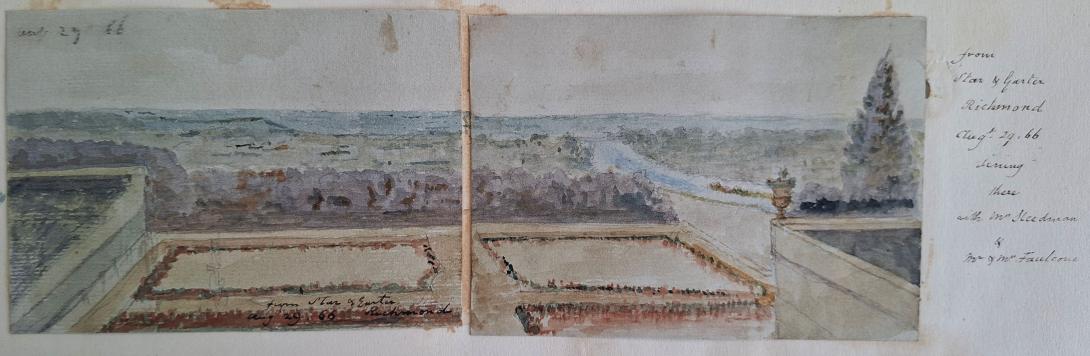
inscribed and dated " From Star and Garter /Aug 29 66/ from Star & Garter / Richmond/ Aug 29th 66/ dinning/there/ with Mrs Steedman/ & Mr & Mrs Falcone"
Many hotels and inn throughout the country bear the name 'Star and Garter': the name stems from the royal insignia of the Garter and establishments adopting it were frequently found near royal palaces. When Charles I added a star to the insignia of the Order of the Garter, it was quickly incorporated into the inn signs. According to one author Richmond's 'Star and Garter' received its name because the Earl of Dysart, from whom the land on which the original inn was built had been leased, was a member of the Order. The name itself, however, seems to have been anticipated at a much earlier date. A passage in the Lansdowne manuscripts (in the British Museum) refers to a meal taken by certain royal officials in 1509 in the village of Shene (the former name of Richmond), after which they were handed the bill by mine host of the 'Star and Garter'. No other records appear to exist relating to this house and there is certainly no connection between it and the more famous establishment on Richmond Hill - which dates from a much later period. The site on which the 'Star and Garter' stood was first leased from the Earl of Dysart by John Christopher (died 1758) who, in 1738, built a small and unpretentious inn in Petersham Meadows, close to the entrance of Richmond Park. The inn was later rebuilt and a large private house was added to the west side in 1780 - which then became part of the hotel. In 1803 a large piece of ground (on which, at a much later date, part of the hotel was built) was leased to Richard Brewer by the Earl of Dysart at a rental of 60 shillings a year. This lease had one condition - that the view from Sir Lionel Darell's house (Ancaster House) opposite or from the lodge at New Park Gate should not be interrupted. However, no legal agreement was made to this effect and the condition was found not to be obligatory. Probably due to some reckless extravagance on his part, Brewer was soon obliged to close the establishment. In her diary for Sunday, June 12th, 1808, Miss Berry wrote ‘The door of the Star and Garter (now shut up as a hotel) being open, we walked in, and a civil quondam servant of the house showed us the rooms. Dismal history from the woman of the foolish man who made these great additions to the former house, ruined himself, and died in prison! His wife, seeing that all was going wrong, became insane and died before him.’ [Brewer had been declared bankrupt and died in a debtor’s prison in 1808.] The inn, now large enough to provide overnight accommodation, was then taken over by Christopher Crean, sometime cook to the Duke of York, who renewed its neglected appearance and reopened it in 1809. Under his direction the ‘Star and Garter’ gained an unfortunate reputation for exorbitant charges - it was said that a visitor paid half a sovereign for the privilege of looking through one of its windows. When Crean died in 1815 the property was mortgaged for £4,000 and his widow continued to run the business. In 1822 Crean’s executors were ordered to sell the hotel to pay off the mortgage and it was bought by Joseph Ellis for £11,022. It was to remain in the Ellis family for well over 40 years, during which time it was again enlarged and attained its greatest prosperity. The residential accommodation was increased by building a new wing at the back and the grounds at the back overlooking the river were terraced.
John Evans, in his book Richmond and its vicinity (1825), describes the building thus "the renowned tavern and hotel, the 'Star and Garter', more like a mansion of a nobleman than a receptacle for the public." After Joseph Ellis's death in 1858 the establishment passed to his son George. In 1864 the 'Star and Garter' was purchased by a limited company who erected a new block – to replace the oldest buildings - from the designs of E.M. Barry in the ‘French Chateau’ style next to the existing hotel. A banqueting hall was also built at the northern end of the later buildings A letter to The Times newspaper described the new building as …gross, pretentious, common, impudently obtrusive, it stood out, a great disfiguring wart or wen on the face of Richmond Hill.’ On 12th January 1870, the whole of the old building - with the exception of the coffee rooms - was destroyed by fire. As the hotel had closed for the winter season, only 3 people were in the building at the time - one of them being the manager John Lever who lost his life in the flames. The banqueting hall also survived which became the Grand Concert Hall for the hotel. The ruined area between the two was finally cleared away in 1872 Between 1873 /74 a Pavilion designed by C.J. Phipps in the ‘Italian Romanesque’ style was erected in place of the old building to link in with the banqueting hall. The ballroom was the main feature of this building. It was 80ft. by 61ft. with windows facing the Terrace and river on one side and the main road on the other and could accommodate 400 people. The room was 33ft. high and had a counter-ceiling of ground glass from which hung a gas chandelier with 96 lights. An open loggia ran round the room at a height of 16ft. from which opened 13 private rooms of varying sizes and there was room of an orchestra of 50. Other rooms in the Pavilion included kitchens, etc., a billiard and smoking-room and various offices. Together with the dining-rooms in the main hotel over 1,000 people could dine in the building. This soon became the main business of the hotel, catering for Londoners visiting Richmond for the day or evening. Another fire in 1888 destroyed all that remained of the original hotel - namely the coffee rooms which had escaped the 1870 fire. At the end of the Victorian era, the hotel suffered a gradual decline in business. On 25th June 1907 it was placed on the market for auction, but the best offer was £20,000 and a later auction in April 1909 produced the same result. Earlier in 1909 a sale of the furniture had realised altogether about £1,500. The Richmond Herald of 3rd September 1911 carried the news that the hotel had been acquired by a ‘prominent North of England firm… closely associated with some of the more important American enterprises now maturing in London.’ The price was £18,000. Later in the same month, the Richmond and Twickenham Times reported an ambitious scheme by the new owners for remodelling the hotel's interior. Although these plans, which also included extensive alterations to the garage under The Terrace, were approved by the Richmond Justices, nothing further seems to have come of them. During the 12 months period from December 1911, the hotel was twice resold with the last owners planning to expand the hotel to 250 bedrooms and opening to the public in 9 months time – it never happened! In 1915 the hotel was purchased by the Auctioneers and Estate Agents' Institute for presentation to Queen Mary (as Patron of the British Red Cross Society) for use as a hospital for paralysed soldiers and managed by the British Red Cross. It began life as such in January 1916, but the hotel building was soon found to be too small and generally unsuitable for its new role. It was finally demolished, in 1919, to make way for the present building – the Royal Star and Garter Home for Disabled Sailors, Soldiers and Airmen - which was opened in July 1924 by George V and Queen Mary. The home was principally paid for by the women of the British Empire, who adopted it as their war memorial. There is still a hotel in Richmond which bore the name 'Star and Garter Hotel' until the 1970s when it became the ‘Petersham Hotel.’ It is situated in Nightingale Lane and approached from the Petersham or Lower Road and it had no connections with that famous establishment other than its name.
Richard Suter (1797–1883).
Richard Suter was born in Greenwich, Kent on 30th March 1798, to William Suter and his wife Sarah Knights. On 7th January 1825 he married Anne Ruth Burn.
English architect. As Surveyor to The Fishmongers' Company he designed the severe Presbyterian churches for Ballykelly (1825–7) and Banagher (1825) on the Company's Estate in County Londonderry, drawings of which were exhibited at the Royal Academy in 1827. He was also responsible for the Model Farm (1823–4), the Lancasterian Schools (1828–30), the Company Agent's House (1830–2—now a hotel, much altered), a range of houses on the south side of the main road (1823–4), the lodge in the Presbyterian churchyard (1828), and the Dispensary (1829), all at Ballykelly, and all Classical. As Surveyor to Trinity House Corporation, he designed houses that were erected by Thomas Cubitt in 1821–3 on a site adjoining Trinity House. For The Fishmongers' Company he designed St Peter's Almshouses, Wandsworth, London (1849–51), and The Old School-House, Gresham's School, Holt, Norfolk(1859), in an Elizabethan style.
On the 1841 Census Richard, an architect and lawyer, can be found living in London with his wife Ann (listed as Ruth) and their two children, Richard George and Andrew Burn. Living with them is Edward D Suter. 1851 finds the family living in Tottenham Court in London, by this time Andrew had left the home, but I am unable to trace him on the 1851 Census. In 1860 Andrew marries Amelia Damaris Harrison. Both Richard George and Andrew were to become ordained ministers, with Andrew later becoming a Bishop and emigrating to New Zealand. Sadly in 1854 Anne Ruth was to pass away. In 1861, widowed Richard, Justice of the Peace for Maidenhead, is living at Castle Hill, Maidenhead, Berkshire. In 1862 he married Elizabeth Anne Pocock. In 1871 and 1881 Richard and Elizabeth are still living in Castle Hill. Richard was to pass away on 1st March1883.
Richard Suter & Annesley Voysey, architects, had their office at number 35 Fenchurch Street, but they did not have it all to themselves as they shared the premises with W.C. Franks, a tea broker, who will get a separate post some other time. The earliest mention I found of Richard Suter in Fenchurch Street is in 1832 when he is listed at that address in a list of contributing members of the Society for the Propagation of the Gospel in Foreign Parts. It says that he had been a member since 1829, but that does not mean he was already at 35 Fenchurch Street in that year.(1) In fact, that seems unlikely as the Sun Fire Office records give Messrs. Short and Co., merchants, as paying the insurance premium on the premises in May 1830. The Directory of British Architects 1834-1914 give the year 1827, but I do not know on what evidence. When Suter and Voysey became partners is also uncertain, but they had known each other since at least 1825 as Suter is named as one of the executors of Voysey’s will which was dated 22 July, 1825. The address given for Suter in the will is Suffolk Street, Southwark. Voysey then lives at Conway Street, Fitzroy Square.