
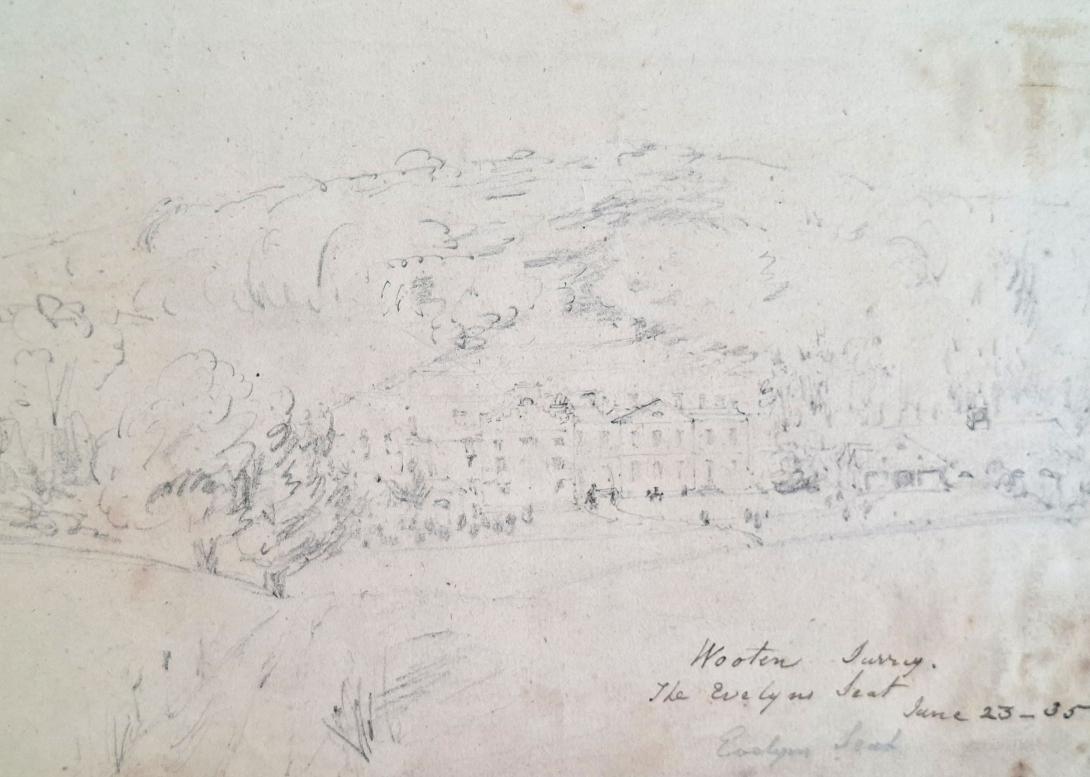
"Wotton House Surrey The Evelyns seat June 23 1835"
Wotton House is a hotel, wedding venue, conference centre and former country house in Wotton near Dorking, Surrey, England. Originally the centre of the Wotton Estate and the seat of the Evelyn family, it was the birthplace in 1620 of diarist and landscape gardener John Evelyn, who built the first Italian garden in England there.

Construction
George Evelyn bought Wotton from Henry Owen, a descendant of Owen Tudor, in 1579.The house was built in the early 17th century by the Evelyn family who extended it in the later 17th century. In the 18th century it was extended eastwards by William Kent. Further extensions and alterations were made in the early 19th century by Francis Edwards. Following a fire in the 1870s the house was restored and enlarged by Henry Woodyer for William John Evelyn in 1877.
Its architectural features include distinctive terracotta decorations on brickwork, octagonal turrets and stacks, winged gryphons on the porch, and plaster wall panels by Kent painted in Chinese style by Belgian Jean Derraux. The old orangery (now the centre's bar), has a decorative parapet and banded piers. Many of the doors feature small paintings above them.
The estate

John Evelyn (1620–1706) and his elder brother George created the first Italian garden in England. Work on it started in 1643, was completed by 1652, and it is the house's most famous feature. The grounds are unusually highly listed as Grade II* and there are also two grottoes close to the house, both listed Grade II.
The River Tillingbourne flows through the estate, which had its own mill at one time. The mill was originally used for the manufacture of gunpowder, a major source of the family's fortune. Later the mill was adapted for use as a wire-works and copper mill.
Notable residents
Wotton House was the family seat of the Evelyn Family. John Evelyn, the diarist, landscape designer and collector, was born in a room still in existence there. He inherited the house and estates on the death of his brother George in 1699.
The descendants who inherited the house in turn included Conservative politician William John Evelyn (1822-1908), who was elected MP for Western Surrey from 1849 until 1857 and became MP for Deptford in 1885 until resigning in 1888.
Post-war use
Between 1947 and 1981 the house was leased to the Home Office and used as the Fire Service College.
Grade II* listed status was given to the garden in 1984, and the house and its two garden grottoes became listed in 1987.
Twenty-first century

In 2003, having been fully refurbished following a period of relative neglect, Wotton House was re-opened as a hotel, wedding venue, training and conference centre.
The property is currently owned and run by InterContinental Hotels Group. It consists of accommodation, several conference suites, an indoor swimming pool and athletic centre, a large church-style structure on the North side for ceremonial events (see the photo), bars and restaurants.
The garden on the south side is of several acres, and can be walked, including up steps to near the top of the hill.
Richard Suter (1797–1883).
Richard Suter was born in Greenwich, Kent on 30th March 1798, to William Suter and his wife Sarah Knights. On 7th January 1825 he married Anne Ruth Burn.
English architect. As Surveyor to The Fishmongers' Company he designed the severe Presbyterian churches for Ballykelly (1825–7) and Banagher (1825) on the Company's Estate in County Londonderry, drawings of which were exhibited at the Royal Academy in 1827. He was also responsible for the Model Farm (1823–4), the Lancasterian Schools (1828–30), the Company Agent's House (1830–2—now a hotel, much altered), a range of houses on the south side of the main road (1823–4), the lodge in the Presbyterian churchyard (1828), and the Dispensary (1829), all at Ballykelly, and all Classical. As Surveyor to Trinity House Corporation, he designed houses that were erected by Thomas Cubitt in 1821–3 on a site adjoining Trinity House. For The Fishmongers' Company he designed St Peter's Almshouses, Wandsworth, London (1849–51), and The Old School-House, Gresham's School, Holt, Norfolk(1859), in an Elizabethan style.
On the 1841 Census Richard, an architect and lawyer, can be found living in London with his wife Ann (listed as Ruth) and their two children, Richard George and Andrew Burn. Living with them is Edward D Suter. 1851 finds the family living in Tottenham Court in London, by this time Andrew had left the home, but I am unable to trace him on the 1851 Census. In 1860 Andrew marries Amelia Damaris Harrison. Both Richard George and Andrew were to become ordained ministers, with Andrew later becoming a Bishop and emigrating to New Zealand. Sadly in 1854 Anne Ruth was to pass away. In 1861, widowed Richard, Justice of the Peace for Maidenhead, is living at Castle Hill, Maidenhead, Berkshire. In 1862 he married Elizabeth Anne Pocock. In 1871 and 1881 Richard and Elizabeth are still living in Castle Hill. Richard was to pass away on 1st March1883.
Richard Suter & Annesley Voysey, architects, had their office at number 35 Fenchurch Street, but they did not have it all to themselves as they shared the premises with W.C. Franks, a tea broker, who will get a separate post some other time. The earliest mention I found of Richard Suter in Fenchurch Street is in 1832 when he is listed at that address in a list of contributing members of the Society for the Propagation of the Gospel in Foreign Parts. It says that he had been a member since 1829, but that does not mean he was already at 35 Fenchurch Street in that year.(1) In fact, that seems unlikely as the Sun Fire Office records give Messrs. Short and Co., merchants, as paying the insurance premium on the premises in May 1830. The Directory of British Architects 1834-1914 give the year 1827, but I do not know on what evidence. When Suter and Voysey became partners is also uncertain, but they had known each other since at least 1825 as Suter is named as one of the executors of Voysey’s will which was dated 22 July, 1825. The address given for Suter in the will is Suffolk Street, Southwark. Voysey then lives at Conway Street, Fitzroy Square.