
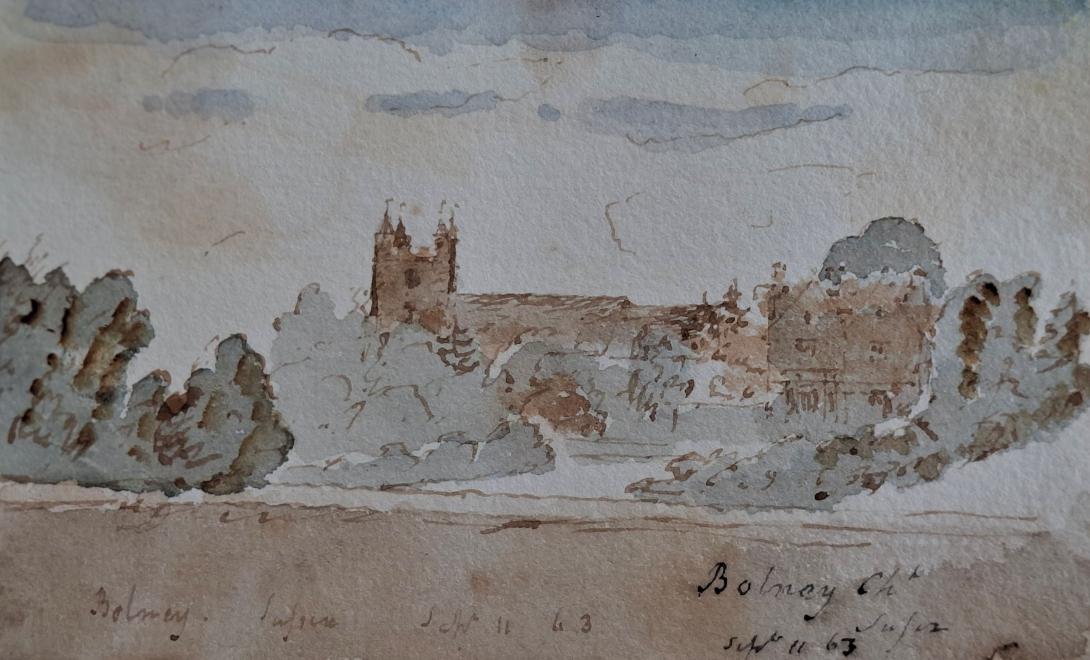
Bolney Church Sussex Sept 11 1863
St Mary Magdalene's Church is an Anglican church in the village of Bolney in Mid Sussex, one of seven local government districts in the English county of West Sussex. The parish church, which is dedicated to Jesus' companion Mary Magdalene, serves a large rural parish centred on a village straddling the ancient London–Brighton road and apparently dates from about 1100, and an older origin has been suggested. Many structural additions have been made over the centuries—including a tower built solely using the labour of villagers—and at the entrance to the churchyard is a "magnificent" 20th-century lychgate made of local materials including Sussex Marble. The church is protected as a Grade I Listed building.
Bolney is on the ancient London–Brighton road about 11 miles (18 km) north of Brighton and 7 miles (11 km) southeast of the market town of Horsham. The main road now bypasses the village to the east. Neither a settlement nor a church was recorded in the Domesday survey of 1086. The parish was first recorded as Bolneya or Bolne in the 13th century, and was one of 12 in the Hundred of Buttinghill in the Rape of Lewes. Despite the absence of earlier written records, some sources date the present church's origins to about 1100, around the start of the Norman era, and most others attribute it to that period without specifying a date. One study, however, suggested an earlier construction date based on the design and decoration of the south doorway, which was stated to have little in common with standard Norman work: comparisons were drawn instead with similar Saxon doorways at 8th- to 11th-century churches elsewhere in England and at nearby Wivelsfield.
The church was built on hilly ground overlooking Bolney from the south, and was reached by a twitten (a narrow lane) from the village street.[7][8] The core of the Norman building consisted of a nave, a narrower chancel set at an angle,[5] one window in the east wall and the doorway in the south wall of the nave. To this was added the main east window in the end of the chancel—a large traceried window dating from about 1300. The south wall of the chancel has a window of a similar date,[5] and on the same wall is a 13th-century piscina.
The next structural alteration, a west tower that "dominates the church", came in 1536–38: the date is known precisely because details of costs and progress were recorded in the churchwarden's record book, which still exists. The churchwarden at the time was John Bolney, also a significant and wealthy landowner in the parish, whose family was long established in the area. Described as the "moving spirit" behind "an inspired community effort involving the whole village",[11] he paid for the tower to be built and arranged for dozens of villagers to use their skills and any money they could offer to quarry the sandstone, cut and shape it, build temporary bridges and paths to transport the material to the church, build tools and wooden scaffolding, and erect the 66-foot (20 m) tall, 12-by-12-foot (3.7 m × 3.7 m) structure at the west end of the church. The project was completed in 1538, and a new west doorway was inserted below John Bolney's coat of arms and the commemorative wording This Stepl is 66 Foot high.
The church continued to expand as the congregation grew. A west gallery for choristers was inserted in 1670—an early example of the practice, common in Sussex, of building accommodation for a choir at the west end of a church so the congregation could face them when they sang. Organs were sometimes too expensive for churches to buy, so choral music by local singers was often preferred instead. West-end galleries only became prevalent in Sussex churches in the early 18th century, though. A porch was built on the south side in 1718, enclosing the Saxon/Norman doorway; and as part of a Victorian restoration, the capacity was increased in 1853 when the nave was extended with a north aisle. A clock was added to the tower in 1898 to commemorate Queen Victoria's Diamond Jubilee. A vestry was added in 1912, and general work was carried out in the nave and chancel during the 1930s. A modern stained glass window by prolific Sussex-based firm Cox & Barnard was inserted in the south aisle in 1982; it depicts a rural scene.
The Huth family were important in church life in the 19th and 20th centuries. Henry Huth was a bibliophile whose enormous collection of rare books was sold for £300,000 in 1910 (£38,680,000 in 2023). He lived in an extravagant château-style 1870s house called Wykehurst Place in the parish, and was buried in the churchyard after his death in 1878. In 1905, his son Edward gave the church a large, "magnificent" lychgate constructed from local materials: oak, millstones from a mill in the parish, Sussex Marble (a locally quarried limestone) and a Horsham Stone slab roof. It stands at the end of the twitten leading to the churchyard, which has been left slightly overgrown to conserve wildlife. A mid-19th-century rector planted the churchyard and rectory grounds with a wide range of trees, many of which survive—including Bhutan pines and oaks from Somerset. There are many Victorian tombs and grave-markers in the churchyard, including some rare wooden grave-boards and some with wooden cross-pieces set between stone balls. Another of Huth's sons, Alfred Henry Huth—who also became a book-collector and author, and who died in 1910—is commemorated by a memorial tablet inside the church; its style was described by Nikolaus Pevsner as "neo-late 17th-century".
Richard Suter (1797–1883).
Richard Suter was born in Greenwich, Kent on 30th March 1798, to William Suter and his wife Sarah Knights. On 7th January 1825 he married Anne Ruth Burn.
English architect. As Surveyor to The Fishmongers' Company he designed the severe Presbyterian churches for Ballykelly (1825–7) and Banagher (1825) on the Company's Estate in County Londonderry, drawings of which were exhibited at the Royal Academy in 1827. He was also responsible for the Model Farm (1823–4), the Lancasterian Schools (1828–30), the Company Agent's House (1830–2—now a hotel, much altered), a range of houses on the south side of the main road (1823–4), the lodge in the Presbyterian churchyard (1828), and the Dispensary (1829), all at Ballykelly, and all Classical. As Surveyor to Trinity House Corporation, he designed houses that were erected by Thomas Cubitt in 1821–3 on a site adjoining Trinity House. For The Fishmongers' Company he designed St Peter's Almshouses, Wandsworth, London (1849–51), and The Old School-House, Gresham's School, Holt, Norfolk(1859), in an Elizabethan style.
On the 1841 Census Richard, an architect and lawyer, can be found living in London with his wife Ann (listed as Ruth) and their two children, Richard George and Andrew Burn. Living with them is Edward D Suter. 1851 finds the family living in Tottenham Court in London, by this time Andrew had left the home, but I am unable to trace him on the 1851 Census. In 1860 Andrew marries Amelia Damaris Harrison. Both Richard George and Andrew were to become ordained ministers, with Andrew later becoming a Bishop and emigrating to New Zealand. Sadly in 1854 Anne Ruth was to pass away. In 1861, widowed Richard, Justice of the Peace for Maidenhead, is living at Castle Hill, Maidenhead, Berkshire. In 1862 he married Elizabeth Anne Pocock. In 1871 and 1881 Richard and Elizabeth are still living in Castle Hill. Richard was to pass away on 1st March1883.
Richard Suter & Annesley Voysey, architects, had their office at number 35 Fenchurch Street, but they did not have it all to themselves as they shared the premises with W.C. Franks, a tea broker, who will get a separate post some other time. The earliest mention I found of Richard Suter in Fenchurch Street is in 1832 when he is listed at that address in a list of contributing members of the Society for the Propagation of the Gospel in Foreign Parts. It says that he had been a member since 1829, but that does not mean he was already at 35 Fenchurch Street in that year.(1) In fact, that seems unlikely as the Sun Fire Office records give Messrs. Short and Co., merchants, as paying the insurance premium on the premises in May 1830. The Directory of British Architects 1834-1914 give the year 1827, but I do not know on what evidence. When Suter and Voysey became partners is also uncertain, but they had known each other since at least 1825 as Suter is named as one of the executors of Voysey’s will which was dated 22 July, 1825. The address given for Suter in the will is Suffolk Street, Southwark. Voysey then lives at Conway Street, Fitzroy Square.