
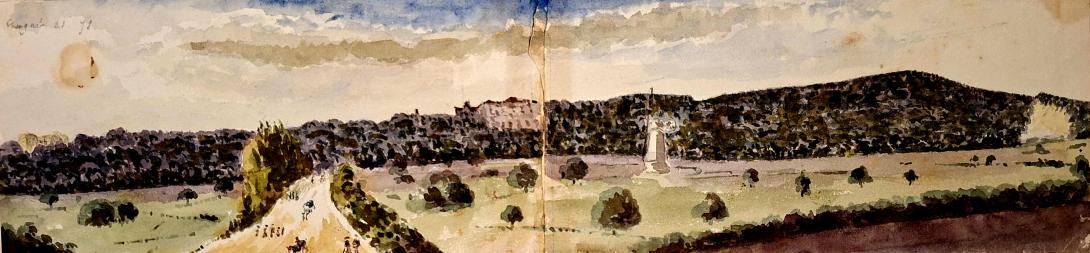
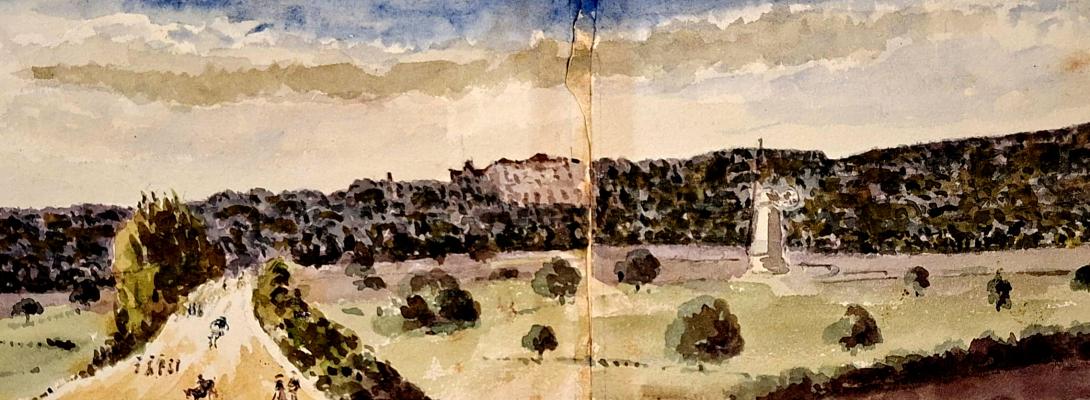
inscribed and dated " August 21 71 / ARUNDEL
Arundel Castle, a stunning Norman fortress in West Sussex, dominates the historic town of Arundel, dramatically rising above the River Arun and the surrounding Arun Valley, offering iconic views from its Norman keep and grounds, making it a picturesque landmark and family seat of the Dukes of Norfolk, visible from the river and surrounding countryside.
Arundel Castle is a restored and remodelled medieval castle in Arundel, West Sussex, England. It was established by Roger de Montgomery in the 11th century. The castle was damaged in the English Civil War and then restored in the 18th and early 19th centuries by Charles Howard, 11th Duke of Norfolk. Further restoration and embellishment was undertaken from the 1890s by Charles Alban Buckler for the 15th Duke. Since the 11th century, the castle has been the seat of the Earls of Arundel and the Dukes of Norfolk. It is a Grade I listed building.
The original structure was a motte-and-bailey castle. Roger de Montgomery was declared the first Earl of Arundel as the King granted him the property as part of a much larger honour of hundreds of manors. Roger, who was a cousin of William the Conqueror, had stayed in Normandy to keep the peace there while William was away in England. He was rewarded for his loyalty with extensive lands in the Welsh Marches and across the country, together with one fifth of Sussex (Arundel Rape). He began work on Arundel Castle in around 1067.
Between 1101 and 1102 the castle was besieged by the forces of Henry I after its holder Robert of Bellême rebelled.The siege ended with the castle surrendering to the king. The castle then passed to Adeliza of Louvain (who had previously been married to Henry I) and her husband William d'Aubigny. Empress Matilda stayed in the castle, in 1139. It then passed down the d'Aubigny line until the death of Hugh d'Aubigny, 5th Earl of Arundel in 1243. John Fitzalan then inherited jure matris the castle and honour of Arundel, by which, according to Henry VI's "admission" of 1433, he was later retrospectively held to have become de jure Earl of Arundel.
The FitzAlan male line ceased on the death of Henry Fitzalan, 12th Earl of Arundel, whose daughter and heiress Mary FitzAlan married Thomas Howard, 4th Duke of Norfolk in 1555, to whose descendants the castle and earldom passed. In 1643, during the First English Civil War, the castle was besieged.[8] The 800 royalists inside surrendered after 18 days. Afterwards in 1653 Parliament ordered the slighting of the castle; however "weather probably destroyed more".
Although the castle remained in the hands of the Howard family over the succeeding centuries, it was not their favourite residence, and the various Dukes of Norfolk invested their time and energy into improving other ducal estates, including Norfolk House in London. Charles Howard, 11th Duke of Norfolk, was known for his restoration work and improvements to the castle beginning in 1787. The folly that still stands on the hill above Swanbourne Lake was commissioned by and built for the Duke by Francis Hiorne at this time.Some stained glass was supplied by William Raphael Eginton. Circa 1816, he described it thus: 3 Portraits of Barons, full length, of the time of King John, in Baronial Hall, at Arundel Castle.
In 1846, Queen Victoria and her husband, Prince Albert, visited Arundel Castle for three days. Henry Howard, 13th Duke of Norfolk, internally remodelled the castle in time for her visit. The architectural firm responsible for design of the furniture was named Morant. The work included a suite of six rooms, built on the second floor of the south-east range at this time.
After the 1846 royal visit the 15th Duke began re-structuring the castle again from 1875 to 1905. The work, which was done to the designs of Charles Alban Buckler and undertaken by Rattee and Kett of Cambridge, was completed in the late 19th century. The 16th Duke had planned to give the castle to the National Trust but following his death in 1975 the 17th Duke cancelled the plan. He created an independent charitable trust to guarantee the castle's future, and oversaw restoration works.
The gardens had received significant improvements by early 2020 through the efforts of head gardener Martin Duncan and his crew. A horticulturalist and landscape designer, Duncan has been working at the Castle since 2009; in 2018, he received the Kew Guild Medal. The gardeners and volunteers "have worked wonders with their bold and innovative plantings", according to an April 2020 report by Country Life. Their most recent efforts led to a wild water garden around the medieval friary ponds.
Richard Suter (1797–1883).
Richard Suter was born in Greenwich, Kent on 30th March 1798, to William Suter and his wife Sarah Knights. On 7th January 1825 he married Anne Ruth Burn.
English architect. As Surveyor to The Fishmongers' Company he designed the severe Presbyterian churches for Ballykelly (1825–7) and Banagher (1825) on the Company's Estate in County Londonderry, drawings of which were exhibited at the Royal Academy in 1827. He was also responsible for the Model Farm (1823–4), the Lancasterian Schools (1828–30), the Company Agent's House (1830–2—now a hotel, much altered), a range of houses on the south side of the main road (1823–4), the lodge in the Presbyterian churchyard (1828), and the Dispensary (1829), all at Ballykelly, and all Classical. As Surveyor to Trinity House Corporation, he designed houses that were erected by Thomas Cubitt in 1821–3 on a site adjoining Trinity House. For The Fishmongers' Company he designed St Peter's Almshouses, Wandsworth, London (1849–51), and The Old School-House, Gresham's School, Holt, Norfolk(1859), in an Elizabethan style.
On the 1841 Census Richard, an architect and lawyer, can be found living in London with his wife Ann (listed as Ruth) and their two children, Richard George and Andrew Burn. Living with them is Edward D Suter. 1851 finds the family living in Tottenham Court in London, by this time Andrew had left the home, but I am unable to trace him on the 1851 Census. In 1860 Andrew marries Amelia Damaris Harrison. Both Richard George and Andrew were to become ordained ministers, with Andrew later becoming a Bishop and emigrating to New Zealand. Sadly in 1854 Anne Ruth was to pass away. In 1861, widowed Richard, Justice of the Peace for Maidenhead, is living at Castle Hill, Maidenhead, Berkshire. In 1862 he married Elizabeth Anne Pocock. In 1871 and 1881 Richard and Elizabeth are still living in Castle Hill. Richard was to pass away on 1st March1883.
Richard Suter & Annesley Voysey, architects, had their office at number 35 Fenchurch Street, but they did not have it all to themselves as they shared the premises with W.C. Franks, a tea broker, who will get a separate post some other time. The earliest mention I found of Richard Suter in Fenchurch Street is in 1832 when he is listed at that address in a list of contributing members of the Society for the Propagation of the Gospel in Foreign Parts. It says that he had been a member since 1829, but that does not mean he was already at 35 Fenchurch Street in that year.(1) In fact, that seems unlikely as the Sun Fire Office records give Messrs. Short and Co., merchants, as paying the insurance premium on the premises in May 1830. The Directory of British Architects 1834-1914 give the year 1827, but I do not know on what evidence. When Suter and Voysey became partners is also uncertain, but they had known each other since at least 1825 as Suter is named as one of the executors of Voysey’s will which was dated 22 July, 1825. The address given for Suter in the will is Suffolk Street, Southwark. Voysey then lives at Conway Street, Fitzroy Square.