
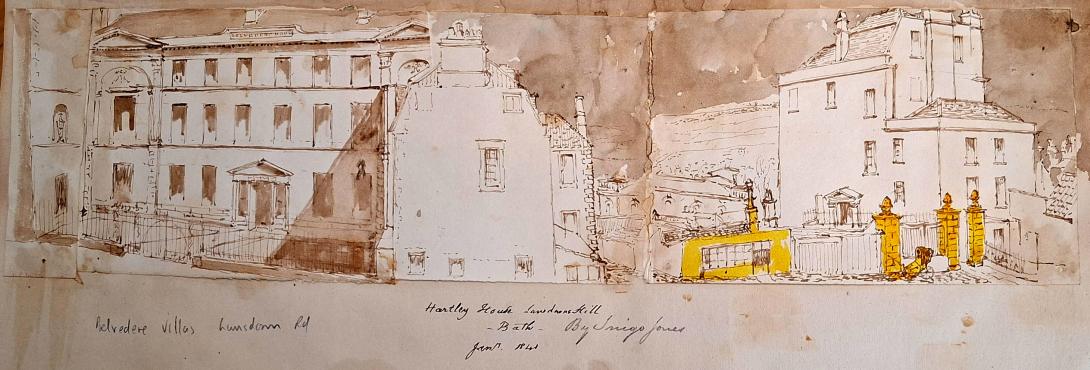
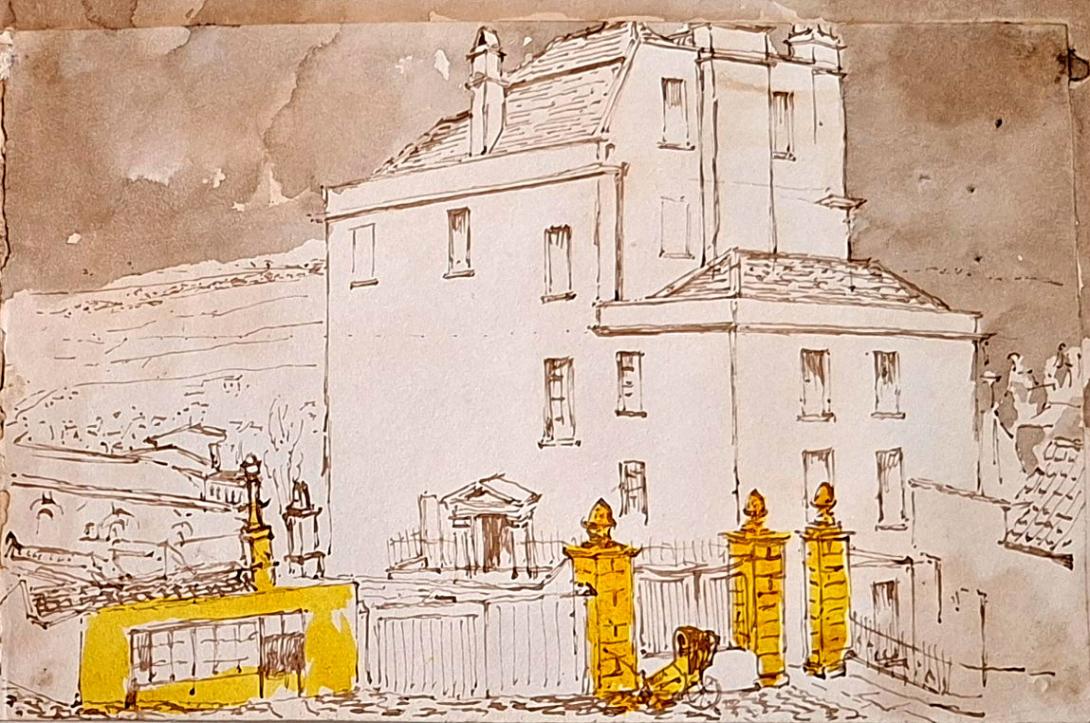
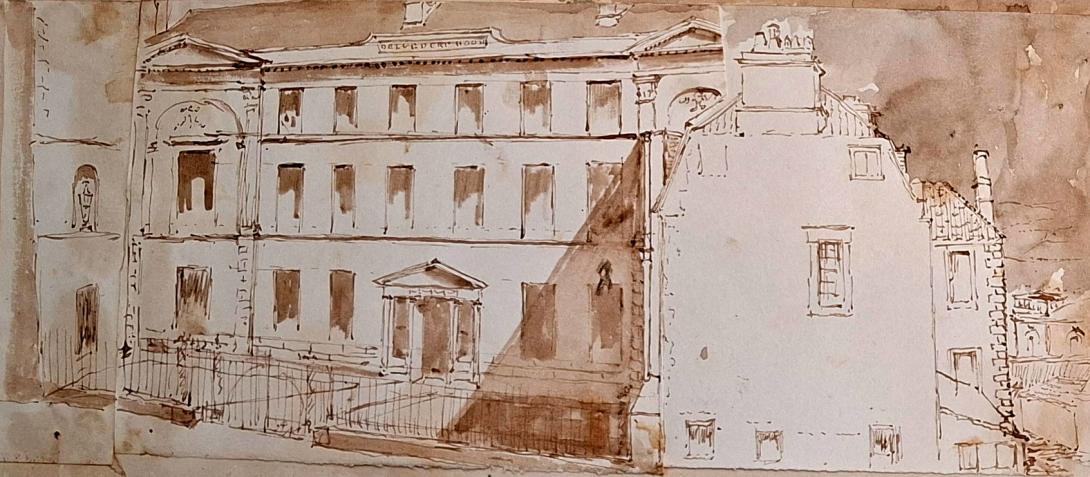
" Belvedere Villas Lansdown Rd / Hartley House Lansdown Hill/ Bath/ Jan 11 1841 / by Inigo Jones"
Belvedere House, now Belvedere Villas. Built c1755 - 1775 by John Wood Junior, it was a school run by the Lee sisters until 1803 . The school closed in the 1830's, it was taken over by the Whittaker sisters of Frances, the youngest and superintendent ( with her husband Thomas Broadhurst, the Unitarian Minister of Trim Street Chapel ), and her older sisters Catherine, Mary and Martha. The sisters are originally from Manchester. From 1809 teh sisters ran the school where they were key players in the early life of Elisabeth Gaskell. The school closed around 1830 the but the family continued to live there until 1867, when it was converted into the four apartment houses.
Belvedere Villas on Lansdown Road, Bath, isn't a single famous historic building like Belvedere House in Ireland or Vienna, but rather part of Bath's grand Georgian Lansdown area, known for its crescents and villas built from the late 18th century, reflecting Bath's elegant development, with Lansdown Crescent itself designed by John Palmer around the same era as other prominent Lansdown structures. While specific villa histories often focus on individual residences or hotels like the nearby Lansdown Grove Hotel (Georgian mansion from 1770), Belvedere Villas embody the architectural grandeur and aspirational living of Georgian Bath, evolving from grand homes to potential boutique hotels or residences near the iconic Lansdown Crescent, a landmark of Bath's development.
As its name implies, the area around Belvidere was noted for its fine view across the city to Beechen Cliff and the adjoining Downs, and individual houses were already being built there by the early 18th century. Betsy Sheridan, writing in 1786 recorded that ‘.. in the Evening I walk’d with Mrs Paterson to a new Walk which has been made by Belvidere, Shelter’d to the North by an immense Hill where they purpose building the New Crescent [Camden Crescent], and on the other side commands the most beautiful prospect immaginable...’. Prints and drawings of this view, some taken from lower down in what later became Hedgemead Park [Illus.9, Watts, Wallis, and postcard], were frequently produced in 19th century, and even in the 20th century was a subject for the postimpressionist painter, Walter Sickert (1860-1942), in his Beechen Cliff from Belvedere, Lansdown, Bath [Illus.9]. John Wood, whilst speculating on the course of the Roman road through Bath to Sea Mills (outlined in the Itinerary of Antoninus - the so-called ‘Julian Road’), identified what he supposed to be a land-mark on its route; ‘.. At the North West Corner of the Win Yards [Vineyards] there is a large Mount of Earth, by the side of the Fosse Road [Guinea Lane] … It is a spot of ground so conspicuous to the whole Country, for many Miles, that from it there are some of the most delightful Views I have ever seen; and they are such as had once like to have seduced me into a very great Expense, by erecting a House, in a military Taste, upon it’. A rank of houses appropriately named Belmont Row was eventually built on this site at the corner of Guinea Lane and Lansdown Road by John Wood the Younger in 1769.
Prominent among later eighteenth-century schools are those of Anne Roscoe and the Lee sisters. The history of the first began at Bristol, where in 1749 a London embroideress, Anna Barbara Roscoe and her husband opened a school on St. Michael's Hill. Widowed c.1762, Mrs Roscoe was joined by her daughter Anne who gave up a budding stage career to become a schoolmistress. In 1770 they moved to Bath and set up temporarily in Brock Street until their new house was ready in Royal Crescent (the present no.2, but the end house until no. 1 was belatedly completed). Boarding fees were fairly steep at £30 a year (later £35) with a 5-guinea entrance charge, but the cost did at least cover laundry, mending and tea besides the basic curriculum subjects of writing, English, French, accounting and needlework. Extras such as Italian, geography, dancing, drawing and music were, as usual, taught by masters from outside the establishment and paid for separately. The one annual vacation lasted six weeks from 1 August. On her mother's death in 1774 Anne Roscoe left the Crescent for the centre house in Barton Buildings near Queen Square; in 1779 she also extended into an adjoining house to give more room for parlour (or family) boarders, including orphaned girls. More ambitiously, in 1782, Anne Roscoe removed to a large building in Lansdown Road facing Montpelier (later known as Hartley House), brought in her three nieces (former pupils) as assistants, engaged a resident teacher from Paris, and announced that in future French would be spoken throughout the school even though English elocution had hitherto been a strong point of the syllabus. Alas, demand for the enlarged school cannot have met expectations, for she failed to meet her mounting debts; within six months she had quitted Bath leaving the field to her rivals, and notably the Misses Lee.
Probably early in 1786 the school expanded into new premises higher up Lansdown Road, immediately north of the present entrance to Hedgemead Park on a site rebuilt in the late 19th century. Seemingly it occupied an extended house (or perhaps adjoining houses) running back from the road, its panoramic view justifying the name "Belvedere House". (The Thomas Baldwin design purporting to be the Lees' school in the Hunt scrapbook in Bath Central Library is quite another building). What it felt like to be a pupil here in the late 1790s we know in some detail from Susan Sibbald's Memoirs. She was one of around 72 girls ranging from 8 to 19 years (2 parlour boarders, 50 standard boarders, and c. 20 day pupils), presided over by the three governesses (Sophia, Harriet and Ann) and three assistant teachers. By this date the rather devout Charlotte Lee had married "a man of mean station" in Bristol, but the others stayed committed to the school - Harriet in 1789 even resisting the advances of the radical philosopher William Godwin who, impressed by her conversational powers, offered his hand. Susan Sibbald tells us about the big school room at the back of the building, the dining room below, and the paved terrace that served as a playground overlooking the garden. Though she shared her bedroom with only two other girls plus the French mistress, at least one other bedroom slept as many as eight girls. The regime was firm but benign. Sanctions ranged from a breakfast of thin gruel to the scandal of expulsion, but corporal punishment had no place. Tutors from the city arrived most days to take lessons: Billy Perks in writing and arithmetic, Monsieur Becker in drawing, Miss Oaks in music (the school had three pianos), and the famous Miss Fleming in dancing training her pupils to perform at special scholars' balls at the Assembly Rooms. There were treats, pocket money, country walks and, after Sunday church, visits to friends. They watched the Sydney Garden's fireworks from their windows and made a pretence at rivalry with Mrs Colbourne's school (before that Ann Wignall's) at 10 Lansdown Crescent - who dubbed them the "Leevites" in return. It seems hardly surprising the Lees had a waiting list for admissions. The three sisters retired, no doubt comfortably off, in summer 1803 and by 1804/5 had settled in South Lyncombe at newly-built Hatfield Place just off the Wells Road. Sophia at 53 already looked elderly, though she would live to 74 and Harriet to 94. The frail-looking Ann was the real worry. In October 1805 she returned from her Welsh tour (with Harriet) still depressed, and on the 23rd, while her sisters were visiting Bath market, she hanged herself. She was buried in Widcombe cemetery after a coroner's verdict of lunacy, and Sophia and Harriet left Bath for good, first to join their brother, partner in a Manchester cotton-spinning firm, and later to live near Tintern Abbey and then at Clifton.
Richard Suter (1797–1883).
Richard Suter was born in Greenwich, Kent on 30th March 1798, to William Suter and his wife Sarah Knights. On 7th January 1825 he married Anne Ruth Burn.
English architect. As Surveyor to The Fishmongers' Company he designed the severe Presbyterian churches for Ballykelly (1825–7) and Banagher (1825) on the Company's Estate in County Londonderry, drawings of which were exhibited at the Royal Academy in 1827. He was also responsible for the Model Farm (1823–4), the Lancasterian Schools (1828–30), the Company Agent's House (1830–2—now a hotel, much altered), a range of houses on the south side of the main road (1823–4), the lodge in the Presbyterian churchyard (1828), and the Dispensary (1829), all at Ballykelly, and all Classical. As Surveyor to Trinity House Corporation, he designed houses that were erected by Thomas Cubitt in 1821–3 on a site adjoining Trinity House. For The Fishmongers' Company he designed St Peter's Almshouses, Wandsworth, London (1849–51), and The Old School-House, Gresham's School, Holt, Norfolk(1859), in an Elizabethan style.
On the 1841 Census Richard, an architect and lawyer, can be found living in London with his wife Ann (listed as Ruth) and their two children, Richard George and Andrew Burn. Living with them is Edward D Suter. 1851 finds the family living in Tottenham Court in London, by this time Andrew had left the home, but I am unable to trace him on the 1851 Census. In 1860 Andrew marries Amelia Damaris Harrison. Both Richard George and Andrew were to become ordained ministers, with Andrew later becoming a Bishop and emigrating to New Zealand. Sadly in 1854 Anne Ruth was to pass away. In 1861, widowed Richard, Justice of the Peace for Maidenhead, is living at Castle Hill, Maidenhead, Berkshire. In 1862 he married Elizabeth Anne Pocock. In 1871 and 1881 Richard and Elizabeth are still living in Castle Hill. Richard was to pass away on 1st March1883.
Richard Suter & Annesley Voysey, architects, had their office at number 35 Fenchurch Street, but they did not have it all to themselves as they shared the premises with W.C. Franks, a tea broker, who will get a separate post some other time. The earliest mention I found of Richard Suter in Fenchurch Street is in 1832 when he is listed at that address in a list of contributing members of the Society for the Propagation of the Gospel in Foreign Parts. It says that he had been a member since 1829, but that does not mean he was already at 35 Fenchurch Street in that year.(1) In fact, that seems unlikely as the Sun Fire Office records give Messrs. Short and Co., merchants, as paying the insurance premium on the premises in May 1830. The Directory of British Architects 1834-1914 give the year 1827, but I do not know on what evidence. When Suter and Voysey became partners is also uncertain, but they had known each other since at least 1825 as Suter is named as one of the executors of Voysey’s will which was dated 22 July, 1825. The address given for Suter in the will is Suffolk Street, Southwark. Voysey then lives at Conway Street, Fitzroy Square.