
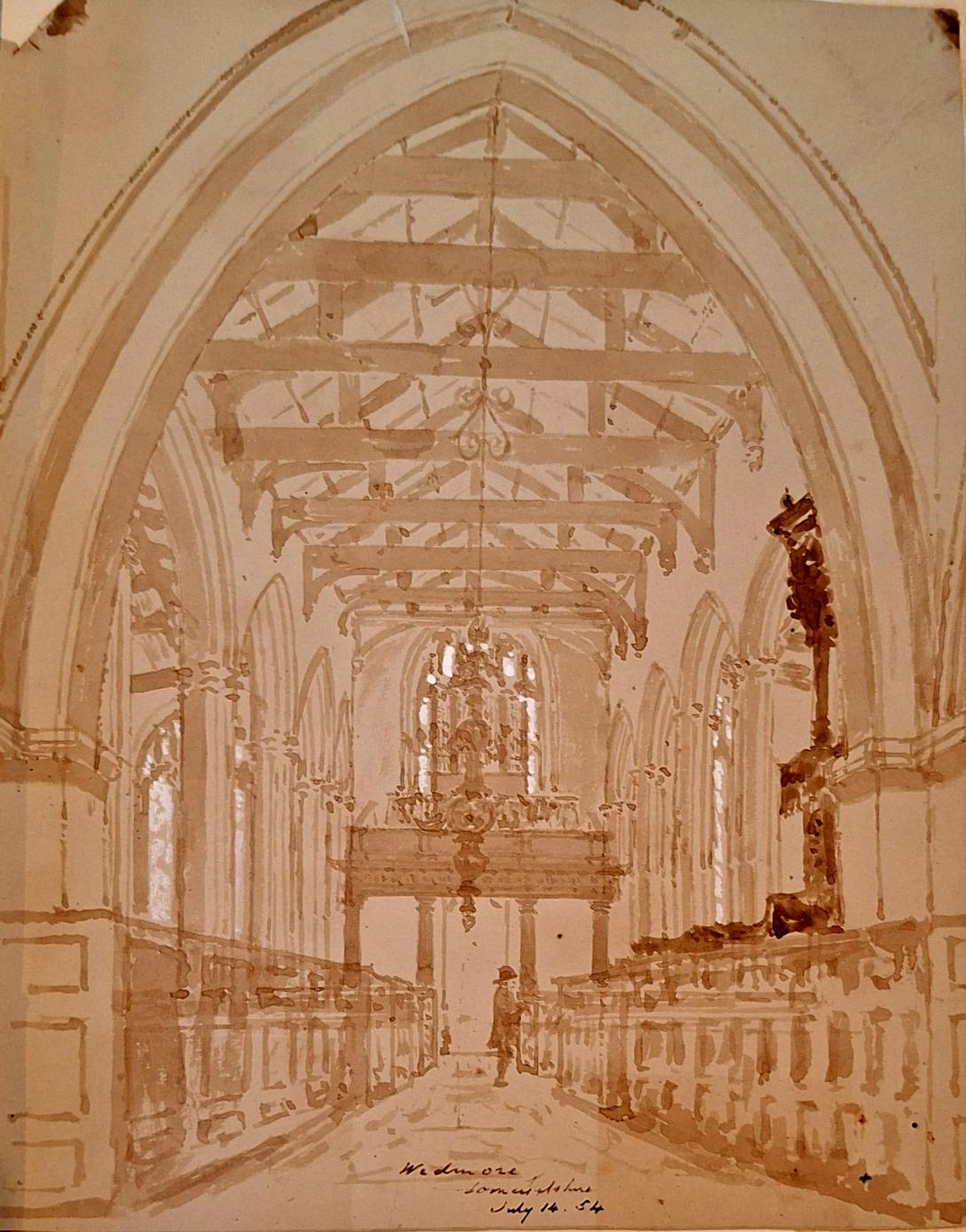
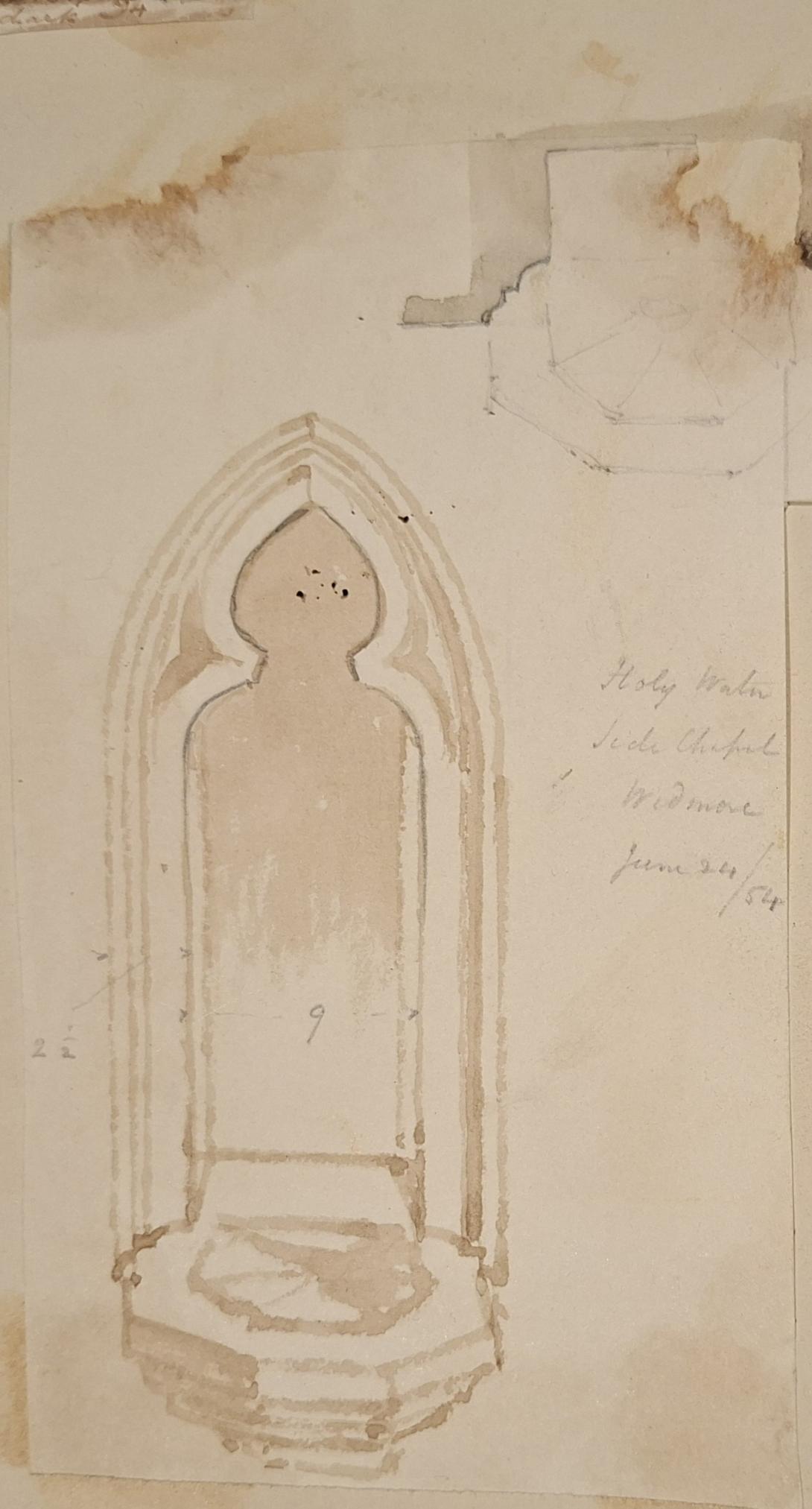
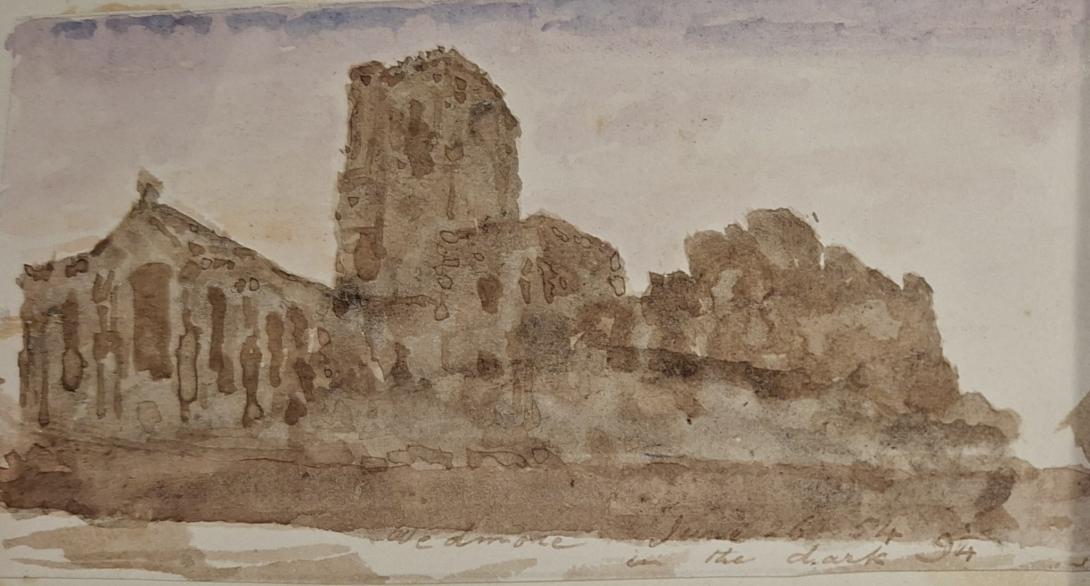
inscribed " Wedmore Somersetshire / July 14 54"
The Church of St Mary in Wedmore, Somerset, England is predominantly from the 15th century, although some 12th- and 13th-century work survives. It has been designated as a Grade I listed building.
The tower, which was built around 1400, with its set-back buttresses, includes triple two-light bell chamber windows; those to the centre are louvred, those to each side blank. It is mostly a 15th century rebuilding of a much earlier church. There may have been a Saxon church here: it is known that Wedmore was part of an estate belonging to the Saxon kings of Wessex, and King Alfred had a house nearby.
Inside, the church is spacious and airy, with slender pillars and high ceilings in the side aisles. The congregation was large: a 1547 record tells of 1,000 communicants at one service. Do take time to look at the detailing on the church's exterior, which includes many good gargoyles. St Mary's porch has two rooms, one above the other, probably used by priests at one time.The porch shelters a beautiful reused 13th century doorway, and also a door that has 13th century hinges and the initials, marked out in nail heads, of the church wardens who had the door remade in 1677.
In 878 King Alfred and the Saxons won a famous battle against the Danes as Edington Wiltshire. Guthrum, the Danish leader, was baptised a Christian. He and 30 Danish followers were brought by Alfred to the royal estate at Wedmore. During the feasting they made the agreement which has been known ever since as The Peace of Wedmore.
St Mary’s church has been rebuilt several times, the present church was built in 14-1500s. There is an information leaflet and a children’s trail to help you to enjoy your visit.
Look out for; the medieval font, the eagle lecturn, the Jacobean pulpit, the chandeliers (which are still lit at Christmas), the stained glass windows.
Many details of the church are strikingly similar to features at Wells cathedral - a reminder of the close links between Wedmore and Wells. Between the late 1300s and early 1500s the church was almost totally rebuilt in Perpendicular style. Chancel and nave were lengthened, and the upper part of the tower rebuilt. Aisles, a guild chapel and a porch were added to the nave, and two more chapels at the east end. A vestry built on the southeast corner in 1828, was removed during the extensive restoratation of 1880-81. The outside walls, built of local Wedmore stone, were formerly rendered. The oldest part of the church, probably early 1200s, is the lower section of the central tower. In the south transept high in the southwest angle with the tower, are the remains of a primitive arch now blocked. This may be very early, possibly even dating back to the Saxon church of the 1000s. The chancel lies beyond the tower crossing. It was lengthened in the 1400s. High on the walls traces of pre 1200 English Lancet windows can be seen. In the north wall are the remains of a steep flight of steps discovered in 1880-81, above them against the east face of the tower is a blocked doorway. This suggests the presence of a rood beam or screen east of the tower. At the Vestry (Chapel of St Anne) services were said three times a week for the souls of Dean Cosyn and his sucessors. It has a handsome carved roof. The Lady Chapel on the south side of the Chancel is another 1400s chapel. The stone altar is medieval on 19th century legs. It was found in 1880 buried under the Chancel floor. The Nave contains many carved corbels, some of which may have been reused from the earlier church. The font originally stood inside the west door. The octagonal bowl may be earlier than the 1400s stem. The guild chapel was the last addition to the church in 1449. The small door leading into the chapel was sealed up in 1547 and reopened in 1880-81. A small stone effigy of an unknown young girl (c.1400s) was found buried under the chapel floor in 1880-81. {9}
There are several war memorials within the church. A cast bronze plaque commemorates the parishioners that died in the First World War. A plaque commemorates 2Lt W G Bown who was killed in 1915. Another plaque is dedicated to 2Lt S B Henson who died in 1914. The church's font cover is a memorial to 2Lt V C E Bracey who was killed in an accident whilst on active service in 1917. Bracey is buried in the churchyard. Another tombstone and a cross mark the grave of Sgt J Wilkinson who died of wounds in 1918. The cover is adorned with a carved wooden sculpture. There are wooden figures at each of the four corners. The front figure is of a RFC officer in flying uniform, there also Madonna and child, a Roman gladiator carrying a cross and St George slaying the dragon. The RFC badge is carved into the wooden base. A yew tree within the churchyard was planted in 1945 on November 11th to commemorate the restoration of peace. A roughly shield shaped plaque is dedicated to Capt T Hodges who was killed in 1583 at the siege of Antwerp. {10}
A fresh examination of the architectural history of the parish church for a new church guide brought out the close architectural connections between Wedmore and Wells. The dean of Wells owned Wedmore and was patron of the parish church, and it would seem that much of the workmanship of the sophisticated 13th-century church which preceded the present 15th-century building was probably carried out by Wells masons.
The well-known south doorway at Wedmore church - reset in a 15th-century wall - is flanked by compound shafts with stiff-leaf capitals exactly like those in the part of Wells Cathedral nave that was built in the early 1200s. The present nave and aisles at Wedmore were built in the 1400s; but among the varied stone corbels supporting the roof are two at the west end of the south aisle which, unlike all the rest, are of blue Lias carved with naturalistic foliage. One has long, oak-type leaves and the other has ivy leaves with conspicuous long stems. Both, on examination, prove to be former pillar capitals later reused as corbels. The collar around the pillar top is still visible, and surplus carving has been crudely hacked away where the stone has been reset as a corbel. Both foliage carvings can be very closely matched with the blue Lias capitals on the upper part of the Chapter House stairs and in the Chapter House entry at Wells, which were built c.1270-1290. Not only do these reused fragments of the previous Wedmore church reinforce the close connection between Wedmore and Wells in the 13th century, but they also serve to suggest definite dates at both the beginning and the end of the 1200s when Wedmore church was being improved to the highest standards. {12}
It is strongly suspected that Wedmore had a church by the late 9th century, since this was the place where the chrism was loosened for Guthrum in 878. This was a religious ceremony, and so probably took place in a church. {14}
There are blue lias shafts to the inner S door which are contemporary with the middle part of the nave at Wells cathedral.
Richard Suter (1797–1883).
Richard Suter was born in Greenwich, Kent on 30th March 1798, to William Suter and his wife Sarah Knights. On 7th January 1825 he married Anne Ruth Burn.
English architect. As Surveyor to The Fishmongers' Company he designed the severe Presbyterian churches for Ballykelly (1825–7) and Banagher (1825) on the Company's Estate in County Londonderry, drawings of which were exhibited at the Royal Academy in 1827. He was also responsible for the Model Farm (1823–4), the Lancasterian Schools (1828–30), the Company Agent's House (1830–2—now a hotel, much altered), a range of houses on the south side of the main road (1823–4), the lodge in the Presbyterian churchyard (1828), and the Dispensary (1829), all at Ballykelly, and all Classical. As Surveyor to Trinity House Corporation, he designed houses that were erected by Thomas Cubitt in 1821–3 on a site adjoining Trinity House. For The Fishmongers' Company he designed St Peter's Almshouses, Wandsworth, London (1849–51), and The Old School-House, Gresham's School, Holt, Norfolk(1859), in an Elizabethan style.
On the 1841 Census Richard, an architect and lawyer, can be found living in London with his wife Ann (listed as Ruth) and their two children, Richard George and Andrew Burn. Living with them is Edward D Suter. 1851 finds the family living in Tottenham Court in London, by this time Andrew had left the home, but I am unable to trace him on the 1851 Census. In 1860 Andrew marries Amelia Damaris Harrison. Both Richard George and Andrew were to become ordained ministers, with Andrew later becoming a Bishop and emigrating to New Zealand. Sadly in 1854 Anne Ruth was to pass away. In 1861, widowed Richard, Justice of the Peace for Maidenhead, is living at Castle Hill, Maidenhead, Berkshire. In 1862 he married Elizabeth Anne Pocock. In 1871 and 1881 Richard and Elizabeth are still living in Castle Hill. Richard was to pass away on 1st March1883.
Richard Suter & Annesley Voysey, architects, had their office at number 35 Fenchurch Street, but they did not have it all to themselves as they shared the premises with W.C. Franks, a tea broker, who will get a separate post some other time. The earliest mention I found of Richard Suter in Fenchurch Street is in 1832 when he is listed at that address in a list of contributing members of the Society for the Propagation of the Gospel in Foreign Parts. It says that he had been a member since 1829, but that does not mean he was already at 35 Fenchurch Street in that year.(1) In fact, that seems unlikely as the Sun Fire Office records give Messrs. Short and Co., merchants, as paying the insurance premium on the premises in May 1830. The Directory of British Architects 1834-1914 give the year 1827, but I do not know on what evidence. When Suter and Voysey became partners is also uncertain, but they had known each other since at least 1825 as Suter is named as one of the executors of Voysey’s will which was dated 22 July, 1825. The address given for Suter in the will is Suffolk Street, Southwark. Voysey then lives at Conway Street, Fitzroy Square.