
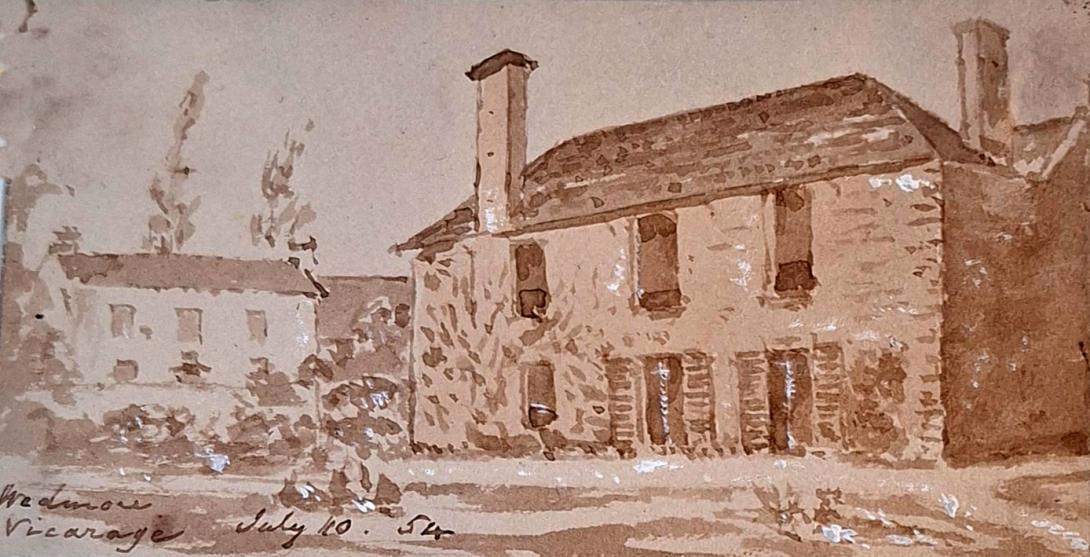
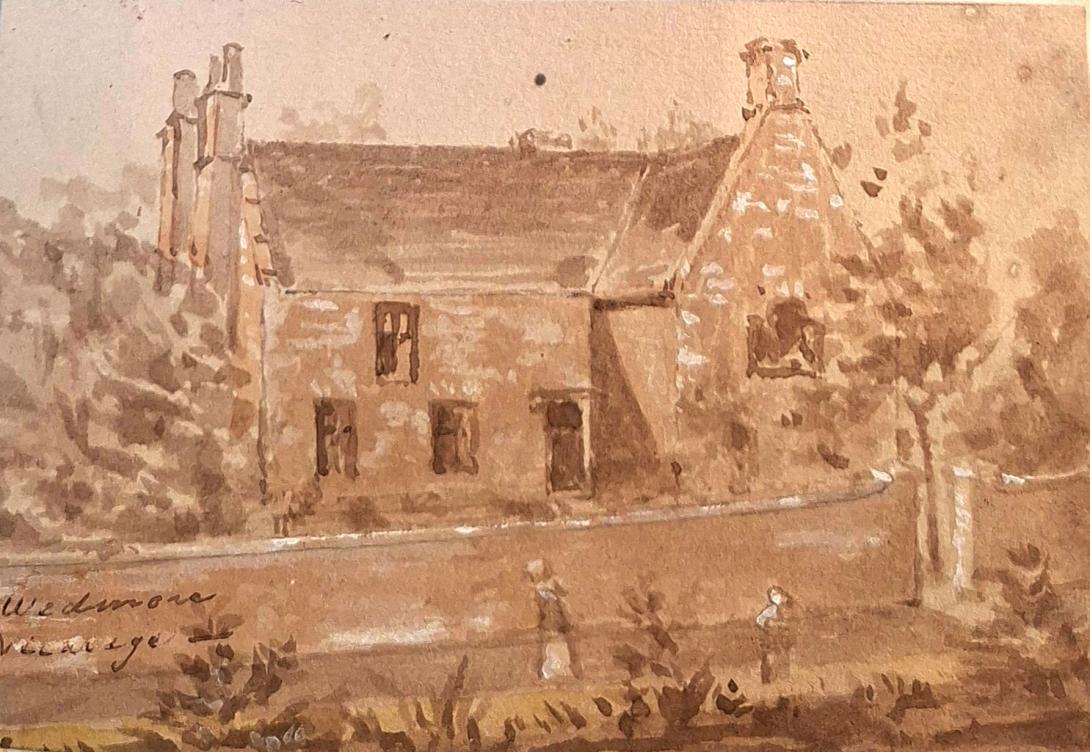
inscribed " Wedmore Vicarage July 10 54/ Wedmore Vicarage "
The Vicarage, now a house. C15 establishment, C17, much rebuilt C19. Painted rubble, slate roof, coped verge to left, brick stacks. Central gabled block with a wing projecting to each side, central portion postulated as the remains of an open hall. Two storeys, 3:1:2 bays; some 12-pane casements, some sash windows with glazing bars, Venetian window to first floor of centre bay of 10-lights; gothic window under a pointed arch head to left return of central projecting wing. Door opening to left, plank door, transomlight with glazing bars, flat hood on moulded brackets; further door opening to right return of projecting wing, Uniform 6-bay garden front, hipped roof, sash windows with glazing bars. Interior predominantly C19 with C20 alterations; fragmentary remains of C17 roof to central wing. Believed to be on an ancient Saxon site. (N J Record, unpublished SRO, Febuary 1977; VAG report, unpublished SRO, March 1977).
Wedmore is a large village and civil parish in the county of Somerset, England. It is situated on raised ground, in the Somerset Levels between the River Axe and River Brue, often called the Isle of Wedmore. The parish consists of three main villages: Wedmore, Blackford and Theale, with the 17 hamlets of Bagley, Blakeway, Clewer, Crickham, Cocklake, Heath House, Latcham, Little Ireland, Middle Stoughton, Mudgley, Panborough, Sand, Stoughton Cross, Washbrook, West End, West Ham and West Stoughton. The parish of Wedmore has a population of 3,318 according to the 2011 census.
Its facilities include a medical and dental practice, pharmacy, butcher's, a village store with off licence, three pubs, restaurant, café and several other local shops. It is 4 miles (6 km) south of Cheddar, 7 miles (11 km) west of the city of Wells and 7 miles (11 km) north west of Glastonbury.
Iron Age remains have been found in the Wedmore area, and there are a number of Roman sites in the district.
The name Wedmore in Old English is thought to mean "hunting lodge" or "hunting moor" and there was a Saxon royal estate in the area. Centwine gained control of the area in 682 and named it 'Vadomaer' after one of the Saxon leaders, Vado the famous.After winning the Battle of Ethandun, Alfred the Great caused the Viking leader Guthrum and his followers to be baptised at Aller and then celebrated at Wedmore. After this the Vikings withdrew to East Anglia.
The Treaty of Wedmore is a term used by some historians inferred for the events in the Anglo-Saxon Chronicle, outlining how in 878 the Viking leader Guthrum was baptised and accepted Alfred the Great as his godfather. No such treaty still exists but there is a document that is not specifically linked to Wedmore that is a Treaty of Alfred and Guthrum. Alfred then left Wedmore in his will to his son Edward the Elder.
Wedmore was part of the hundred of Bempstone. Earthworks from a complex of buildings, including a hall and chapel, surrounded by a moat, have been identified. The site is believed to have been a bishop's palace demolished by John Harewel in the 1380s.

In 1853 a hoard of 200 silver coins dating from the Saxon period was found in the churchyard. In 1988 a Saxon ring, made of copper alloy with a unique knot design and dating from the 6th or 7th century, was found in the village by Tim Purnell. It has been authenticated by the British Museum and a modern copy made by local jeweller Erica Sharpe.
According to the 1086 Domesday Book, Wedmore/Wetmore was one of the holdings of the Bishop of Wells with 18 cottagers, woodlands, pasture and two fisheries.In the medieval period, Wedmore was the centre for the surrounding agricultural area, with weekly markets as well as a larger annual one. The market cross dates from the 14th century.In the 17th century Dr John Westover built a mental hospital to which patients came from all over the West Country. This is believed to have been England's first private lunatic asylum. The doctor is thought to have treated his patients compassionately, ensuring that they had luxuries such as playing cards and tobacco. He kept a record of the ailments of Wedmore people over a period of 15 years.
The original post office in Church Street opposite the church itself, dates from Georgian times, while the Old Vicarage was built at the end of the 15th century.The George Hotel was a 16th-century coaching inn. John Tonkin built a fashionable house, in the Italianate style, which is now the pharmacy.

In 1799 Hannah More established a Sunday school for children in Wedmore in the face of opposition from the vicar and local gentry.Wedmore's market cross was moved roughly 100 yards along The Borough in the 1830s to allow widening of the high street.Between 1881 and 1898 the Reverend Hervey produced the Wedmore Chronicle which gives a picture of the people and area at the time.
In late 2018, Strongvox Homes commissioned the development of 35 new houses to the east of Wedmore First School Academy on Blackford Road, with a completion date of early 2020. The scheme comes in the wake of a previous application to build 60 homes opposite the school and 18 opposite Westholme Farm, also on Blackford Road. The development plans were called "ludicrous" and "unnecessary" by residents concerned about the strain placed on infrastructure in the Wedmore region. Wedmore Parish Council supported the development, saying "The neighbourhood plan will provide an element of affordable housing, which is much-needed in the village.
Richard Suter (1797–1883).
Richard Suter was born in Greenwich, Kent on 30th March 1798, to William Suter and his wife Sarah Knights. On 7th January 1825 he married Anne Ruth Burn.
English architect. As Surveyor to The Fishmongers' Company he designed the severe Presbyterian churches for Ballykelly (1825–7) and Banagher (1825) on the Company's Estate in County Londonderry, drawings of which were exhibited at the Royal Academy in 1827. He was also responsible for the Model Farm (1823–4), the Lancasterian Schools (1828–30), the Company Agent's House (1830–2—now a hotel, much altered), a range of houses on the south side of the main road (1823–4), the lodge in the Presbyterian churchyard (1828), and the Dispensary (1829), all at Ballykelly, and all Classical. As Surveyor to Trinity House Corporation, he designed houses that were erected by Thomas Cubitt in 1821–3 on a site adjoining Trinity House. For The Fishmongers' Company he designed St Peter's Almshouses, Wandsworth, London (1849–51), and The Old School-House, Gresham's School, Holt, Norfolk(1859), in an Elizabethan style.
On the 1841 Census Richard, an architect and lawyer, can be found living in London with his wife Ann (listed as Ruth) and their two children, Richard George and Andrew Burn. Living with them is Edward D Suter. 1851 finds the family living in Tottenham Court in London, by this time Andrew had left the home, but I am unable to trace him on the 1851 Census. In 1860 Andrew marries Amelia Damaris Harrison. Both Richard George and Andrew were to become ordained ministers, with Andrew later becoming a Bishop and emigrating to New Zealand. Sadly in 1854 Anne Ruth was to pass away. In 1861, widowed Richard, Justice of the Peace for Maidenhead, is living at Castle Hill, Maidenhead, Berkshire. In 1862 he married Elizabeth Anne Pocock. In 1871 and 1881 Richard and Elizabeth are still living in Castle Hill. Richard was to pass away on 1st March1883.
Richard Suter & Annesley Voysey, architects, had their office at number 35 Fenchurch Street, but they did not have it all to themselves as they shared the premises with W.C. Franks, a tea broker, who will get a separate post some other time. The earliest mention I found of Richard Suter in Fenchurch Street is in 1832 when he is listed at that address in a list of contributing members of the Society for the Propagation of the Gospel in Foreign Parts. It says that he had been a member since 1829, but that does not mean he was already at 35 Fenchurch Street in that year.(1) In fact, that seems unlikely as the Sun Fire Office records give Messrs. Short and Co., merchants, as paying the insurance premium on the premises in May 1830. The Directory of British Architects 1834-1914 give the year 1827, but I do not know on what evidence. When Suter and Voysey became partners is also uncertain, but they had known each other since at least 1825 as Suter is named as one of the executors of Voysey’s will which was dated 22 July, 1825. The address given for Suter in the will is Suffolk Street, Southwark. Voysey then lives at Conway Street, Fitzroy Square.