
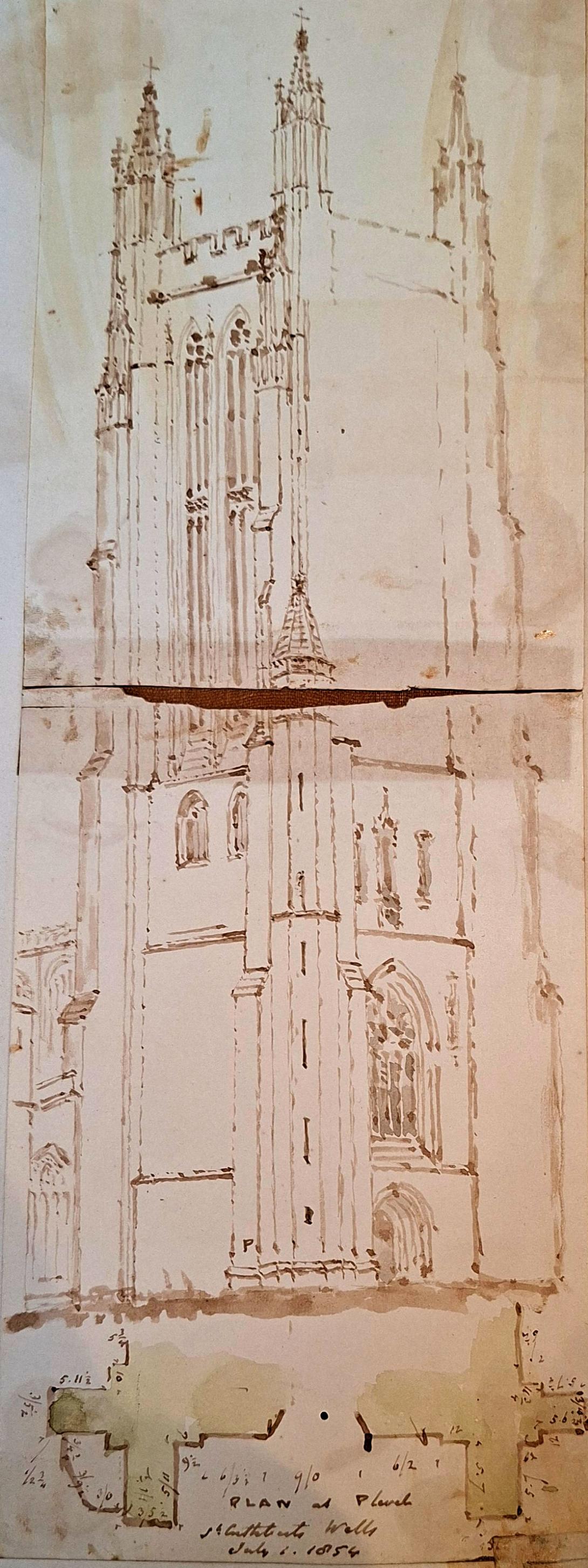
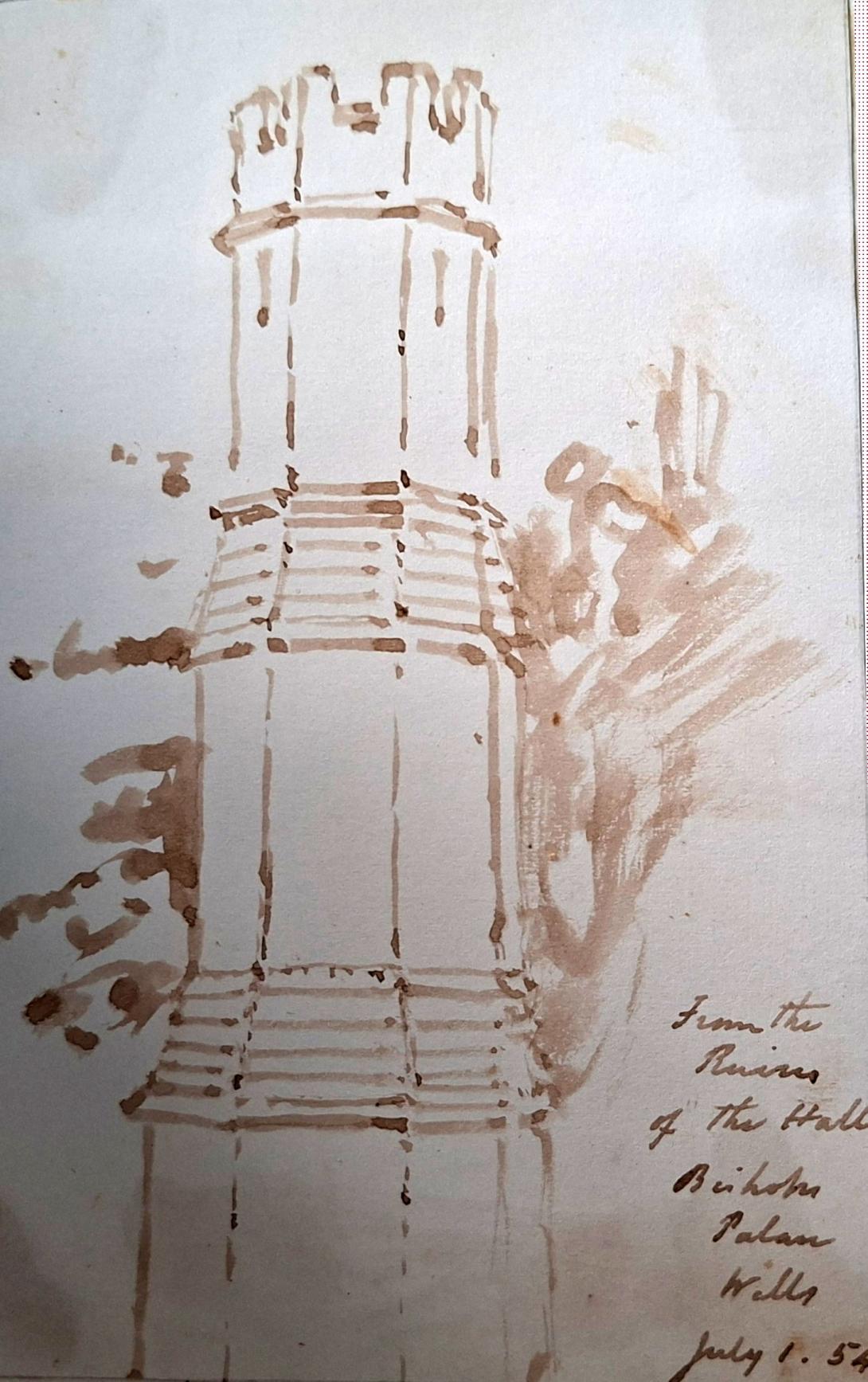
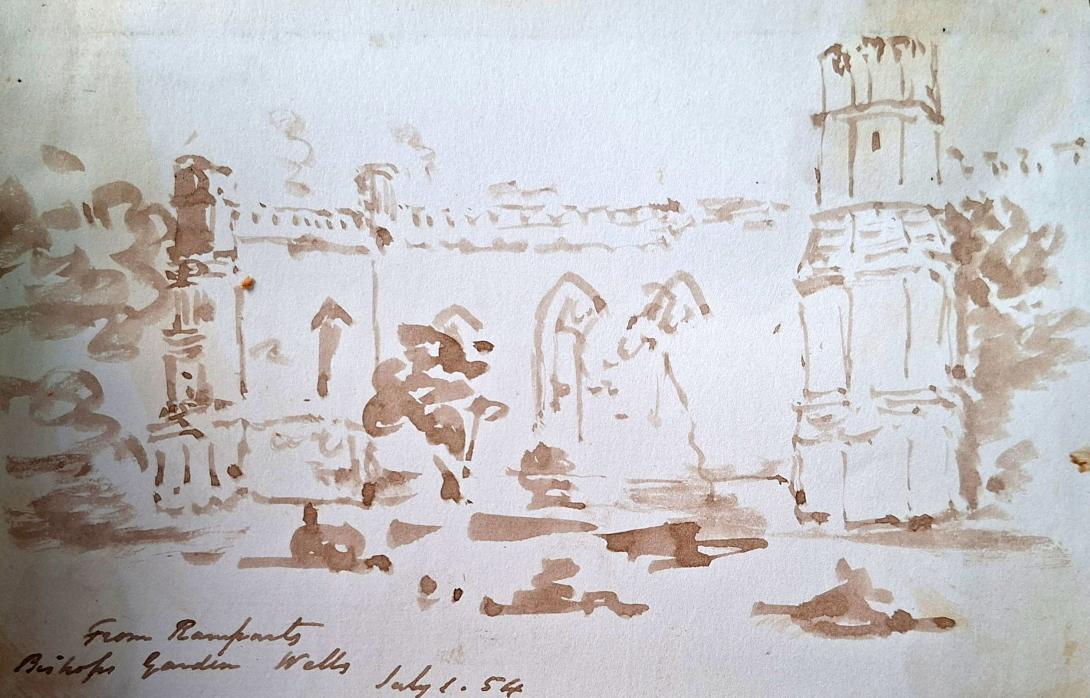
St Cuthberts Wells / July 1 1854 and from Ramparts Bishops Garden and Palce Wells July 1 54 and from the ruins of the Hall Bishops Palace Wells July 1 54"
The Church of St Cuthbert is an Anglican parish church in Wells, Somerset, England, dating from the 13th century. It is often mistaken for the cathedral. It has a fine Somerset stone tower and a superb carved roof. It is a Grade I listed building. The dedication of the church to St Cuthbert suggests Saxon origins. Originally an Early English building (13th century), from which the arcade pillars survive, it was much altered in the Perpendicular Period (15th century), when the clerestory and angel roof were added to the seven-bay aisled nave.
It is built of Doulting ashlar stone to most of the south side. The north side is rubble with ashlar dressings. The north transept (St Catherine's Chapel) has the remains of its 13th century reredos on the east wall, which was rediscovered in 1848. The south transept which is otherwise known as The Lady Chapel has another stone reredos dating from 1470, based on the Tree of Jesse theme.
Until 1561 the church had a central tower which either collapsed or was removed, as a result of alterations to the structure and decoration of the church in line with the changes in theological and liturgical practice during the Protestant Reformation. It has been replaced with the current tower over the west door. Bells were cast for the tower by Roger Purdy. The present tower, the third highest in Somerset, is of 3 stages, with the top stage occupying half the total height. The height to the battlements is 123 feet (37 metres), and when the top stones of the pinnacles are included, the total height is 151 feet (46 metres).
The nave's coloured ceiling was repainted in 1963 at the instigation of the then Vicar's wife, Mrs Barnett. During the restoration works in the 1960s a 15th-century carved and panelled ceiling was found above the side chapel which had been covered with plaster during the 18th or 19th century.

In 1975 a lightning strike caused one of the tower pinnacles to fall through the roof of the nave and damage the nave floor. The replacement pinnacle remained much paler than the other three for some years.
There is a carved wood pulpit of 1636, with an elaborate stair and two carved coats of arms, of Charles I, and Charles II.
The church contains a pipe organ originally by Henry Lincoln dating from 1820. It was rebuilt by William Sweetland of Bath in 1864, George Osmond of Taunton in 1959 and Percy Daniel in 1984. A specification of the organ can be found on the National Pipe Organ Register.
The grounds of the palace in the 13th century included a medieval deer park. The right to form the park was granted by King John to Bishop Jocelin in 1207.The Palace Camery was planted with orchards, a herbarium and kitchen gardens to provide food for the Bishop and staff.
There are now 14 acres (5.7 ha) of gardens including St Andrew's Spring from which the city takes its name. The spring supplies St. Andrew's Well from which water flows at a rate of 40 imperial gallons (180 L) per second into the moat which holds 4 million imperial gallons (18,000,000 L). The water emerging from the spring originates from the cave system of the Mendip Hills including Thrupe Lane Swallet. The Well House was built in 1451, for Bishop Beckington to provide water to the citizens of Wells in the market place. The small stone building with a slate roof has a central hole in the stone floor giving access to the well itself.The gardens are listed, Grade II*, on the Register of Historic Parks and Gardens of special historic interest in England.
The grounds included The Bishop's Barn which was built as a tithe barn in the 15th century, and the area next to it which is now a public park and play area. The barn was built of local stone roughly squared, with Doulting ashlar dressings and a Westmorland slate roof. Royalist troops were quartered in the barn during the Bloody Assizes.
.jpg)
Much of the existing landscaping on the south lawn was carried out by Bishop George Henry Law in the 1820s. This included the incorporation of the remains of the roofless great hall and the construction of a raised rampart around the inside of the wall accessible from one of the towers. Bishop Law also created a grotto which he used to display fossils from Banwell Caves which were also part of his estate. A range of trees and shrubs were planted including: a black walnut, Lebanon cedar, catalpa and ginkgo. In the 1830s, Bishop Law had a pool created next to the springs. This acts as a mirror on a still day providing reflections of the east end of the cathedral in the water.
In the outer garden is an arboretum, planted in 1977 by Bishop John Bickersteth to commemorate the Silver Jubilee of Elizabeth II. The mute swans on the moat have been trained to ring bells by pulling strings, to beg for food. The first swans were trained by one of the daughters of Bishop Hervey in the 1870s. Two swans which were given to the bishop by Queen Elizabeth II in 2006, are still able to ring for lunch fed to them by the caretakers who live in the gatehouse.
Every August bank holiday, the moat is used for the Wells Moat Boat Race, a charity raft race organised by Wells Lions Club and Air Training Corps. In 2007, the Bishop entered a raft into the race. In 2013, a "tree of heaven" on the south lawn, which had been planted in 1885, was blown down during the St. Jude storm.
The Bishop's Palace is the residence of the bishop of Bath and Wells in Wells, Somerset, England. The palace is adjacent to Wells Cathedral and has been the residence of the bishops since the early thirteenth century. It has been designated a grade I listed building.
Building of the palace started around 1210 by bishops Jocelin of Wells and Reginald Fitz Jocelin, and the chapel and great hall were added by Bishop Robert Burnell between 1275 and 1292. The walls, gatehouse and moat were added in the 14th century by Bishop Ralph of Shrewsbury. The Bishop's House was added in the 15th century by Bishop Thomas Beckington. The great hall later fell into disrepair and was partially demolished around 1830.
The palace was originally surrounded by a medieval deer park. When the walls were built, streams were diverted to form the moat as a reservoir. In the 1820s, the grounds within the walls were planted and laid out as pleasure grounds by Bishop George Henry Law, who created a reflecting pond near the springs. Parts of the buildings are still used as a residence by the current bishop; however, much of the palace is now used for public functions and as a tourist attraction.
Construction began around 1210 by Bishop Jocelin of Wells but principally dates from 1230. Bishop Jocelin continued the cathedral building campaign begun by Bishop Reginald Fitz Jocelin, and was responsible for building the Bishop's Palace, as well as the choristers' school, a grammar school, a hospital (or perhaps hostel) for travellers and a chapel within the liberty of the cathedral. He also built a manor house at Wookey, near Wells. The chapel and great hall were built between 1275 and 1292 for Bishop Robert Burnell. The windows had stone tracery. Stone bosses where the supporting ribs meet on the ceiling are covered with representations of oak leaves and the Green Man. The building is seen as a fine example of the Early English architectural style.
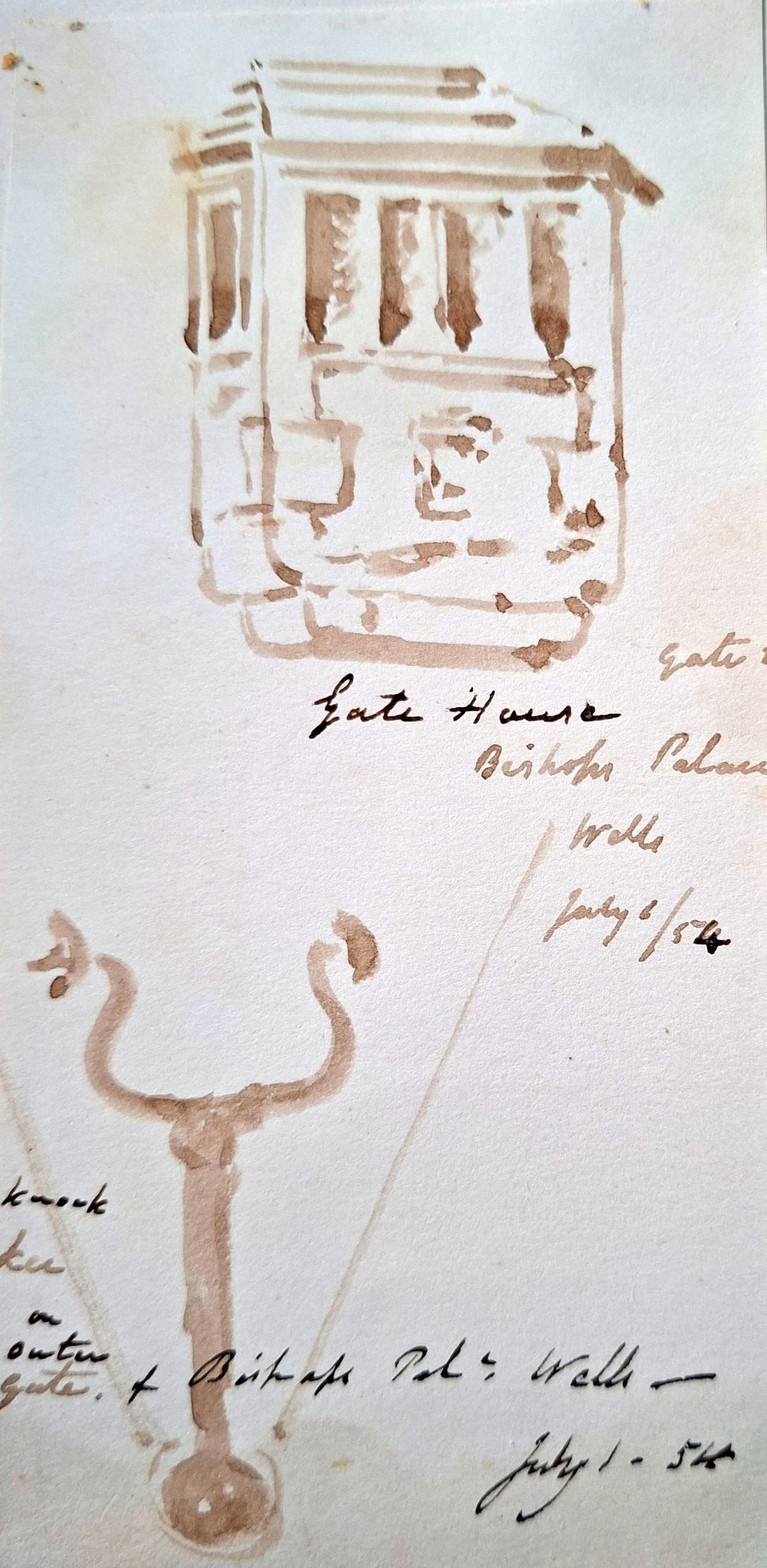
In the 14th century, Bishop Ralph of Shrewsbury continued the building. He had an uneasy relationship with the citizens of Wells, partly because of his imposition of taxes, and surrounded his palace with 5 metres (16 ft) crenellated walls a moat and a drawbridge. The three-storey gatehouse, which dates from 1341, has a bridge over the moat. The entrance was protected by a heavy gate, portcullis and drawbridge, operated by machinery above the entrance, and spouts through which defenders could pour scalding liquids onto any attacker. The drawbridge was still operational in 1831 when it was closed after word was received that the Palace of the Bishop of Bristol was subject to an arson attack during the Bristol riots. These took place after the House of Lords rejected the second Reform Bill. The proposal had aimed to get rid of some of the rotten boroughs and give Britain's fast-growing industrial towns such as Bristol, Manchester, Birmingham, Bradford and Leeds greater representation in the House of Commons; however, there was no rioting in Wells.The water which filled the moat flowed from the springs in the grounds which had previously chosen its own course as a small stream separating the cathedral and the palace and causing marshy ground around the site. The moat acted as a reservoir, controlled by sluice gates, which powered watermills in the town.
The north wing (now the Bishop's House) was added in the 15th century by Bishop Beckington, with further modifications in the 18th century, and in 1810 by Bishop Beadon. It was restored, divided, and the upper storey added by Benjamin Ferrey between 1846 and 1854. Following the Dissolution of the Monasteries in 1548, Bishop Barlow sold Edward Seymour, 1st Duke of Somerset the palace and grounds. These were recovered after the Duke's execution in 1552.

In the 1550s, Bishop Barlow sold the lead from the roofs of the Great Hall. It can be seen in an engraving of 1733, but was largely demolished around 1830 by Bishop Law. He created a "more picturesque ruin" by removing the south and east walls and laying out and planting the area previously occupied by the great hall. The palace was used as a garrison for troops in both the English Civil War and Monmouth Rebellion after which it was used as a prison for rebels after the Battle of Sedgemoor.
Bishop Kidder was killed during the Great Storm of 1703, when two chimney stacks in the palace fell on him and his wife, while they were asleep in bed.A central porch was added around 1824 and, in the 1840s and 1850s, Benjamin Ferrey restored the palace and added an upper storey. He also restored the chapel using stained glass from ruined French churches.
In 1953, it was designated as a Grade I listed building. In February 2008, the poet laureate of the United Kingdom, Andrew Motion, was commissioned by the BBC West television programme Inside Out West to write a poem in Harry Patch's honour. Entitled "The Five Acts of Harry Patch" it was first read at a special event at the Bishop's Palace, where it was introduced by Charles, Prince of Wales and received by Harry Patch.
Richard Suter (1797–1883).
Richard Suter was born in Greenwich, Kent on 30th March 1798, to William Suter and his wife Sarah Knights. On 7th January 1825 he married Anne Ruth Burn.
English architect. As Surveyor to The Fishmongers' Company he designed the severe Presbyterian churches for Ballykelly (1825–7) and Banagher (1825) on the Company's Estate in County Londonderry, drawings of which were exhibited at the Royal Academy in 1827. He was also responsible for the Model Farm (1823–4), the Lancasterian Schools (1828–30), the Company Agent's House (1830–2—now a hotel, much altered), a range of houses on the south side of the main road (1823–4), the lodge in the Presbyterian churchyard (1828), and the Dispensary (1829), all at Ballykelly, and all Classical. As Surveyor to Trinity House Corporation, he designed houses that were erected by Thomas Cubitt in 1821–3 on a site adjoining Trinity House. For The Fishmongers' Company he designed St Peter's Almshouses, Wandsworth, London (1849–51), and The Old School-House, Gresham's School, Holt, Norfolk(1859), in an Elizabethan style.
On the 1841 Census Richard, an architect and lawyer, can be found living in London with his wife Ann (listed as Ruth) and their two children, Richard George and Andrew Burn. Living with them is Edward D Suter. 1851 finds the family living in Tottenham Court in London, by this time Andrew had left the home, but I am unable to trace him on the 1851 Census. In 1860 Andrew marries Amelia Damaris Harrison. Both Richard George and Andrew were to become ordained ministers, with Andrew later becoming a Bishop and emigrating to New Zealand. Sadly in 1854 Anne Ruth was to pass away. In 1861, widowed Richard, Justice of the Peace for Maidenhead, is living at Castle Hill, Maidenhead, Berkshire. In 1862 he married Elizabeth Anne Pocock. In 1871 and 1881 Richard and Elizabeth are still living in Castle Hill. Richard was to pass away on 1st March1883.
Richard Suter & Annesley Voysey, architects, had their office at number 35 Fenchurch Street, but they did not have it all to themselves as they shared the premises with W.C. Franks, a tea broker, who will get a separate post some other time. The earliest mention I found of Richard Suter in Fenchurch Street is in 1832 when he is listed at that address in a list of contributing members of the Society for the Propagation of the Gospel in Foreign Parts. It says that he had been a member since 1829, but that does not mean he was already at 35 Fenchurch Street in that year.(1) In fact, that seems unlikely as the Sun Fire Office records give Messrs. Short and Co., merchants, as paying the insurance premium on the premises in May 1830. The Directory of British Architects 1834-1914 give the year 1827, but I do not know on what evidence. When Suter and Voysey became partners is also uncertain, but they had known each other since at least 1825 as Suter is named as one of the executors of Voysey’s will which was dated 22 July, 1825. The address given for Suter in the will is Suffolk Street, Southwark. Voysey then lives at Conway Street, Fitzroy Square.