
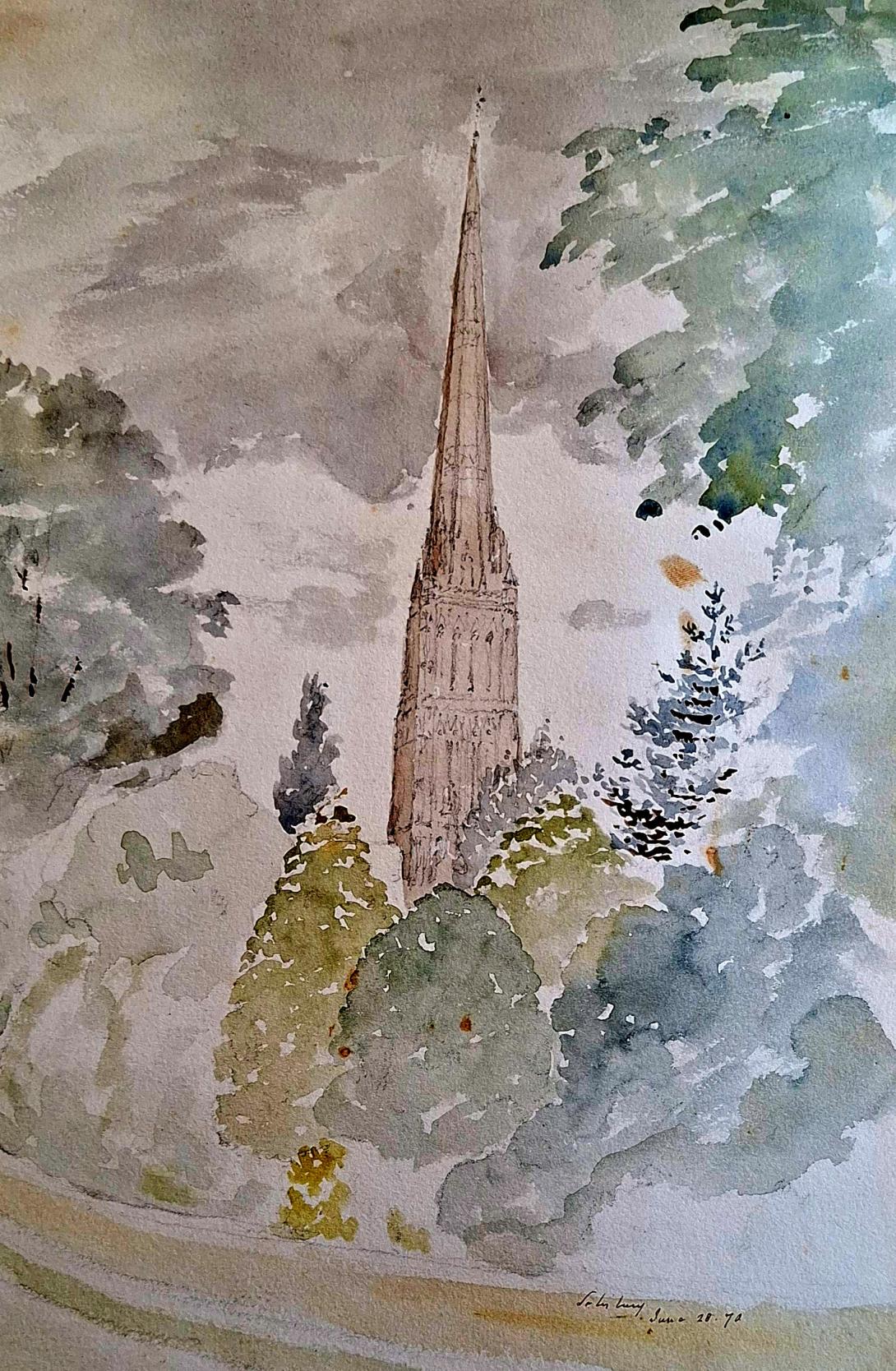
inscribed " Salisbury Cathedral from the Close June 20th 1870"
Salisbury Cathedral, formally the Cathedral Church of the Blessed Virgin Mary, is an Anglican cathedral in the city of Salisbury, England. The cathedral is regarded as one of the leading examples of Early English Gothic design. Built over a relatively short period, some 38 years between 1220 and 1258, it has a unity and coherence that is unusual in medieval English cathedrals. The tower and spire were completed by 1330. The cathedral's spire, at 404 feet (123 m), is the tallest in England.
The original cathedral in the district was located at Old Sarum, about 2 miles (3.2 km) north of the present city. In 1197 bishop Herbert Poore determined on a relocation but this was not taken forward until the episcopate of his brother, Richard Poore in the early 13th century. Foundation stones for the new building were laid on 28 April 1220 by the Earl and Countess of Salisbury. By 1258 the nave, transepts and choir were complete. The only major additions were the cloisters, added 1240, the chapter house in 1263, and the tower and spire, which was constructed by 1330. At its completion it was the third highest in England, but the collapse of those at Lincoln Cathedral and Old St Paul's Cathedral in the 16th century saw Salisbury become England's tallest.
The cathedral close is Britain's largest, and has many buildings of architectural and/or historical significance. Pevsner describes it as "the most beautiful of England's closes".The cathedral contains a clock which is among the oldest working examples in the world. It also holds one of the four surviving original copies of Magna Carta. In 2008, the cathedral celebrated the 750th anniversary of its consecration. In 2023, the completion of a programme of external restoration begun in 1985 saw the removal of scaffolding that had stood around the building for some 37 years.
Although the spire is the cathedral's most impressive feature, it has proved troublesome. Together with the tower, it added 6,397 long tons (6,500 t) to the weight of the building. Without the addition of buttresses, bracing arches and anchor irons over the succeeding centuries, it would have suffered the fate of spires on other great ecclesiastical buildings (such as Malmesbury Abbey, 1180 to 1500; Lincoln Cathedral, 1311 to 1548; Old St Paul's Cathedral, London, 1314 to 1561; and Chichester Cathedral, 1402 to 1861) and fallen down; instead, Salisbury became the tallest church spire in the country on the collapse at St Paul's (as the result of a fire) in 1561. The large supporting pillars at the corners of the spire are seen to bend inwards under the stress. The addition of reinforcing tie-beams above the crossing, designed by Christopher Wren in 1668, halted further deformation. The beams were hidden by a false ceiling installed below the lantern stage of the tower.
The bell chamber is in the middle level of the tower. The bells strike the hour and quarters and are now operated by a Victorian clock, which is not to be confused with the better-known medieval clock that is on display downstairs. Salisbury is one of only three English cathedrals to lack a ring of bells, the others being Norwich Cathedral and Ely Cathedral.
Visitors can access the tower by taking the "Tower Tour", allowing them to climb as high as the base of the spire. From this level, there is a view of the interior of the hollow spire and the ancient wooden scaffolding inside it. There are 332 steps from ground level to the base of the spire, ascending a height of 225 feet (69 m).
Maintenance workers have sometimes climbed the spire, including to service the aircraft warning light and weather station at the summit. The first 144 feet (44 m) of the spire can be climbed by internal ladders. The remaining 39 feet (12 m) requires climbing out of a small door and up the exterior. In 2010, Blue Peter presenter Helen Skelton climbed the spire to assist in the changing of the lights.
Richard Suter (1797–1883).
Richard Suter was born in Greenwich, Kent on 30th March 1798, to William Suter and his wife Sarah Knights. On 7th January 1825 he married Anne Ruth Burn.
English architect. As Surveyor to The Fishmongers' Company he designed the severe Presbyterian churches for Ballykelly (1825–7) and Banagher (1825) on the Company's Estate in County Londonderry, drawings of which were exhibited at the Royal Academy in 1827. He was also responsible for the Model Farm (1823–4), the Lancasterian Schools (1828–30), the Company Agent's House (1830–2—now a hotel, much altered), a range of houses on the south side of the main road (1823–4), the lodge in the Presbyterian churchyard (1828), and the Dispensary (1829), all at Ballykelly, and all Classical. As Surveyor to Trinity House Corporation, he designed houses that were erected by Thomas Cubitt in 1821–3 on a site adjoining Trinity House. For The Fishmongers' Company he designed St Peter's Almshouses, Wandsworth, London (1849–51), and The Old School-House, Gresham's School, Holt, Norfolk(1859), in an Elizabethan style.
On the 1841 Census Richard, an architect and lawyer, can be found living in London with his wife Ann (listed as Ruth) and their two children, Richard George and Andrew Burn. Living with them is Edward D Suter. 1851 finds the family living in Tottenham Court in London, by this time Andrew had left the home, but I am unable to trace him on the 1851 Census. In 1860 Andrew marries Amelia Damaris Harrison. Both Richard George and Andrew were to become ordained ministers, with Andrew later becoming a Bishop and emigrating to New Zealand. Sadly in 1854 Anne Ruth was to pass away. In 1861, widowed Richard, Justice of the Peace for Maidenhead, is living at Castle Hill, Maidenhead, Berkshire. In 1862 he married Elizabeth Anne Pocock. In 1871 and 1881 Richard and Elizabeth are still living in Castle Hill. Richard was to pass away on 1st March1883.
Richard Suter & Annesley Voysey, architects, had their office at number 35 Fenchurch Street, but they did not have it all to themselves as they shared the premises with W.C. Franks, a tea broker, who will get a separate post some other time. The earliest mention I found of Richard Suter in Fenchurch Street is in 1832 when he is listed at that address in a list of contributing members of the Society for the Propagation of the Gospel in Foreign Parts. It says that he had been a member since 1829, but that does not mean he was already at 35 Fenchurch Street in that year.(1) In fact, that seems unlikely as the Sun Fire Office records give Messrs. Short and Co., merchants, as paying the insurance premium on the premises in May 1830. The Directory of British Architects 1834-1914 give the year 1827, but I do not know on what evidence. When Suter and Voysey became partners is also uncertain, but they had known each other since at least 1825 as Suter is named as one of the executors of Voysey’s will which was dated 22 July, 1825. The address given for Suter in the will is Suffolk Street, Southwark. Voysey then lives at Conway Street, Fitzroy Square.