
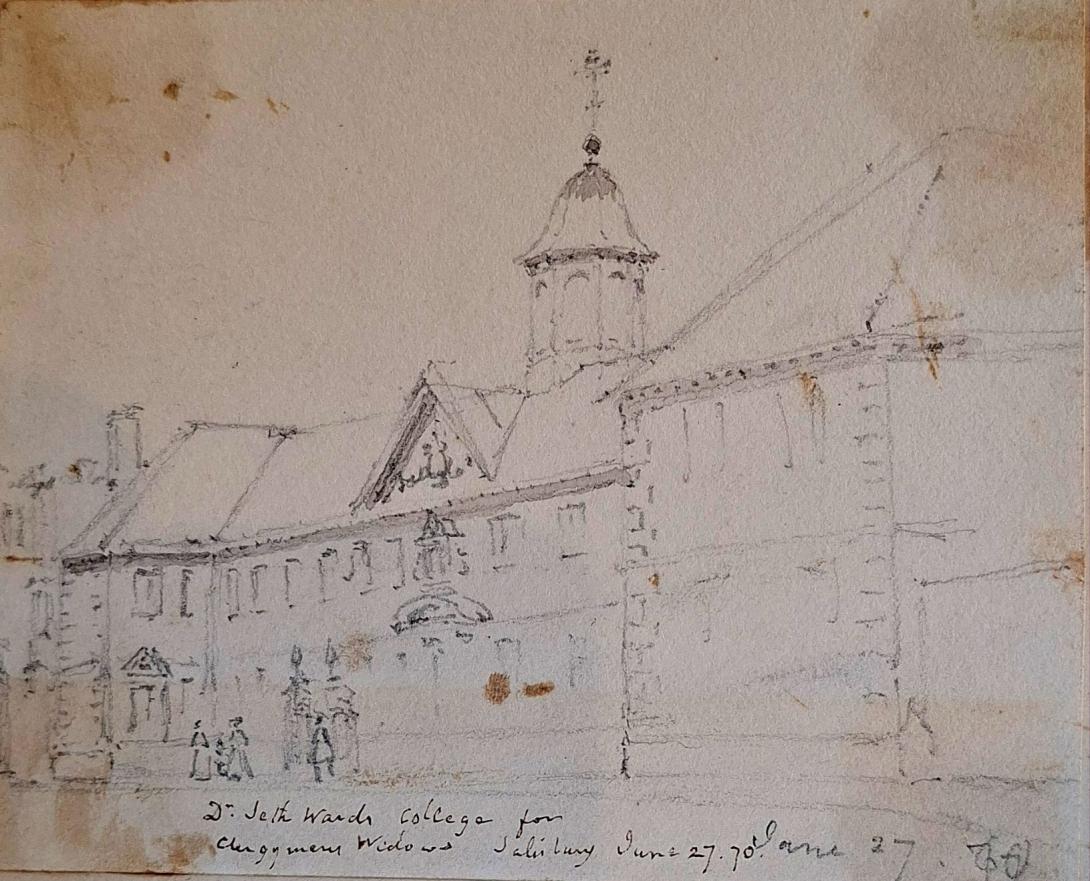
Dr. Seth Ward's College of Matrons Salisbury , June 27 1870
Bishop Seth Ward was born at Buntingford, in the parish of Aspenden, Hertfordshire, in 1617. His early education was at the grammar school there and, still under 16, he was admitted as a sizar of Sidney Sussex College, Cambridge, of which college he was afterwards elected a fellow. Ejected from Cambridge for refusing the Solemn League and Covenant and other oaths, he migrated to Oxford, where in 1649 he became Savillian Professor of Astronomy and, from 1659 to 1660, President of Trinity College. Here he became one of the earliest Fellows of the Royal Society for the Improvement of Natural Knowledge by Experiment.
King Charles II appointed him to the livings of St Lawrence Jewry in London, and Uplowman, Devonshire, in 1661. Dr. Ward also became dean of Exeter Cathedral (1661) and rector of St Breock, Cornwall in 1662. In the latter year he was consecrated Bishop of Exeter, and on 16th September 1667 he was translated to the see of Salisbury. The office of Chancellor of the Order of the Garter was conferred on him in 1671.He died at Knightsbridge on 6 January 1689.
The College was originally founded by Seth Ward, Lord Bishop of Salisbury, by a Foundation Deed dated 13th February 1683. That deed defined the objects of the College and the means whereby they would be achieved and remains in force, save to the extent that it has been subsequently adjusted and varied to take account of social changes.
Almshouses are charitable housing provided to enable people (typically elderly people who can no longer work to earn enough to pay rent) to live in a particular community. They are often targeted at the poor of a locality, at those from certain forms of previous employment, or their widows, and are generally maintained by a charity or the trustees of a bequest. They tend to be characterised by the aim of supporting the continued independence of their residents.
Many almshouses are Christian institutions though some are secular. They trace their history back to monastic times where the terms bedehouse, hospital, maison dieu, almshouse and others described the provision of accommodation for those in need. The first recorded Almshouse was founded by King Athelstan in York in the 10th Century, and the oldest still in existence is thought to be the Hospital of St. Oswald in Worcester that dates from circa 990. By the middle of 1500s, there were about 800 mediaeval hospitals spread across the country but following the dissolution of the monasteries, only a handful remained, and these were re-founded on secular lines, and rebuilt in the new domestic collegiate style. Thus, many almshouses are typified by the traditional three sided square that provide a sense of safety and security without isolating residents from the outside world.
The College of Matrons, a stately 339-year-old building just beyond the gates of the Cathedral Close. Its impressive frontage, topped by a cupola and bearing the Royal coat of arms is much gawped at by tourists tourists and a locals alikee and at any a pointnt of the day there are several taking pictures and wondering what lies beyond its main door. The college is one of 39 almshouses in Wiltshire registered with the Almshousd Imshouse Association offering sheltered accommodation in a variety of buildings - ranging in age from hundreds of years to indreds of years to ju Salisbury alisbury has the largest concentration with 13 in and around the city. Each is run by a charity, some will be responsible for just one or two buildings and a handful of homes, while others oversee a whole range. Most are for older people on their own but some house couples and others offer low cost housing to young families Winifred, an 88-year-old former hospital almoner (latterly known as aa medical socia worker) has lived at the College of Matrons for 18 years after moving from Donhead St Andrew near Shaftesbury when she felt ndrew near Shaftesbu unable to live on her own somewhere so remote. She, like hundreds of others, has found somewhere to live that not only offers ffordable accommodation but a place in a community. Hers is one of six three-storey, two-bedroomed homes alongside a twoedroomed and a one-bedroomed cottage in one building at the college, with a further five one bedroomed flats and two two-bedroomed ats in the converted 16th century town house next doo The 339 year old College of Matrons building.
Hers and her neighbours' world is both secluded and secure. Stepping through that main door leads the the visitor visitor into an entrance hall with a front door on either side. Continuing through takes you into a beautiful garden, resplendent with flower beds, lawns on either side of a central path that are sheltered by trees. I feel very fortunate to live here. it is a beautiful building and it has so much hoitl uildine nd history" says Winifred gazing across the lawn a stunning view of the cathedral spire. "I secure. I don'tt have to worry about the worry about the upkeep or maintenance of a home and there are people close by should they be needed." The college came into being, maybe for not college came into being, maybe for uou entirely philanthropic reasons, in 1682 when then Bishop of Salisbury Seth Ward decided a home and pension was needed for widows of the clergy's diocese. It is said that he had one particular widow in mind when he turned over the site of a former chantry just a short stroll from the cathedral - and granted buildings and farmland to the venture so that it would have an annual income Ten cottages were built and filled with widows from the diocese, which the stretched as far as Exeter. The widows expected to attend services twice daily and considered so delicate they were nev allowed into the city without a chaperone. The matrons received a weekly pension of 6s and to qualify for living there had d to aulife for livine there had to be at les 50 and have an income of less than £10 a year. Over the years the criteria was extended. sibly du possibly shortage о include unmarried daughters of the clergy and, whenever that still didn't produce sufficient occupancy, the area was extended ficient occupancy, the area was exte to neighbouring dioceses so that now eligible folk can hail from Bath and Wells. Winchester, Portsmouth, Exeter and Truro.
In 1869 the building was modernised and two wings added, at the same time reducing the number of homes to eight and after the Second World War changes in church pensions and the introduction of the Welfare State made life better for clergy widows so the residency criteria was altered to "women in need- both financial and emotional". In 1980 the adjacent town house, formerly accommodation for the St Michael's teacher training college that is now Salisbury Museum, was acquired, raising the number of units to 15. Then in 1997, thanks to the sale of a farm, the college built 12 flats at St John's priory in Wilton to ring its homes total to 27. Nick Stiven became steward of the college in 2014 after many years as bursar at Chafyn Grove School in the city. He has seena gradual modernisation of the historic building's plumbing and insulation but believes the real benefit remains its sense of community. "You can expect someone to be here 20 years at least if they started off relatively young, are fit and are capable of looking after themselves," he says. "Almshouses have a reputation for prolonging life - you don't We care about people but we don't care for them really have to worry about money or the building falling apart." Studies commissioned by the Almshouse Association show that people living independently in almshouses are healthier, happier, and live longer. Winifred is ample proof of this, she only stopped driving just before the pandemic and used to volunteer at homeless charity Alabare'. "The age range has dropped in my time here and it affects the dynamic, but I am happy enough with it," she says. "We have a huge diversity of people here - we have a clergywoman and there's a lady who used to run a crocodile farm." Winifred Alford from Donhead St Andrew has lived at the College for the past 18 years, pictured here in its beautiful gardens. Vacancies, says Nick, tend to come in batches - five homes became available when two occupants died and three went into a care home. The process for finding new ones differs only slightly in most almshouses. Would-be residents' learn of vacancies either through the college, the Almshouse Association or housing associations' websites or via the Salisbury Diocese's Grapevine newsletter. There is often a list of people needing accommodation but, stresses Nick, it is not a waiting list as such because homes are not occupied on a first come first served basis, but according to need. Applicants are assessed for eligibility and Nick checks medical records for any conditions that might impact on staff or neighbours. "If they can live independently they can come here. If they need carers, that's fine but if they need carers to stay overnight we can't accommodate them," he says: "We care about people, but we don't care for them." He then interviews each applicant in person to find out more about their reasons for wanting. "A lot of people just want to live in the Cathedral Close," he says. Before making a recommendation to the trustees for a final nod, he has to be sure the prospective occupant will benefit from being there. "We have to make sure that they are the sort of people we can accept and the sort we would want to accept," he says. "Someone who accepts that they are living in a community and that they are going to have to get on with their neighbours." Residents are not tenants, they live at the college under a licence to occupy, similar to the rules of tied housing. They pay a maintenance contribution of £445 a month, in exchange for which they get their accommodation plus heating, electricity, water, an emergency care line, the services of a full-time warden and maintenance of the property and gardens. Each vacant home is completely redecorated before they are re-occupied with kitchens and bathrooms replaced with more modern upgrades when deemed necessary. A refurbishment can cost up top £25,000 because of the building's Grade I listed status. Talking to Winifred there is a sense that for those whose application is accepted, it is like winning life's lottery. She says: "I am very fortunate to live in this home because I have so little to worry about now. I have the garden where I can feed the birds and I am away from the road so it is peaceful. My life is very settled now."
Richard Suter was born in Greenwich, Kent on 30th March 1798, to William Suter and his wife Sarah Knights. On 7th January 1825 he married Anne Ruth Burn.
English architect. As Surveyor to The Fishmongers' Company he designed the severe Presbyterian churches for Ballykelly (1825–7) and Banagher (1825) on the Company's Estate in County Londonderry, drawings of which were exhibited at the Royal Academy in 1827. He was also responsible for the Model Farm (1823–4), the Lancasterian Schools (1828–30), the Company Agent's House (1830–2—now a hotel, much altered), a range of houses on the south side of the main road (1823–4), the lodge in the Presbyterian churchyard (1828), and the Dispensary (1829), all at Ballykelly, and all Classical. As Surveyor to Trinity House Corporation, he designed houses that were erected by Thomas Cubitt in 1821–3 on a site adjoining Trinity House. For The Fishmongers' Company he designed St Peter's Almshouses, Wandsworth, London (1849–51), and The Old School-House, Gresham's School, Holt, Norfolk(1859), in an Elizabethan style.
On the 1841 Census Richard, an architect and lawyer, can be found living in London with his wife Ann (listed as Ruth) and their two children, Richard George and Andrew Burn. Living with them is Edward D Suter. 1851 finds the family living in Tottenham Court in London, by this time Andrew had left the home, but I am unable to trace him on the 1851 Census. In 1860 Andrew marries Amelia Damaris Harrison. Both Richard George and Andrew were to become ordained ministers, with Andrew later becoming a Bishop and emigrating to New Zealand. Sadly in 1854 Anne Ruth was to pass away. In 1861, widowed Richard, Justice of the Peace for Maidenhead, is living at Castle Hill, Maidenhead, Berkshire. In 1862 he married Elizabeth Anne Pocock. In 1871 and 1881 Richard and Elizabeth are still living in Castle Hill. Richard was to pass away on 1st March1883.
Richard Suter & Annesley Voysey, architects, had their office at number 35 Fenchurch Street, but they did not have it all to themselves as they shared the premises with W.C. Franks, a tea broker, who will get a separate post some other time. The earliest mention I found of Richard Suter in Fenchurch Street is in 1832 when he is listed at that address in a list of contributing members of the Society for the Propagation of the Gospel in Foreign Parts. It says that he had been a member since 1829, but that does not mean he was already at 35 Fenchurch Street in that year.(1) In fact, that seems unlikely as the Sun Fire Office records give Messrs. Short and Co., merchants, as paying the insurance premium on the premises in May 1830. The Directory of British Architects 1834-1914 give the year 1827, but I do not know on what evidence. When Suter and Voysey became partners is also uncertain, but they had known each other since at least 1825 as Suter is named as one of the executors of Voysey’s will which was dated 22 July, 1825. The address given for Suter in the will is Suffolk Street, Southwark. Voysey then lives at Conway Street, Fitzroy Square.