
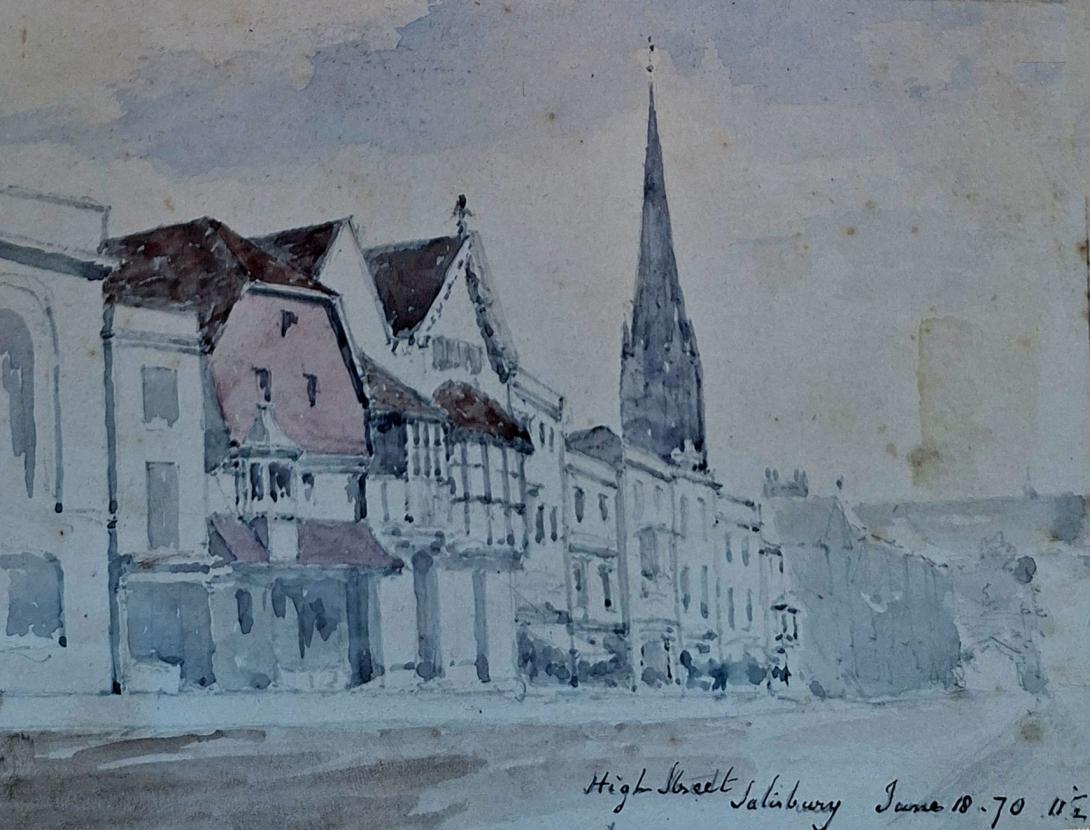
High Street Salisbury June 18th 1870
This parish developed quickly after the foundation of New Salisbury, for its position on level ground on the direct route from the cathedral to Old Salisbury made it better suited for a market place and town centre than the higher land near St. Martin's church. The parish as defined in 1269 included in the north the houses on the west side of Castle Street as far as the line of Scots Lane. The boundary then ran diagonally across the Market Place from Blue Boar Corner to the corner of the modern Queen Street and Milford Street, along part of the latter, down part of Brown Street and back along St. Ann Street to the Close wall. On the south and west it was bounded by the Close and the Avon. (fn. 1)
The two main parallel routes crossing this parish and that of St. Edmund from south to north were at first known as Minster Street and High Street. The former followed the most direct way from the cathedral to Old Salisbury and included the whole of the present High Street, Minster Street, and Castle Street. The High Street included the way along Drakehall Street (said in 1396 to be part of the High Street), (fn. 2) the present St. John's Street, Catherine Street, Queen Street, and Endless Street (said in 1348 to be part of the High Street). (fn. 3) It appears that the High Street was intended to be the chief thoroughfare through the city in the 13th century, especially after the building of the bridge to Harnham at its south end. (fn. 4) The fact that parts of it acquired other names in the 14th century, while the description High Street was transferred to the present street of that name, suggests a shifting of the city centre westward toward the direct line between St. Thomas's church and the cathedral. The changes in the nomenclature of both these main routes were well established by the 15th century. (fn. 5)
The present High Street, leading from the North Gate of the Close to the churchyard of St. Thomas, was laid out when the cathedral was built, and still has 14th- and 15th-century work in many of its houses, although many have been much altered since the 18th century, especially by the addition of shop fronts. The corner of High Street and New Street is called Mitre Corner and is traditionally said to be the site of a house built by Bishop Poore as a temporary residence while the cathedral was being built. In later centuries the house was part of an inn called successively 'The Lamb' (1455), 'The Holy Lamb' (1620) and 'The Sun and Lamb' (1649, 1742). (fn. 6) The custom of the bishop robing here for his enthronement and then being conducted to the cathedral by the dean and chapter was established by 1451, and is still maintained. (fn. 7) The present building on the site (no. 37) is a tall gable-ended house with overhanging second floor, much altered in the 18th century. The Old George Hotel in the present High Street was the most important of the city's medieval inns; the present half-timbered building includes parts which date from the 14th century. In that century it belonged to the family of Teynturer, of whom William the elder and William the younger both held the office of mayor. The name of the inn may have been connected with the activities of the guild of St. George, to which William Teynturer the younger left property in 1376. (fn. 8) After the deaths of his widow and her second husband the inn was purchased by the mayor and commonalty in 1414. It was then called 'Georges Ynne' and comprised laundry houses, chambers, solars, cellars, and shops. Later in the century its thirteen guest chambers each had a distinguishing name. (fn. 9) Samuel Pepys stayed there for two nights in 1668. (fn. 10) Its size caused it to be used also for other purposes: from about 1590 to 1624 the Free School was held in a room here; on the removal of the school the commonalty ordered that all players, who had resorted to various inns, were to confine their plays to the George Inn, 'the size and form of the inner courtyard being well adapted for that purpose'. (fn. 11) The importance of this short street is shown by the number of other medieval inns built here. On the site of Woolworth's store stood buildings which in the first years of the city belonged to William Pinnock and his son Richard, who represented Salisbury in the Parliament of 1295. From the 14th century the property was known as Pinnock's Inn, and later, after it had been given to the commonalty, 'The Helm'. In 1491 the commonalty had it demolished and built four shops with dwelling houses in its place. (fn. 12) To the north of this stood 'Countewelle's Inn', at one time owned by Geoffrey of Warminster, mayor in 1335. (fn. 13) To its south, on the site of the present nos. 42–44, was an inn called Tarent's, which had changed its name to 'The Angel' by 1455. It was still so called in the 18th century, and in 1751 was the inn from which the Bath coaches started. In 1761 the landlord went bankrupt, and the building was let for use as a dwelling-house and timberyard. (fn. 14) The Crown Hotel (nos. 46–48) stands on the site of a 15th-century inn called 'The Rose', which became the Rose and Crown in the 17th century. (fn. 15)
Richard Suter was born in Greenwich, Kent on 30th March 1798, to William Suter and his wife Sarah Knights. On 7th January 1825 he married Anne Ruth Burn.
English architect. As Surveyor to The Fishmongers' Company he designed the severe Presbyterian churches for Ballykelly (1825–7) and Banagher (1825) on the Company's Estate in County Londonderry, drawings of which were exhibited at the Royal Academy in 1827. He was also responsible for the Model Farm (1823–4), the Lancasterian Schools (1828–30), the Company Agent's House (1830–2—now a hotel, much altered), a range of houses on the south side of the main road (1823–4), the lodge in the Presbyterian churchyard (1828), and the Dispensary (1829), all at Ballykelly, and all Classical. As Surveyor to Trinity House Corporation, he designed houses that were erected by Thomas Cubitt in 1821–3 on a site adjoining Trinity House. For The Fishmongers' Company he designed St Peter's Almshouses, Wandsworth, London (1849–51), and The Old School-House, Gresham's School, Holt, Norfolk(1859), in an Elizabethan style.
On the 1841 Census Richard, an architect and lawyer, can be found living in London with his wife Ann (listed as Ruth) and their two children, Richard George and Andrew Burn. Living with them is Edward D Suter. 1851 finds the family living in Tottenham Court in London, by this time Andrew had left the home, but I am unable to trace him on the 1851 Census. In 1860 Andrew marries Amelia Damaris Harrison. Both Richard George and Andrew were to become ordained ministers, with Andrew later becoming a Bishop and emigrating to New Zealand. Sadly in 1854 Anne Ruth was to pass away. In 1861, widowed Richard, Justice of the Peace for Maidenhead, is living at Castle Hill, Maidenhead, Berkshire. In 1862 he married Elizabeth Anne Pocock. In 1871 and 1881 Richard and Elizabeth are still living in Castle Hill. Richard was to pass away on 1st March1883.
Richard Suter & Annesley Voysey, architects, had their office at number 35 Fenchurch Street, but they did not have it all to themselves as they shared the premises with W.C. Franks, a tea broker, who will get a separate post some other time. The earliest mention I found of Richard Suter in Fenchurch Street is in 1832 when he is listed at that address in a list of contributing members of the Society for the Propagation of the Gospel in Foreign Parts. It says that he had been a member since 1829, but that does not mean he was already at 35 Fenchurch Street in that year.(1) In fact, that seems unlikely as the Sun Fire Office records give Messrs. Short and Co., merchants, as paying the insurance premium on the premises in May 1830. The Directory of British Architects 1834-1914 give the year 1827, but I do not know on what evidence. When Suter and Voysey became partners is also uncertain, but they had known each other since at least 1825 as Suter is named as one of the executors of Voysey’s will which was dated 22 July, 1825. The address given for Suter in the will is Suffolk Street, Southwark. Voysey then lives at Conway Street, Fitzroy Square.