

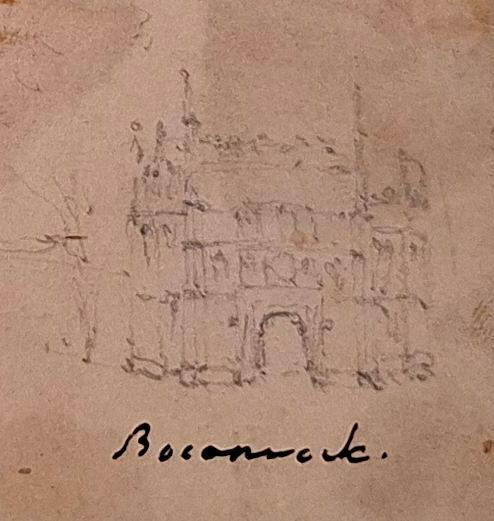
Boconnoc House Cornwall
Boconnoc Estate and Manor were taxed in the Domesday Roll in 1086. After the De Cancias, Carminows and Courtenays, Sir William Mohun bought the property in 1579 from Francis Russell, the 2nd Earl of Bedford, who had been granted Boconnoc as part of the Earldom of Bedford as reward for helping to crush the Prayer Book Rebellion of 1550.
Sir William rebuilt the house which had formerly been a medieval tower known as the ‘Tower of Boconnoc’ dating from the 13th Century. He passed it to his son, Sir Reginald Mohun, who was made a Baronet in 1612. In 1644, the Earl of Essex for Parliament, marched into Cornwall followed by the armies of Charles I and his nephew, Prince Maurice. The King made his headquarters at Boconnoc. The Royalists defeated the Parliamentarians in Cornwall, but after the final victory of Cromwell and the Parliamentarians and the execution of the King, Warwick Mohun had to pay over £2,000 to retain Boconnoc. It remained in the family until Charles, 4th Baron Mohun was killed in a duel with the Duke of Hamilton in 1712.
Baron Mohun’s Estate passed to his second wife, who in 1717 sold it to Thomas Pitt, late Governor of Madras, for £54,000. He raised the purchase money from the Pitt Diamond bought in India in 1701 – which he sold to the Regent of France for the sum of £135,000 to be set in the crown of Louis XV for his coronation. It was subsequently set in the hilt of Napoleon’s sword, which is now on view in the Louvre in Paris. Thomas Pitt remodelled the main East side of the house and the gallery wing, facing south, was built by his great grandson, Thomas, in 1771.
The House and Stable Yard were improved by Sir John Soane, a unique architect who developed artistic techniques for his clients who often had fascinating houses to be restored and improved but little money. He worked at Boconnoc from 1786 with Thomas Pitt, 1st Lord Camelford, nephew of Lord Chatham and cousin of Pitt the Younger.
In 1804 the heir, Thomas Pitt, was killed in a duel with Captain Best. The Estate passed to his sister, Anne Pitt, who married William Wyndham, Lord Grenville, later the Prime Minister who was famous for abolishing the slave trade. In 1864 on Lady Grenville’s death the Estate was bequeathed to George Matthew Fortescue, younger son of Lord Grenville’s sister, Hester, who married the first Earl Fortescue of Castle Hill, Devon. It has remained in the Fortescue family ever since.
The superb parkland was first laid out by Thomas Pitt 1st Lord Camelford from 1760 and has been steadily improved by the Grenville and Fortescue families. The magnificent woodland garden contains rhododendrons, azaleas, camellias and a collection of magnolias.
Luminaries, royals, and other famous personalities have all found their way to Boconnoc: from King Charles I, who is said to have spent the night in what is now the King’s Bedroom, to Thomas “Diamond” Pitt, the former Governor of Madras, the ‘Great Commoner’ William Pitt, Lord Chatham. The Prince of Orange, the poet Thomas Gray and Sir Josiah Wedgwood.
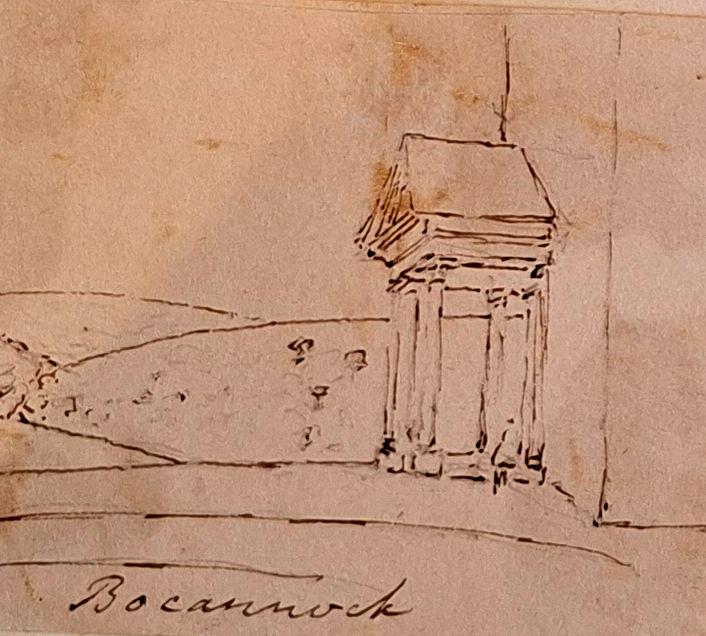
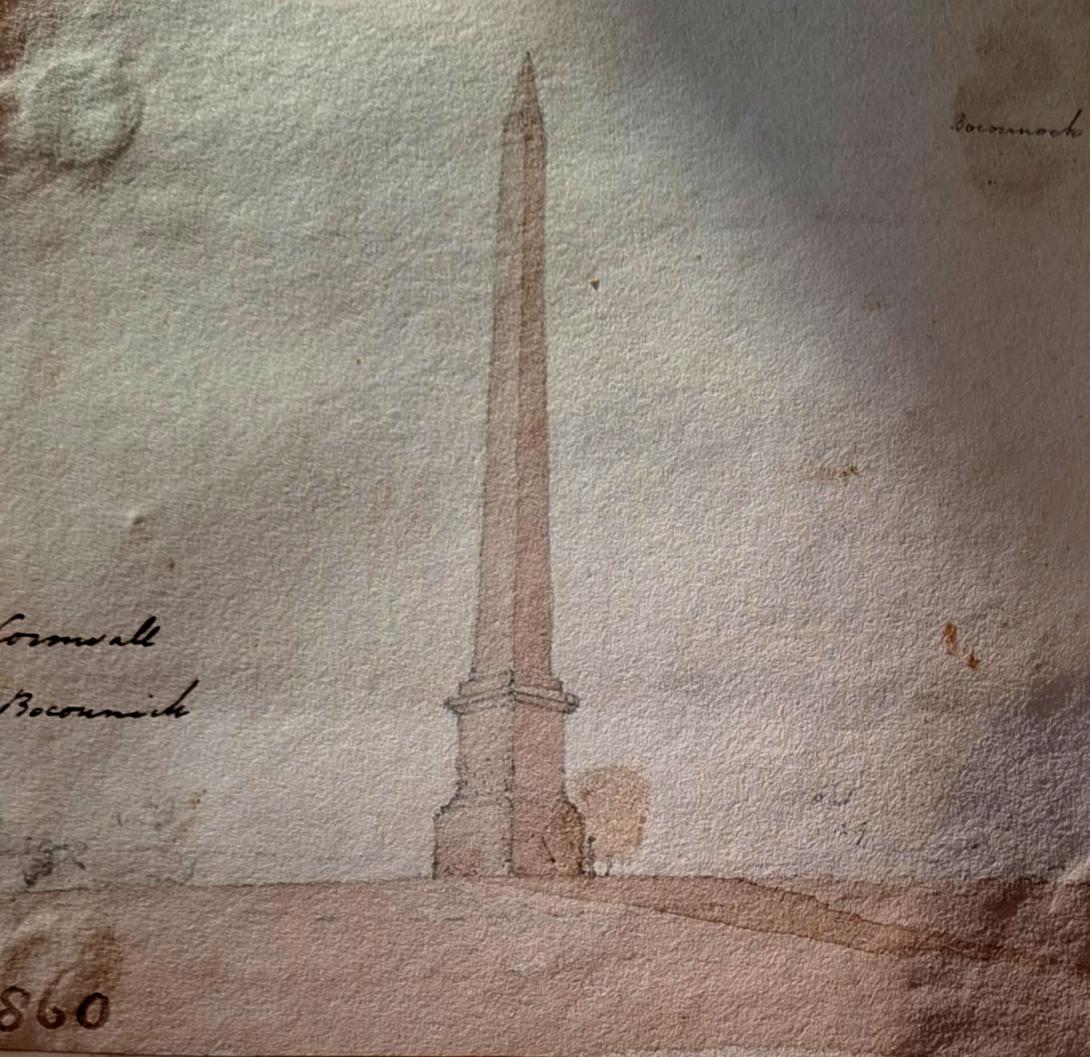
Among the most impressive monuments in the grounds is the obelisk, which soars 123 feet into the sky. Raised in 1771, it was dedicated by Lord Camelford to his benefactor, Sir Richard Lyttelton. Obelisk and 2 piers to north-east. Obelisk, 1771, for Thomas Pitt, 1st Lord of Camelford. Inscription 'In gratitude and affection to the memory of Sir Richard Lyttleton and to perpetuate that peculiar character of benevolence which rendered him the delight of his own age and worthy the veneration of posterity MDCCLXXI' Ashlar granite blocks with inscribed slate tablets on the north-east face. 123 feet in height. Tall square plinth with cyma reversa and ovolo moulded tall base. Obelisk, square in plan and slightly tapered. Surmounted by pyramidal cap. Stands on grassed square battery. 70 years to north-east are 2 classical shrines which frame the vista when the obelisk is approached along the mile long straight drive from the north-east. Circa 1771 or slightly later. Rusticated ashlar granite and pedimented. Comprising 2 rectangular piers each decorated on north-east and south-west faces with blind round arches with Gibbs surrounds below pediments with recessed tympanii.
Richard Suter was born in Greenwich, Kent on 30th March 1798, to William Suter and his wife Sarah Knights. On 7th January 1825 he married Anne Ruth Burn.
English architect. As Surveyor to The Fishmongers' Company he designed the severe Presbyterian churches for Ballykelly (1825–7) and Banagher (1825) on the Company's Estate in County Londonderry, drawings of which were exhibited at the Royal Academy in 1827. He was also responsible for the Model Farm (1823–4), the Lancasterian Schools (1828–30), the Company Agent's House (1830–2—now a hotel, much altered), a range of houses on the south side of the main road (1823–4), the lodge in the Presbyterian churchyard (1828), and the Dispensary (1829), all at Ballykelly, and all Classical. As Surveyor to Trinity House Corporation, he designed houses that were erected by Thomas Cubitt in 1821–3 on a site adjoining Trinity House. For The Fishmongers' Company he designed St Peter's Almshouses, Wandsworth, London (1849–51), and The Old School-House, Gresham's School, Holt, Norfolk(1859), in an Elizabethan style.
On the 1841 Census Richard, an architect and lawyer, can be found living in London with his wife Ann (listed as Ruth) and their two children, Richard George and Andrew Burn. Living with them is Edward D Suter. 1851 finds the family living in Tottenham Court in London, by this time Andrew had left the home, but I am unable to trace him on the 1851 Census. In 1860 Andrew marries Amelia Damaris Harrison. Both Richard George and Andrew were to become ordained ministers, with Andrew later becoming a Bishop and emigrating to New Zealand. Sadly in 1854 Anne Ruth was to pass away. In 1861, widowed Richard, Justice of the Peace for Maidenhead, is living at Castle Hill, Maidenhead, Berkshire. In 1862 he married Elizabeth Anne Pocock. In 1871 and 1881 Richard and Elizabeth are still living in Castle Hill. Richard was to pass away on 1st March1883.
Richard Suter & Annesley Voysey, architects, had their office at number 35 Fenchurch Street, but they did not have it all to themselves as they shared the premises with W.C. Franks, a tea broker, who will get a separate post some other time. The earliest mention I found of Richard Suter in Fenchurch Street is in 1832 when he is listed at that address in a list of contributing members of the Society for the Propagation of the Gospel in Foreign Parts. It says that he had been a member since 1829, but that does not mean he was already at 35 Fenchurch Street in that year.(1) In fact, that seems unlikely as the Sun Fire Office records give Messrs. Short and Co., merchants, as paying the insurance premium on the premises in May 1830. The Directory of British Architects 1834-1914 give the year 1827, but I do not know on what evidence. When Suter and Voysey became partners is also uncertain, but they had known each other since at least 1825 as Suter is named as one of the executors of Voysey’s will which was dated 22 July, 1825. The address given for Suter in the will is Suffolk Street, Southwark. Voysey then lives at Conway Street, Fitzroy Square.