
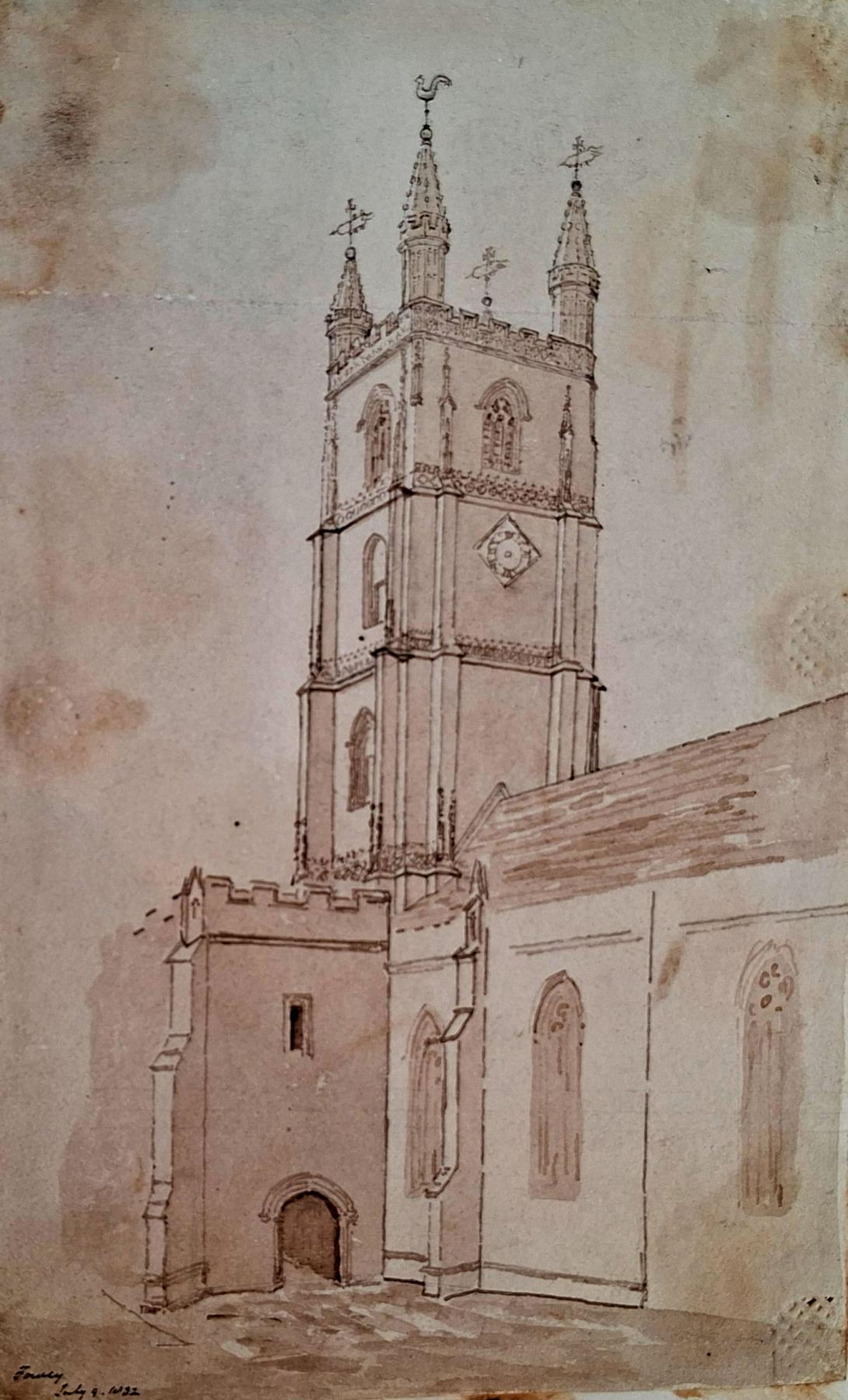
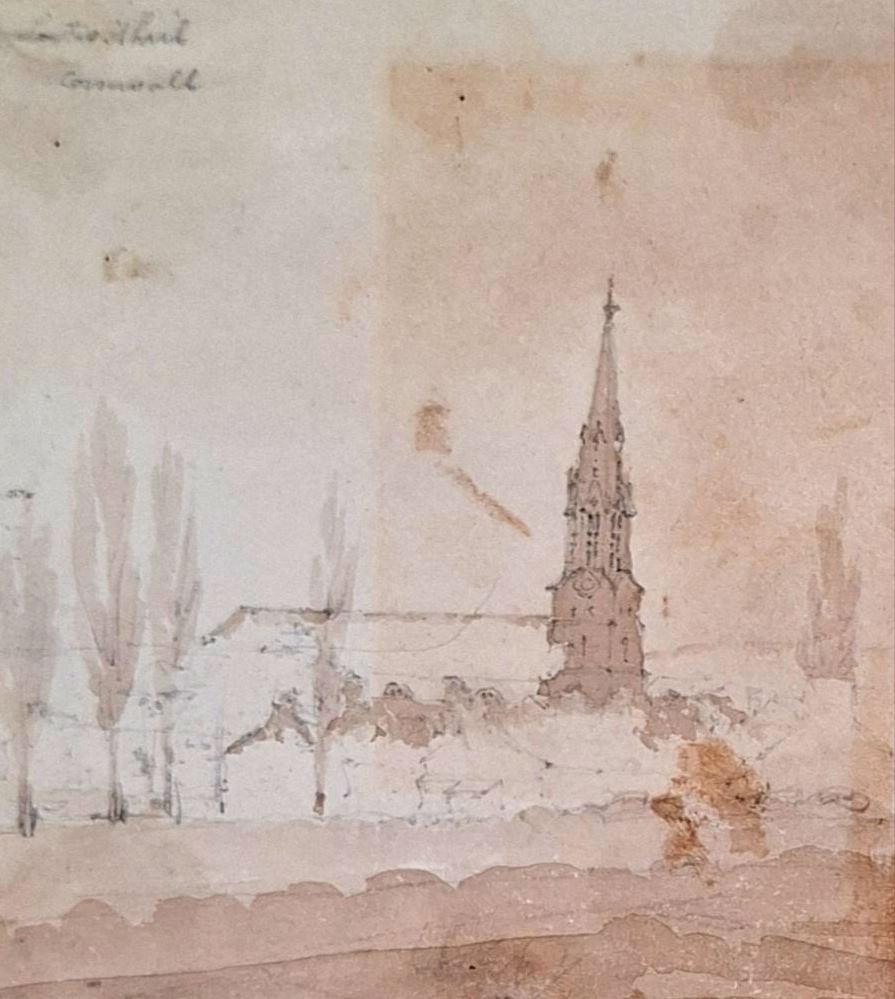
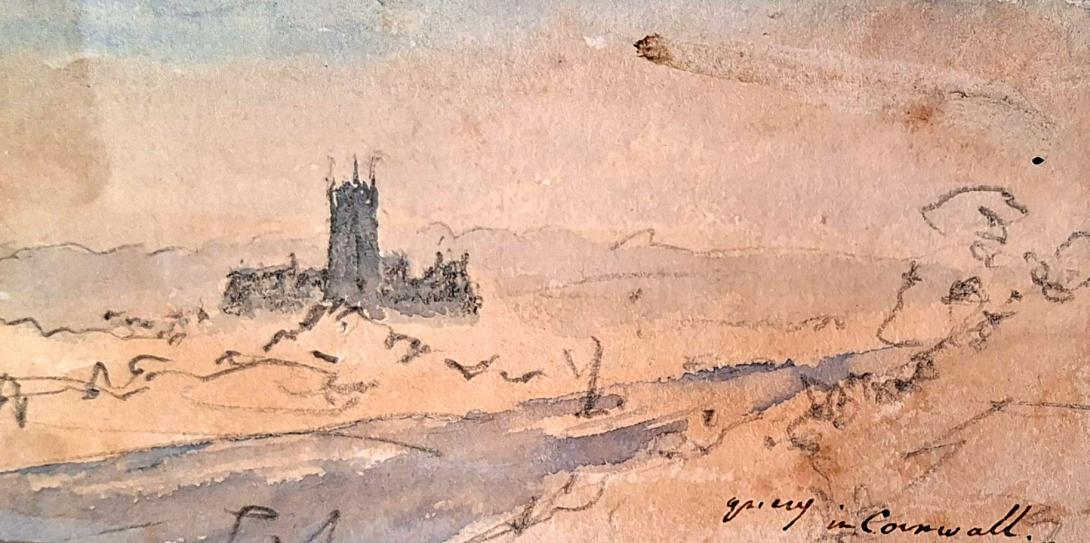
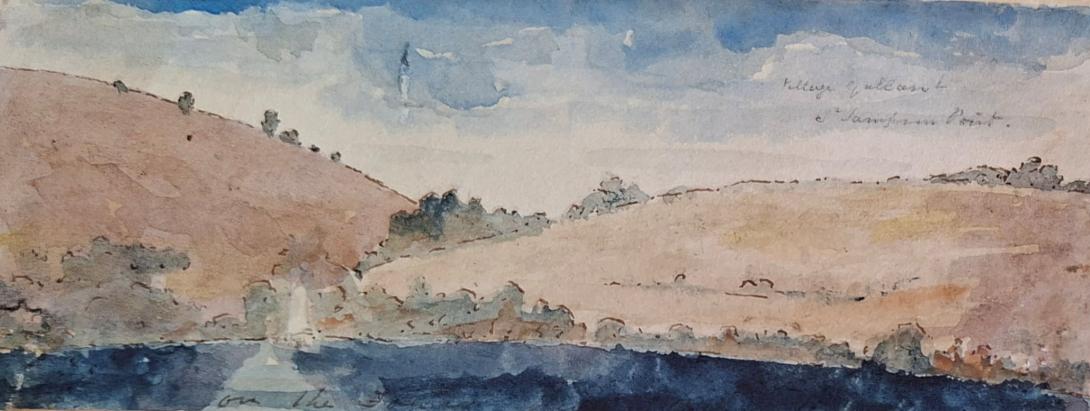
" Fowey July 9 1832 " and Between lostwithiel and Fowey & Near Fowey" (4)
The Church of St Fimbarrus is an Anglican parish church in Fowey, Cornwall, England. Also known as Fowey Parish Church, it is in the Church of England's Diocese of Truro. The church is a grade I listed building and dates from the 14th century.
The church is dedicated to Saint Finbarr and is listed Grade I. It was built in the early 14th century and rededicated in 1336, replacing a previous Norman church. The church was damaged by the French in 1457, and repaired in 1460 by the Earl of Warwick, when the clerestory and the north and south aisles were rebuilt. There is a nave and two aisles with a clerestory, and the aisles are unusually wide; the aisles and the clerestory may be additions of the 15th century. The tower, of the 16th century, is of four stages and has buttresses and bands of ornament. There is an exceptionally fine 15th-century carved wagon roof. The south porch has open arches to the west and east and an eight-ribbed vaulted roof. The font is Norman, of Catacleuze stone, and similar to those of Ladock, Feock and St Mewan. The hexagonal pulpit was made in 1601. The monuments include two brasses of the mid 15th century and those of John Rashleigh, 1582, and Alice Rashleigh, 1602. The most interesting are two later Rashleigh monuments: John Rashleigh, c. 1610, and another of 1683.The church was used as a town hall for a period up to 1684.
In 1899, Kenneth Grahame, author of The Wind in the Willows, married Elspeth Thompson at the church. Sir Arthur Quiller-Couch (1863–1944) is buried in the churchyard.
St Bartholomew's Church is a parish church of the Church of England Diocese of Truro in Lostwithiel, Cornwall, England, United Kingdom.
The earliest part of the church is the tower which dates from the 13th century. The spire was added in the early 14th century, and the rest of the church dates from the later 14th century.
The spire has an octagonal screen around its foot, with former windows on four of its eight sides. Built of Pentewan stone, is the outstanding feature of this sizable town church.The north side has a St Catherine's Wheel. Unusually for a Cornish church there is a clerestory above the nave. There are some fine monuments of Georgian period and a brass of 1423. The east window of five lights is one of the most notable in Cornwall, of the same date as the spire. The early fourteenth century font is outstanding, with carved figures of a huntsman and hawk, a head with leaves sprouting from its mouth, an evil face, a wolf and hounds, and lions.
The church was restored in 1878 and 1879 by a Lostwithiel firm of builders, Messrs Phelp and Brown. The architect for the work was Mr Clark of London. The exterior of the building was renovated, plaster ceiling removed and the interior was stripped of ″pew monstrosities″. An open-timbered roof of pitch pine was erected along with new floors and the new carvings was carried out by Harry Hems of Ecclesiastical Art Works, Exeter. The restoration cost £1,200 (equivalent to £154,100 in 2023), and the church was reopened on 29 May 1879 with a service by Archdeacon Hobhouse.
Richard Suter was born in Greenwich, Kent on 30th March 1798, to William Suter and his wife Sarah Knights. On 7th January 1825 he married Anne Ruth Burn.
English architect. As Surveyor to The Fishmongers' Company he designed the severe Presbyterian churches for Ballykelly (1825–7) and Banagher (1825) on the Company's Estate in County Londonderry, drawings of which were exhibited at the Royal Academy in 1827. He was also responsible for the Model Farm (1823–4), the Lancasterian Schools (1828–30), the Company Agent's House (1830–2—now a hotel, much altered), a range of houses on the south side of the main road (1823–4), the lodge in the Presbyterian churchyard (1828), and the Dispensary (1829), all at Ballykelly, and all Classical. As Surveyor to Trinity House Corporation, he designed houses that were erected by Thomas Cubitt in 1821–3 on a site adjoining Trinity House. For The Fishmongers' Company he designed St Peter's Almshouses, Wandsworth, London (1849–51), and The Old School-House, Gresham's School, Holt, Norfolk(1859), in an Elizabethan style.
On the 1841 Census Richard, an architect and lawyer, can be found living in London with his wife Ann (listed as Ruth) and their two children, Richard George and Andrew Burn. Living with them is Edward D Suter. 1851 finds the family living in Tottenham Court in London, by this time Andrew had left the home, but I am unable to trace him on the 1851 Census. In 1860 Andrew marries Amelia Damaris Harrison. Both Richard George and Andrew were to become ordained ministers, with Andrew later becoming a Bishop and emigrating to New Zealand. Sadly in 1854 Anne Ruth was to pass away. In 1861, widowed Richard, Justice of the Peace for Maidenhead, is living at Castle Hill, Maidenhead, Berkshire. In 1862 he married Elizabeth Anne Pocock. In 1871 and 1881 Richard and Elizabeth are still living in Castle Hill. Richard was to pass away on 1st March1883.
Richard Suter & Annesley Voysey, architects, had their office at number 35 Fenchurch Street, but they did not have it all to themselves as they shared the premises with W.C. Franks, a tea broker, who will get a separate post some other time. The earliest mention I found of Richard Suter in Fenchurch Street is in 1832 when he is listed at that address in a list of contributing members of the Society for the Propagation of the Gospel in Foreign Parts. It says that he had been a member since 1829, but that does not mean he was already at 35 Fenchurch Street in that year.(1) In fact, that seems unlikely as the Sun Fire Office records give Messrs. Short and Co., merchants, as paying the insurance premium on the premises in May 1830. The Directory of British Architects 1834-1914 give the year 1827, but I do not know on what evidence. When Suter and Voysey became partners is also uncertain, but they had known each other since at least 1825 as Suter is named as one of the executors of Voysey’s will which was dated 22 July, 1825. The address given for Suter in the will is Suffolk Street, Southwark. Voysey then lives at Conway Street, Fitzroy Square.