
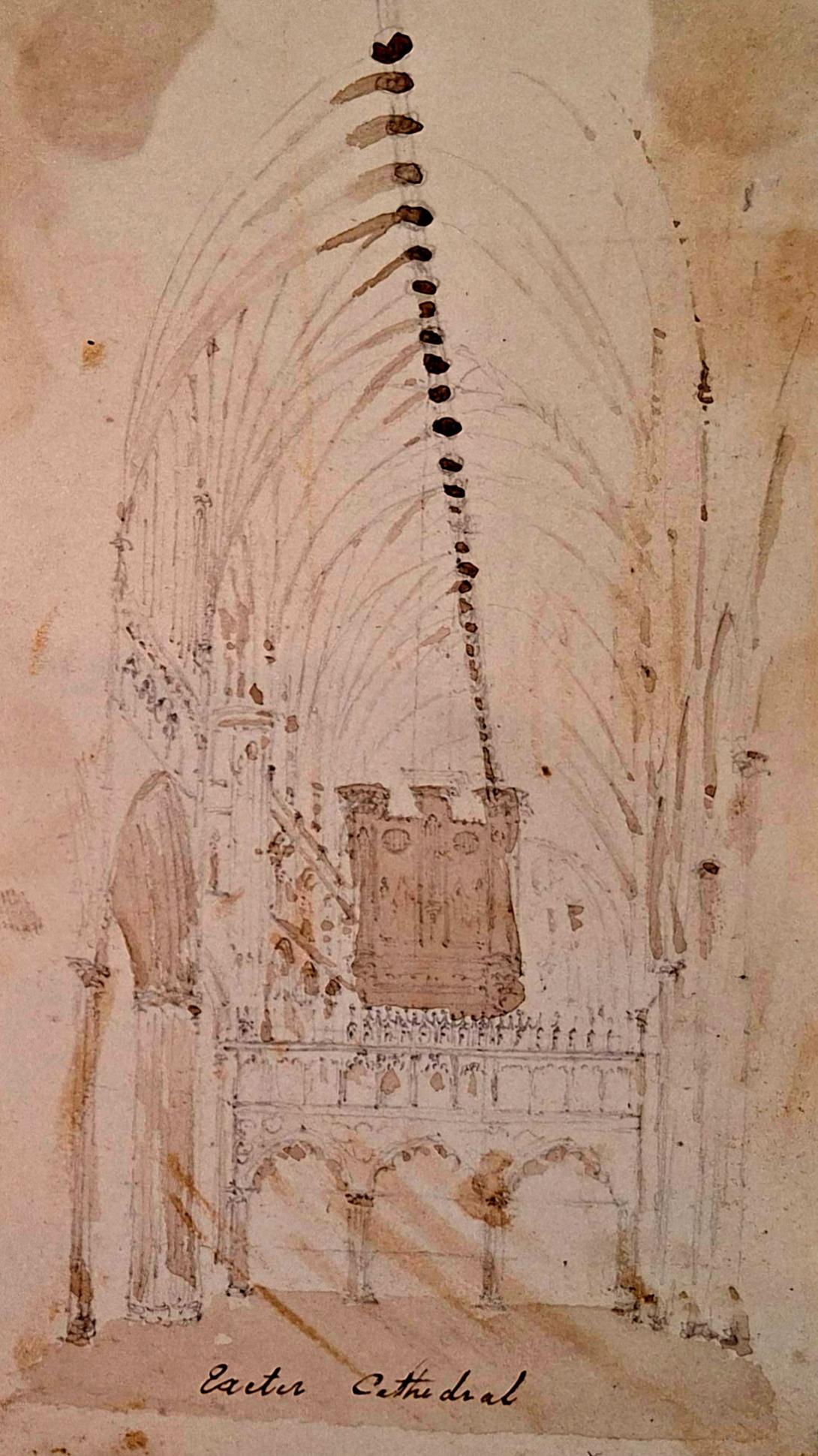
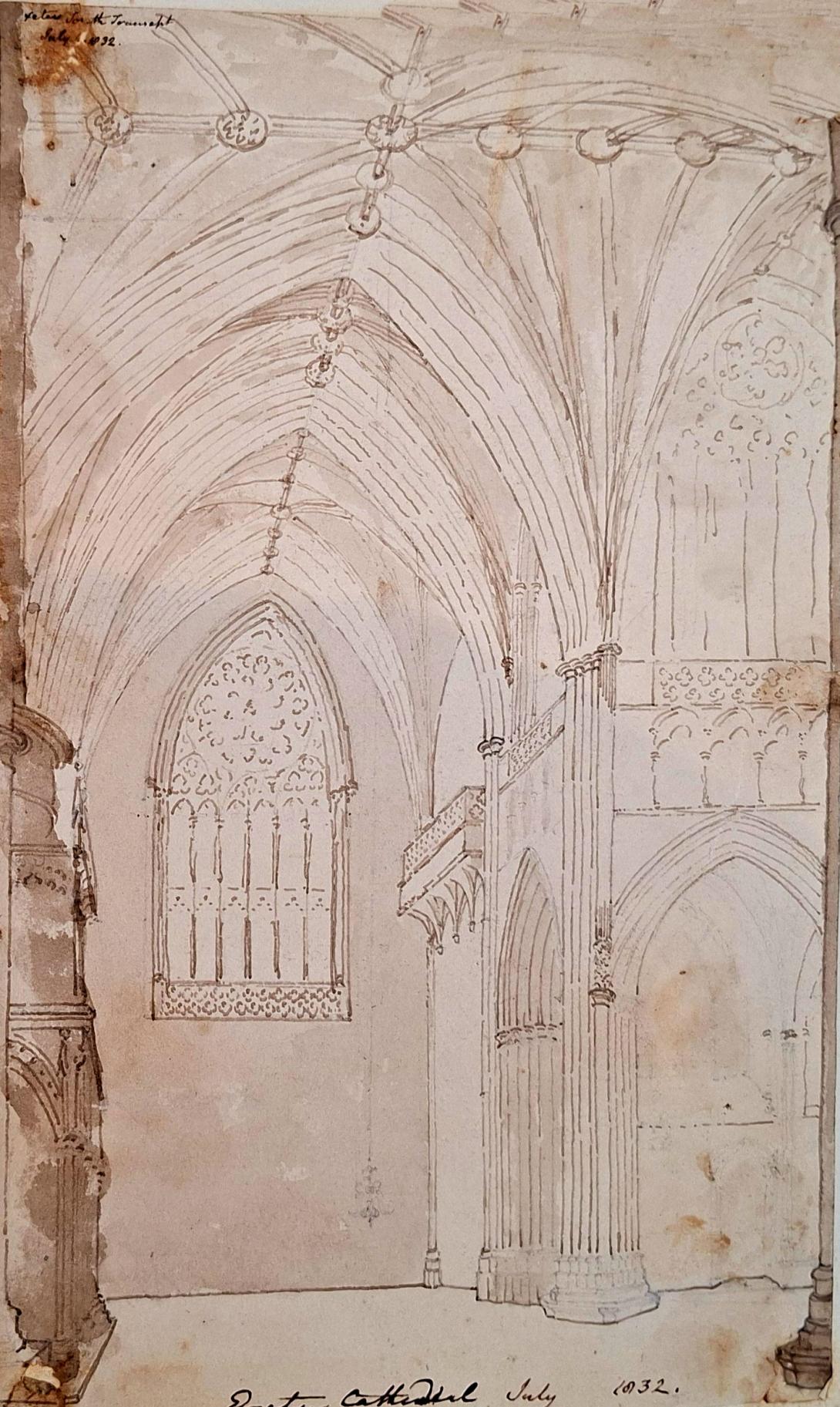
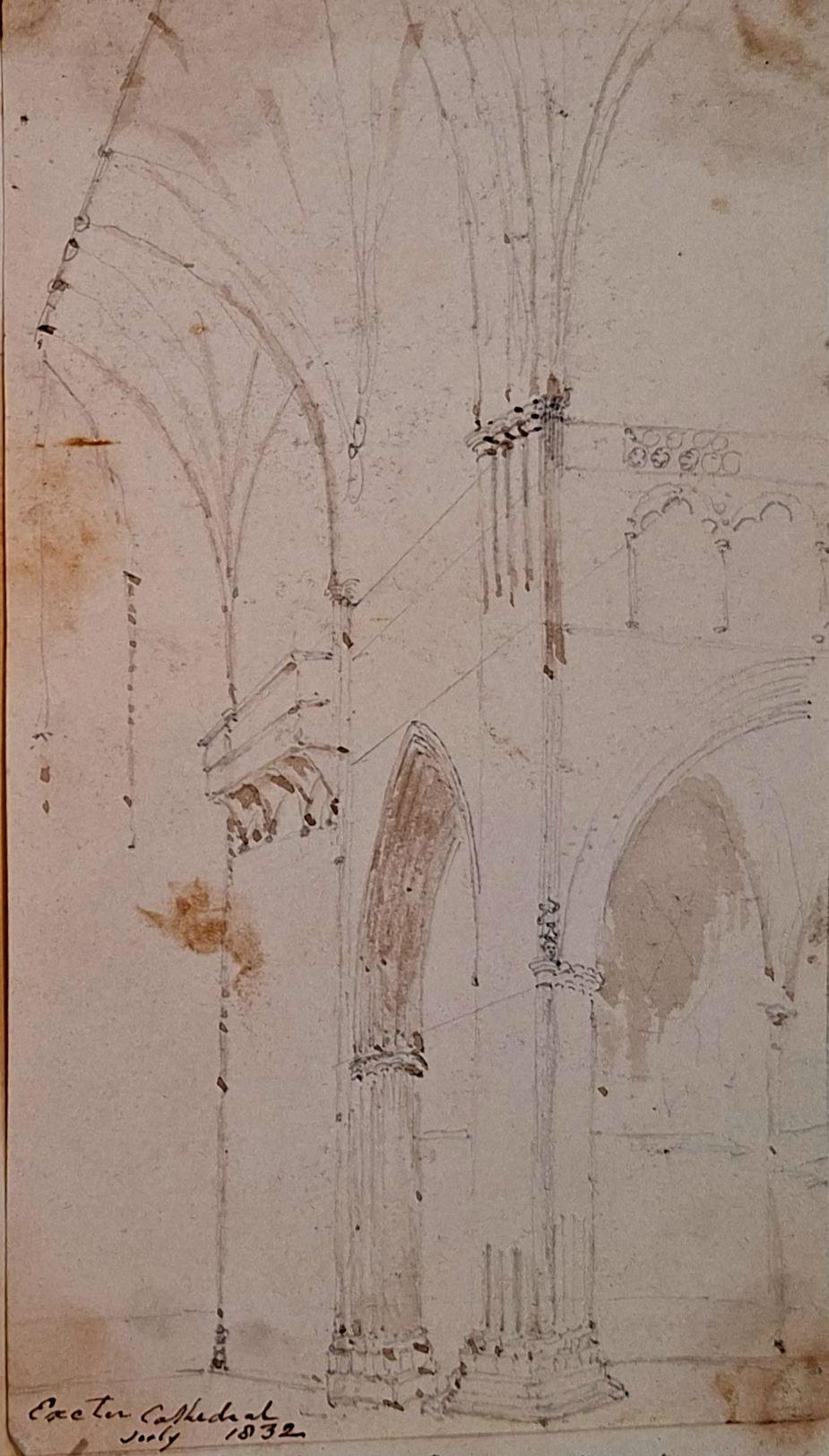
varioulsy inscribed and dated " Exeter Cathedral July 1832" Exeter South Transept July 1832
Exeter Cathedral, properly known as the Cathedral Church of Saint Peter in Exeter, is an Anglican cathedral, and the seat of the Bishop of Exeter, in the city of Exeter, Devon, in South West England. The present building was complete by about 1400 and has several notable features, including an early set of misericords, an astronomical clock and the longest uninterrupted medieval stone vaulted ceiling in the world.
History


The site where Exeter Cathedral was constructed was home to Roman buildings. A legionary fortress was constructed between 50–75 AD. A Roman bathhouse was discovered in 1971.
The founding of the cathedral at Exeter, dedicated to Saint Peter, dates from 1050, when the seat of the bishop of Devon and Cornwall was transferred from Crediton because of a fear of sea-raids. A Saxon minster already existing within the town (and dedicated to Saint Mary and Saint Peter) was used by Leofric as his seat.
In 1107 William Warelwast was appointed to the see, and this was the catalyst for the building of a new cathedral in the Norman style. Its official foundation was in 1133, during Warelwast's time, but it took many more years to complete.[4] Following the appointment of Walter Bronescombe as bishop in 1258, the building was already recognised as outmoded, and it was rebuilt in the Decorated Gothic style, following the example of Salisbury. However, much of the Norman building was kept, including the two massive square towers and part of the walls. It was constructed entirely of local stone, including Purbeck Marble. The new cathedral was complete by about 1400, apart from the addition of the chapter house and chantry chapels.
Like most English cathedrals, Exeter suffered during the Dissolution of the Monasteries, but not as much as it would have done had it been a monastic foundation. Further damage was done during the Civil War, when the cloisters were destroyed. Following the restoration of Charles II, a new pipe organ was built in the cathedral by John Loosemore. Charles II's sister Henrietta Anne of England was baptised here in 1644. In 1650 an independent church was meeting in the cathedral and this small church caused upset when the minister "excommunicated" Susanna Parr.
During the Victorian era, some refurbishment was carried out by George Gilbert Scott. As a boy, the composer Matthew Locke was trained in the choir of Exeter Cathedral, under Edward Gibbons, the brother of Orlando Gibbons. His name can be found scribed into the stone organ screen.

During the Second World War, Exeter was one of the targets of a German air offensive against British cities of cultural and historical importance, which became known as the "Baedeker Blitz". On 4 May 1942 an early-morning air raid took place over Exeter. The cathedral sustained a direct hit by a large high-explosive bomb on the chapel of St James, completely demolishing it. The muniment room above, three bays of the aisle and two flying buttresses were also destroyed in the blast. The medieval wooden screen opposite the chapel was smashed into many pieces by the blast, but it has been reconstructed and restored.[6] Many of the cathedral's most important artefacts, such as the ancient glass (including the great east window), the misericords, the bishop's throne, the Exeter Book, the ancient charters (of King Athelstan and Edward the Confessor) and other precious documents from the library had been removed in anticipation of such an attack. The precious effigy of Walter Branscombe had been protected by sand bags.
In July 2023, The Methodist Recorder reported that the cathedral chapter signed a sharing agreement between it and Mint Methodist Exeter for shared use of the Lady Chapel.
Architecture


The Norman cathedral construction began in 1112, presumably at the east end and was consecrated in 1133, by which date the choir, transept and first two bays of the nave were probably complete. As detailed above, remains of the Norman building can be seen in the massive transept towers. By 1160 the nave and west front were complete, and a cloister and chapter house were added between 1180 and 1244.
During the 1270s, a new project began to replace the entire east end, starting with the east end chapels. This work is documented by a very extensive series of fabric rolls. Work advanced slowly, with the retrochoir, presbytery and choir being built in the 1290s. The original choir elevation had two storeys, but was later modified to three, presumably after the arrival of Master Roger in 1297. Master Thomas of Witney was engaged in 1316 to design the choir furnishings, then became master mason and stayed at Exeter until 1342.
By 1328 the church was complete to the first two bays of the nave, where a design change in the vaults is visible. During Master Thomas of Witney's time the east cloister walk was begun (1318–25) and the nave, west front and north cloister walk were probably completed (c.1328–42). That the present west front is on the same site as the Norman predecessor is indicated by the narrowing of the nave bays towards the west, squeezed to meet an existing feature.
The image screen across the west facade and the chantry chapel of Bishop Grandisson located within the west front were probably designed by William Joy, who succeeded Witney as master mason in 1342 but seems to have died in 1347, possibly from the Black Death. From 1377 to 1414 the east, south and west cloister walks were finished by Master Robert Lesyngham, who probably also designed the great East Window (1390–92).
The architecture of Exeter Cathedral at first appears remarkably harmonious with the continuous run of tierceron vaults extending from west to east.Although the bays are irregular in size, the plan is throughout based on a division into ninths. There is also a wonderful array of tracery designs in the clerestorey windows. More detailed analysis nevertheless reveals a number of changes, including the decision to adopt a three-storey facade with a triforium more typical of cathedrals than the previous two-storey design. 3-D scanning of the vaults has also revealed numerous changes to the curvatures of the ribs.
Richard Suter was born in Greenwich, Kent on 30th March 1798, to William Suter and his wife Sarah Knights. On 7th January 1825 he married Anne Ruth Burn.
English architect. As Surveyor to The Fishmongers' Company he designed the severe Presbyterian churches for Ballykelly (1825–7) and Banagher (1825) on the Company's Estate in County Londonderry, drawings of which were exhibited at the Royal Academy in 1827. He was also responsible for the Model Farm (1823–4), the Lancasterian Schools (1828–30), the Company Agent's House (1830–2—now a hotel, much altered), a range of houses on the south side of the main road (1823–4), the lodge in the Presbyterian churchyard (1828), and the Dispensary (1829), all at Ballykelly, and all Classical. As Surveyor to Trinity House Corporation, he designed houses that were erected by Thomas Cubitt in 1821–3 on a site adjoining Trinity House. For The Fishmongers' Company he designed St Peter's Almshouses, Wandsworth, London (1849–51), and The Old School-House, Gresham's School, Holt, Norfolk(1859), in an Elizabethan style.
On the 1841 Census Richard, an architect and lawyer, can be found living in London with his wife Ann (listed as Ruth) and their two children, Richard George and Andrew Burn. Living with them is Edward D Suter. 1851 finds the family living in Tottenham Court in London, by this time Andrew had left the home, but I am unable to trace him on the 1851 Census. In 1860 Andrew marries Amelia Damaris Harrison. Both Richard George and Andrew were to become ordained ministers, with Andrew later becoming a Bishop and emigrating to New Zealand. Sadly in 1854 Anne Ruth was to pass away. In 1861, widowed Richard, Justice of the Peace for Maidenhead, is living at Castle Hill, Maidenhead, Berkshire. In 1862 he married Elizabeth Anne Pocock. In 1871 and 1881 Richard and Elizabeth are still living in Castle Hill. Richard was to pass away on 1st March1883.
Richard Suter & Annesley Voysey, architects, had their office at number 35 Fenchurch Street, but they did not have it all to themselves as they shared the premises with W.C. Franks, a tea broker, who will get a separate post some other time. The earliest mention I found of Richard Suter in Fenchurch Street is in 1832 when he is listed at that address in a list of contributing members of the Society for the Propagation of the Gospel in Foreign Parts. It says that he had been a member since 1829, but that does not mean he was already at 35 Fenchurch Street in that year.(1) In fact, that seems unlikely as the Sun Fire Office records give Messrs. Short and Co., merchants, as paying the insurance premium on the premises in May 1830. The Directory of British Architects 1834-1914 give the year 1827, but I do not know on what evidence. When Suter and Voysey became partners is also uncertain, but they had known each other since at least 1825 as Suter is named as one of the executors of Voysey’s will which was dated 22 July, 1825. The address given for Suter in the will is Suffolk Street, Southwark. Voysey then lives at Conway Street, Fitzroy Square.