
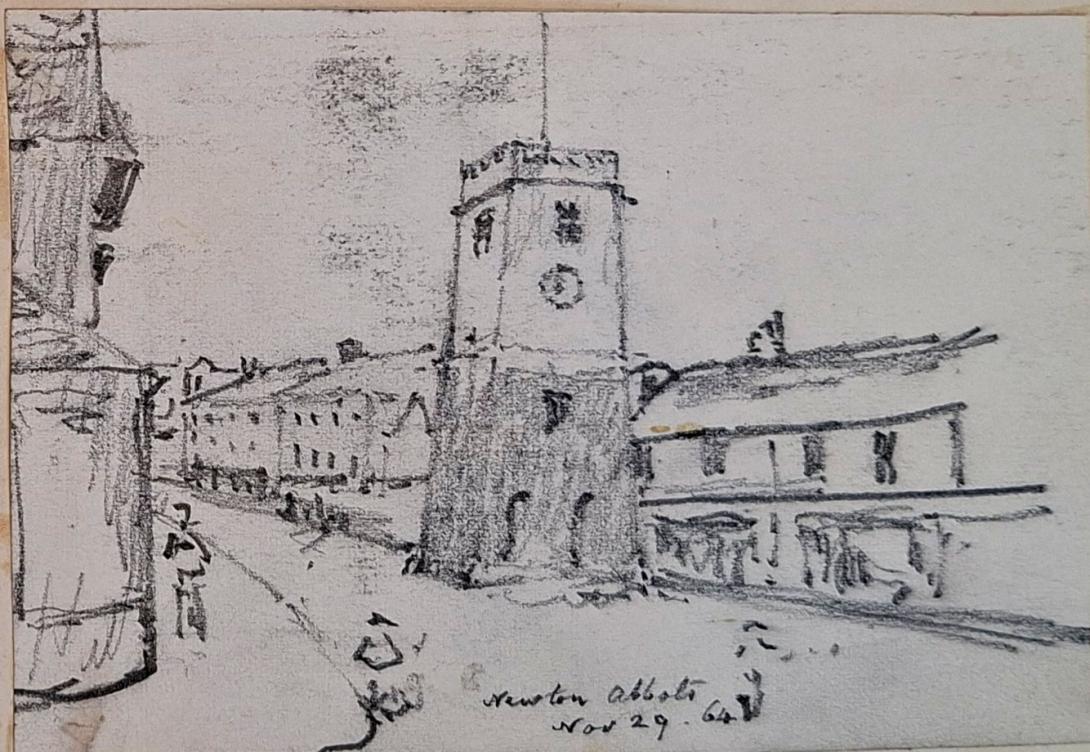
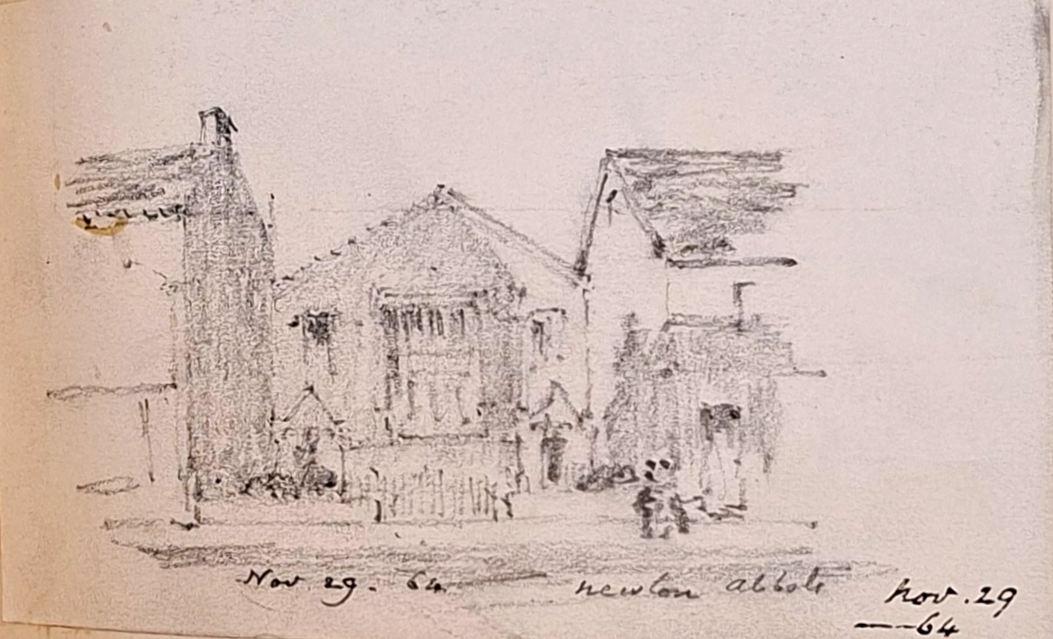
" Newton Abbots Nov 29 64 " and one other (2)
St Leonard's Tower, Newton Abbot, popularly known as The Clock Tower, is a Grade II* listed building in Newton Abbot. It was constructed in the 15th-century as part of a Gothic-style church and was the site of William III's first proclamation in England (although he had not yet become king). The adjoining nave was demolished in 1836 to improve traffic flows but the tower was saved by a local petition. The structure is owned by the town council and opened to the public on selected days.
St Leonard's Tower is approximately 60 feet (18 m) in height and built of Plymouth stone. It is formed of two stages (or storeys), demarked by moulded stone string courses on the outside faces. The lower stage has a door on the west face set within a granite arch, the door is wooden and dates to the 20th century. Above the door is a large twin arched window. On the east face of the lower stage the roof line of the former nave can be discerned in the stonework; below this is a small trefoil-topped window. The upper stage has two arched windows in the centre of each face with a clock face below on the west and east faces. The parapet at the top of the structure is battlemented.
The tower is the remaining part of a 15th-century Gothic church structure. A church had sat on this site, in the centre of Newton Abbot and the meeting point of its three main streets, since 1220 and is mentioned in a surviving document of 29 May 1350.The church consisted of the tower and a small nave to the east measuring 55 feet (17 m) by 20 feet (6.1 m). The nave was described as unremarkable aside from some oak seats to the east of the font which were particularly historic.
In 1688, William III of Orange during the Glorious Revolution made his first proclamation in England from the market cross to the immediate east of the church. The site is marked today by an engraved stone. By 1830 the tower had received its clock and housed six bells. The structure's use as a church had largely been supplanted by the newer church at nearby Wolborough but it was used for marriage and baptism ceremonies.
The church was set to be demolished in 1836 to allow widening of Wolborough Street to alleviate traffic congestion. However a popular petition saved the tower, which became an island within the road. The structure received protection as a grade II* listed building on 16 July 1949.
In the late 1960s the Central Electricity Generating Board proposed installing a substation within the tower and a local group raised funds to purchase the tower to prevent this. A plaque on the west face of the structure records that "this tower was refurbished in 1972–1973 by the people of Newton Abbot in memory of Councillor Arthur Claude Shobbrook, JP CA who died on July 17 July 1970".
Richard Suter was born in Greenwich, Kent on 30th March 1798, to William Suter and his wife Sarah Knights. On 7th January 1825 he married Anne Ruth Burn.
English architect. As Surveyor to The Fishmongers' Company he designed the severe Presbyterian churches for Ballykelly (1825–7) and Banagher (1825) on the Company's Estate in County Londonderry, drawings of which were exhibited at the Royal Academy in 1827. He was also responsible for the Model Farm (1823–4), the Lancasterian Schools (1828–30), the Company Agent's House (1830–2—now a hotel, much altered), a range of houses on the south side of the main road (1823–4), the lodge in the Presbyterian churchyard (1828), and the Dispensary (1829), all at Ballykelly, and all Classical. As Surveyor to Trinity House Corporation, he designed houses that were erected by Thomas Cubitt in 1821–3 on a site adjoining Trinity House. For The Fishmongers' Company he designed St Peter's Almshouses, Wandsworth, London (1849–51), and The Old School-House, Gresham's School, Holt, Norfolk(1859), in an Elizabethan style.
On the 1841 Census Richard, an architect and lawyer, can be found living in London with his wife Ann (listed as Ruth) and their two children, Richard George and Andrew Burn. Living with them is Edward D Suter. 1851 finds the family living in Tottenham Court in London, by this time Andrew had left the home, but I am unable to trace him on the 1851 Census. In 1860 Andrew marries Amelia Damaris Harrison. Both Richard George and Andrew were to become ordained ministers, with Andrew later becoming a Bishop and emigrating to New Zealand. Sadly in 1854 Anne Ruth was to pass away. In 1861, widowed Richard, Justice of the Peace for Maidenhead, is living at Castle Hill, Maidenhead, Berkshire. In 1862 he married Elizabeth Anne Pocock. In 1871 and 1881 Richard and Elizabeth are still living in Castle Hill. Richard was to pass away on 1st March1883.
Richard Suter & Annesley Voysey, architects, had their office at number 35 Fenchurch Street, but they did not have it all to themselves as they shared the premises with W.C. Franks, a tea broker, who will get a separate post some other time. The earliest mention I found of Richard Suter in Fenchurch Street is in 1832 when he is listed at that address in a list of contributing members of the Society for the Propagation of the Gospel in Foreign Parts. It says that he had been a member since 1829, but that does not mean he was already at 35 Fenchurch Street in that year.(1) In fact, that seems unlikely as the Sun Fire Office records give Messrs. Short and Co., merchants, as paying the insurance premium on the premises in May 1830. The Directory of British Architects 1834-1914 give the year 1827, but I do not know on what evidence. When Suter and Voysey became partners is also uncertain, but they had known each other since at least 1825 as Suter is named as one of the executors of Voysey’s will which was dated 22 July, 1825. The address given for Suter in the will is Suffolk Street, Southwark. Voysey then lives at Conway Street, Fitzroy Square.