
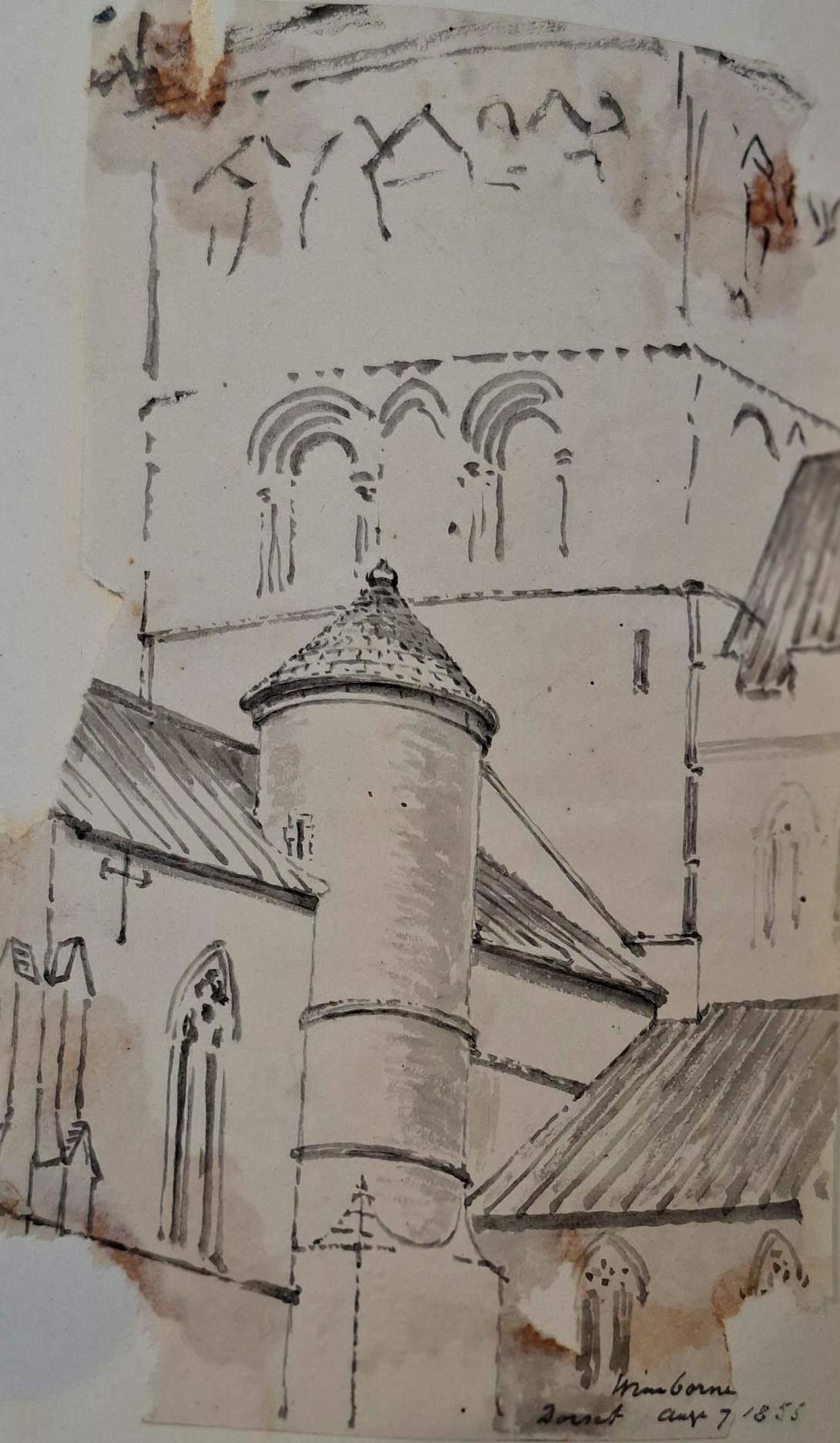
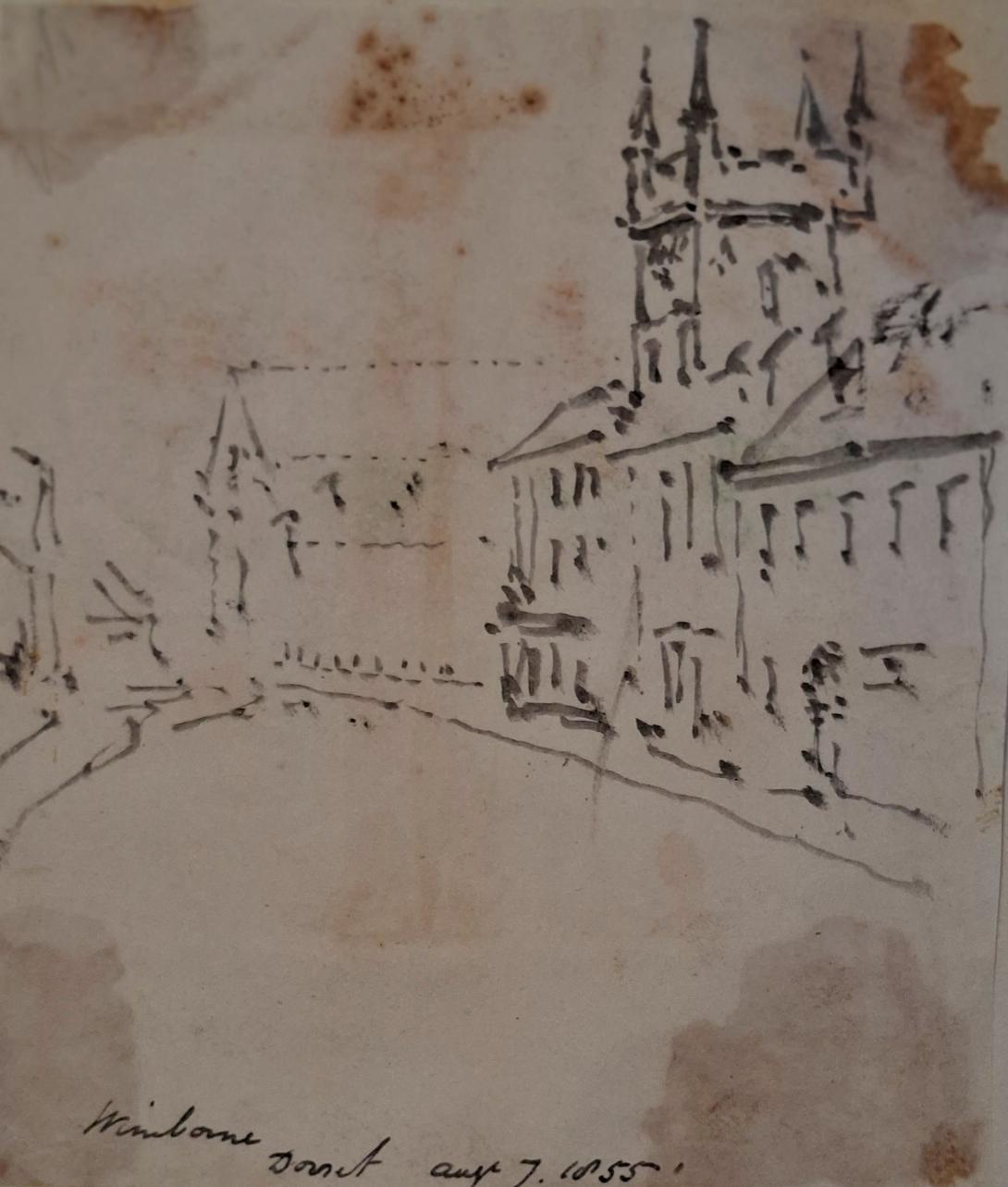

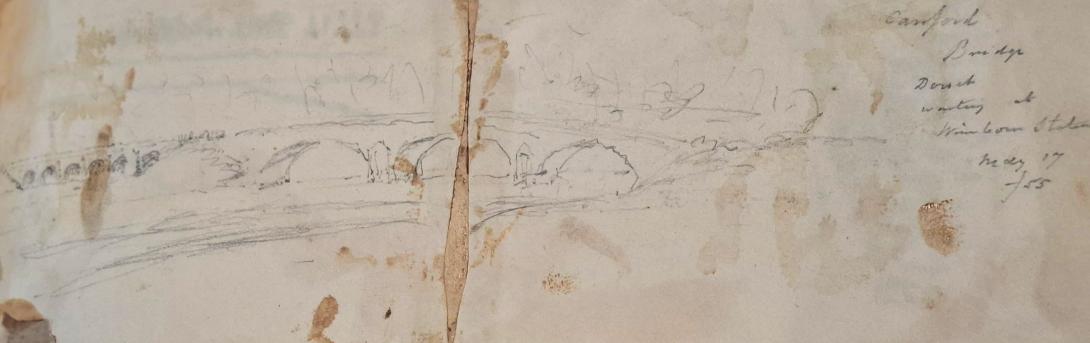
variously inscribed "Wimborne Minster Dorset Aug 7 1855 and Canford Bridge"
Wimborne Minster is the parish church of Wimborne, Dorset, England. The minster has existed for over 1300 years and is recognised for its unusual chained library (one of only a few surviving chained libraries in the world). The minster is a former monastery and Benedictine nunnery, and King Æthelred of Wessex is buried there.
Wimborne Abbey
The minster is dedicated to Saint Cuthburga (sister to King Ine of Wessex and wife of King Aldfrith of Northumbria) who founded a Benedictine abbey of nuns at the present day minster c. 705. Saint Walpurga was educated in the monastery, where she spent 26 years before travelling to Germany, following the missionary call of her mother's brother Saint Boniface. Leoba was also educated in this place. A monastery for men was also built around this time, adjacent to the abbey. Over the next hundred years the abbey and monastery grew in size and importance. The Anglo-Saxon name of the abbey, monastery and town was Winburna.

In 871 King Æthelred I of Wessex, elder brother of Alfred the Great, was buried in the minster. Alfred was succeeded by his son Edward the Elder in 899, and Æthelred's son, Æthelwold, rebelled and attempted to claim the throne. He seized a nun, probably of Wimborne, and made a stand there, probably because of its symbolic importance as his father's burial place, but he was unable to gain enough support to fight Edward and fled to the Vikings of Northumbria.[2]
Collegiate church
The women's monastery was destroyed by the Danes in 1013 during one of their incursions into Wessex and never rebuilt, though the main abbey building survived. In 1043 Edward the Confessor founded a college of secular (non-monastic) canons, consisting of a dean, four prebends, four vicars, four deacons, and five singers at the minster. The minster was remodelled and rebuilt by the Normans between 1120 and 1180, to support that institution.

In 1318 Edward II issued a document that made the minster a royal peculiar which exempted it from all diocesan jurisdiction. The choir used to wear scarlet robes, a legacy of this peculiar. Similar robes of this type are worn in Westminster Abbey and St George's Chapel at Windsor Castle. In 1496 Lady Margaret Beaufort, great-granddaughter of John of Gaunt and mother of Henry VII, founded a small chapel in the minster. With the reign of Henry VIII the remaining parts of the monastery were adopted into part of the minster to avoid being destroyed. However much of the wealth of the minster was confiscated by Henry.
In 1562 a grant was obtained from Queen Elizabeth I by which part of the property formerly belonging to the college, together with all ecclesiastical rights and prerogatives was returned to Wimborne and vested in twelve governors. The charter was surrendered to James I and a new charter was obtained from Charles I at a cost of £1,000 with the addition of an organist and singing men. During the Civil War, when Charles I was beheaded, his coat of arms was painted out from the wall of the minster, but on the restoration of Charles II the arms were speedily replaced and have now been restored.
In 1846 the royal peculiar was abolished, and now all that remains of the old order is the control by 12 governors of some of the minster affairs. The church was renovated towards the end of the 19th century and its last addition, a vestry was added at the same time. Today the church is a place of visit and worship for the local community and visitors.
Deans of Wimborne
- Martin de Pateshull 1223
- Randolf Brito 1229
- John Mansell 1247
- John Kirby 1265
- John de Berwick 1286
- Stephen de Malo Lacu or Mauley 1312
- Richard de Clare 1317
- Richard de Swynnerton 1335
- Richard de Murymouth 1338
- Robert de Kyngeston 1342
- Thomas de Clopton 1349
- Reginald Brian 1349
- Thomas de Brembre 1350
- Henry de Bukyngham 1361
- Richard de Beverley 1367
- John Carp 1387
- Roger Coryngham 1400
- Peter de Altobasso or Altobosco 1412
- Walter Medford c. 1415
- Gilbert Kymer 1423
- Walter Hurte c. 1467
- Hugh Oldham 1485
- Thomas Ruthall c. 1508
- Henry Hornby c. 1509
- Reginald Pole 1518
- Nicholas Wilson 1537
Architecture
The central tower and nave were founded in Saxon times, but the surviving building is predominantly Norman in design and construction, with Gothic components from various periods. One of its more famous architectural features include a working astronomical clock, which rings every hour and is represented in the form of a colourful quarterjack. The minster is built in a combination of Dorset limestone and New Forest stone.
The central length of the minster is 198 feet (60 m). The width, except the transepts, varies from 23 feet (7.0 m) in the nave to 21 feet (6.4 m) in the choir. The western tower of the minster is 95 feet (29 m) high. The smaller tower of the minster, above the transepts, is 84 feet (26 m). The 13th-century spire which once topped this tower fell down in a storm around 1600.
Canford Bridge in Wimborne is a historic road bridge over the River Stour, known for its scenic views and as a starting point for local walks. The main road bridge was completed in 1813 by engineer John Dyson. It is a Grade II listed structure.
Richard Suter was born in Greenwich, Kent on 30th March 1798, to William Suter and his wife Sarah Knights. On 7th January 1825 he married Anne Ruth Burn.
English architect. As Surveyor to The Fishmongers' Company he designed the severe Presbyterian churches for Ballykelly (1825–7) and Banagher (1825) on the Company's Estate in County Londonderry, drawings of which were exhibited at the Royal Academy in 1827. He was also responsible for the Model Farm (1823–4), the Lancasterian Schools (1828–30), the Company Agent's House (1830–2—now a hotel, much altered), a range of houses on the south side of the main road (1823–4), the lodge in the Presbyterian churchyard (1828), and the Dispensary (1829), all at Ballykelly, and all Classical. As Surveyor to Trinity House Corporation, he designed houses that were erected by Thomas Cubitt in 1821–3 on a site adjoining Trinity House. For The Fishmongers' Company he designed St Peter's Almshouses, Wandsworth, London (1849–51), and The Old School-House, Gresham's School, Holt, Norfolk(1859), in an Elizabethan style.
On the 1841 Census Richard, an architect and lawyer, can be found living in London with his wife Ann (listed as Ruth) and their two children, Richard George and Andrew Burn. Living with them is Edward D Suter. 1851 finds the family living in Tottenham Court in London, by this time Andrew had left the home, but I am unable to trace him on the 1851 Census. In 1860 Andrew marries Amelia Damaris Harrison. Both Richard George and Andrew were to become ordained ministers, with Andrew later becoming a Bishop and emigrating to New Zealand. Sadly in 1854 Anne Ruth was to pass away. In 1861, widowed Richard, Justice of the Peace for Maidenhead, is living at Castle Hill, Maidenhead, Berkshire. In 1862 he married Elizabeth Anne Pocock. In 1871 and 1881 Richard and Elizabeth are still living in Castle Hill. Richard was to pass away on 1st March1883.
Richard Suter & Annesley Voysey, architects, had their office at number 35 Fenchurch Street, but they did not have it all to themselves as they shared the premises with W.C. Franks, a tea broker, who will get a separate post some other time. The earliest mention I found of Richard Suter in Fenchurch Street is in 1832 when he is listed at that address in a list of contributing members of the Society for the Propagation of the Gospel in Foreign Parts. It says that he had been a member since 1829, but that does not mean he was already at 35 Fenchurch Street in that year.(1) In fact, that seems unlikely as the Sun Fire Office records give Messrs. Short and Co., merchants, as paying the insurance premium on the premises in May 1830. The Directory of British Architects 1834-1914 give the year 1827, but I do not know on what evidence. When Suter and Voysey became partners is also uncertain, but they had known each other since at least 1825 as Suter is named as one of the executors of Voysey’s will which was dated 22 July, 1825. The address given for Suter in the will is Suffolk Street, Southwark. Voysey then lives at Conway Street, Fitzroy Square.