
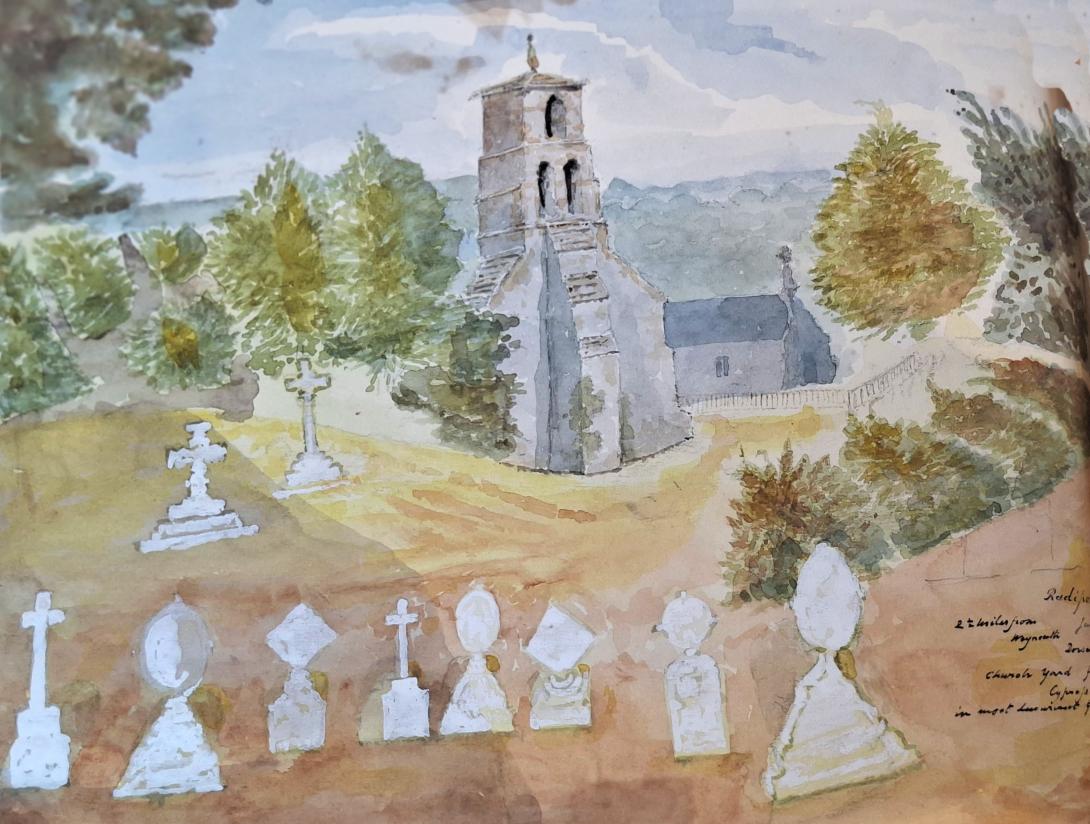
" Radipole Church July 14 1876 2.1/2 miles from Weymouth Dorsetshire Church Yard full of Cypruses in most luxirant growth"
St Ann's Church is a Church of England parish church in Radipole, Weymouth, Dorset, England. The church dates to the 13th century, with later additions, and is a Grade II* listed building. Both the boundary wall of the churchyard and church room opposite are also Grade II listed.
St Ann's was originally dedicated to St Mary and served as the parish church of Melcombe Regis. The existing church dates to the 13th century, but it is believed that an older church occupied the site, owing to the discovery of encaustic tiles when the church's flooring was replaced in the 1863 restoration. Much of the existing nave dates to the 13th century, at which time the main body of the church was made up of nave and chancel only. North and south chapels were added in the 14th century and the chancel was rebuilt and enlarged during the same century. The west end of the nave was rebuilt in the early 16th century which included the replacement of a small tower with a bell-turret. The south porch was rebuilt in 1733 and the south chapel rebuilt in 1735.
In 1605, a new church dedicated to St Mary's was built on a more centralised site near Melcombe Regis' harbourside. It became the new parish church the following year, leaving St Ann's as a chapel of ease. The decision to build a new church stemmed from the Radipole church being too small and at an inconvenient location for many parishioners. Furthermore, it was considered that Melcombe Regis was "subject to the incursion of foreign enemies, who might surprise the town during Divine service, and depart before the inhabitants could repair home to make resistance".
St Mary's at Radipole was rededicated to St Ann during the 19th century. It underwent internal restoration and reseating for £400 in 1863. The plans were drawn up by Mr. G. R. Crickmay of Weymouth and the work carried out by Mr. R. Reynolds of Weymouth, under the supervision of the architect. The work included repairing the walls, replacing the pews with new ones of stained and varnished deal, laying new flooring and replacing the church's gallery. The two small windows on the west side of the porch were replaced by a larger, single one, the timbers of the nave's roof were restored, and new timber roofs added in the porch and south transept. New fittings were also added to the church, including a pulpit fixed on a pedestal of Portland stone, an octagonal font of Portland stone, a reading desk and communion rail. The church reopened on 23 December 1863.
Further restoration was carried out in 1882 and its completion marked by a ceremony on 16 June 1882. The external walls and roof of the church were extensively repaired, the interior cleaned and recoloured, and some new fittings added. St Ann's became a parish church again in 1926 when Radipole and Melcombe Regis were split into separate parishes. A daughter church, St Aldhelm's, was built in 1939–41 to serve the growing population of Radipole. The vestry of St Ann's was rebuilt in 1960, with its doorway incorporating stonework from a 17th-century house in Weymouth which was demolished the previous year.
St Ann's is built of ashlar and rubble stone with slate roofs. It is made up of a five-bay nave, chancel, north and south chapels, south porch and vestry. The west side contains a two-stage bell-turret. Above the chancel arch are the Royal Arms of William IV. In the south porch is the church's original 13th-century font. It was originally square but later recut in the 16th century to form a rounded front. Other fittings include a late 19th-century stone reredos and a carved oak pulpit of 1902.
The church room opposite St Ann's was built as a schoolroom in 1850 on a plot of land donated by William Eliot. It became Grade II listed in 1974.
In 1997, a number of monuments in the churchyard became Grade II listed:
- Edward and Mary Bealle, 1694, headstone
- William Moulam, 1737, headstone
- Sarah, wife of John Moulam, 1749, headstone
- Archibald Grant, 1805, chest tomb
- Joseph Swafield Thorne, 1846, chest tomb
Richard Suter was born in Greenwich, Kent on 30th March 1798, to William Suter and his wife Sarah Knights. On 7th January 1825 he married Anne Ruth Burn.
English architect. As Surveyor to The Fishmongers' Company he designed the severe Presbyterian churches for Ballykelly (1825–7) and Banagher (1825) on the Company's Estate in County Londonderry, drawings of which were exhibited at the Royal Academy in 1827. He was also responsible for the Model Farm (1823–4), the Lancasterian Schools (1828–30), the Company Agent's House (1830–2—now a hotel, much altered), a range of houses on the south side of the main road (1823–4), the lodge in the Presbyterian churchyard (1828), and the Dispensary (1829), all at Ballykelly, and all Classical. As Surveyor to Trinity House Corporation, he designed houses that were erected by Thomas Cubitt in 1821–3 on a site adjoining Trinity House. For The Fishmongers' Company he designed St Peter's Almshouses, Wandsworth, London (1849–51), and The Old School-House, Gresham's School, Holt, Norfolk(1859), in an Elizabethan style.
On the 1841 Census Richard, an architect and lawyer, can be found living in London with his wife Ann (listed as Ruth) and their two children, Richard George and Andrew Burn. Living with them is Edward D Suter. 1851 finds the family living in Tottenham Court in London, by this time Andrew had left the home, but I am unable to trace him on the 1851 Census. In 1860 Andrew marries Amelia Damaris Harrison. Both Richard George and Andrew were to become ordained ministers, with Andrew later becoming a Bishop and emigrating to New Zealand. Sadly in 1854 Anne Ruth was to pass away. In 1861, widowed Richard, Justice of the Peace for Maidenhead, is living at Castle Hill, Maidenhead, Berkshire. In 1862 he married Elizabeth Anne Pocock. In 1871 and 1881 Richard and Elizabeth are still living in Castle Hill. Richard was to pass away on 1st March1883.
Richard Suter & Annesley Voysey, architects, had their office at number 35 Fenchurch Street, but they did not have it all to themselves as they shared the premises with W.C. Franks, a tea broker, who will get a separate post some other time. The earliest mention I found of Richard Suter in Fenchurch Street is in 1832 when he is listed at that address in a list of contributing members of the Society for the Propagation of the Gospel in Foreign Parts. It says that he had been a member since 1829, but that does not mean he was already at 35 Fenchurch Street in that year.(1) In fact, that seems unlikely as the Sun Fire Office records give Messrs. Short and Co., merchants, as paying the insurance premium on the premises in May 1830. The Directory of British Architects 1834-1914 give the year 1827, but I do not know on what evidence. When Suter and Voysey became partners is also uncertain, but they had known each other since at least 1825 as Suter is named as one of the executors of Voysey’s will which was dated 22 July, 1825. The address given for Suter in the will is Suffolk Street, Southwark. Voysey then lives at Conway Street, Fitzroy Square.