
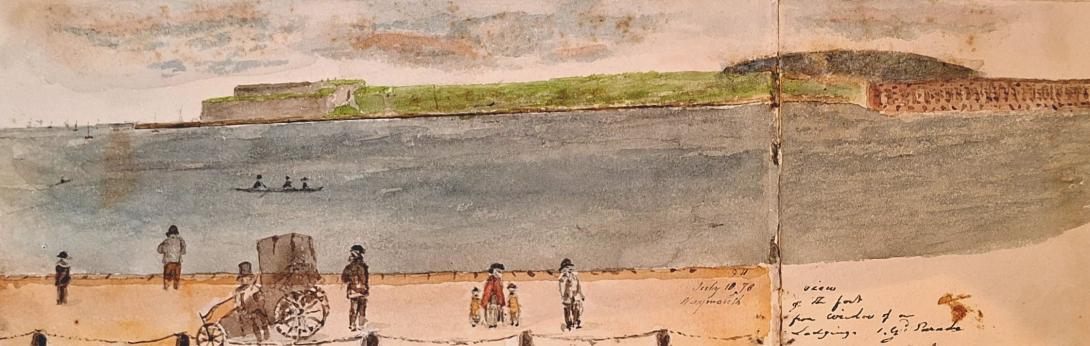
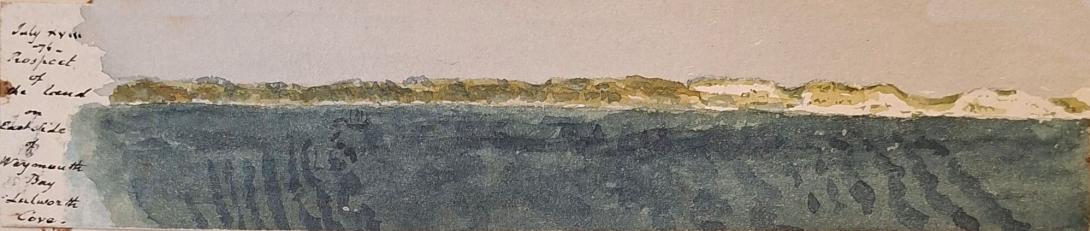
"view of the fort from window of our lodging 1 Grande Parade July 10 1878 and July XVIII 76 Prospect of the land on the east side of Weymouth Bay and Lulworth Cove "
"view of the fort from window of our lodging 1 Grande Parade July 10 1878 and July XVIII 76 Prospect of the land on the east side of Weymouth Bay and Lulworth Cove "
Nothe Fort is a fort in Weymouth, Dorset, England, situated at the end of the Nothe Peninsula, which juts eastwards from the town of Weymouth, and Weymouth Harbour, into the sea to the north of the ex-military Portland Harbour. The fort is located next to Nothe Gardens.
The coastal defence was built between 1860 and 1872 by 26 Company of the Royal Engineers to protect Portland and Weymouth Harbours, with Portland then becoming an important Royal Navy base. Shaped like the letter D, the fort was built with bomb-proof casemates and deep magazines. The fort was abandoned in 1956 and purchased by the local council in 1961. It is now a museum and remains one of the best-preserved forts of its kind in the country.
The fort and its outer gateway have been Grade II* listed since 1974. Its fusee steps, located in Nothe Gardens, have been Grade II listed since 2000, and was constructed for hauling trolleys transporting ammunition, spares and stores from the quay to Nothe Fort. In 1978, the Nothe Fort, tramway and searchlight battery at The Nothe, also became scheduled under the Ancient Monuments and Archaeological Areas Act 1979.
Military


Work began on Nothe Fort in 1860 by a civil engineering contractor, with the first stage of construction involving leveling the site and building a sea wall. After the contractor suffered financial problems, the construction work was taken over by 26 Company Royal Engineers in 1862. Although the upper earthen parapet was complete by 1869, the fort was fully commissioned in 1872 at a total cost of £117,049. It was constructed on three levels; the magazine stored the ammunition, the ground level casemates were designed to hold heavy muzzle-loaded cannons and accommodation for the soldiers manning them, and the ramparts, featuring a raised platform that could be used to fire weapons such as muskets and light muzzle-loaded cannons during attacks.
The first soldiers to be stationed at the fort were No. 2 Battery Royal Artillery (Tatton-Browns). The unit were given responsibility to install the original cannons, which were two 64 pounders, four 9-inch rifled muzzle loaders and six 10-inch cannons. During the 1890s, seven of the guns were replaced by 12.5-inch RML guns. With the introduction of breech-loading guns in the early 20th century, the RML guns were removed and replaced by three 6-inch Mark VII breechloading naval guns on the ramparts. In order to carry the 100-pound shells from the magazines, a series of hoists were installed.
In 1938 alterations were completed to allow the fort to be used as a central anti-aircraft ammunition depot for the south west, which included installing an electrically-operated hoist and the construction of a loading platform. Nothe Fort did not see combat until World War II. In July 1940, two ships entered the area and failed to identify themselves, prompting the fort to fire its guns as a warning. The two ships immediately switched on their lights, revealing themselves to be refugees from the Channel Islands. During the war, the fort was equipped with a battery of four Vickers QF 3.7-inch AA guns. The guns are sited on a purpose-built platform within the north-west corner of the fort, which was later replaced by a Bofors 40 mm gun.
It was abandoned in 1956 as it was no longer required as a coastal defence, then used by the Royal Navy to house stores and degaussing equipment.
Richard Suter was born in Greenwich, Kent on 30th March 1798, to William Suter and his wife Sarah Knights. On 7th January 1825 he married Anne Ruth Burn.
English architect. As Surveyor to The Fishmongers' Company he designed the severe Presbyterian churches for Ballykelly (1825–7) and Banagher (1825) on the Company's Estate in County Londonderry, drawings of which were exhibited at the Royal Academy in 1827. He was also responsible for the Model Farm (1823–4), the Lancasterian Schools (1828–30), the Company Agent's House (1830–2—now a hotel, much altered), a range of houses on the south side of the main road (1823–4), the lodge in the Presbyterian churchyard (1828), and the Dispensary (1829), all at Ballykelly, and all Classical. As Surveyor to Trinity House Corporation, he designed houses that were erected by Thomas Cubitt in 1821–3 on a site adjoining Trinity House. For The Fishmongers' Company he designed St Peter's Almshouses, Wandsworth, London (1849–51), and The Old School-House, Gresham's School, Holt, Norfolk(1859), in an Elizabethan style.
On the 1841 Census Richard, an architect and lawyer, can be found living in London with his wife Ann (listed as Ruth) and their two children, Richard George and Andrew Burn. Living with them is Edward D Suter. 1851 finds the family living in Tottenham Court in London, by this time Andrew had left the home, but I am unable to trace him on the 1851 Census. In 1860 Andrew marries Amelia Damaris Harrison. Both Richard George and Andrew were to become ordained ministers, with Andrew later becoming a Bishop and emigrating to New Zealand. Sadly in 1854 Anne Ruth was to pass away. In 1861, widowed Richard, Justice of the Peace for Maidenhead, is living at Castle Hill, Maidenhead, Berkshire. In 1862 he married Elizabeth Anne Pocock. In 1871 and 1881 Richard and Elizabeth are still living in Castle Hill. Richard was to pass away on 1st March1883.
Richard Suter & Annesley Voysey, architects, had their office at number 35 Fenchurch Street, but they did not have it all to themselves as they shared the premises with W.C. Franks, a tea broker, who will get a separate post some other time. The earliest mention I found of Richard Suter in Fenchurch Street is in 1832 when he is listed at that address in a list of contributing members of the Society for the Propagation of the Gospel in Foreign Parts. It says that he had been a member since 1829, but that does not mean he was already at 35 Fenchurch Street in that year.(1) In fact, that seems unlikely as the Sun Fire Office records give Messrs. Short and Co., merchants, as paying the insurance premium on the premises in May 1830. The Directory of British Architects 1834-1914 give the year 1827, but I do not know on what evidence. When Suter and Voysey became partners is also uncertain, but they had known each other since at least 1825 as Suter is named as one of the executors of Voysey’s will which was dated 22 July, 1825. The address given for Suter in the will is Suffolk Street, Southwark. Voysey then lives at Conway Street, Fitzroy Square.