
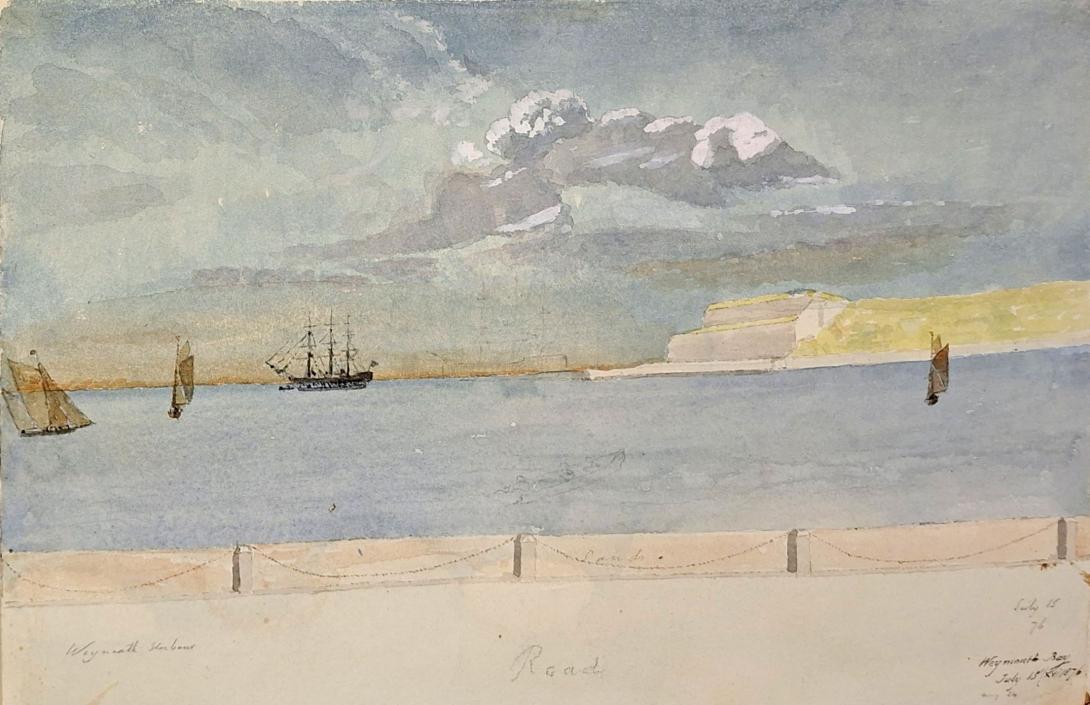
" Weymouth Harbour Road / July 15 76/ Weymouth Bay Ju;y 15 (XV) 1876 Aug 24"
Weymouth Bay is a sheltered bay on the south coast of England, in Dorset. It is protected from erosion by Chesil Beach and the Isle of Portland, and includes several beaches, notably Weymouth Beach, a gently curving arc of golden sand which stretches from the resort of Weymouth. Weymouth Bay is situated approximately halfway along the UNESCO Jurassic Coast World Heritage Site.
When Natural England looked at access to Weymouth Bay prior to the 2012 Olympic Games, they defined it as the stretch between Rufus Castle on the Isle of Portland and Lulworth Cove, an area which covers Portland Harbour, Weymouth Beach, and Ringstead Bay.
The bay's waters are excellent for sailing — the best sailing waters in northern Europe, in part because the bay is sheltered from south-west winds. This means that Portland Bill can be accessed easily from anywhere on Weymouth Bay by sailing when the tide is turning as an eddy flows along Portland's eastern side.
The bay is home to the Weymouth and Portland National Sailing Academy and hosted the sailing events for the 2012 Olympic Games. Since the games, the Academy's venue has continued to improve to ensure a "legacy" for the Olympic Games.

Weymouth Bay: Bowleaze Cove and Jordon Hill was painted by the leading English landscape artist John Constable in 1816–17. Constable had honeymooned on the south coast in October 1816, inspiring the painting. The painting now hangs in the National Gallery, London.
Portland stone is a limestone geological formation (formally named the Portland Stone Formation) dating to the Tithonian age of the Late Jurassic that is quarried on the Isle of Portland in Dorset, England. The quarries are cut in beds of white-grey limestone separated by chert beds. It has been used extensively as a building stone throughout the British Isles, notably in major public buildings in London such as St Paul's Cathedral and Buckingham Palace. Portland stone is also exported to many countries, being used for example at the United Nations headquarters in New York City.
Stone has been quarried on Portland since Roman times and was being shipped to London in the 14th century.[4] Extraction as an industry began in the early 17th century, with shipments to London for Inigo Jones' Banqueting House. Wren's choice of Portland for the new St Paul's Cathedral was a great boost for the quarries and established Portland as London's choice of building stone. The island was connected by railway to the rest of the country from 1865. Albion Stone PLC has been quarrying and mining Portland stone since 1984. Portland Stone Firms Ltd have been quarrying Portland stone since 1994.
Jordans is part of the Inmosthay Quarry in the centre of the island, which also includes Fancy Beach. The quarry has been worked since the late 19th century. Albion Stone leases the southern section from The Crown Estate and purchased the northern part of the site in 2006. The majority of the southern reserves lie under the grounds of the local cricket club. To avoid disturbing the site at surface level, the company has applied and received permission to extract the stone using mining rather than quarrying techniques. The reserves to the north will be quarried using the diamond bladed cutting machines, hydro bags and wire saws to shape the blocks. This process avoids the use of dusty and noisy blasting as the primary extraction method, thereby protecting the surrounding environment, which has been designated as a Site of Special Scientific Interest (SSSI). Albion Stone PLC now extract all their stone through mining which dramatically reduces the impact on the environment and local residents. Jordan's Mine is currently the biggest mine on Portland.
Bowers Quarry has been operational since the late 18th century. It has been leased from The Crown Estate since 1979, and in 2002 it became the site of the first Portland stone mine by Albion Stone PLC. Extraction from this site is now completely underground, with the original Bowers Mine in the extreme southern end of the quarry and the High Wall Extraction on the eastern and south east boundaries. High Wall Extraction is a series of small mines that extract otherwise wasted stone that sits between the final faces of the quarry and the actual boundary of the site.
Stonehills Mine is the first completely new mine on Portland (not a mine as an extension from an existing quarry). Albion Stone Plc began the process to open this mine in 2015 and reserves are estimated to last for 50 years (2066).
Independent Quarry and Admiralty Quarry are both owned by The Crown Estate and have been leased since 1982. These quarries have been worked since the mid-19th century with the final dimension stones coming out of Independent in 2006, although some stocks of Portland stone block still remain.
Coombefield Quarry, located near Southwell has been open cast quarried over the last 80 years and is one of three privately owned quarries by Portland Stone Firms Ltd, the largest landholder on the island. The quarry is nearing the end of its life and will be regenerated as a holiday caravan park to boost local tourism on the island.
Perryfield Quarry is found towards the middle of the island and being actively open cast quarried. There are over 20 years of reserves left which is privately owned by Portland Stone Firms. Open cast quarrying provides quicker extraction of raw block dimension stone whilst maintaining its integrity. The majority of buildings in London today use Portland which has been quarried using the same methods over the last 60 years.
Broadcroft Quarry is located on the eastern side of the island and is a part of the open cast quarries used for St Paul's Cathedral. Privately owned by Portland Stone Firms Limited there are over 20 years of reserves left and still being actively quarried.
The coastal strip toward the southern tip of the island has permission to be worked by Portland Stone Firms and will provide in excess of 30 years of reserves. Permission has been granted for this to be open cast quarried.
Once quarries have been worked they are then restored. The Portland Sculpture and Quarry Trust was formed in 1983 and is dedicated to preserving a knowledge and understanding of stone and the landscape from which it comes. The main non-working quarry remains Tout Quarry in which the trust is based, where a workshop is held every year. Tout Quarry has been donated to the Portland Sculpture and Quarry Trust by Portland Stone Firms Limited.
Richard Suter was born in Greenwich, Kent on 30th March 1798, to William Suter and his wife Sarah Knights. On 7th January 1825 he married Anne Ruth Burn.
English architect. As Surveyor to The Fishmongers' Company he designed the severe Presbyterian churches for Ballykelly (1825–7) and Banagher (1825) on the Company's Estate in County Londonderry, drawings of which were exhibited at the Royal Academy in 1827. He was also responsible for the Model Farm (1823–4), the Lancasterian Schools (1828–30), the Company Agent's House (1830–2—now a hotel, much altered), a range of houses on the south side of the main road (1823–4), the lodge in the Presbyterian churchyard (1828), and the Dispensary (1829), all at Ballykelly, and all Classical. As Surveyor to Trinity House Corporation, he designed houses that were erected by Thomas Cubitt in 1821–3 on a site adjoining Trinity House. For The Fishmongers' Company he designed St Peter's Almshouses, Wandsworth, London (1849–51), and The Old School-House, Gresham's School, Holt, Norfolk(1859), in an Elizabethan style.
On the 1841 Census Richard, an architect and lawyer, can be found living in London with his wife Ann (listed as Ruth) and their two children, Richard George and Andrew Burn. Living with them is Edward D Suter. 1851 finds the family living in Tottenham Court in London, by this time Andrew had left the home, but I am unable to trace him on the 1851 Census. In 1860 Andrew marries Amelia Damaris Harrison. Both Richard George and Andrew were to become ordained ministers, with Andrew later becoming a Bishop and emigrating to New Zealand. Sadly in 1854 Anne Ruth was to pass away. In 1861, widowed Richard, Justice of the Peace for Maidenhead, is living at Castle Hill, Maidenhead, Berkshire. In 1862 he married Elizabeth Anne Pocock. In 1871 and 1881 Richard and Elizabeth are still living in Castle Hill. Richard was to pass away on 1st March1883.
Richard Suter & Annesley Voysey, architects, had their office at number 35 Fenchurch Street, but they did not have it all to themselves as they shared the premises with W.C. Franks, a tea broker, who will get a separate post some other time. The earliest mention I found of Richard Suter in Fenchurch Street is in 1832 when he is listed at that address in a list of contributing members of the Society for the Propagation of the Gospel in Foreign Parts. It says that he had been a member since 1829, but that does not mean he was already at 35 Fenchurch Street in that year.(1) In fact, that seems unlikely as the Sun Fire Office records give Messrs. Short and Co., merchants, as paying the insurance premium on the premises in May 1830. The Directory of British Architects 1834-1914 give the year 1827, but I do not know on what evidence. When Suter and Voysey became partners is also uncertain, but they had known each other since at least 1825 as Suter is named as one of the executors of Voysey’s will which was dated 22 July, 1825. The address given for Suter in the will is Suffolk Street, Southwark. Voysey then lives at Conway Street, Fitzroy Square.