
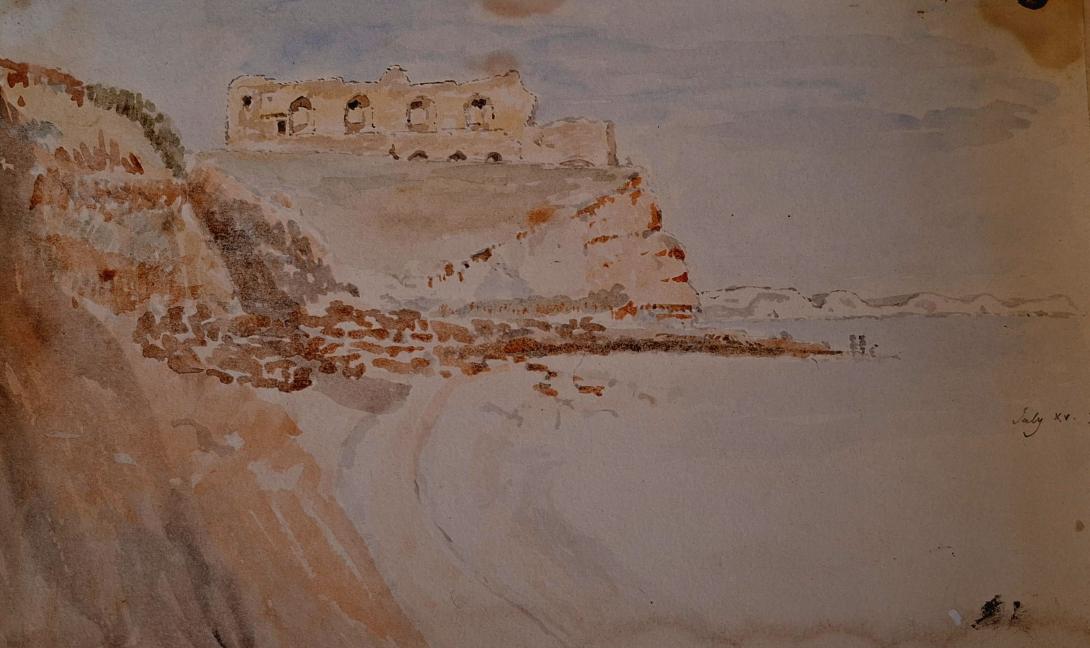
July 18 76
Sandsfoot Castle, also known historically as Weymouth Castle, is an artillery fort constructed by Henry VIII near Weymouth, Dorset. It formed part of the King's Device programme to protect against invasion from France and the Holy Roman Empire, and defended the Weymouth Bay anchorage. The stone castle had an octagonal gun platform, linked to a residential blockhouse, and was completed by 1542 at a cost of £3,887. Earthwork defences were built around the landward side of the castle, probably in 1623. Sandsfoot saw service during the English Civil War, when it was held by Parliament and Royalists in turn during the conflict. It survived the interregnum but, following Charles II's restoration to the throne, the fortress was withdrawn from military use in 1665.
By the early 18th century, Sandsfoot was in ruins, its stonework taken for use in local building projects. The clay cliffs on which the castle had been built had always been unstable and subject to erosion. The castle's gun platform began to collapse into the sea and, by the 1950s, had been entirely destroyed. The ruins were closed to visitors on safety grounds, although civic gardens were planted alongside it in 1951. Repairs were undertaken between 2009 and 2012 at a total cost of £217,800, enabling the site to be reopened to the public. Historic England considers Sandsfoot to be "one of the most substantial examples" of the 16th-century blockhouses to survive in England.[2] The ruins were once again closed to visitors on safety grounds in January 2021.[3] It remains closed to the public as of August 2022.
History
16th century
Sandsfoot Castle was built as a consequence of international tensions between England, France and the Holy Roman Empire in the final years of the reign of King Henry VIII. Traditionally the Crown had left coastal defences to the local lords and communities, only taking a modest role in building and maintaining fortifications, and while France and the Empire remained in conflict with one another, maritime raids were common but an actual invasion of England seemed unlikely.[4] Modest defences, based around simple blockhouses and towers, existed in the south-west and along the Sussex coast, with a few more impressive works in the north of England, but in general the fortifications were very limited in scale.[5]

After 1533, Henry broke with popes Pope Clement VII and Paul III in order to annul the long-standing marriage to his wife, Catherine of Aragon, and remarry.[6] Catherine was the aunt of Charles V, the Holy Roman Emperor, and Charles took the annulment as a personal insult.[7] This resulted in France and the Empire declaring an alliance against Henry in 1538, and the Pope encouraging the two countries to attack England.[8] An invasion of England appeared certain.[9] In response, Henry issued an order, called a "device", in 1539, giving instructions for the "defence of the realm in time of invasion" and the construction of forts along the English coastline.[10]
Sandsfoot Castle was built to protect the Weymouth Bay anchorage, being placed on cliffs overlooking the waterway, opposite Portland Castle on the other side.[11] Sandsfoot was a blockhouse, intended to defeat enemy ships using a battery of heavy artillery, and had minimal protection against an attack from the land.[12] It was completed by 1541, run by a captain appointed by the Crown, and cost £3,887 to build.[13][b] There was probably an early agreement that the nearby village of Wyke Regis had a responsibility to support the castle, and in exchange they came to traditionally enjoy an exemption from taxes and militia duties.[15] The antiquarian John Leland visited the castle soon after its construction, describing it as "a right goodlie and warlyke castle" with "one open barbican", probably referring to the castle's gun platform.[16]
Coastal erosion quickly began to threaten the castle, causing what was reported as a "great gulf" on its seaward side, and repairs costing £383 were necessary by 1583,[17][b] completed by John Wadham of Catherston, MP and Recorder for Weymouth and “Captain of the Queen’s Majestie at Sandesfoot Castle” who died in 1584.[18] During the invasion scare that accompanied the Spanish Armada of 1588, the normal garrison of Sandsfoot was supplemented by another 50 men.[19]
17th–19th centuries

Repairs were made to the castle between 1610 and 1611 by the captain, Sir George Bampfield, at a cost of £211.[20][b] A survey in 1623 carried out by Sir Richard Morryson showed the castle to be equipped with ten iron guns – one culverin, five demi-culverins, two sakers, a minion and a falcon – and garrisoned by its captain, five gunners and three soldiers.[21] It was in a poor condition, and one corner of the gun platform had been undermined by the sea; Morryson's team estimated the likely costs of repairs to amount to £459.[22][b]
During the English Civil War between the supporters of Charles I and Parliament, Weymouth was predominantly Parliamentarian in loyalty and the surrounding forts were held by their garrisons.[23] Robert Dormer, the Earl of Carnarvon, entered Dorset with an army in 1643 and Weymouth surrendered, resulting in Sandsfoot Castle being controlled by the Royalists between August 1643 and June 1644.[24] During this period the castle may have been used as a Royalist mint.[25][c] Robert Devereux, the Earl of Essex, then retook the county for Parliament; Colonel William Ashburnham, the Royalist governor of Weymouth, retreated to Portland Castle without a fight. Devereux approached Sandsfoot and, after three hours of negotiations, the fort surrendered to him. In 1647, Parliament ordered the garrison at the castle to be demobilised but this did not occur, and John Hayne was appointed as its new captain.
Charles II was restored to the throne in 1660 and the next year a fresh order was given to demobilise the garrison at Sandsfoot. An argument then broke out between Humphrey Weld, the lieutenant-governor of Portland and captain of Sandsfoot Castle, and Charles Stewart, the Duke of Richmond, over the control of the local defences. The village of Wyke Regis petitioned Weld in a bid to prevent the demobilisation, concerned that their traditional exemptions from militia service would be revoked by the Duke. Weld championed their case but was dismissed from his post as lieutenant-governor, and the Duke occupied Sandsfoot with his militia. Weld appealed to the government and in 1665 a compromise was announced in which Weld would be reappointed to his role as lieutenant-governor, while Sandsfoot would be declared redundant and be demolished. The order for its destruction was never carried out, and the castle was used as a storehouse until at least 1691.

By 1725, the castle had become ruinous. Early in the century, the remains of the castle was sold to the town of Weymouth, whose people reused some of the stone to construct their new town bridge. Local tradition in the 19th century maintained that several houses in Weymouth were also constructed using stone taken from the castle. In 1825, the carved stone Elizabethan arms of the castle were moved to All Saints Church in Wyke Regis. Captains continued to be formally appointed, however, and Gabriel Stewart held the post as late as 1795.
The majority of the gun platform collapsed into the sea as the cliffs eroded. It is uncertain precisely when this occurred; in a prolonged historical debate over this during the late 19th and early 20th centuries, the historian Henry Symonds argued that the first falls occurred during the 18th century, W. Norman placed the main fall in 1835, and T. Groves argued in favour of a more recent collapse in the second half of the 19th century. The ruined castle was drawn and painted by various artists in the 18th and 19th centuries, including Samuel Buck, J. H. Grimm, C. Sawyer and Edward Pritchard. The castle featured in Joseph Drew's short novel "the Poisoned Cup" in 1876.
Richard Suter was born in Greenwich, Kent on 30th March 1798, to William Suter and his wife Sarah Knights. On 7th January 1825 he married Anne Ruth Burn.
English architect. As Surveyor to The Fishmongers' Company he designed the severe Presbyterian churches for Ballykelly (1825–7) and Banagher (1825) on the Company's Estate in County Londonderry, drawings of which were exhibited at the Royal Academy in 1827. He was also responsible for the Model Farm (1823–4), the Lancasterian Schools (1828–30), the Company Agent's House (1830–2—now a hotel, much altered), a range of houses on the south side of the main road (1823–4), the lodge in the Presbyterian churchyard (1828), and the Dispensary (1829), all at Ballykelly, and all Classical. As Surveyor to Trinity House Corporation, he designed houses that were erected by Thomas Cubitt in 1821–3 on a site adjoining Trinity House. For The Fishmongers' Company he designed St Peter's Almshouses, Wandsworth, London (1849–51), and The Old School-House, Gresham's School, Holt, Norfolk(1859), in an Elizabethan style.
On the 1841 Census Richard, an architect and lawyer, can be found living in London with his wife Ann (listed as Ruth) and their two children, Richard George and Andrew Burn. Living with them is Edward D Suter. 1851 finds the family living in Tottenham Court in London, by this time Andrew had left the home, but I am unable to trace him on the 1851 Census. In 1860 Andrew marries Amelia Damaris Harrison. Both Richard George and Andrew were to become ordained ministers, with Andrew later becoming a Bishop and emigrating to New Zealand. Sadly in 1854 Anne Ruth was to pass away. In 1861, widowed Richard, Justice of the Peace for Maidenhead, is living at Castle Hill, Maidenhead, Berkshire. In 1862 he married Elizabeth Anne Pocock. In 1871 and 1881 Richard and Elizabeth are still living in Castle Hill. Richard was to pass away on 1st March1883.
Richard Suter & Annesley Voysey, architects, had their office at number 35 Fenchurch Street, but they did not have it all to themselves as they shared the premises with W.C. Franks, a tea broker, who will get a separate post some other time. The earliest mention I found of Richard Suter in Fenchurch Street is in 1832 when he is listed at that address in a list of contributing members of the Society for the Propagation of the Gospel in Foreign Parts. It says that he had been a member since 1829, but that does not mean he was already at 35 Fenchurch Street in that year.(1) In fact, that seems unlikely as the Sun Fire Office records give Messrs. Short and Co., merchants, as paying the insurance premium on the premises in May 1830. The Directory of British Architects 1834-1914 give the year 1827, but I do not know on what evidence. When Suter and Voysey became partners is also uncertain, but they had known each other since at least 1825 as Suter is named as one of the executors of Voysey’s will which was dated 22 July, 1825. The address given for Suter in the will is Suffolk Street, Southwark. Voysey then lives at Conway Street, Fitzroy Square.