
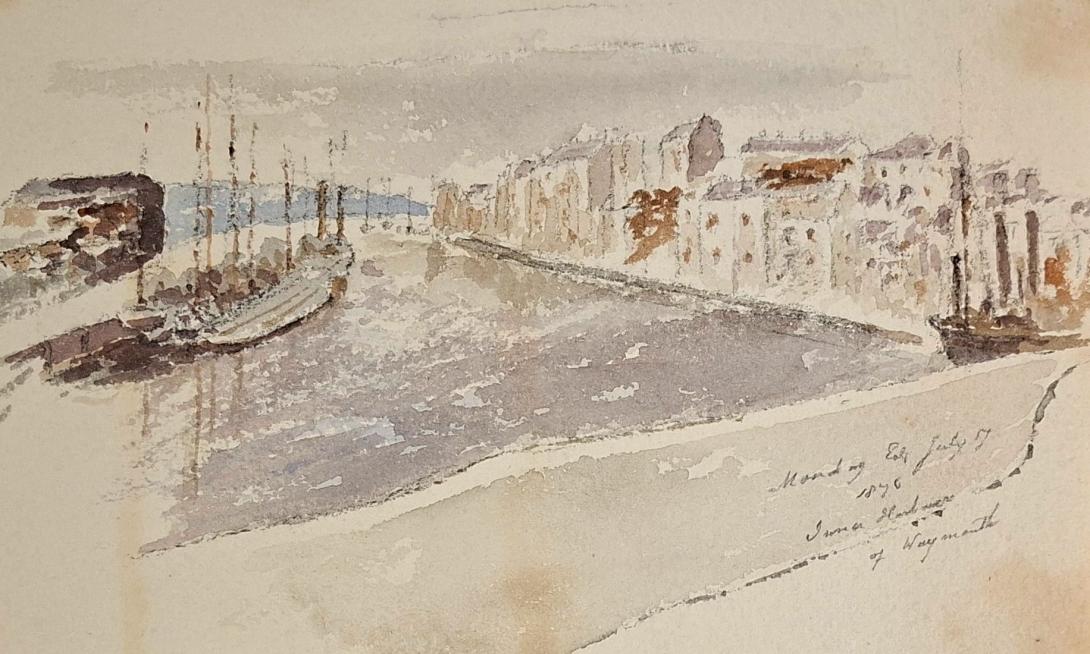
Inner Harbour of Weymouth Monday July 17th 1876
Weymouth Inner Harbour's history spans from Roman times as a supply route to Dorchester, evolving through medieval trade (wool, spices) and the Black Death, becoming a crucial port for the Spanish Armada, and later a Georgian resort and naval base, eventually transforming from a busy cargo port into a modern marina for pleasure boats while still retaining its historic quayside for fishing and ferries, serving as a focal point for the linked towns of Weymouth and Melcombe Regis. The Romans used the natural harbour formed by the River Wey estuary, transporting goods inland to Durnovaria (Dorchester) via the river and Radipole Lake, with evidence of salt and fish farming. Silting led to the loss of the Roman port at Radipole, with the current harbour developing further downstream from the 12th-13th centuries.
By the 14th century, Weymouth was a significant port, supplying ships for the Siege of Calais (1347). The plague entered Britain via Weymouth in 1348, spreading inland from the port. In 1588, English ships sailed from Weymouth to fight the Armada, and a captured Spanish ship was brought into the harbour. In the 1500s, Mayor Hugh Randall ran the town and smuggled treasure, linking to modern pirate festivals.
Royal visits spurred development, turning Weymouth into a fashionable Georgian seaside resort, with the two towns of Weymouth and Melcombe Regis growing on opposite sides, linked by bridges. The harbour became a military base during the Napoleonic Wars, with barracks built and the harbour used for troop movements. Port Decline & Revival: While trade declined somewhat, the port remained important, handling fertiliser and cars in the 20th century. Cross-channel ferry services to the Channel Islands and France began, continuing today. World War II: The harbour served as a key embarkation point for Allied troops heading to Normandy in 1944.
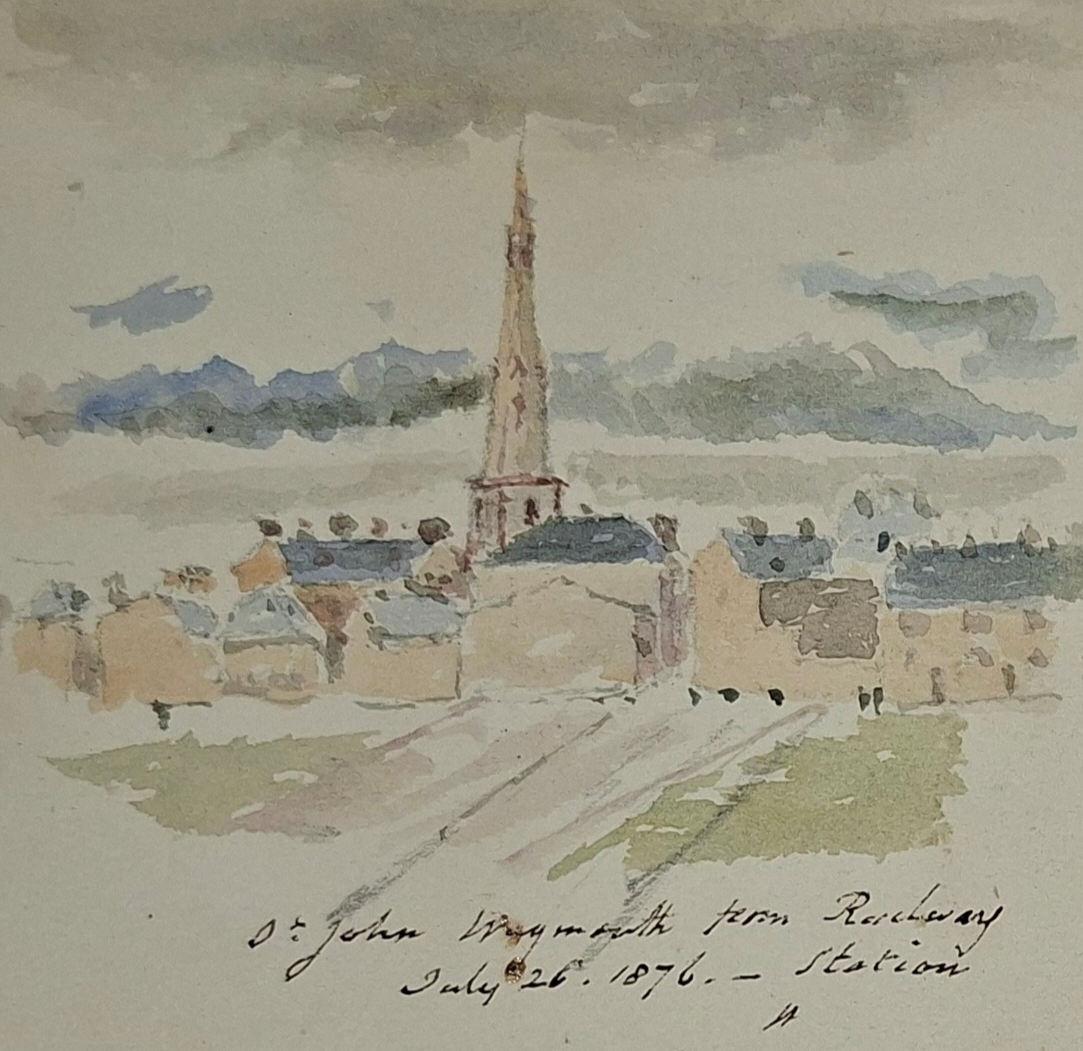
St John's Church is a large evangelical Church of England church in Weymouth, Dorset, England. It was built in 1850–1854 to the designs of Talbot Bury and is a Grade II* listed building.

St John's was built as a chapel of ease for the parish of Radipole at an approximate cost of £3,500. The plans for the new church were drawn up by Talbot Bury of London and provided accommodation for up to 800 people. The foundation stone was laid in front of a large gathering of clergymen and spectators by Rev. Edmund Holland on 10 September 1850.
By the end of 1852, the church's exterior was complete except for the porch. St John's was consecrated by the Bishop of Salisbury, the Right Rev. Walter Kerr Hamilton, on 19 October 1854.
As the parish's population continued to grow during the mid-19th century, the church accommodation provided by St John's was considered inadequate by 1868. Plans for the church's enlargement were drawn up by R. C. Bennett of Weymouth. An additional 320 sittings were provided by the work, which was carried out by T. Dodson of Weymouth.
St John's is built of Ridgeway Hill stone, with dressings in Bath and Caen stone. The south-west tower and spire stands at a height of approximately 150 feet. Original fittings include a pulpit of Caen stone, and a stone reredos and sedilia at the east end of the church. The roof and seating is made of stained and varnished deal.
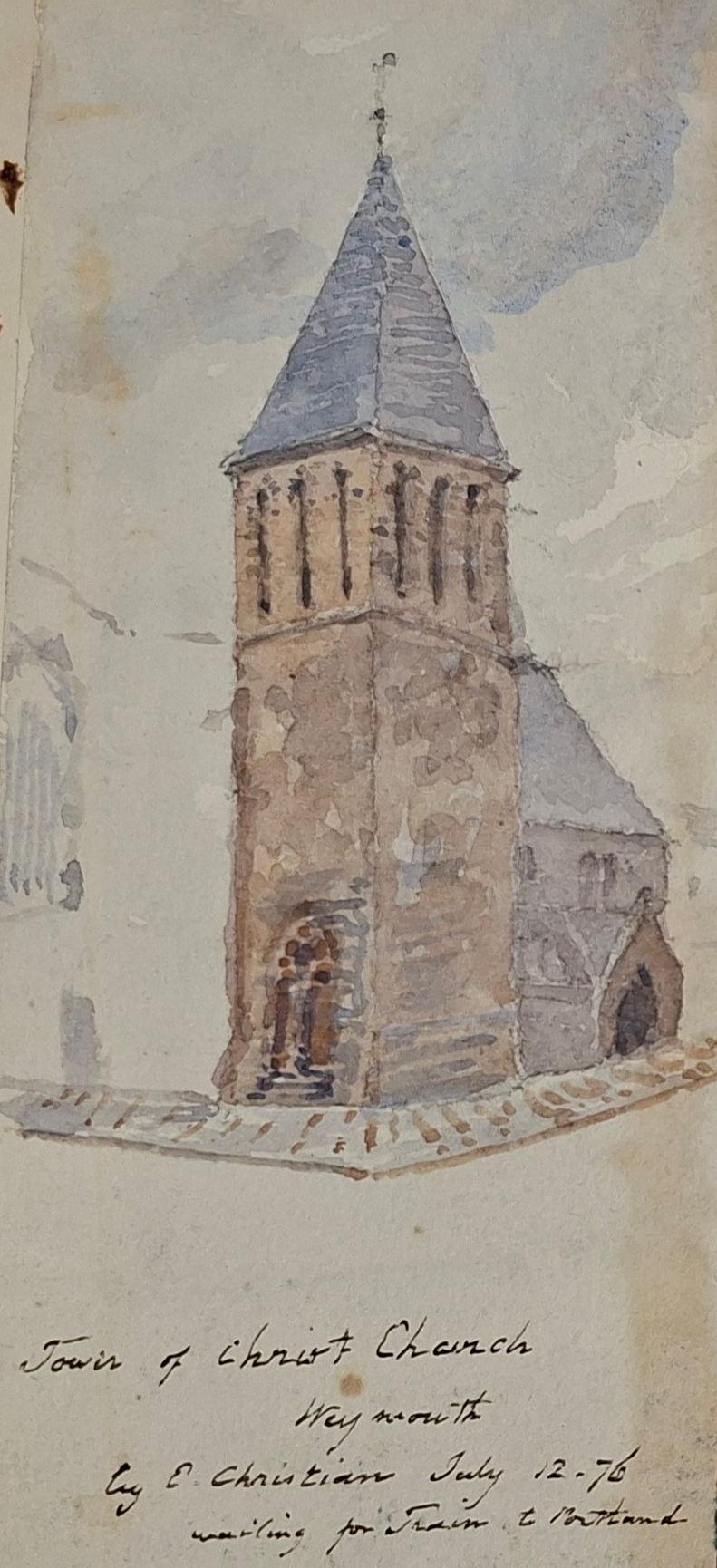
Christ Church was a Church of England church in Weymouth, Dorset, England. It was built between 1873 and 1874 as a chapel of ease to the parish church of St Mary's. It closed as a place of worship in 1939 and was demolished between 1956 and 1957. The site is now occupied by the residential (with retail units) Garnet Court.
Christ Church was built in 1873–74 as a chapel of ease to the parish church of St Mary's, at a time when the population of Weymouth had increased and the town's existing churches were unable to provide enough accommodation. There was a lack of free seats for use by the poorer inhabitants of the parish and the demand for accommodation was even higher during the summer months when there was also an influx of visitors. A meeting was held by the rector of Melcombe Regis, Rev. Talbot A. Greaves, on 7 September 1866, which resulted in the formation of a committee tasked with raising the funds for a new church and a sub-committee for finding an eligible site. An offer from the trustees of the Middle School for the free use of their upper room as a temporary place of worship for up to 300 people was also accepted, along with the approval of a second curate for the parish at an annual stipend of £140.
The site chosen for the new church was on the corner of Park and King Streets in the rapidly expanding "Park District", within the north-west region of the parish, and was conveniently situated opposite Weymouth's train station. It belonged to Colonel Vandeleur and an agreement between him and the Melcombe Regis Home Mission Committee was reached in 1867. It was initially decided to lease the site for 1,000 years at an annual rent of £60 rather than pay £1,200 to buy the freehold, but the decision to purchase the site was made later in the year.
Rev. Greaves would lead the movement for the church and donated £600 of his own money towards it. Many other donations were received and fundraising events held over the next few years. A number of designs were considered for the church, including from at least three local architects, but that of London architect Ewan Christian was chosen in January 1871. Due to the nature of the ground, the architect recommended that concrete foundations should be laid across the entire site prior to any construction work. The tender of local builder Thomas Dodson was accepted for this work in July 1871 and it was carried out in 1872.
Dodson was also hired to construct the church and work began in May 1873, by which time approximately £4,600 had been raised by the Committee. Although no ceremony was held to mark the occasion, one was held on 26 September 1873 when the Lord-lieutenant of the county, Anthony Ashley-Cooper, 8th Earl of Shaftesbury, laid the central stone of the chancel window. Christ Church was consecrated by the Bishop of Salisbury, the Right Rev. George Moberly, on 23 July 1874.
The church cost £6,800 to build, including £4,100 for Dodson's contract, £1,200 for the purchase of the land and £500 for laying the foundations. The foundations were six feet deep across the entire site and, as it was to hold a peal of bells, the tower was strengthened by approximately 3,600 piles, eight feet in length and driven into foundations.There was seated accommodation for 800 people and, with the church being "devote[d] specially to the working classes", half of the seats were free. The church finished in 1874 was approximately two-thirds of the original design and it was anticipated that extension work would be carried out when funds allowed in the future, but this never materialised.
In September 1874, a tower clock was gifted by Mr. Scardaw of Bath at the value of £200 and a peal of ten bells for the tower, along with their fittings, was gifted by the local MP, Henry Edwards, at an approximate cost of £350. The bells were cast by John Taylor & Co of Loughborough and chimed by machinery from Messrs Lund and Blockley of London, who were also responsible for their installation. The £200 for the machinery was funded by money raised at a bazaar held in the summer of 1874. The bells first rang out to mark the beginning of 1875 and this was the first occasion in which the town had heard a peal of bells ring out as the other local churches only had a single bell.
A harmonium was originally installed in the church until funds allowed for the purchase of an organ. In 1889, it was decided to purchase one from St Barnabas' Church in Holloway which was for sale through the organ builder Eustace Ingram. It was built by Bishop & Son of London and had been recently restored by Henry Willis & Sons. The total cost of purchasing and fitting the organ in Christ Church was £227 and it was opened on 9 May 1890.
Richard Suter was born in Greenwich, Kent on 30th March 1798, to William Suter and his wife Sarah Knights. On 7th January 1825 he married Anne Ruth Burn.
English architect. As Surveyor to The Fishmongers' Company he designed the severe Presbyterian churches for Ballykelly (1825–7) and Banagher (1825) on the Company's Estate in County Londonderry, drawings of which were exhibited at the Royal Academy in 1827. He was also responsible for the Model Farm (1823–4), the Lancasterian Schools (1828–30), the Company Agent's House (1830–2—now a hotel, much altered), a range of houses on the south side of the main road (1823–4), the lodge in the Presbyterian churchyard (1828), and the Dispensary (1829), all at Ballykelly, and all Classical. As Surveyor to Trinity House Corporation, he designed houses that were erected by Thomas Cubitt in 1821–3 on a site adjoining Trinity House. For The Fishmongers' Company he designed St Peter's Almshouses, Wandsworth, London (1849–51), and The Old School-House, Gresham's School, Holt, Norfolk(1859), in an Elizabethan style.
On the 1841 Census Richard, an architect and lawyer, can be found living in London with his wife Ann (listed as Ruth) and their two children, Richard George and Andrew Burn. Living with them is Edward D Suter. 1851 finds the family living in Tottenham Court in London, by this time Andrew had left the home, but I am unable to trace him on the 1851 Census. In 1860 Andrew marries Amelia Damaris Harrison. Both Richard George and Andrew were to become ordained ministers, with Andrew later becoming a Bishop and emigrating to New Zealand. Sadly in 1854 Anne Ruth was to pass away. In 1861, widowed Richard, Justice of the Peace for Maidenhead, is living at Castle Hill, Maidenhead, Berkshire. In 1862 he married Elizabeth Anne Pocock. In 1871 and 1881 Richard and Elizabeth are still living in Castle Hill. Richard was to pass away on 1st March1883.
Richard Suter & Annesley Voysey, architects, had their office at number 35 Fenchurch Street, but they did not have it all to themselves as they shared the premises with W.C. Franks, a tea broker, who will get a separate post some other time. The earliest mention I found of Richard Suter in Fenchurch Street is in 1832 when he is listed at that address in a list of contributing members of the Society for the Propagation of the Gospel in Foreign Parts. It says that he had been a member since 1829, but that does not mean he was already at 35 Fenchurch Street in that year.(1) In fact, that seems unlikely as the Sun Fire Office records give Messrs. Short and Co., merchants, as paying the insurance premium on the premises in May 1830. The Directory of British Architects 1834-1914 give the year 1827, but I do not know on what evidence. When Suter and Voysey became partners is also uncertain, but they had known each other since at least 1825 as Suter is named as one of the executors of Voysey’s will which was dated 22 July, 1825. The address given for Suter in the will is Suffolk Street, Southwark. Voysey then lives at Conway Street, Fitzroy Square.