
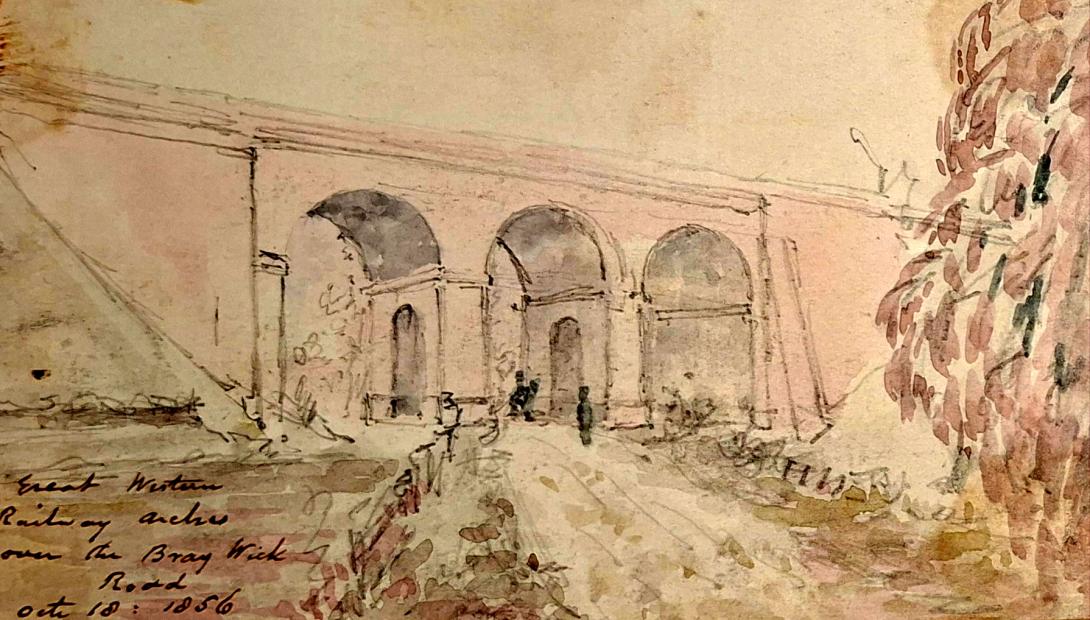
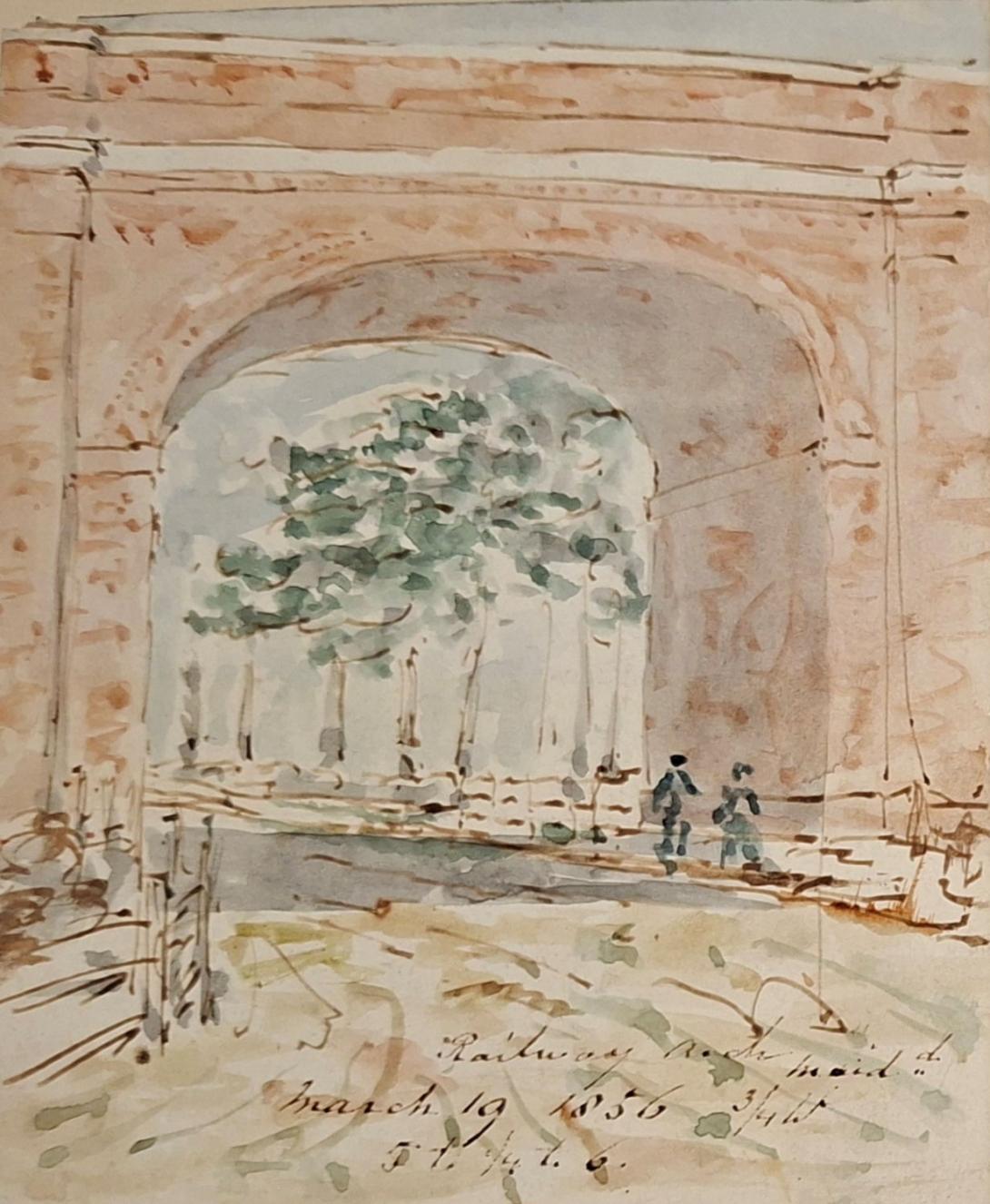
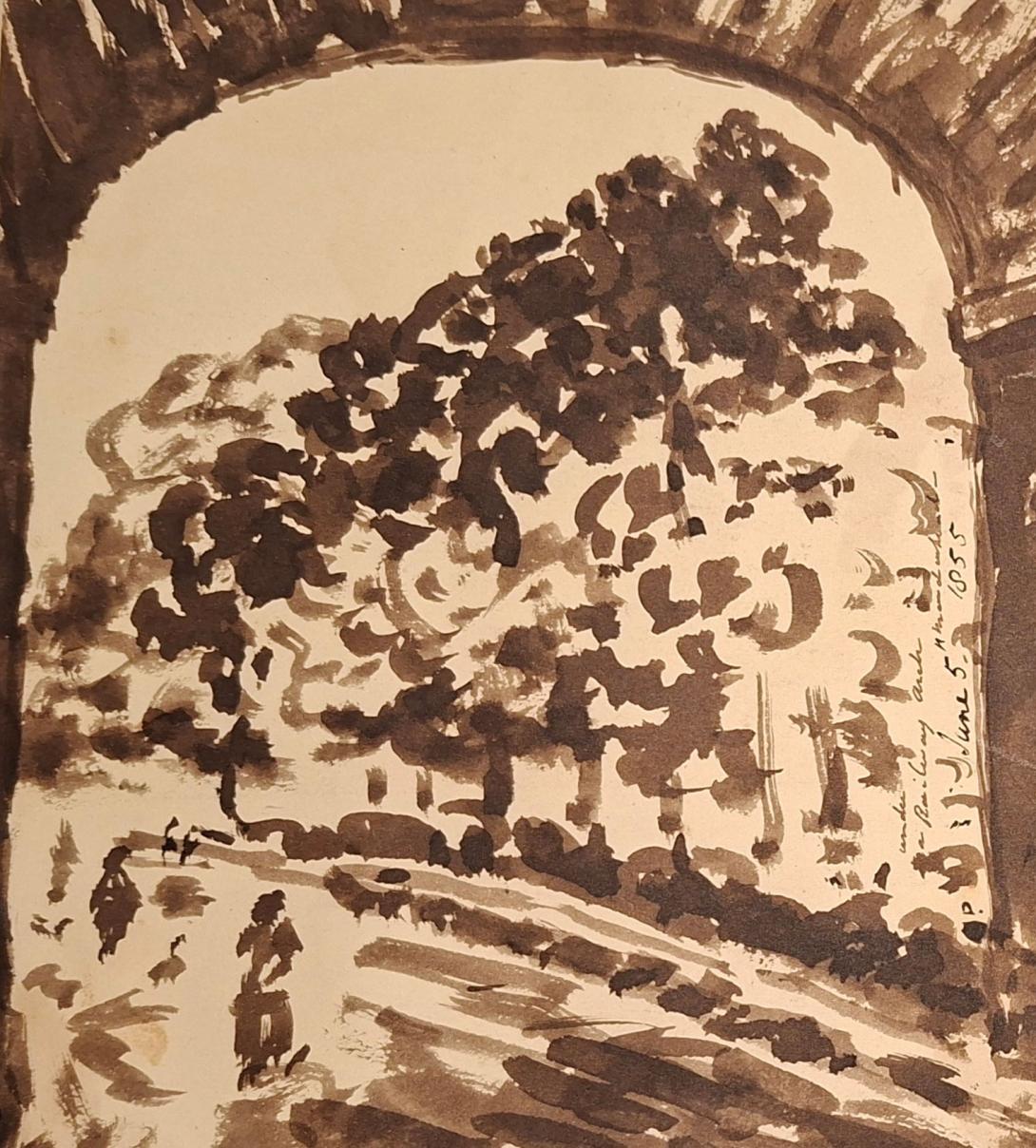
Great Western Railway Arches over the Bray Wick Road Oct 18 1856
Braywick Road in Maidenhead features railway arches that carry the Great Western Main Line, designed by Isambard Kingdom Brunel. The specific railway structure that crosses the River Thames is known as the Maidenhead Railway Bridge, or more famously, the "Sounding Arch" due to its spectacular echo.When completed in 1838 (opened in 1839), its two semi-elliptical brick arches were the widest and flattest in the world, a significant engineering achievement for its time.Brunel designed the arches with an unprecedented span of 128 feet (39 meters) but a rise of only 24 feet (7.3 meters), necessary to maintain a flat, gentle gradient for the railway line.The bridge crosses the River Thames between Maidenhead and Taplow. The Thames towpath passes directly under one of the arches, allowing public access and the chance to experience the famous echo. Braywick Road goes underneath the railway line, passing through a different set of arches closer to the town centre and Maidenhead station area. The arches on Braywick Road were widened in the early 1980s as part of the town's Western Relief Road project.
Maidenhead was the first terminus of the Great Western when it started services from Paddington in 1838, though the original station for the town was the one now called Taplow, on the London side of the bridge: it was not until 1878 that the current Maidenhead station opened. The line was swiftly expanded westwards to Twyford (1839), Reading (1840) and on via Pangborne and Goring, where it passes through the Chilterns, to Swindon (all reached in 1840) and Bristol (1841).
First time travellers on the branch line from Maidenhead to Marlow are often surprised when the train reverses direction at Bourne End. It is easy to assume that you have somehow missed your stop and that the train is now heading back to Maidenhead. But no, the train soon curves away to the west and across the floodplains of the Thames towards Marlow.

A detail of the canopy at Paddington
Why does the train reverse direction in this way? The answer is that the line to Bourne End once went on to High Wycombe, and Marlow was just a branch line off it. This line was in fact only the second line to be built up into Chiltern Hills - the first being the London to Birmingham line that passed through Berkhamsted and Tring in 1838 (see Beginnings). When the Maidenhead to High Wycombe line was built, there were no Chiltern lines out of Marylebone and no Metropolitan Line out of Baker Street. It was to be thirty years before the High Wycombe line had any competition.
The Wycombe Railway opened in 1854, nominally as an independent company, but with the intention of being taken over by the Great Western Railway, as indeed happened in 1867. It was one of several branch lines off the GWR's main line out of Paddington: the one to Henley opened three years later. The Wycombe line ran via Cookham and was built in single track, in classic branch line style, as it remains to this day.
High Wycombe was not the terminus for long. In 1862 the line was extended to Princes Risborough, becoming the first railway to reach that town. There was an intermediate station at West Wycombe - near the famous caves - which closed in 1958, but no station at Saunderton until 1901. Barely had this opened when in 1913 it was burnt down by suffragettes, one of several similar attacks.
Once past Princes Risborough, the line was liberated from the confines of the Chilterns and spread out in several directions across the flat plains beyond. In 1863 a line was built to Aylesbury: this is the line that goes through Monks Risborough and Little Kimble, and once again it is still single track. (This was not, incidentally, the first line to Aylesbury: a branch had been built to the town from Cheddington on the London to Birmingham line as early as 1839. There was also a branch line from Watford to Rickmansworth, opened in 1862: both lines closed in the early 1950s, though Rickmansworth and Watford remain linked by the Metropolitan Line, built 30 years later: see below.)
Another line from Princes Risborough went to Thame, reached in 1862, and by 1864 this route had linked up to a junction on the GWR line between Didcot and Oxford (which is only 23 miles from Princes Risborough). There was also a short line south westwards from Princes Risborough to Chinnor and Watlington, opened in 1872 (see Lines we lost).
Rather surprisingly given that it was quite a substantial town, the branch line to Marlow did not open until 1873, 19 years after the Wycombe Railway had started services. It was built from Bourne End (until then known as 'Marlow Road') by the Great Marlow Railway Company - a vehicle for local investors. The name did not reflect any affiliation with the Great Western: the town itself was known as Great Marlow until the end of the nineteenth century, to distinguish it from the nearby village of Little Marlow - but right from the start the Great Western Railway operated the branch, and went on to buy it in 1897. The train on this route was known as the ‘Marlow Donkey’ (the nickname of the type of locomotive used, a shunter designed for dock work, though one likes to think it may have been a term of affection or an unflattering reference to its speed). This explains the name of the pub near Marlow station today.
The Great Western Railway is of course one of the most celebrated of Victorian railway companies, and it is the only one to have kept its identity intact until the present day. In the 'grouping' of 1923, when the Victorian companies were merged into four large ones at the urging of the government (see The golden age of the railways), the GWR kept its name and network, and merely added some other minor railways. From 1947, under nationalisation, it was the British Railways Western Region, but since privatisation in 1996-7 the franchise is once again known by its original Victorian name. Parts of its infrastructure were recognised in 1999 as UNESCO World Heritage Sites.
The GWR’s chief engineer and creative genius was the famous Isambard Kingdom Brunel. Much has been written about his various engineering marvels, but for our purposes two are worth mentioning. One is Paddington Station itself. The present structure opened in 1854, replacing an earlier station to its immediate north west, and is the oldest London terminus still in its original form (the main addition being the fourth span of the roof, added in 1910). Its once rather grimy canopy has now been fully cleaned and restored and has an opulence (see photo) that you find in no other major terminus. (The earlier station, incidentally, was right on the edge of London when it opened, surrounded by fields: it became a freight terminal and lasted in this role, through various redevelopments, until 1975.)
The other point to note is that Brunel built the main line out of Paddington to be as straight, and flat as is humanly possible: this was to make his trains fast, though the fact that he built the line to a wide 7ft gauge (ie track width: as opposed to the 4ft 8.25 inches that was standard on the rest of the rail network) also meant he needed to avoid tight curves. The wider gauge was more expensive to build, however - Brunel was an engineering genius, not a business one - and made connection with other railway companies' lines impossible. In the end the GWR bowed to the inevitable and changed its tracks to standard gauge. The Wycombe branch was converted in one week in August 1870, though some GWR lines remained broad gauge until 1892.

The famous flat-arched bridge at Maidenhead
Brunel’s obsession with keeping his railway line flat can be seen in his bridge across the Thames at Maidenhead, which can be seen close up on the Maidenhead to Marlow walk. Opened in 1839, this has the two flattest brick arches ever built – 128 feet or 39 metres wide, but only 24 feet or 7 metres high - and was built this way to keep gradients on this stretch of line down to just 1 foot in 1,320. This bridge is the one that features in the famous 1844 Turner painting Rain, Steam and Speed, now in the National Gallery.
Richard Suter was born in Greenwich, Kent on 30th March 1798, to William Suter and his wife Sarah Knights. On 7th January 1825 he married Anne Ruth Burn.
English architect. As Surveyor to The Fishmongers' Company he designed the severe Presbyterian churches for Ballykelly (1825–7) and Banagher (1825) on the Company's Estate in County Londonderry, drawings of which were exhibited at the Royal Academy in 1827. He was also responsible for the Model Farm (1823–4), the Lancasterian Schools (1828–30), the Company Agent's House (1830–2—now a hotel, much altered), a range of houses on the south side of the main road (1823–4), the lodge in the Presbyterian churchyard (1828), and the Dispensary (1829), all at Ballykelly, and all Classical. As Surveyor to Trinity House Corporation, he designed houses that were erected by Thomas Cubitt in 1821–3 on a site adjoining Trinity House. For The Fishmongers' Company he designed St Peter's Almshouses, Wandsworth, London (1849–51), and The Old School-House, Gresham's School, Holt, Norfolk(1859), in an Elizabethan style.
On the 1841 Census Richard, an architect and lawyer, can be found living in London with his wife Ann (listed as Ruth) and their two children, Richard George and Andrew Burn. Living with them is Edward D Suter. 1851 finds the family living in Tottenham Court in London, by this time Andrew had left the home, but I am unable to trace him on the 1851 Census. In 1860 Andrew marries Amelia Damaris Harrison. Both Richard George and Andrew were to become ordained ministers, with Andrew later becoming a Bishop and emigrating to New Zealand. Sadly in 1854 Anne Ruth was to pass away. In 1861, widowed Richard, Justice of the Peace for Maidenhead, is living at Castle Hill, Maidenhead, Berkshire. In 1862 he married Elizabeth Anne Pocock. In 1871 and 1881 Richard and Elizabeth are still living in Castle Hill. Richard was to pass away on 1st March1883.
Richard Suter & Annesley Voysey, architects, had their office at number 35 Fenchurch Street, but they did not have it all to themselves as they shared the premises with W.C. Franks, a tea broker, who will get a separate post some other time. The earliest mention I found of Richard Suter in Fenchurch Street is in 1832 when he is listed at that address in a list of contributing members of the Society for the Propagation of the Gospel in Foreign Parts. It says that he had been a member since 1829, but that does not mean he was already at 35 Fenchurch Street in that year.(1) In fact, that seems unlikely as the Sun Fire Office records give Messrs. Short and Co., merchants, as paying the insurance premium on the premises in May 1830. The Directory of British Architects 1834-1914 give the year 1827, but I do not know on what evidence. When Suter and Voysey became partners is also uncertain, but they had known each other since at least 1825 as Suter is named as one of the executors of Voysey’s will which was dated 22 July, 1825. The address given for Suter in the will is Suffolk Street, Southwark. Voysey then lives at Conway Street, Fitzroy Square.