
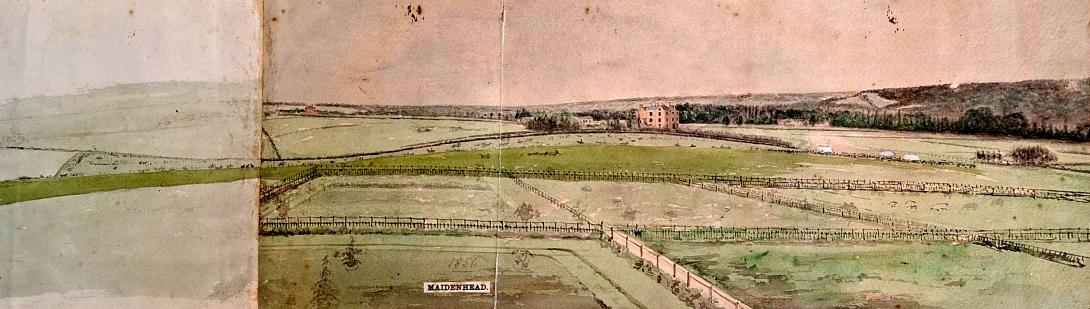
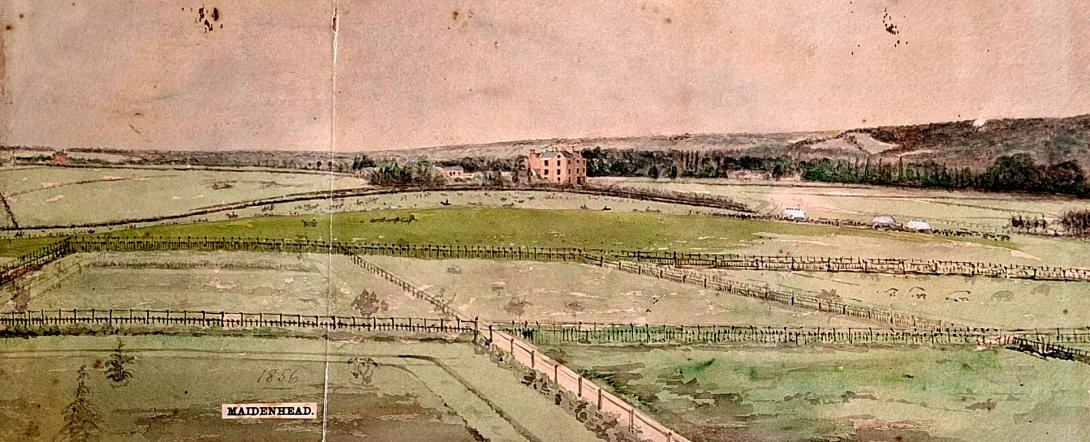
View from … Bed Room Maidenhead with groups looking at the ploughmans Match at the Cattle Show July 1856
The Royal East Berkshire Agricultural Association (REBAA) has held an annual ploughing match and show for over 170 years, suggesting it would have been active in 1856. These events often occurred in September or October after the harvest, rather than July, but specific dates varied by association and year. The skill of ploughing has traditionally been the foundation for successful farming and, for over 100 years, the REBAA Ploughing Match has drawn ploughmen and women from a wide area who bring a mix of modern and vintage equipment to pit their skills against one another. The event is a magnificent ploughing spectacle for the general public as well as the farming community. The ploughing, together with tractor rides, trade stands and stalls and a popular fun dog show, attract visitors from across the area.
"Castle Hill House" in Maidenhead refers to the former Yeomanry House, an 18th-century building on Castle Hill, Reading (near Maidenhead), that was later the site of the Royal Berkshire Archives (RBA), a purpose-built record office opened in 2000, itself sitting atop a site with Roman villa ruins and earlier structures. The hill itself was once Folly Hill, possibly named for the Roman ruins, and the area has historical significance, with the current RBA building replacing the older Yeomanry House.
Roman Origins: The hill was known as Folly Hill, likely due to Roman villa ruins discovered there, suggesting early settlement. Yeomanry House: In the 18th century, Yeomanry House (formerly Castle Hill House) stood on the site, a landmark in the area. Landmark Trust Property: A building on South Street, Cawsey House, also had a history with underground discoveries suggesting older structures, but this isn't the main Castle Hill House.
Castle Hill House SU 9676 NE 3/6A II GV 2. Corner site between Church Street and St Alban's Street. Large late C18 town house refaced mid C19 with irregular ashlar and gothic details 3 storeys attic and basement. Mansard slate roof with 2 gabled bargeboarded dormers. Parapet coping. 4 windows and one window space, recessed sashes glazing bars intact. Large 2 storey canted bay window to ground and 1st floors on right hand. Crow stepped gabled porch with pointed archway. 4 window return elevation, 2 blind. Windows have cast iron flower guards. C18 wrought iron area railings with urn shaped finials to standards. Nos 2 to 4 (consec). Nos l0 and 11 and Castle Hill House form a group.
Richard Suter was born in Greenwich, Kent on 30th March 1798, to William Suter and his wife Sarah Knights. On 7th January 1825 he married Anne Ruth Burn.
English architect. As Surveyor to The Fishmongers' Company he designed the severe Presbyterian churches for Ballykelly (1825–7) and Banagher (1825) on the Company's Estate in County Londonderry, drawings of which were exhibited at the Royal Academy in 1827. He was also responsible for the Model Farm (1823–4), the Lancasterian Schools (1828–30), the Company Agent's House (1830–2—now a hotel, much altered), a range of houses on the south side of the main road (1823–4), the lodge in the Presbyterian churchyard (1828), and the Dispensary (1829), all at Ballykelly, and all Classical. As Surveyor to Trinity House Corporation, he designed houses that were erected by Thomas Cubitt in 1821–3 on a site adjoining Trinity House. For The Fishmongers' Company he designed St Peter's Almshouses, Wandsworth, London (1849–51), and The Old School-House, Gresham's School, Holt, Norfolk(1859), in an Elizabethan style.
On the 1841 Census Richard, an architect and lawyer, can be found living in London with his wife Ann (listed as Ruth) and their two children, Richard George and Andrew Burn. Living with them is Edward D Suter. 1851 finds the family living in Tottenham Court in London, by this time Andrew had left the home, but I am unable to trace him on the 1851 Census. In 1860 Andrew marries Amelia Damaris Harrison. Both Richard George and Andrew were to become ordained ministers, with Andrew later becoming a Bishop and emigrating to New Zealand. Sadly in 1854 Anne Ruth was to pass away. In 1861, widowed Richard, Justice of the Peace for Maidenhead, is living at Castle Hill, Maidenhead, Berkshire. In 1862 he married Elizabeth Anne Pocock. In 1871 and 1881 Richard and Elizabeth are still living in Castle Hill. Richard was to pass away on 1st March1883.
Richard Suter & Annesley Voysey, architects, had their office at number 35 Fenchurch Street, but they did not have it all to themselves as they shared the premises with W.C. Franks, a tea broker, who will get a separate post some other time. The earliest mention I found of Richard Suter in Fenchurch Street is in 1832 when he is listed at that address in a list of contributing members of the Society for the Propagation of the Gospel in Foreign Parts. It says that he had been a member since 1829, but that does not mean he was already at 35 Fenchurch Street in that year.(1) In fact, that seems unlikely as the Sun Fire Office records give Messrs. Short and Co., merchants, as paying the insurance premium on the premises in May 1830. The Directory of British Architects 1834-1914 give the year 1827, but I do not know on what evidence. When Suter and Voysey became partners is also uncertain, but they had known each other since at least 1825 as Suter is named as one of the executors of Voysey’s will which was dated 22 July, 1825. The address given for Suter in the will is Suffolk Street, Southwark. Voysey then lives at Conway Street, Fitzroy Square.