
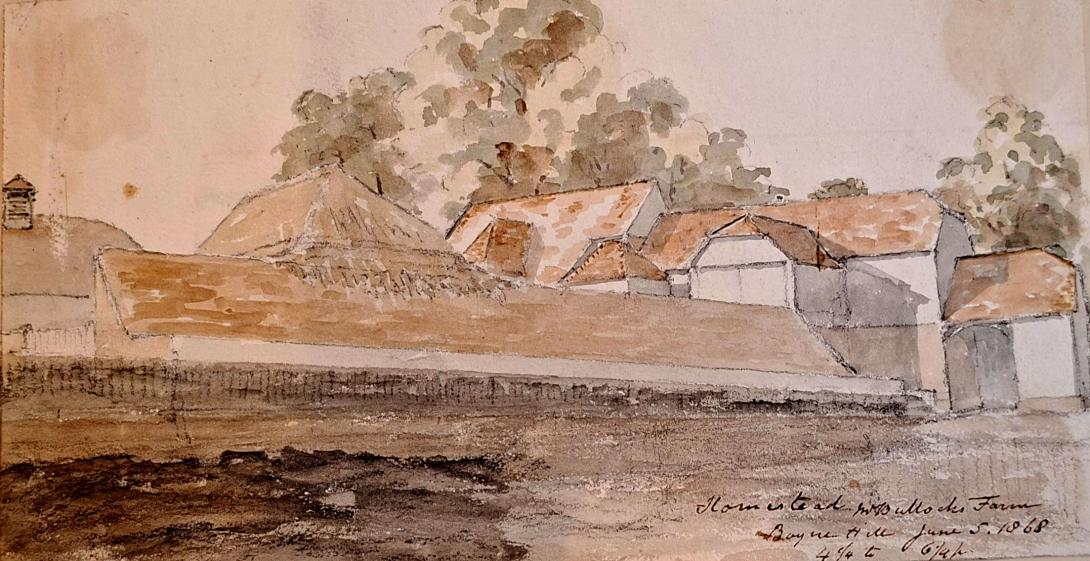
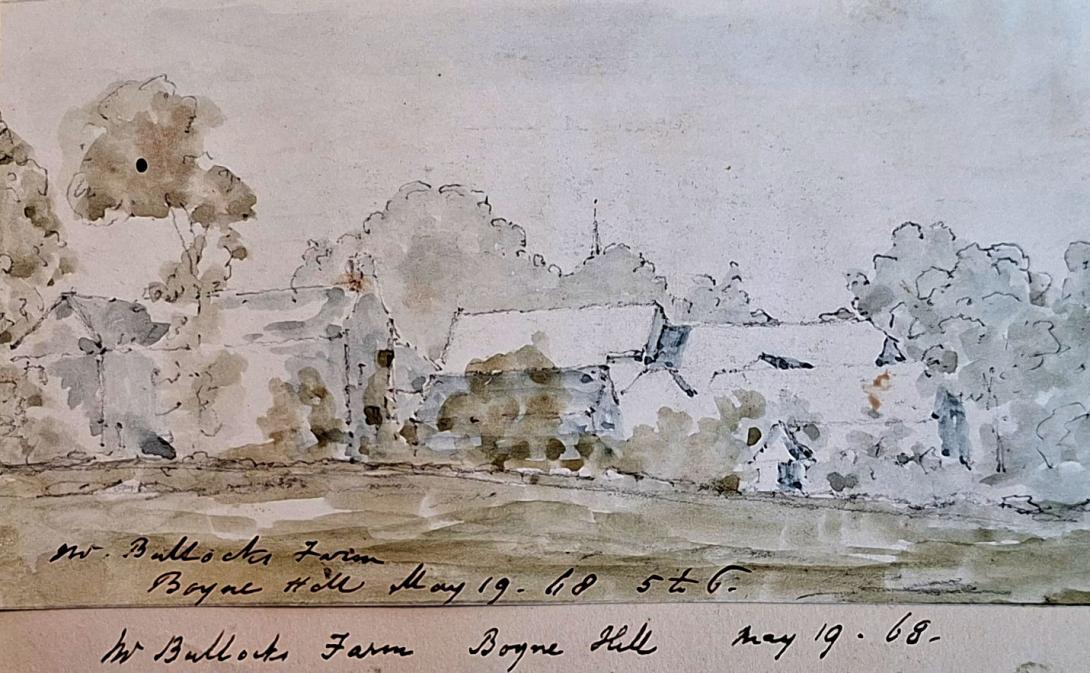
Homestead Mr Bullocks Farm Boyne Hill June 5th 1868 and Mr Bullocks Farm Boyne Hill May 19 68 5 to 6" (2)
Norden Farm, now a well-known arts center in Maidenhead, was originally a dairy farm in the Boyn Hill (Altwood) area. Historical records from June 1868 document a tragic accident at the farm involving a young worker and a threshing machine. In the 19th century, the farm was operated by the Bullock family, who were prominent local farmers. The site still retains its original Georgian Farmhouse and an 18th-century Long Barn, both of which are Grade II listed buildings. Norden Farm is built on the site of an ancient Dairy Farm. The site includes two original, listed buildings; a Georgian Farmhouse and 18th Century Long Barn.
Early C19 farmhouse, 2 storeys. Small front to deep square building, double flanking chimney. Red brick, flat moulded eaves on pairs of cut wood brackets. High pitched roof of 'Ton' slates laid in diminishing courses, gable parapets. 3 windows on 1st floor, 2 large windows on ground floor. All double hung sashes with glazing bars. Centre modern flush door in arched recess, arched radiating fan-light under bold Doric porch of 2 columns and wall pilasters, entablature with block triglyph frieze and flat moulded pediment. Pevsner p 176.
June 5, 1868 On this date, a 13-year-old boy named William Kimber, employed by Mr. Bullock at Norden Farm, was fatally injured while working with a horse-powered threshing machine. Reports from the time indicate that Kimber’s clothes became entangled in the machinery's "revolving shaft" or "horse-gear" while the machine was in motion. He was pulled into the mechanism, resulting in severe injuries. He died shortly after being extricated. A coroner’s inquest held at the farm a few days later returned a verdict of "accidental death."
Boyne Hill, at Maidenhead in Berkshire, twenty-five miles west of London, was the birthplace of the painter Malcolm Drummond. Despite living in London from 1903, Drummond frequently returned to visit the family home at Boyne Hill, and the church, house and garden appear in a number of works.
For this view of his parents’ house, Drummond set up his easel in the back courtyard behind the vicarage, to see the point where their home, at the right, joined with the adjacent school buildings, on the left.
Like the work of his close friend and fellow Camden Town Group member Charles Ginner, many of Drummond’s paintings show his interest in architecture. Both artists liked to record mundane, everyday views of backstreets and buildings, with the focus on the visual spectacle of contrasting façades, varying rooflines and the decorative patterning of windows and chimneys.
Richard Suter was born in Greenwich, Kent on 30th March 1798, to William Suter and his wife Sarah Knights. On 7th January 1825 he married Anne Ruth Burn.
English architect. As Surveyor to The Fishmongers' Company he designed the severe Presbyterian churches for Ballykelly (1825–7) and Banagher (1825) on the Company's Estate in County Londonderry, drawings of which were exhibited at the Royal Academy in 1827. He was also responsible for the Model Farm (1823–4), the Lancasterian Schools (1828–30), the Company Agent's House (1830–2—now a hotel, much altered), a range of houses on the south side of the main road (1823–4), the lodge in the Presbyterian churchyard (1828), and the Dispensary (1829), all at Ballykelly, and all Classical. As Surveyor to Trinity House Corporation, he designed houses that were erected by Thomas Cubitt in 1821–3 on a site adjoining Trinity House. For The Fishmongers' Company he designed St Peter's Almshouses, Wandsworth, London (1849–51), and The Old School-House, Gresham's School, Holt, Norfolk(1859), in an Elizabethan style.
On the 1841 Census Richard, an architect and lawyer, can be found living in London with his wife Ann (listed as Ruth) and their two children, Richard George and Andrew Burn. Living with them is Edward D Suter. 1851 finds the family living in Tottenham Court in London, by this time Andrew had left the home, but I am unable to trace him on the 1851 Census. In 1860 Andrew marries Amelia Damaris Harrison. Both Richard George and Andrew were to become ordained ministers, with Andrew later becoming a Bishop and emigrating to New Zealand. Sadly in 1854 Anne Ruth was to pass away. In 1861, widowed Richard, Justice of the Peace for Maidenhead, is living at Castle Hill, Maidenhead, Berkshire. In 1862 he married Elizabeth Anne Pocock. In 1871 and 1881 Richard and Elizabeth are still living in Castle Hill. Richard was to pass away on 1st March1883.
Richard Suter & Annesley Voysey, architects, had their office at number 35 Fenchurch Street, but they did not have it all to themselves as they shared the premises with W.C. Franks, a tea broker, who will get a separate post some other time. The earliest mention I found of Richard Suter in Fenchurch Street is in 1832 when he is listed at that address in a list of contributing members of the Society for the Propagation of the Gospel in Foreign Parts. It says that he had been a member since 1829, but that does not mean he was already at 35 Fenchurch Street in that year.(1) In fact, that seems unlikely as the Sun Fire Office records give Messrs. Short and Co., merchants, as paying the insurance premium on the premises in May 1830. The Directory of British Architects 1834-1914 give the year 1827, but I do not know on what evidence. When Suter and Voysey became partners is also uncertain, but they had known each other since at least 1825 as Suter is named as one of the executors of Voysey’s will which was dated 22 July, 1825. The address given for Suter in the will is Suffolk Street, Southwark. Voysey then lives at Conway Street, Fitzroy Square.