
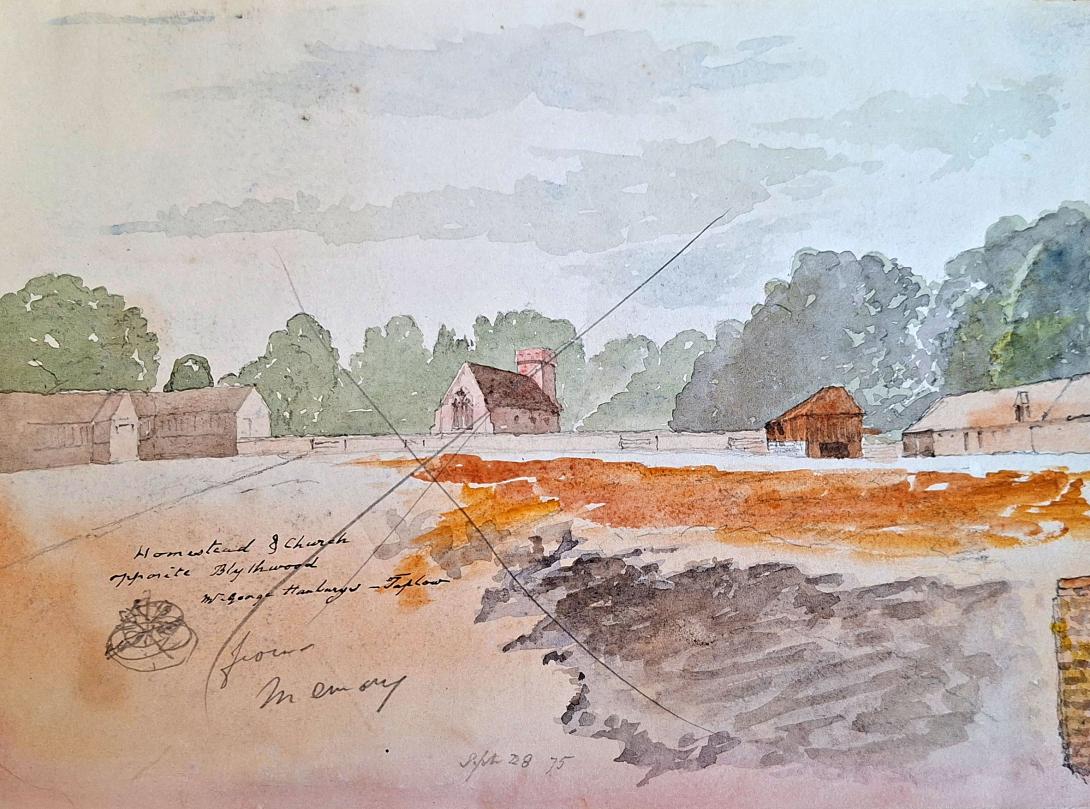
Homestead & Church opposite Blythwood Mr George Hanbury - Taplow sept 28 1875"
The present 'Hitcham House' was originally built for by George Hanbury, the great-grandfather of Robert Hanbury who currently lives in 'Tithe Barn' adjacent to St. Mary's Church to the north of Hitcham Lane. It was built on a parcel of land that George Hanbury purchased in 1866 that was bordered by Hitcham Lane to the north, Hitcham Road to the west, and extended south nearly to Hanbury Close and east towards Lent Rise Road. This land appears to have been totally agricultural and to have had no buildings on it.
An item raised at the General Quarter Session at Aylesbury on 30th December 1867 ( One of the justices at the Session was The Right-Honorable Benjamin Disraeli!) was the closing of a road called 'Love Lane'. The exact location of this road is unclear but, from the various descriptions given in the record of the Session, I believe this road extended south from the junction of The Gore and Hitcham Lane ("from a certain road called the Burnham and Hitcham Road") a "distance of 367 yards and I foot" to the footpath ("to a certain footway leading to Lent"), and would explain the Z-bend that now exists at that point in Hitcham Lane. This road appears to have been the eastern boundary of the parcel of land on which Hitcham House was built and was closed on the grounds of it being no longer required. Can anyone confirm that this was the location of Love Lane?
The building contractor used was the firm of Messrs. Holland & Hannen under the control of architect Professor Roger Smith. Site works commenced in 1866 and appears to have lasted until June 1868. An additional acre of land (where Hanbury Close now stands) was purchased in 1872. At that time, however, the house was called 'Blythwood'. It only became 'Hitcham House' after the Hanbury family purchased the land to the north of Hitcham Lane on which the original 'Hitcham House' had stood, located close to the site of the present 'Hitcham Park Cottage'. At one time, Queen Elizabeth I visited Sir Nicholas Clarke at 'Hitcham House' and reportedly said that he was a very rude man and she would not visit him again! At some time, the site was occupied by a monastery and 'Stew' ponds were created to provide a guaranteed source of fish. Finally, a Georgian house was built on the site, used as a school at some time, but was demolished in 1804 after a fire. Some of the bricks from this house were reputed to have been used in the building of 'Dropmore'. The date of the name change from 'Blythwood' to 'Hitcham House' is uncertain as the plan showing the land purchased north of Hitcham Lane is not dated. Until George Hanbury died in 1911 the name 'Blythwood' appears to have remained in use. Between 1912 and 1914, building alterations were made by his son, Lionel, and 1914 appears to be the most likely date of the name change coinciding with Lionel moving in.
An undated plan shows a building north-west of the junction of Hitcham Road and Hitcham Lane which is now called 'Cloverdown House'. This house appears to have been built around 1868 as a school for the children of servants employed at 'Blythwood'. Robert Hanbury adds that, if so, George Hanbury would have owned that land and arranged the building of the school (as he did the Vestry and Reading Room). Another large plot of land, south of Hitcham Lane opposite 'Cloverdown House', bordered by Hitcham Lane and Hitcham Road, appears to have been given to the Church by George Hanbury sometime before 1897, at which time the Rectory for St. Mary's Church was built there. The undated plan also raises some interesting questions about the bridle path shown running almost in a straight line from beside 'Cloverdown House' to Huntswood Lane. When did it get diverted around the old chalk pit to join another existing path? If it had remained as it was, it would now run right across Huntswood Golf Club course.
Skipping ahead now to the 20th century, here are some more recent activities involving Hitcham. House and its estates:
During the Great War, Home Farm (now called 'Hitcham House Farm' with its entrance off Lent Rise road) was occupied in March 1915 by the Kent Heavy Battery. It was also used as billets by the 2nd/4th Royal Berkshire Regiment, which was raised and commanded by Colonel L H Hanbury CMG VD. This Regiment moved to France in June 1916. In World War 11, 'Hitcham House' was partly occupied by the RAF Police (with Lionel Hanbury residing in one wing of the house only) and the RAF occupied both gate lodges. There was also a prison camp for Italian and other prisoners-of-war in the field on the north side of Hitcham Lane adjacent to the Gore.
According to Beryl Montague (who now lives in Church Lodge opposite St. Mary's Church), 'Hitcham House' and its stable block was sold to the then Windsor Group Hospital Management Committee (now East Berks health Authority) sometime between 1950 and 1952 for the princely sum of £17,000. As late as March 1949 Beryl's husband, John, was working for the Hanbury family as a gardener at 'Hitcham House', at which time he enlisted in the Royal Marines. After minor alterations to the interior of the main house, it opened as a hostel for student nurses of the Canadian Red Cross Hospital in March 1953. Beryl first lived in 'Hitcham House' as a student nurse in the 1950's. The stable block was converted into a School of Nursing in the mid-1960's with the loose boxes becoming offices, the stables two large classrooms, and the carriage room a very large practical room. After raising her own family, Beryl returned there in the 1970's, first as a nurse and then working as a nurse teacher. Her recollections make fascinating reading:
"On entering the front door, you walked into a very large hall complete with various animal heads peering somewhat abjectly at you from the back wall, The very large dining room had been divided up with stud walls to make 3 or 4 small bedrooms. As these rooms had floor-length windows through which boyfriends could come and go, they were allotted to senior students. Having said that, woe betide anyone caught with a man in her rooms. Instant dismissal was not uncommon in those days! Bob Hanbury's grandfather came to see the house soon after we had moved in and he told us that our sitting-room had been his library, our classroom his lounge and, much to his amusement, his garden room had been transformed into a Practical room complete with beds, dummies and various hospital equipment. The stable block at that time was just as it had been left, with cobbled courtyard complete with mounting block. Peering through the windows one could see looseboxes, stables and carriage stores. The rooms above the stables were used as night nurses quarters -the theory being that it would be quieter away from the main house. Unfortunately, no-one told the bell-ringers at the church! A 4-hour peal (and there were lots of them in those days) did nothing for your temper or your beauty sleep.
Although Hitcham House was ‘home’, there was still a lot of formality within it, mainly because tutors lived there too. For instance, you couldn't go downstairs in dressing gown and slippers, and to go down to a meal in an incomplete uniform was just asking for trouble. The doors were locked at 10pm and it was not unusual to see the Senior Tutor silhouetted at her first-floor windows as you rushed up the drive a few minutes before ten. Thanks to a lovely crowd of local women, in your room at least you could have a homely feel. They worked part-time, two to each floor, cleaning the rooms. As they got to know their students, and vice-versa, they became surrogate mums. They got us out of all sorts of scrapes, looked after us when we were ill and, if we were on night duty, we would often come back to find a hot-water bottle in our bed and a hot drink in our locker. They really were our guardian angels.
I came back to nursing in the 1970's after having my own family. After further training myself, I trained pupil nurses in the converted stable block. We had a lot of foreign pupils,-mainly from Malaya and the Philippines. At the end of the first week with us, mainly to check their written English, we used to get them to write down their first impressions. Regarding Hitcham House itself, some thought it was a lovely old house whilst others found it 'spooky' and were convinced it was haunted. The only 'ghost' story that I thought remotely believable was one pupil feeling a distinct tug on the hem of her extremely short skirt, as if to pull it down over her knees. From what I have heard about Bob Hanbury's stern grandmother, that mini-skirt would have provoked her spirit into action if anything could.”
By the end of the 70's, it was becoming obvious that Hitcham House would not be needed by the hospital for much longer. The upkeep was enormous, more students lived out, training had changed, and the Hospital was to be closed. In 1982, the training school moved into one of the now redundant wards at the Hospital and Hitcham House was closed up.”
The first recorded Rector of Hitcham was called John the Clerk and he came to the parish in 1167. The nave at Hitcham was built in the 12th century and there are four windows on the north and south sides of the nave which provided light for services. At the east end of the nave are two two-light windows (one near the pulpit and one opposite) which were added in the 14th century.
A 14th century Norman arch divides the chancel from the nave. The tower was built in the 16th century and contains six bells. The pulpit and its sounding-board are from the 17th century, as were the oak box pews. The pews were removed a hundred years ago and parts were used to panel the church porch. The most valuable item in the church is the painted glass in the chancel windows. It dates back to the reign of Edward III (1327-1377) whose son, the Black Prince, was lord of the manor of Hitcham.
In the churchyard there is a tomb with an icon let into the stonework at its foot. This is the burial place of Prince Alexis Dolgorouki of Russia and his English wife, they lived in Nashdom, near Hitcham.
There are mermaid tiles in the chancel. They date from the fourteenth century - so really very old. Quite why mermaids appear when we are so far from the sea is a mystery. Below is a modern reproduction to give an idea of what they would have looked like; a photograph of the tiles in the chancel and a photograph showing where the tiles are situated – between the two memorial stones in the centre of the tiled area. There seems to be at least 4 mermaids.
Alan Woodley has put together a fascinating history of Hitcham. Did you know that up until 1530 there were no pews or pulpit at St Mary’s – the congregation knelt on straw whilst the Lord of the Manor sat in the chancel? Can you imagine that!
Richard Suter was born in Greenwich, Kent on 30th March 1798, to William Suter and his wife Sarah Knights. On 7th January 1825 he married Anne Ruth Burn.
English architect. As Surveyor to The Fishmongers' Company he designed the severe Presbyterian churches for Ballykelly (1825–7) and Banagher (1825) on the Company's Estate in County Londonderry, drawings of which were exhibited at the Royal Academy in 1827. He was also responsible for the Model Farm (1823–4), the Lancasterian Schools (1828–30), the Company Agent's House (1830–2—now a hotel, much altered), a range of houses on the south side of the main road (1823–4), the lodge in the Presbyterian churchyard (1828), and the Dispensary (1829), all at Ballykelly, and all Classical. As Surveyor to Trinity House Corporation, he designed houses that were erected by Thomas Cubitt in 1821–3 on a site adjoining Trinity House. For The Fishmongers' Company he designed St Peter's Almshouses, Wandsworth, London (1849–51), and The Old School-House, Gresham's School, Holt, Norfolk(1859), in an Elizabethan style.
On the 1841 Census Richard, an architect and lawyer, can be found living in London with his wife Ann (listed as Ruth) and their two children, Richard George and Andrew Burn. Living with them is Edward D Suter. 1851 finds the family living in Tottenham Court in London, by this time Andrew had left the home, but I am unable to trace him on the 1851 Census. In 1860 Andrew marries Amelia Damaris Harrison. Both Richard George and Andrew were to become ordained ministers, with Andrew later becoming a Bishop and emigrating to New Zealand. Sadly in 1854 Anne Ruth was to pass away. In 1861, widowed Richard, Justice of the Peace for Maidenhead, is living at Castle Hill, Maidenhead, Berkshire. In 1862 he married Elizabeth Anne Pocock. In 1871 and 1881 Richard and Elizabeth are still living in Castle Hill. Richard was to pass away on 1st March1883.
Richard Suter & Annesley Voysey, architects, had their office at number 35 Fenchurch Street, but they did not have it all to themselves as they shared the premises with W.C. Franks, a tea broker, who will get a separate post some other time. The earliest mention I found of Richard Suter in Fenchurch Street is in 1832 when he is listed at that address in a list of contributing members of the Society for the Propagation of the Gospel in Foreign Parts. It says that he had been a member since 1829, but that does not mean he was already at 35 Fenchurch Street in that year.(1) In fact, that seems unlikely as the Sun Fire Office records give Messrs. Short and Co., merchants, as paying the insurance premium on the premises in May 1830. The Directory of British Architects 1834-1914 give the year 1827, but I do not know on what evidence. When Suter and Voysey became partners is also uncertain, but they had known each other since at least 1825 as Suter is named as one of the executors of Voysey’s will which was dated 22 July, 1825. The address given for Suter in the will is Suffolk Street, Southwark. Voysey then lives at Conway Street, Fitzroy Square.