
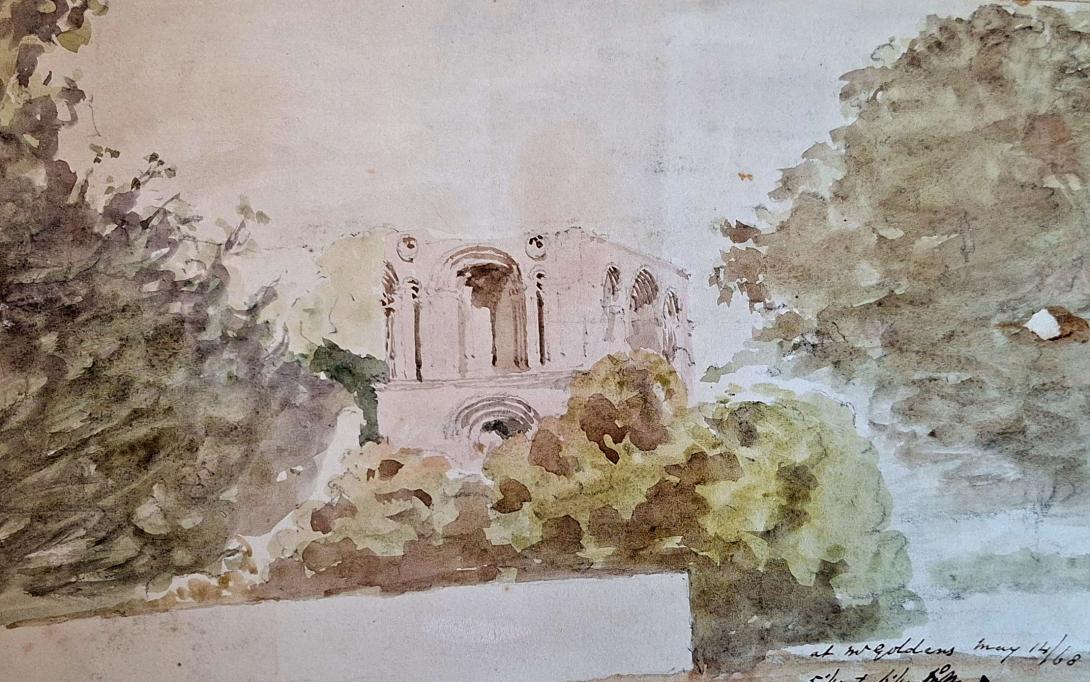
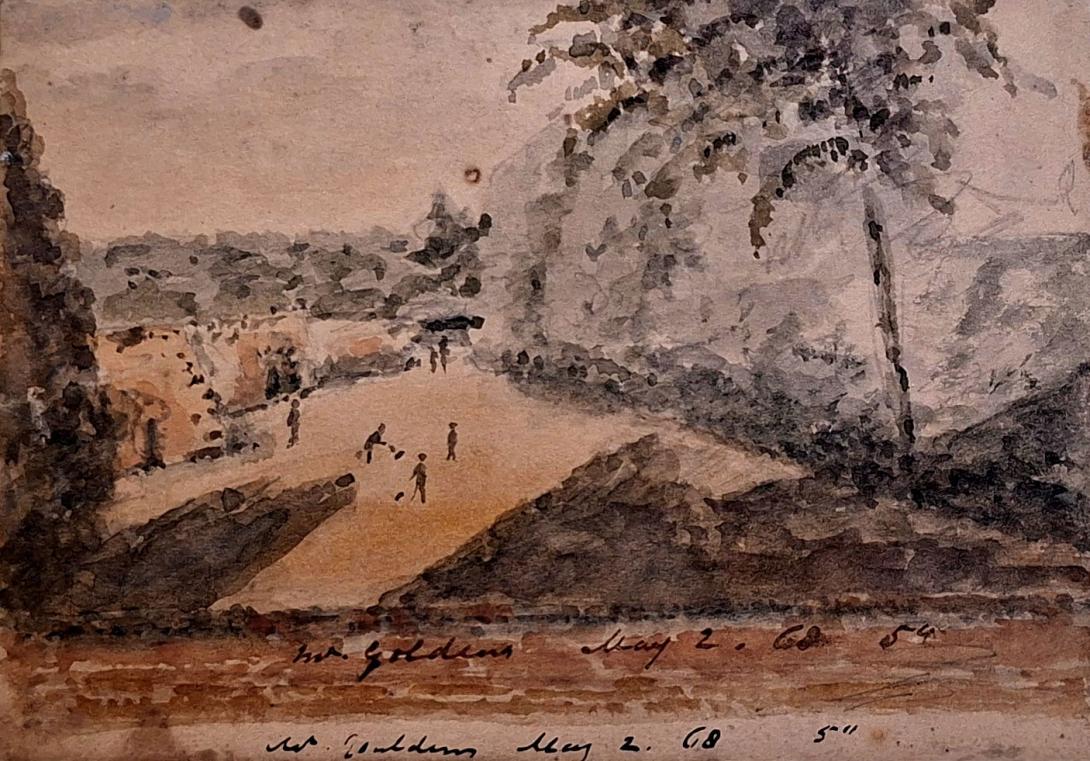
Ruined Building at Mr Golden's Maidenhead May 14 1868
These ruins maybe Reading Abbey ?
Reading Abbey is a large, ruined abbey in the centre of the town of Reading, in the English county of Berkshire. It was founded by Henry I in 1121 "for the salvation of my soul, and the souls of King William, my father, and of King William, my brother, and Queen Maud, my wife, and all my ancestors and successors." In its heyday the abbey was one of Europe's largest royal monasteries. The traditions of the Abbey are continued today by the neighbouring St James's Church, which is partly built using stones of the Abbey ruins.
Reading Abbey was the focus of a major £3 million project called "Reading Abbey Revealed" which conserved the ruins and Abbey Gateway and resulted in them being re-opened to the public on 16 June 2018. Alongside the conservation, new interpretation of the Reading Abbey Quarter was installed, including a new gallery at Reading Museum, and an extensive activity programme.
Abbey Ward of Reading Borough Council takes its name from Reading Abbey, which lies within its boundaries. Now HM Prison Reading is on the site.
The abbey was founded by Henry I in 1121. As part of his endowments, he gave the abbey his lands within Reading, along with land at Cholsey, then in Berkshire, and Leominster in Herefordshire. He also arranged for further land in Reading, previously given to Battle Abbey by William the Conqueror, to be transferred to Reading Abbey, in return for some of his land at Appledram in Sussex.
Following its royal foundation, the abbey was established by a party of monks from Cluny Abbey in Burgundy, together with monks from the Cluniac priory of St Pancras at Lewes in Sussex. The abbey was dedicated to the Virgin Mary and St John the Evangelist. The first abbot, in 1123, was Hugh of Amiens who became archbishop of Rouen and was buried in Rouen Cathedral.
According to the twelfth-century chronicler William of Malmesbury, the abbey was built on a gravel spur "between the rivers Kennet and Thames, on a spot calculated for the reception of almost all who might have occasion to travel to the more populous cities of England". The adjacent rivers provided convenient transport, and the abbey established wharves on the River Kennet. The Kennet also provided power for the abbey water mills, most of which were established on the Holy Brook, a channel of the Kennet of uncertain origin.

When Henry I died in Lyons-la-Forêt, Normandy in 1135 his body was returned to Reading, and was buried in the front of the altar of the then incomplete abbey.
Because of its royal patronage, the abbey was one of the pilgrimage centres of medieval England, and one of its richest and most important religious houses, with possessions as far away as Herefordshire and Scotland. The abbey also held over 230 relics including the hand of St James. A shrivelled human hand was found in the ruins during demolition work in 1786 and is now in St Peter's Catholic Church, Marlow. The song Sumer is icumen in, which was first written down in the abbey about 1240, is the earliest known six-part harmony from Britain. The original document is held in the British Library.
Reading Abbey was frequently visited by kings and others, most especially by Henry III who often visited three or four times a year staying several weeks on each visit. It also hosted important state events, including the meeting between Henry II and the Patriarch of Jerusalem in 1185, the wedding of John of Gaunt and Blanche of Lancaster in 1359 and a meeting of Parliament in 1453.
The abbey was mostly destroyed in 1538 during Henry VIII's Dissolution of the Monasteries. The last abbot, Hugh Faringdon, was subsequently tried and convicted of high treason and hanged, drawn and quartered in front of the Abbey Church. After this, the buildings of the abbey were extensively robbed, with lead, glass and facing stones removed for reuse elsewhere.

Some twenty years after the Dissolution, Reading town council created a new town hall by inserting an upper floor into the former refectory of the hospitium of the abbey. The lower floor of this building continued to be used by Reading School, as it had been since 1486. For the next 200 years, the old monastic building continued to serve as Reading's town hall, but by the 18th century it was suffering from structural weakness. Between 1785 and 1786, the old hall was dismantled and replaced on the same site by the first of several phases of building that were to make up today's Reading Town Hall. Around 1787, Henry Seymour Conway removed a large amount of stone from the wall and used it to build Conway's Bridge near his home at Park Place outside Henley.
St James's Church and School was built on a portion of the site of the abbey between 1837 and 1840. Its founder was James Wheble, who owned land in the area at that time. Reading Gaol was built in 1844 on the eastern portion of the abbey site, replacing a small county Gaol on the same site. James Wheble sold the rest of his portion of the abbey site to Reading Corporation to create the Forbury Gardens, which were opened in 1861.
Abbey ruins

The inner rubble cores of the walls of many of the major buildings of the abbey still stand. The only parts of the Abbey Church that still exist are fragments of the piers of the central tower, together with parts of transepts, especially the south transept. In a range to the south of this transept are, in order, the remains of the vestry, the chapter house, the infirmary passage and the ground floor of the dorter or monks dormitory and reredorter or toilet block. The best preserved of these ruins are those of the chapter house, which is apsidal and has a triple entrance and three great windows above. To the west of this range, the site of the cloister is laid out as a private garden and to the south is a surviving wall of the refectory. The ruins are Grade I listed and a Scheduled monument
Richard Suter was born in Greenwich, Kent on 30th March 1798, to William Suter and his wife Sarah Knights. On 7th January 1825 he married Anne Ruth Burn.
English architect. As Surveyor to The Fishmongers' Company he designed the severe Presbyterian churches for Ballykelly (1825–7) and Banagher (1825) on the Company's Estate in County Londonderry, drawings of which were exhibited at the Royal Academy in 1827. He was also responsible for the Model Farm (1823–4), the Lancasterian Schools (1828–30), the Company Agent's House (1830–2—now a hotel, much altered), a range of houses on the south side of the main road (1823–4), the lodge in the Presbyterian churchyard (1828), and the Dispensary (1829), all at Ballykelly, and all Classical. As Surveyor to Trinity House Corporation, he designed houses that were erected by Thomas Cubitt in 1821–3 on a site adjoining Trinity House. For The Fishmongers' Company he designed St Peter's Almshouses, Wandsworth, London (1849–51), and The Old School-House, Gresham's School, Holt, Norfolk(1859), in an Elizabethan style.
On the 1841 Census Richard, an architect and lawyer, can be found living in London with his wife Ann (listed as Ruth) and their two children, Richard George and Andrew Burn. Living with them is Edward D Suter. 1851 finds the family living in Tottenham Court in London, by this time Andrew had left the home, but I am unable to trace him on the 1851 Census. In 1860 Andrew marries Amelia Damaris Harrison. Both Richard George and Andrew were to become ordained ministers, with Andrew later becoming a Bishop and emigrating to New Zealand. Sadly in 1854 Anne Ruth was to pass away. In 1861, widowed Richard, Justice of the Peace for Maidenhead, is living at Castle Hill, Maidenhead, Berkshire. In 1862 he married Elizabeth Anne Pocock. In 1871 and 1881 Richard and Elizabeth are still living in Castle Hill. Richard was to pass away on 1st March1883.
Richard Suter & Annesley Voysey, architects, had their office at number 35 Fenchurch Street, but they did not have it all to themselves as they shared the premises with W.C. Franks, a tea broker, who will get a separate post some other time. The earliest mention I found of Richard Suter in Fenchurch Street is in 1832 when he is listed at that address in a list of contributing members of the Society for the Propagation of the Gospel in Foreign Parts. It says that he had been a member since 1829, but that does not mean he was already at 35 Fenchurch Street in that year.(1) In fact, that seems unlikely as the Sun Fire Office records give Messrs. Short and Co., merchants, as paying the insurance premium on the premises in May 1830. The Directory of British Architects 1834-1914 give the year 1827, but I do not know on what evidence. When Suter and Voysey became partners is also uncertain, but they had known each other since at least 1825 as Suter is named as one of the executors of Voysey’s will which was dated 22 July, 1825. The address given for Suter in the will is Suffolk Street, Southwark. Voysey then lives at Conway Street, Fitzroy Square.