
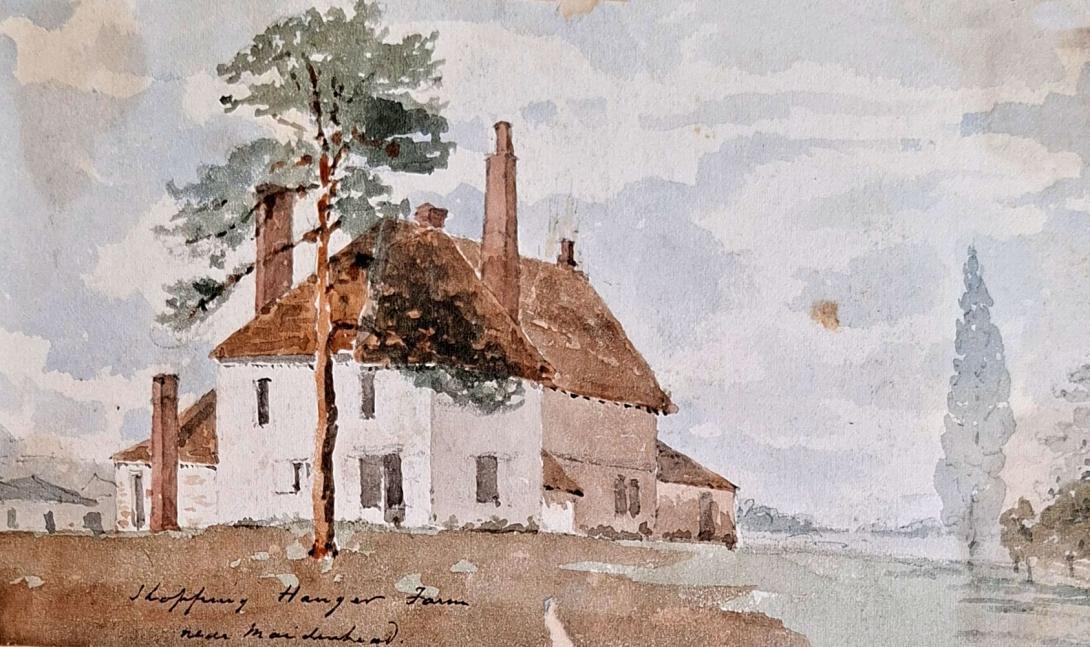


Shopping hangers Farm near Maidenhead and On Shopping Hanger Farm Maid.. June 13 1863 and Shopping Hanger April 25 63 (3)
The historic Shoppenhangers Manor in Maidenhead was a significant local landmark, but it was demolished in 2007. The site is now a residential development near Manor Lane, SL6 2RA.
The manor was located in Maidenhead, Berkshire, England. The main house was controversially pulled down in 2007 by the site owners, HI (Maidenhead) Ltd, part of Realstar. In the mid-to-late 20th century, the manor house was an annex to the nearby Esso Motor Hotel (now a Holiday Inn).
Fire: A 13th-century barn associated with the manor, used for storage by the hotel, was severely damaged by a major fire in June 2000.
In the early 18th century, the manor was inherited by Frances Winchcombe, who was married to the politician Henry St. John (Lord Bolingbroke). They entertained notable figures like Dean Swift, Alexander Pope, and possibly Queen Anne. Lady Bolingbroke is a figure in local ghost lore.
Earlier in the Reign of Queen Victoria the farm was in the hands of a Mr John Brigenshaw, who besides being a farmer had a Butcher's business in the Maidenhead High Street - the name is not now known, he has not left a trace behind of his progeny (Ed. He had not heard of family history research!).
Mr Webster did not follow his (Mr Brigenshaw's) lead in a town business, but he did a little business in retail farm produce at certain times of the year with some of his town associates or customers.
To the writers knowledge and youthful pleasure as a lad, on several occasions, both at Michaelmas and Christmas, my elder brother and myself would be sent up to 'ShoppenhangersFarm' to fetch the seasonable goose
Whilst Mr R Webster was at 'Shoppenhangers' he was twice awarded the Prince Consort's Silver Challenge Cup, namely in 1869 and 1873 for the best cultivated farm within the area covered by the Royal East Berks Agricultural Association.
This cup was presented by the late Queen Victoria. Those of us who remember the acres and acres of golden corn and the fresh and healthy looking root crops will agree that the late Mr Webster deserved his award....
The mention of the Butcher's Business ties in with the 1851 Census
To-day most of those same fertile farmlands of 'Shoppenhangers' are covered by modern housing, a golf course and a motel. It first emerged by sub-infeudation or division of lands by Norman Kings. Nothing is known of the first manor house which would have been a timber framed one and which would have been altered or rebuilt over the next few centuries. The first known one was a 17th century brick building which.is pictured on the title of an 1810 document. It is believed that this was demolished in tile 19th century when in the hands of the Grenfell family. The present building, a replica of a 16th century merchants house "was built on the foundations of the original manor house during the 1914-18 war by Walter George Thornton-Smith, a very wealthy antiques dealer and art collector. A wing was added some years later and he filled the house with art treasures from all over the world. In 1931 a fire caused considerable damage to the first floor and roof.£15,000 was spent on 'restoration.
The quite extensive farm buildings include a timber framed archway with room over, which might have been a coach house and entrance to the farm, and to-day provides a delightful exit from the back of the motel into the gardens and a path leading to the Manor House Restaurant. These buildings, whilst obviously barns, do have features that are unusual. I understand that during the restoration of the Manor House after the fire some of these buildings were converted into work rooms and it is possible that odd bits of decorative material were added by the workmen, to enhance the appearance from the manor, as most of them are on the side facing, the manor while the backs are quite rough.
The historic Shoppenhangers Manor in Maidenhead was a significant local landmark, but it was demolished in 2007. The site is now a residential development near Manor Lane, SL6 2RA. The manor was located in Maidenhead, Berkshire, England. The main house was controversially pulled down in 2007 by the site owners, HI (Maidenhead) Ltd, part of Realstar. In the mid-to-late 20th century, the manor house was an annex to the nearby Esso Motor Hotel (now a Holiday Inn). A 13th-century barn associated with the manor, used for storage by the hotel, was severely damaged by a major fire in June 2000.In the early 18th century, the manor was inherited by Frances Winchcombe, who was married to the politician Henry St. John (Lord Bolingbroke). They entertained notable figures like Dean Swift, Alexander Pope, and possibly Queen Anne. Lady Bolingbroke is a figure in local ghost lore.
Richard Suter was born in Greenwich, Kent on 30th March 1798, to William Suter and his wife Sarah Knights. On 7th January 1825 he married Anne Ruth Burn.
English architect. As Surveyor to The Fishmongers' Company he designed the severe Presbyterian churches for Ballykelly (1825–7) and Banagher (1825) on the Company's Estate in County Londonderry, drawings of which were exhibited at the Royal Academy in 1827. He was also responsible for the Model Farm (1823–4), the Lancasterian Schools (1828–30), the Company Agent's House (1830–2—now a hotel, much altered), a range of houses on the south side of the main road (1823–4), the lodge in the Presbyterian churchyard (1828), and the Dispensary (1829), all at Ballykelly, and all Classical. As Surveyor to Trinity House Corporation, he designed houses that were erected by Thomas Cubitt in 1821–3 on a site adjoining Trinity House. For The Fishmongers' Company he designed St Peter's Almshouses, Wandsworth, London (1849–51), and The Old School-House, Gresham's School, Holt, Norfolk(1859), in an Elizabethan style.
On the 1841 Census Richard, an architect and lawyer, can be found living in London with his wife Ann (listed as Ruth) and their two children, Richard George and Andrew Burn. Living with them is Edward D Suter. 1851 finds the family living in Tottenham Court in London, by this time Andrew had left the home, but I am unable to trace him on the 1851 Census. In 1860 Andrew marries Amelia Damaris Harrison. Both Richard George and Andrew were to become ordained ministers, with Andrew later becoming a Bishop and emigrating to New Zealand. Sadly in 1854 Anne Ruth was to pass away. In 1861, widowed Richard, Justice of the Peace for Maidenhead, is living at Castle Hill, Maidenhead, Berkshire. In 1862 he married Elizabeth Anne Pocock. In 1871 and 1881 Richard and Elizabeth are still living in Castle Hill. Richard was to pass away on 1st March1883.
Richard Suter & Annesley Voysey, architects, had their office at number 35 Fenchurch Street, but they did not have it all to themselves as they shared the premises with W.C. Franks, a tea broker, who will get a separate post some other time. The earliest mention I found of Richard Suter in Fenchurch Street is in 1832 when he is listed at that address in a list of contributing members of the Society for the Propagation of the Gospel in Foreign Parts. It says that he had been a member since 1829, but that does not mean he was already at 35 Fenchurch Street in that year.(1) In fact, that seems unlikely as the Sun Fire Office records give Messrs. Short and Co., merchants, as paying the insurance premium on the premises in May 1830. The Directory of British Architects 1834-1914 give the year 1827, but I do not know on what evidence. When Suter and Voysey became partners is also uncertain, but they had known each other since at least 1825 as Suter is named as one of the executors of Voysey’s will which was dated 22 July, 1825. The address given for Suter in the will is Suffolk Street, Southwark. Voysey then lives at Conway Street, Fitzroy Square.