
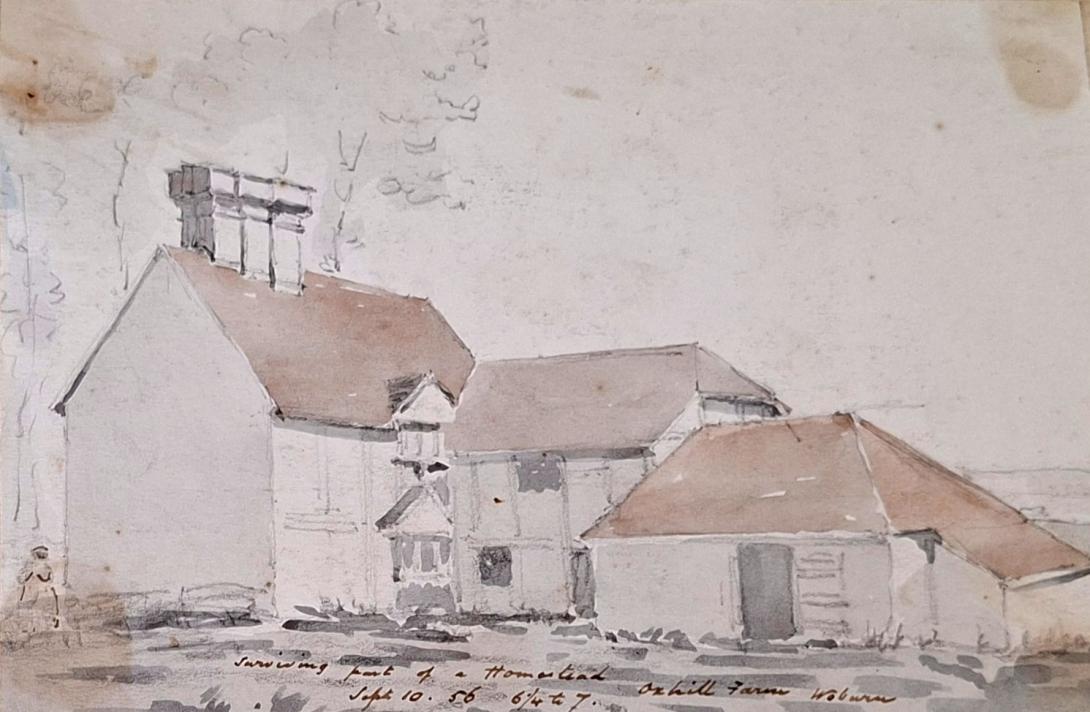
Surviving part of a Homestead Oxhill Farm Woburn Sept 10 1856
Moxhill Farm, Northill Road, Cople, Bedford, MK44 3UD.Moxhill Farm is a historic agricultural property located in the far southeast of Cople parish, Bedfordshire. Historically, Moxhill was recognised as a hamlet within the parish.
The hamlet of Moxhill was first formally recorded in the Quarter Session records of 1776. The farm is situated at one of the highest points in the area; Mox Hill stands at 213 feet above sea level, providing a notable contrast to the low-lying Oxford Clay landscape typical of the rest of Cople and its neighbouring village of Willington. World War II: On October 26, 1940, the farm was the site of a wartime incident when German high explosive (HE) and incendiary bombs were dropped in a line from Moxhill Farm to Hillfoot Farm.
Moxhill Farm, located near Woburn, Bedfordshire, is historically part of the vast Woburn Estate, owned by the Dukes of Bedford, connecting it to medieval Cistercian monastic history (Woburn Abbey founded 1145) and significant landholdings. While specific details for Moxhill are sparse in general records, its location ties it to the Duke of Bedford's vast lands, a key part of the region's identity, with the estate evolving from abbey lands to an aristocratic seat and now a major visitor attraction (Safari Park, Gardens).
Cople is an ancient parish. It had at least two ends, Water End, to the south of the village and Coplewood End (first mentioned in 1276) in the south of the parish around Coplewood Farm. The hamlet of Moxhill is first mentioned in the Quarter Session records of 1776 but is now just a farm in the far south-east of the parish.
The road by Hoo Farm leads to Mox Hill farm. In the year 1914 Mr Astel the timber merchants of Cardington Road Bedford farmed it, later it passed to Mr Sam Vincent of Oak Farm, Northill. This Farm is the boundary of Cople and Northill. It joins Wood End to the right and Sheerhatch Wood on the left.
Bedford Estate: Records from 1878 link the property specifically to "Cople Moxhill Farm". Much of the land in this parish was historically owned by the Dukes of Bedford until it was subdivided and sold in the early 20th century. In recent years, the farm has transitioned from a traditional agricultural holding to a high-value residential property. As of 2026, it is identified as a 3-bedroom detached house on Northill Road. It was last sold in 2018 for £1,950,000.
Richard Suter was born in Greenwich, Kent on 30th March 1798, to William Suter and his wife Sarah Knights. On 7th January 1825 he married Anne Ruth Burn.
English architect. As Surveyor to The Fishmongers' Company he designed the severe Presbyterian churches for Ballykelly (1825–7) and Banagher (1825) on the Company's Estate in County Londonderry, drawings of which were exhibited at the Royal Academy in 1827. He was also responsible for the Model Farm (1823–4), the Lancasterian Schools (1828–30), the Company Agent's House (1830–2—now a hotel, much altered), a range of houses on the south side of the main road (1823–4), the lodge in the Presbyterian churchyard (1828), and the Dispensary (1829), all at Ballykelly, and all Classical. As Surveyor to Trinity House Corporation, he designed houses that were erected by Thomas Cubitt in 1821–3 on a site adjoining Trinity House. For The Fishmongers' Company he designed St Peter's Almshouses, Wandsworth, London (1849–51), and The Old School-House, Gresham's School, Holt, Norfolk(1859), in an Elizabethan style.
On the 1841 Census Richard, an architect and lawyer, can be found living in London with his wife Ann (listed as Ruth) and their two children, Richard George and Andrew Burn. Living with them is Edward D Suter. 1851 finds the family living in Tottenham Court in London, by this time Andrew had left the home, but I am unable to trace him on the 1851 Census. In 1860 Andrew marries Amelia Damaris Harrison. Both Richard George and Andrew were to become ordained ministers, with Andrew later becoming a Bishop and emigrating to New Zealand. Sadly in 1854 Anne Ruth was to pass away. In 1861, widowed Richard, Justice of the Peace for Maidenhead, is living at Castle Hill, Maidenhead, Berkshire. In 1862 he married Elizabeth Anne Pocock. In 1871 and 1881 Richard and Elizabeth are still living in Castle Hill. Richard was to pass away on 1st March1883.
Richard Suter & Annesley Voysey, architects, had their office at number 35 Fenchurch Street, but they did not have it all to themselves as they shared the premises with W.C. Franks, a tea broker, who will get a separate post some other time. The earliest mention I found of Richard Suter in Fenchurch Street is in 1832 when he is listed at that address in a list of contributing members of the Society for the Propagation of the Gospel in Foreign Parts. It says that he had been a member since 1829, but that does not mean he was already at 35 Fenchurch Street in that year.(1) In fact, that seems unlikely as the Sun Fire Office records give Messrs. Short and Co., merchants, as paying the insurance premium on the premises in May 1830. The Directory of British Architects 1834-1914 give the year 1827, but I do not know on what evidence. When Suter and Voysey became partners is also uncertain, but they had known each other since at least 1825 as Suter is named as one of the executors of Voysey’s will which was dated 22 July, 1825. The address given for Suter in the will is Suffolk Street, Southwark. Voysey then lives at Conway Street, Fitzroy Square.