
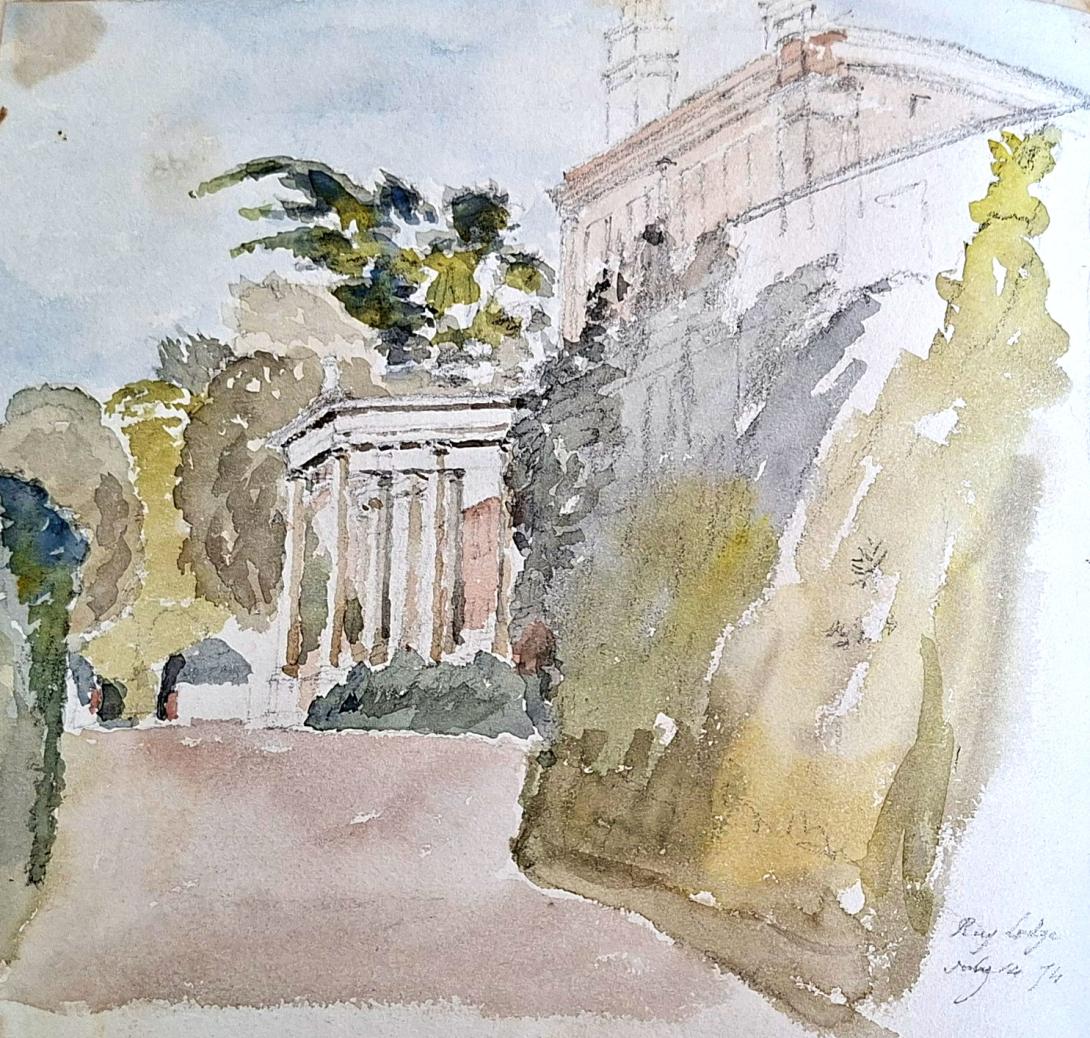
Ray Lodge July 14 1874
Mid C18 3 storeys, and basement. Red brick with parapet and painted dentil cornice. Hipped slate roof and flanking chimneys. South front, 6 windows double hung sash with glazing bars, stone cills on upper floors. 4 windows on ground floor without bars, central timber Doric portico pediment cornices frieze on four fluted columns without bases and capitals and pilasters, approached by broad flight of twelve stone steps with simple iron railings. Central door flanked by 2 windows under portico. 4 windows in basement. North elevation six double hung sashes with glazing bars 2nd floor. 1st floor has four windows with glazing bars and central Palladian window under large gauged brick relieving arch, now partly covered by C19 service tower extension. Two flanking 2 storey Pavilions, brick with moulded wood cornice, each 3 windows and central chimney, and linked across front by a tall tuscan colonnade of nine bays. Slender wood columns on moulded plinths carried up to height of basement and ground floors. Centre breaks forward to form a portico with 2 columns widely spaced in front and 3 at sides. There are 3 columns on either side of portico and pilasters against the Pavilions.
Interior:- some internal shutters remain and decorative plaster ceilings and cornices Ionic columns in former ground floor reception room and Doric columns supporting 3 arches in original stair hall now altered. The whole has been converted into flats and main rooms divided by modern partitions.
Ray Lodge Estate was created. The Ray family soon sold the estate and by 1865 the Lodge was the home of the astronomer William Lassell, who built his own observatory in the garden. This is clearly marked on the 1875 OS map at the north east corner of the kitchen gardens and its site
is incorporated into the north western boundary of the Conservation Area.
Large chunks of the Ray Lodge estate were sold off and Ray Park Avenue was createdwith 29 building lots, many of which still retain the same plot boundaries. At this time all the Ray roads were constructed. The rapid expansion of the area is demonstrated in the 1875 and 1912 OS maps (appendix 1). By 1912, the riverside is lined with detached villas from the newly developed Fishery Estate to the north of Boulters Island.
Richard Suter was born in Greenwich, Kent on 30th March 1798, to William Suter and his wife Sarah Knights. On 7th January 1825 he married Anne Ruth Burn.
English architect. As Surveyor to The Fishmongers' Company he designed the severe Presbyterian churches for Ballykelly (1825–7) and Banagher (1825) on the Company's Estate in County Londonderry, drawings of which were exhibited at the Royal Academy in 1827. He was also responsible for the Model Farm (1823–4), the Lancasterian Schools (1828–30), the Company Agent's House (1830–2—now a hotel, much altered), a range of houses on the south side of the main road (1823–4), the lodge in the Presbyterian churchyard (1828), and the Dispensary (1829), all at Ballykelly, and all Classical. As Surveyor to Trinity House Corporation, he designed houses that were erected by Thomas Cubitt in 1821–3 on a site adjoining Trinity House. For The Fishmongers' Company he designed St Peter's Almshouses, Wandsworth, London (1849–51), and The Old School-House, Gresham's School, Holt, Norfolk(1859), in an Elizabethan style.
On the 1841 Census Richard, an architect and lawyer, can be found living in London with his wife Ann (listed as Ruth) and their two children, Richard George and Andrew Burn. Living with them is Edward D Suter. 1851 finds the family living in Tottenham Court in London, by this time Andrew had left the home, but I am unable to trace him on the 1851 Census. In 1860 Andrew marries Amelia Damaris Harrison. Both Richard George and Andrew were to become ordained ministers, with Andrew later becoming a Bishop and emigrating to New Zealand. Sadly in 1854 Anne Ruth was to pass away. In 1861, widowed Richard, Justice of the Peace for Maidenhead, is living at Castle Hill, Maidenhead, Berkshire. In 1862 he married Elizabeth Anne Pocock. In 1871 and 1881 Richard and Elizabeth are still living in Castle Hill. Richard was to pass away on 1st March1883.
Richard Suter & Annesley Voysey, architects, had their office at number 35 Fenchurch Street, but they did not have it all to themselves as they shared the premises with W.C. Franks, a tea broker, who will get a separate post some other time. The earliest mention I found of Richard Suter in Fenchurch Street is in 1832 when he is listed at that address in a list of contributing members of the Society for the Propagation of the Gospel in Foreign Parts. It says that he had been a member since 1829, but that does not mean he was already at 35 Fenchurch Street in that year.(1) In fact, that seems unlikely as the Sun Fire Office records give Messrs. Short and Co., merchants, as paying the insurance premium on the premises in May 1830. The Directory of British Architects 1834-1914 give the year 1827, but I do not know on what evidence. When Suter and Voysey became partners is also uncertain, but they had known each other since at least 1825 as Suter is named as one of the executors of Voysey’s will which was dated 22 July, 1825. The address given for Suter in the will is Suffolk Street, Southwark. Voysey then lives at Conway Street, Fitzroy Square.