
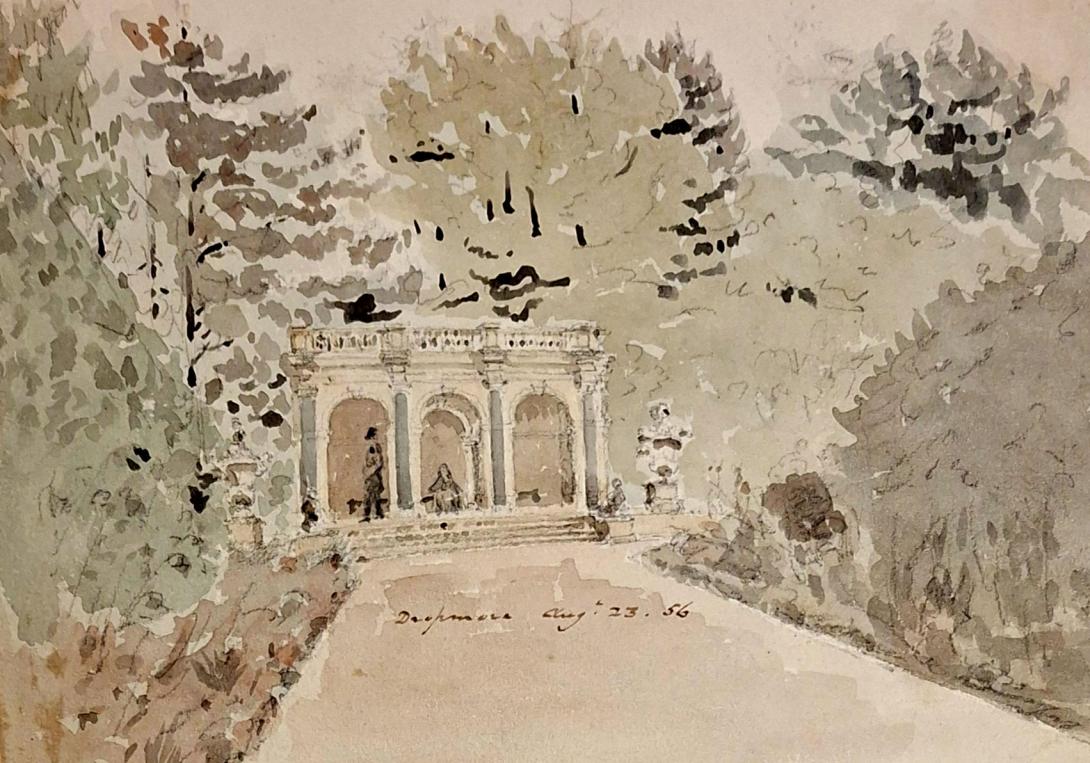
Dropmore Aug 23 1856
Dropmore Park, near Burnham, Buckinghamshire, boasts a rich history centered on its grand house and extensive gardens, started by botanist Prime Minister Lord Grenville in 1792, who created a vast pinetum, with the estate evolving through botanical interests, significant house construction by architect Samuel Wyatt, and becoming known for its remarkable landscape design and trees, particularly after Grenville's early plantings.
The house is in the centre of a 220 acre estate, a plot so large that it spans two planning authorities, South Bucks and Wycombe District. The parish boundary between Burnham and Taplow actually runs through the house, which has been a grade 1 listed building since 1955. It was initially built in 1792–5 by Samuel Wyatt for Lord Grenville with alterations 1806–9 by Charles Tatham.
The gardens, pinetum and plantations were designed and planted by Lord and Lady Grenville. The English Heritage Register of Parks and Gardens of Special Historic Interest describes their development:
Lord Grenville, Prime Minister to George III, began work on the Dropmore estate in 1792, having bought 15 hectares of land complete with a small labourer's cottage, which he demolished, then employing Samuel Wyatt to build the south range of the present house. Grenville wrote to his future wife, Anne Pitt, 'I think you will be pleased with the situation when you see it, though I know Lord Camelford will think it a great deal too exposed. I do not think that a great objection, being compensated, as it is, by the advantage of air and prospect' (Country Life 1956). Grenville began landscaping Dropmore immediately after he built the house, and his improvements are said to have included the removal of a hill that blocked the view of Windsor Castle 12 kilometres to the south-east (Country Life 1956). He was a keen botanist, and planted many trees, some supplied by his brother Lord Buckingham from Stowe, including, in the 1820s, a 25 hectare pinetum west of the house, around the lake. Grenville died in 1834, leaving his widow, also a keen botanist, who continued to develop the estate and gardens, constructing the alcove by the lake, and probably the Italianate features in the walled garden. Following Lady Grenville's death in 1864, aged ninety-one, the estate was inherited by the Fortescue family, and bought in 1943 by Lord Kemsley. Following its occupation by the Army during the Second World War, and consequent deterioration of the house and grounds, the Kemsleys restored the estate and planted many more trees to complement the existing planting. The majority of the house burnt down in 1990, and has not been rebuilt, although there are plans to do so (1997). Much of the garden has subsequently been vandalised and many structures have been stolen. The site remains (1997) in private ownership.
The main two-storey house lies towards the north end of the site. It is built in Classical style of rendered and colour-washed cement, with a central single-storey portico on the north entrance front. The south garden front has three bows with shallow domed roofs. The ground floor garden front supports a wooden trellis-work pergola at the west end, with arched openings in front of each window. (See photo as it is now!) It used also to support an enclosed verandah in similar style at the east end (now long gone).
Dropmore House and the surrounding estate was built on land purchased by William Wyndham Grenville in 1792. Grenville (born 25/10/1759, died at Dropmore on 12/1/1834) led a varied political life as MP for Buckinghamshire, Leader of the House of Lords, Speaker of the House of Commons, and even Foreign Secretary before becoming Prime Minister from 1806-1807.
The house itself was designed by Samuel Wyatt (1737-1807) who removed a hill to give a view of Windsor Castle from the windows (can you envisage that nowadays? - seems like it's light years away, even as the crow flies). Wyatt's work was expanded by Charles Heathcote Tatham (1772-1842) and, over a period of years, lawns and paths were laid out whilst trees and shrubs were planted to transform the 600 acre ‘wilderness’ into an area of exceptional beauty with lakes surrounded by an ornamental woodland and formal garden.
Little else is known after this except that the journal of J. Evelyn Denison, Viscount Ossington, describes a visit to Dropmore House where he once "went round in a bath chair to see the trees." Very nice.
In more recent years, whilst presumably unoccupied (or perhaps causing it to become unoccupied), the building was devastated by two fires and is a cause of concern from a safety point of view. Thankfully, unlike the CRCMH, the future of the Dropmore site looks rather less unstable.
Being a Grade II listed building (English Heritage Register No.GD1589), the estate receives (theoretically) a reasonable amount of legislative protection against modern nastiness. Indeed, an environment and housing review panel decided in November 2001 that the restoration of the house and estate be secured by negotiation with the new owners. Therefore, it looks in all likelyhood like the manor and grounds will eventually be restored to their former glory, which is a great deal better than a replacing them with a ghastly housing estate - a (seemingly rare) triumph in the quest to save Britain's heritage. But for now, much like the CRCMH, the whole estate appears to be lying dormant. Again, in theory at least.
Andrew Findlay from www.taplow.org.uk has this to add:
"The estate was owned by an Arab businessman for many years, but not actively used or maintained. The house and lodges fell into a state of disrepair. The whole lot has now been bought by a developer which is very worrying. A party from the Parish Council and the Hitcham and Taplow Preservation Society were shown round a few months ago and they took some photos at the time. A report on the visit is in the latest HTPS newsletter (not online)."
Richard Suter was born in Greenwich, Kent on 30th March 1798, to William Suter and his wife Sarah Knights. On 7th January 1825 he married Anne Ruth Burn.
English architect. As Surveyor to The Fishmongers' Company he designed the severe Presbyterian churches for Ballykelly (1825–7) and Banagher (1825) on the Company's Estate in County Londonderry, drawings of which were exhibited at the Royal Academy in 1827. He was also responsible for the Model Farm (1823–4), the Lancasterian Schools (1828–30), the Company Agent's House (1830–2—now a hotel, much altered), a range of houses on the south side of the main road (1823–4), the lodge in the Presbyterian churchyard (1828), and the Dispensary (1829), all at Ballykelly, and all Classical. As Surveyor to Trinity House Corporation, he designed houses that were erected by Thomas Cubitt in 1821–3 on a site adjoining Trinity House. For The Fishmongers' Company he designed St Peter's Almshouses, Wandsworth, London (1849–51), and The Old School-House, Gresham's School, Holt, Norfolk(1859), in an Elizabethan style.
On the 1841 Census Richard, an architect and lawyer, can be found living in London with his wife Ann (listed as Ruth) and their two children, Richard George and Andrew Burn. Living with them is Edward D Suter. 1851 finds the family living in Tottenham Court in London, by this time Andrew had left the home, but I am unable to trace him on the 1851 Census. In 1860 Andrew marries Amelia Damaris Harrison. Both Richard George and Andrew were to become ordained ministers, with Andrew later becoming a Bishop and emigrating to New Zealand. Sadly in 1854 Anne Ruth was to pass away. In 1861, widowed Richard, Justice of the Peace for Maidenhead, is living at Castle Hill, Maidenhead, Berkshire. In 1862 he married Elizabeth Anne Pocock. In 1871 and 1881 Richard and Elizabeth are still living in Castle Hill. Richard was to pass away on 1st March1883.
Richard Suter & Annesley Voysey, architects, had their office at number 35 Fenchurch Street, but they did not have it all to themselves as they shared the premises with W.C. Franks, a tea broker, who will get a separate post some other time. The earliest mention I found of Richard Suter in Fenchurch Street is in 1832 when he is listed at that address in a list of contributing members of the Society for the Propagation of the Gospel in Foreign Parts. It says that he had been a member since 1829, but that does not mean he was already at 35 Fenchurch Street in that year.(1) In fact, that seems unlikely as the Sun Fire Office records give Messrs. Short and Co., merchants, as paying the insurance premium on the premises in May 1830. The Directory of British Architects 1834-1914 give the year 1827, but I do not know on what evidence. When Suter and Voysey became partners is also uncertain, but they had known each other since at least 1825 as Suter is named as one of the executors of Voysey’s will which was dated 22 July, 1825. The address given for Suter in the will is Suffolk Street, Southwark. Voysey then lives at Conway Street, Fitzroy Square.