
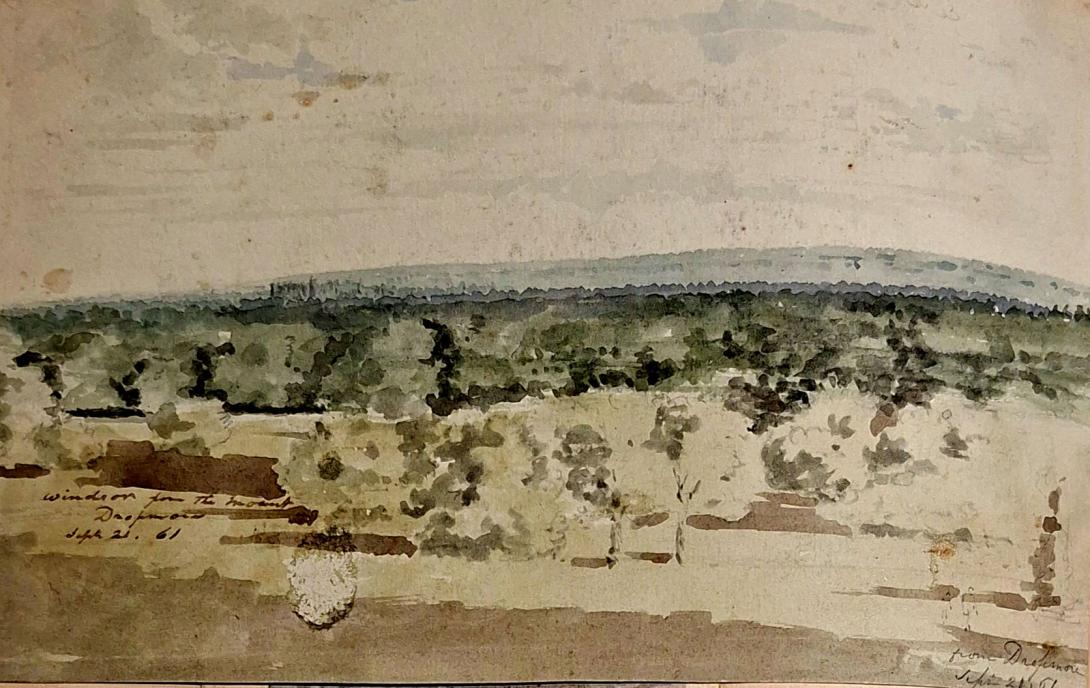
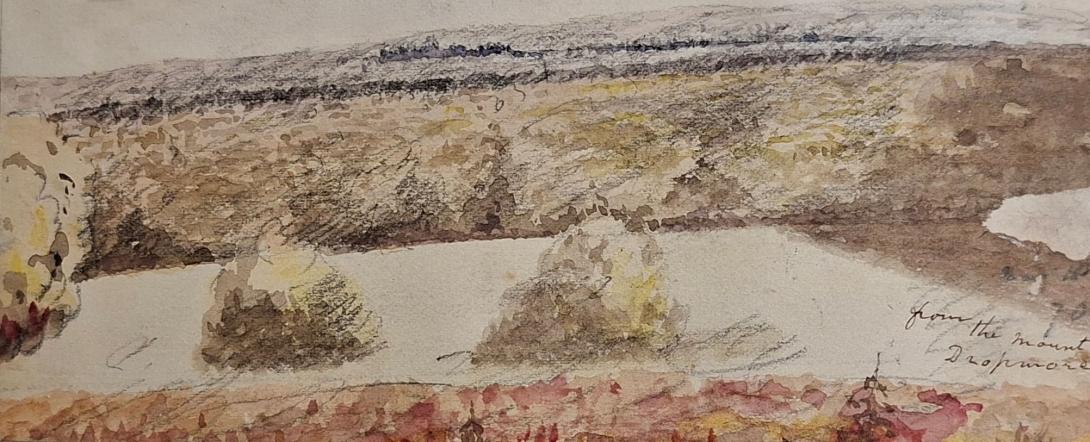
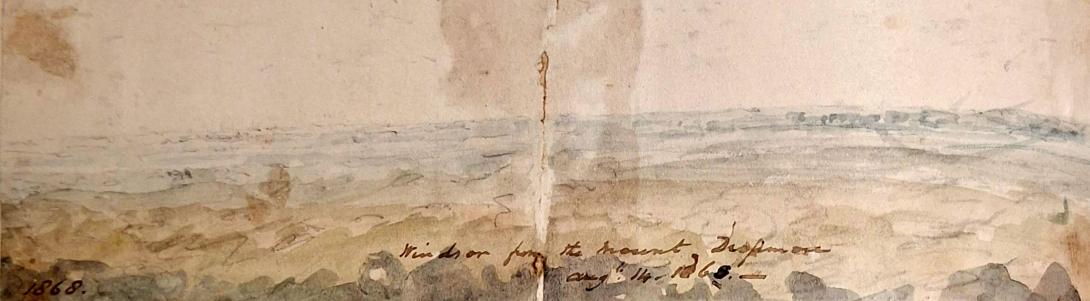
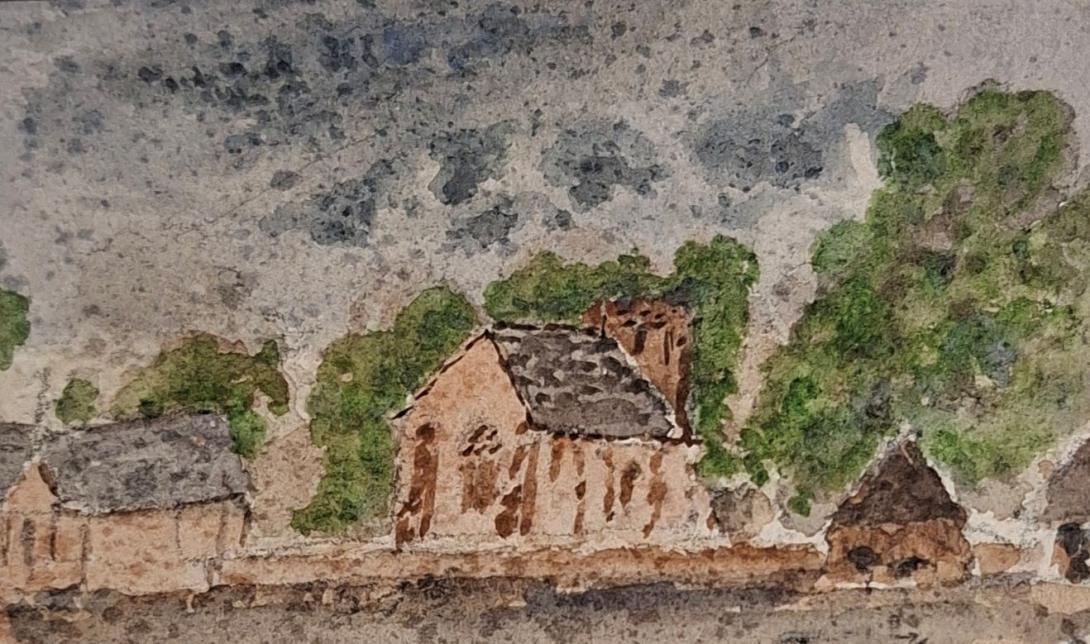
Windsor from the Mount Dropmore Park Sept 21 1861 ? From Dropmore
Dropmore Park is a private estate located along Dropmore Road, north of Burnham, Buckinghamshire, England, about 220 acres (89 ha) in size. The park with its buildings, including Dropmore House, have Grade I listed building status.
Dropmore Park is located in the Thames Valley near to the wood known as Burnham Beeches. It is about 25 miles (40 km) west of the centre of London and about 3 miles (4.8 km) south of junction 2 of the M40 motorway and about 4 miles (6.4 km) north of junction 7 of the M4 motorway. The nearest main towns are High Wycombe, Windsor, Maidenhead and Slough. Close neighbouring grand estates and stately homes include Cliveden and Hedsor House. The house and estate are not normally open to members of the public.
Dropmore House was built in the 1790s for Lord Grenville, who later as Prime Minister pushed through the law abolishing the slave trade.The architect was Samuel Wyatt. Charles Tatham was architect for changes in the 19th century.
Grenville knew the spot from rambles during his time at Eton College, and prized its distant views of his old school and of Windsor Castle. On his first day in occupation, he planted two cedar trees. At least another 2,500 trees were planted. By the time Grenville died in 1834, his pinetum contained the biggest collection of conifer species in Britain. Part of the restoration is to use what survives as the basis for a collection of some 200 species.
In 1945, after wartime use during which it was harshly treated, the house was restored by Viscount Kemsley, the proprietor of The Sunday Times. He filled it with paintings, furniture and books. After his death in 1968 it was sold to United States International University and then to the Ambassador of the United Arab Emirates, Muhammed Mahdi al-Tajir.
An indoor pool was added, but the house was rarely used. In 1990 it was badly damaged by a fire that took four days to put out. Another in 1997 left the house uninhabitable.
Dropmore was restored by the company Corporate Estates via the construction firm MP Brothers Limited into a number of private luxury dwellings around 2006–2008. The restoration included the house, Edwardian stables and a number of garden buildings including a Chinese tea house and aviary. Further plans over a 15-year period include restoration of the formal flower beds, Italian garden, woodlands, lawns, vistas, roads, bridges and gates.The developer has since gone into liquidation before the redevelopment was completed. Dropmore was then purchased in 2012 by Richard and Ian Livingstone.
The exterior of the house and the grounds were used extensively for the location filming of the Doctor Who serial Day of the Daleks.
St. Anne’s is a delightful little Church which celebrated its 150 year anniversary in May 2016. The Community love their Church and are always keen to help with its upkeep including assisting with tidying the Churchyard two or three times a year. At St Anne’s, current services are based on The Book of Common Prayer with hymns from Hymns Ancient and Modern and 100 Hymns for Today. Psalms are taken from the Book of Common Prayer. Sunday Services are at 9.15 a.m. On the second, and fifth Sundays of the month, it is a Holy Communion service and on the fourth Sunday, it is Choral Matins.
Littleworth Common comprises 44 cottages and houses of varying sizes, several of which surround the common which is a ‘Site of Special Scientific Interest’. The Common is a popular place for the local community and especially dog walkers!
Dorneywood house, just outside the parish boundary, is presently the official residence of the Chancellor of the Exchequer. It was gifted to the National Trust with an attached condition that it is held as a Ministerial home. Lord Courtauld Thompson and other members of his family, who gifted the property to the Trust, donated features to the church building including a window, and are buried in St Anne’s Churchyard. Day visitors are also brought to the parish by the family attraction Odds Farm.
Dropmore Parish Hall is a small village hall, located opposite St Anne’s Church. The building is primarily used by the Burnham Montessori school during term time. It hosts occasional village meetings and some private events for local residents. It is a registered charity.
Richard Suter was born in Greenwich, Kent on 30th March 1798, to William Suter and his wife Sarah Knights. On 7th January 1825 he married Anne Ruth Burn.
English architect. As Surveyor to The Fishmongers' Company he designed the severe Presbyterian churches for Ballykelly (1825–7) and Banagher (1825) on the Company's Estate in County Londonderry, drawings of which were exhibited at the Royal Academy in 1827. He was also responsible for the Model Farm (1823–4), the Lancasterian Schools (1828–30), the Company Agent's House (1830–2—now a hotel, much altered), a range of houses on the south side of the main road (1823–4), the lodge in the Presbyterian churchyard (1828), and the Dispensary (1829), all at Ballykelly, and all Classical. As Surveyor to Trinity House Corporation, he designed houses that were erected by Thomas Cubitt in 1821–3 on a site adjoining Trinity House. For The Fishmongers' Company he designed St Peter's Almshouses, Wandsworth, London (1849–51), and The Old School-House, Gresham's School, Holt, Norfolk(1859), in an Elizabethan style.
On the 1841 Census Richard, an architect and lawyer, can be found living in London with his wife Ann (listed as Ruth) and their two children, Richard George and Andrew Burn. Living with them is Edward D Suter. 1851 finds the family living in Tottenham Court in London, by this time Andrew had left the home, but I am unable to trace him on the 1851 Census. In 1860 Andrew marries Amelia Damaris Harrison. Both Richard George and Andrew were to become ordained ministers, with Andrew later becoming a Bishop and emigrating to New Zealand. Sadly in 1854 Anne Ruth was to pass away. In 1861, widowed Richard, Justice of the Peace for Maidenhead, is living at Castle Hill, Maidenhead, Berkshire. In 1862 he married Elizabeth Anne Pocock. In 1871 and 1881 Richard and Elizabeth are still living in Castle Hill. Richard was to pass away on 1st March1883.
Richard Suter & Annesley Voysey, architects, had their office at number 35 Fenchurch Street, but they did not have it all to themselves as they shared the premises with W.C. Franks, a tea broker, who will get a separate post some other time. The earliest mention I found of Richard Suter in Fenchurch Street is in 1832 when he is listed at that address in a list of contributing members of the Society for the Propagation of the Gospel in Foreign Parts. It says that he had been a member since 1829, but that does not mean he was already at 35 Fenchurch Street in that year.(1) In fact, that seems unlikely as the Sun Fire Office records give Messrs. Short and Co., merchants, as paying the insurance premium on the premises in May 1830. The Directory of British Architects 1834-1914 give the year 1827, but I do not know on what evidence. When Suter and Voysey became partners is also uncertain, but they had known each other since at least 1825 as Suter is named as one of the executors of Voysey’s will which was dated 22 July, 1825. The address given for Suter in the will is Suffolk Street, Southwark. Voysey then lives at Conway Street, Fitzroy Square.