
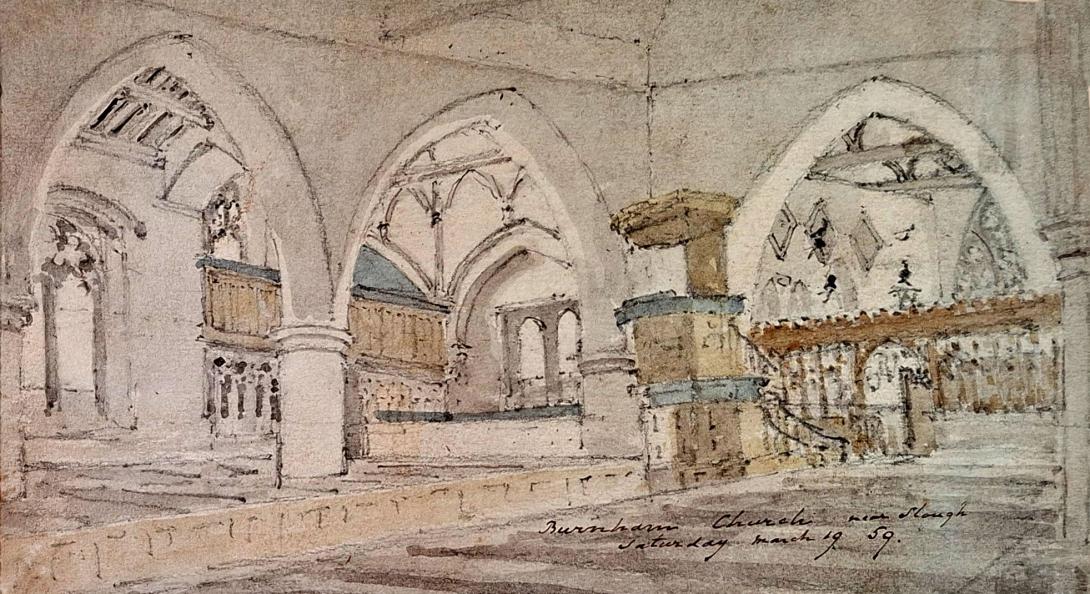
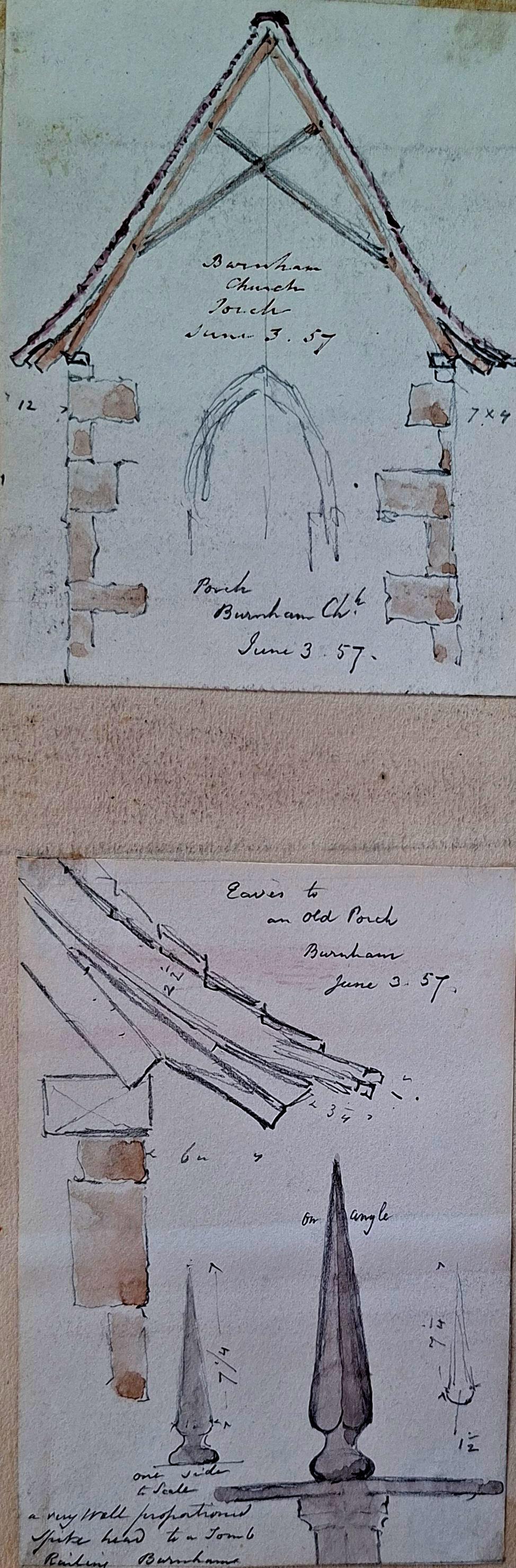
Burnham Church near Slough Saturday March 19th 1859
The Church of England parish church of Saint Peter dates in part from the 12th century but has been substantially expanded, refurbished and altered, with major restorations in 1863–64 and 1891 and the construction of the Cornerstone Centre in 1986.
St Peter’s Church has been at the centre of village life for over a thousand years. Burnham was mentioned in the Domesday Book of 1086 and forms part of the Chiltern Hundreds, which comprise Burnham, Desborough and Stoke.
The present church was built between 1154 and 1202 although there was an older Anglo-Saxon wooden church here before that, and probably an even older Romano-British building which, it is believed, dated from about 500.
Various additions and improvements have been made to the church over the years, including two major restorations during the 19th century. In the second of these the church tower was extended, a spire was added, and in 1897 two extra bells were added to the existing six to make a full peal in honour of Queen Victoria’s Diamond Jubilee.In 1986 the old Victorian vestry was demolished to make way for Cornerstone.
As you enter the church from Cornerstone through the old vestry door you will be in the Chancel. On your left is the Sanctuary which contains the High Altar, and behind it the Reredos, carved with scenes of Christ’s healing ministry. Above it, the East Window portrays important scenes from our Lord’s Nativity to His Ascension ('Themes from the Life of Christ' Circa 1880-1887 by George DANIELS and CLAYTON & BELL).
Two monuments in the sanctuary commemorate Vicar John Wright (1561-94) in the Elizabethan ruff and George Evelyn, who was a cousin of 17th century diarist John Evelyn. Next to the Wright memorial, is a window depicting St Andrew (Circa 1861 by John HARDMAN)
The Altar Rails are dated 1663 and originally formed part of a staircase balustrade at Eton College. The blocked recess on the south wall probably originated as the Vicar’s Door. The long chest was used to hold frontals for the high altar, it was made from the remains of the medieval rood screen. Traces of the original paint can still be seen on it, as can the peepholes through which members of the congregation could glimpse the priest at the altar celebrating mass.
The Victorian architect G.F. Bodley designed the present rood screen which was given in 1899 by a Miss Tollemache as a memorial to her father Revd Clement R Tollemache. As you leave the Chancel you will cross the dais which was installed in 1989 when the Nave Altar was installed. The brass Lectern was donated by Samuel Christie-Miller in 1878.
The Victorian architect G.F. Bodley designed the present rood screen which was given in 1899 by a Miss Tollemache as a memorial to her father Revd Clement R Tollemache. As you leave the Chancel you will cross the dais which was installed in 1989 when the Nave Altar was installed. The brass Lectern was donated by Samuel Christie-Miller in 1878 .Lecturn and Windows Turning left, you come to the wood and wrought iron screen which closes off the Vestry, and this was made locally by Mark Chown as a memorial to Thomas Jones, Registrar of Burnham in the early 1900s and the father of Thomas Luke Jones. The arms on the screen are those of Burnham Abbey, the Diocese of Oxford, and the County of Buckinghamshire.
As you move into the Nave you may notice that the pillars on the south side are hexagonal, while those on the north side are round, this shows the north side was built at an earlier time, you may also notice that the pillars are not opposite each other. At the bottom of the first pillar on the south aisle look for the work of a 16th century graffiti artist who scratched the words “THE POPE IS A KNAVE”. More examples of ancient graffiti can be seen on the other pillars on the south side.
On the left side of the window is the “Hastings Hatchment,” a memorial to John Hastings, great grandson to the 4th Earl of Huntingdon, who was married to Elizabeth Cage of Britwell Court and died in 1656; it contains more than 100 quarterings. The east wall of the transept is filled with carved panels brought from Europe in the 19th century by a Mr Fortesque.
Richard Suter was born in Greenwich, Kent on 30th March 1798, to William Suter and his wife Sarah Knights. On 7th January 1825 he married Anne Ruth Burn.
English architect. As Surveyor to The Fishmongers' Company he designed the severe Presbyterian churches for Ballykelly (1825–7) and Banagher (1825) on the Company's Estate in County Londonderry, drawings of which were exhibited at the Royal Academy in 1827. He was also responsible for the Model Farm (1823–4), the Lancasterian Schools (1828–30), the Company Agent's House (1830–2—now a hotel, much altered), a range of houses on the south side of the main road (1823–4), the lodge in the Presbyterian churchyard (1828), and the Dispensary (1829), all at Ballykelly, and all Classical. As Surveyor to Trinity House Corporation, he designed houses that were erected by Thomas Cubitt in 1821–3 on a site adjoining Trinity House. For The Fishmongers' Company he designed St Peter's Almshouses, Wandsworth, London (1849–51), and The Old School-House, Gresham's School, Holt, Norfolk(1859), in an Elizabethan style.
On the 1841 Census Richard, an architect and lawyer, can be found living in London with his wife Ann (listed as Ruth) and their two children, Richard George and Andrew Burn. Living with them is Edward D Suter. 1851 finds the family living in Tottenham Court in London, by this time Andrew had left the home, but I am unable to trace him on the 1851 Census. In 1860 Andrew marries Amelia Damaris Harrison. Both Richard George and Andrew were to become ordained ministers, with Andrew later becoming a Bishop and emigrating to New Zealand. Sadly in 1854 Anne Ruth was to pass away. In 1861, widowed Richard, Justice of the Peace for Maidenhead, is living at Castle Hill, Maidenhead, Berkshire. In 1862 he married Elizabeth Anne Pocock. In 1871 and 1881 Richard and Elizabeth are still living in Castle Hill. Richard was to pass away on 1st March1883.
Richard Suter & Annesley Voysey, architects, had their office at number 35 Fenchurch Street, but they did not have it all to themselves as they shared the premises with W.C. Franks, a tea broker, who will get a separate post some other time. The earliest mention I found of Richard Suter in Fenchurch Street is in 1832 when he is listed at that address in a list of contributing members of the Society for the Propagation of the Gospel in Foreign Parts. It says that he had been a member since 1829, but that does not mean he was already at 35 Fenchurch Street in that year. In fact, that seems unlikely as the Sun Fire Office records give Messrs. Short and Co., merchants, as paying the insurance premium on the premises in May 1830. The Directory of British Architects 1834-1914 give the year 1827, but I do not know on what evidence. When Suter and Voysey became partners is also uncertain, but they had known each other since at least 1825 as Suter is named as one of the executors of Voysey’s will which was dated 22 July, 1825. The address given for Suter in the will is Suffolk Street, Southwark. Voysey then lives at Conway Street, Fitzroy Square.