
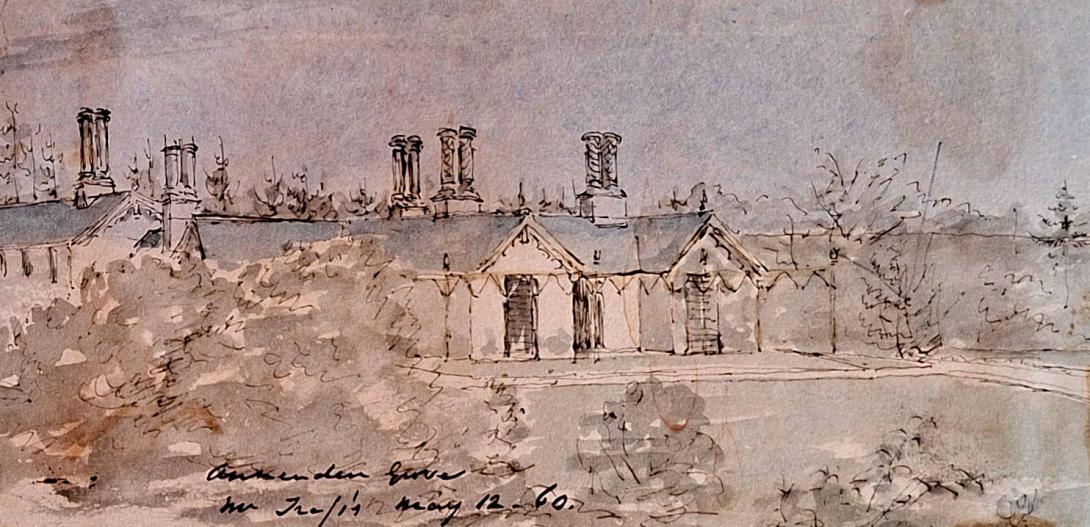
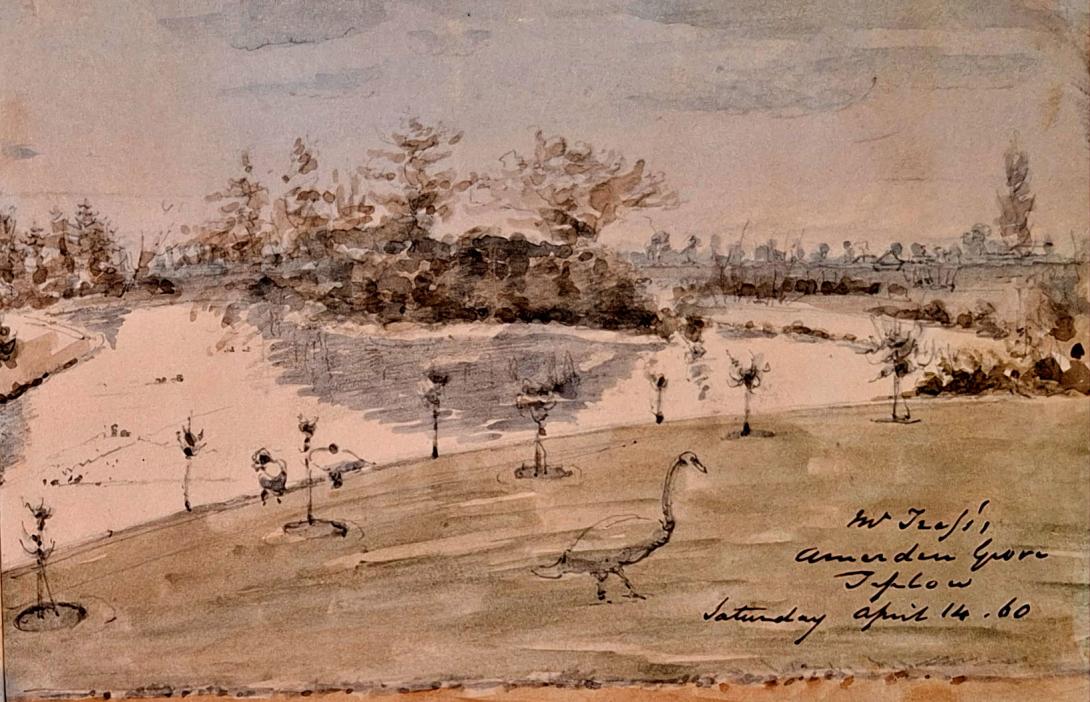
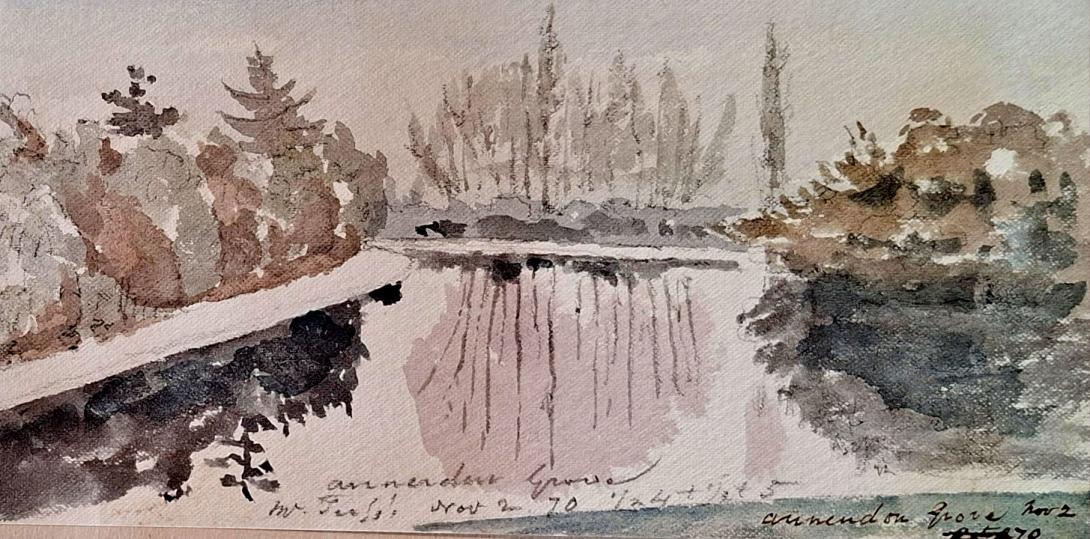
Mr Teass's Amerden Grove /Taplow / Saturday April 14th 1860 and Amerden Grove Nov 2 1870 and Amerden Grove Mr Teass's May 12 60 (3)
Pictures of Amerden from around 1895. Note ornate chimneys - she thinks there is a connection with Taplow Court. At this time the house had a large swimming pool in addition to the two lakes. Apparently a smaller pool was later built close to the house as the occupants were finding the walk harder as they got older. At this time, the house (called Amerden Grove on the 1899 OS Map) was owned by the Whitlaws and leased to Sir Henry Valentine Rae Reid from the 1860s until 1903. The house was later owned by Giles Sims.
A History of the County of Buckingham published in 1925 notes: South of the hill is Amerden Grove with Barge Farm, and to the east of this is Amerden House, the residence of Mrs. Whitlaw.Rae Reid was a wine merchant in London, trading as Rayden & Reid and as Cloymont. Premises were at 5 Pall Mall in the 1890s, later moving to 7 St Martins. Known to be still trading in 1930, having incorporated in 1922.
Sir Rae Reid married Lady Eulia Alberta Louisa Budd (known as Louisa), at St Martin in the Fields. At this time, she already had a son: Herbert John Budd, though the identity of his father is not known. The son lived at Amerden and went to the Palmers Boys School in Greys Thurrocks, Essex before emigrating to the USA at the age of 18. He boarded the RMS Britannia on August 1st 1892, but did not arrive in New York until November of that year. It is thus no surprise that he declared that he would never return!
When we first arrived in Taplow in 1968 Amerden Ponds house was owned by Joyce Simms who was a dear kind elderly lady who kept open house on lazy summer afternoons. We used to go there on hot days when the children all used to have great fun swimming and learning to swim in her lovely open air pool near the house. She always had a tray of soft drinks and refreshments out. The first to arrive would take the cover off the pool and the last ones would put it back on. It was always very sociable and fun. She grew Christmas trees in a field nearby and we would go en famille a few months before Christmas and put a ribbon with our name on the one we wanted and then near Christmas would ceremoniously go and chop it down to take home and decorate. (Eva)
Richard Suter was born in Greenwich, Kent on 30th March 1798, to William Suter and his wife Sarah Knights. On 7th January 1825 he married Anne Ruth Burn.
English architect. As Surveyor to The Fishmongers' Company he designed the severe Presbyterian churches for Ballykelly (1825–7) and Banagher (1825) on the Company's Estate in County Londonderry, drawings of which were exhibited at the Royal Academy in 1827. He was also responsible for the Model Farm (1823–4), the Lancasterian Schools (1828–30), the Company Agent's House (1830–2—now a hotel, much altered), a range of houses on the south side of the main road (1823–4), the lodge in the Presbyterian churchyard (1828), and the Dispensary (1829), all at Ballykelly, and all Classical. As Surveyor to Trinity House Corporation, he designed houses that were erected by Thomas Cubitt in 1821–3 on a site adjoining Trinity House. For The Fishmongers' Company he designed St Peter's Almshouses, Wandsworth, London (1849–51), and The Old School-House, Gresham's School, Holt, Norfolk(1859), in an Elizabethan style.
On the 1841 Census Richard, an architect and lawyer, can be found living in London with his wife Ann (listed as Ruth) and their two children, Richard George and Andrew Burn. Living with them is Edward D Suter. 1851 finds the family living in Tottenham Court in London, by this time Andrew had left the home, but I am unable to trace him on the 1851 Census. In 1860 Andrew marries Amelia Damaris Harrison. Both Richard George and Andrew were to become ordained ministers, with Andrew later becoming a Bishop and emigrating to New Zealand. Sadly in 1854 Anne Ruth was to pass away. In 1861, widowed Richard, Justice of the Peace for Maidenhead, is living at Castle Hill, Maidenhead, Berkshire. In 1862 he married Elizabeth Anne Pocock. In 1871 and 1881 Richard and Elizabeth are still living in Castle Hill. Richard was to pass away on 1st March1883.
Richard Suter & Annesley Voysey, architects, had their office at number 35 Fenchurch Street, but they did not have it all to themselves as they shared the premises with W.C. Franks, a tea broker, who will get a separate post some other time. The earliest mention I found of Richard Suter in Fenchurch Street is in 1832 when he is listed at that address in a list of contributing members of the Society for the Propagation of the Gospel in Foreign Parts. It says that he had been a member since 1829, but that does not mean he was already at 35 Fenchurch Street in that year.(1) In fact, that seems unlikely as the Sun Fire Office records give Messrs. Short and Co., merchants, as paying the insurance premium on the premises in May 1830. The Directory of British Architects 1834-1914 give the year 1827, but I do not know on what evidence. When Suter and Voysey became partners is also uncertain, but they had known each other since at least 1825 as Suter is named as one of the executors of Voysey’s will which was dated 22 July, 1825. The address given for Suter in the will is Suffolk Street, Southwark. Voysey then lives at Conway Street, Fitzroy Square.