
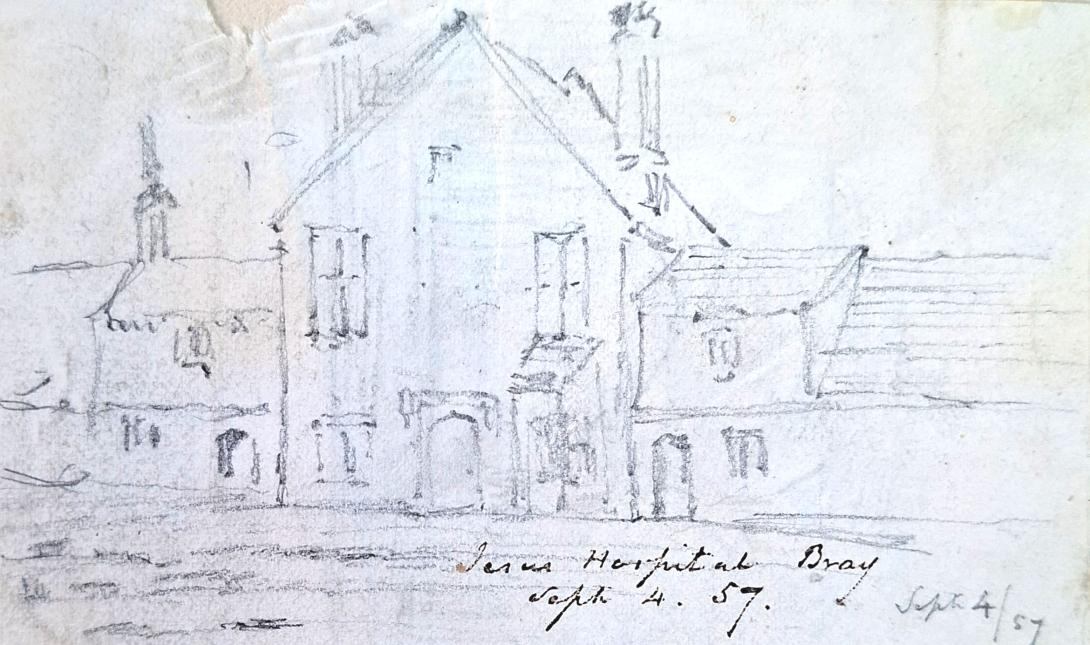
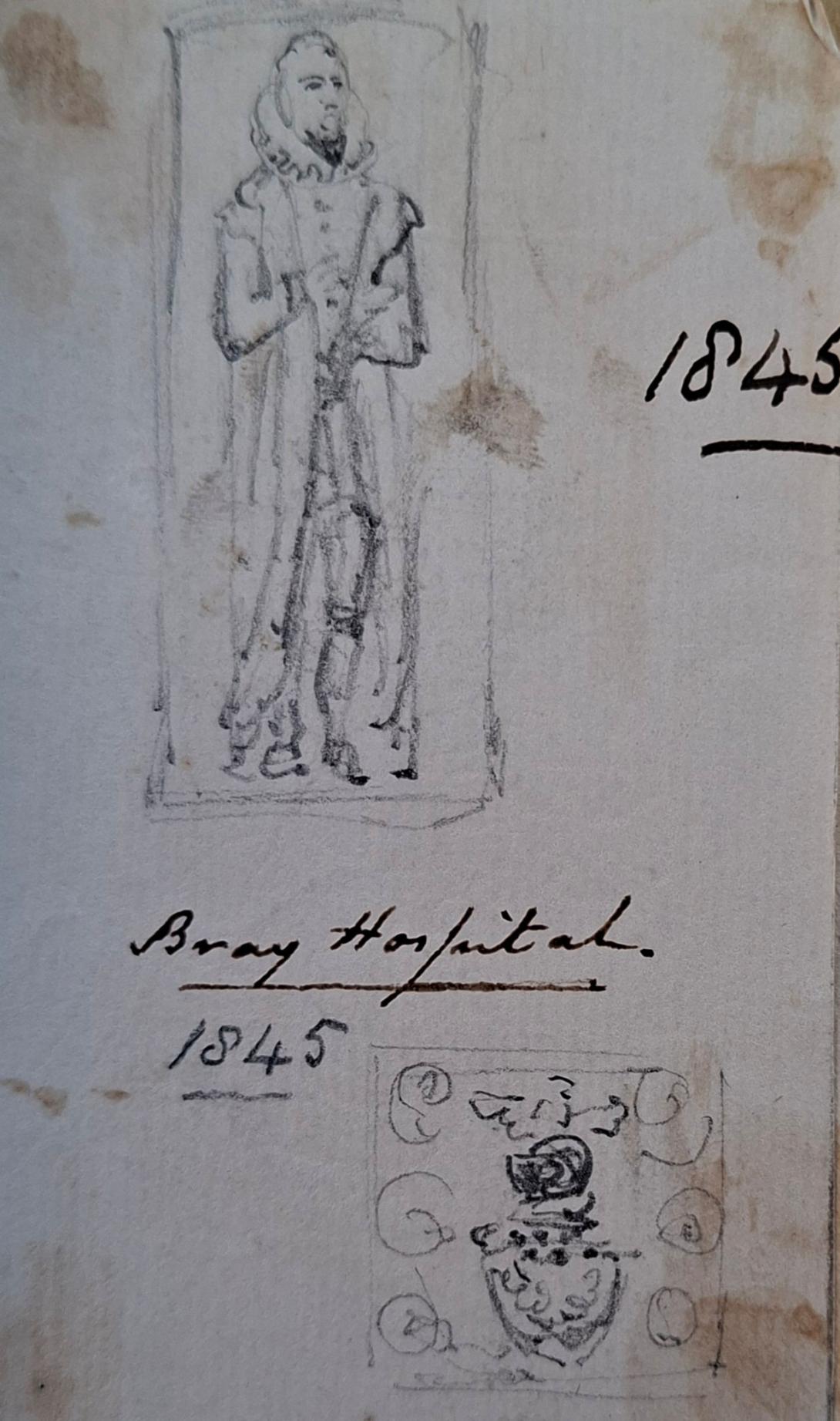
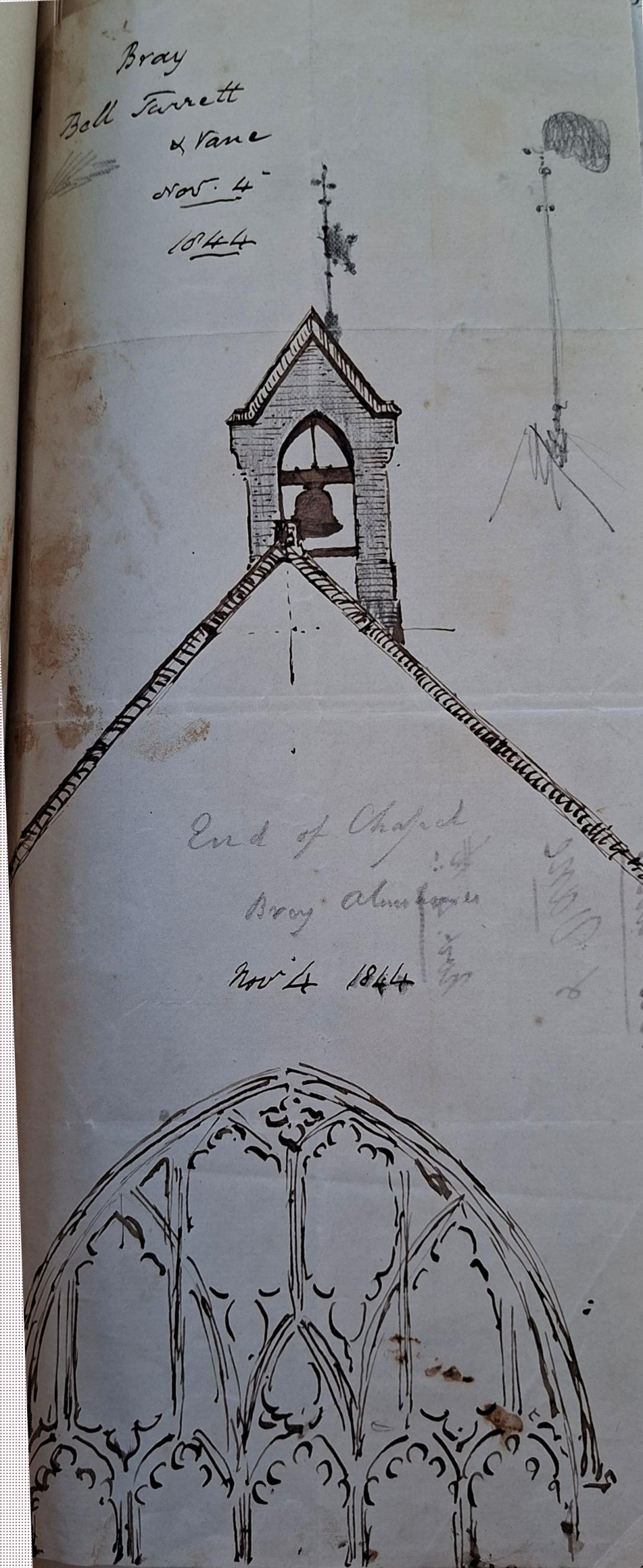
Jesus Hospital Bray Sept 4th 57
Jesus Hospital was originally under the patronage of The Worshipful Company of Fishmongers who had administered Jesus Hospital since its foundation in 1602.Jesus Hospital These almshouses were endowed through the munificence of William Goddard in his will in 1627. He allowed to provide for 40 persons of which 6 were to be aged fishmongers. The four sides, of which this is the front one, surround an internal quadrangle. This is the main entrance with the statue of William Goddard in the gable end. Over the front entrance is the sign advising that "Vagrants Hawkers & Dogs are not admitted". It is to be hoped that the reading standards of dogs in the Bray area are at a higher level than the national average. Jesus Hospital in Bray, Berkshire, is a historic almshouse complex founded by the wealthy Fishmonger, William Goddard, in his 1627 will, providing housing for 40 people, including specific provisions for aged fishmongers, managed by the Worshipful Company of Fishmongers and known for its distinctive quadrangle design, statue of Goddard, and prominent gate. William Goddard, a prominent member of the Fishmongers' Company, established the hospital through his will. His bequest in 1627 provided funds for the almshouses.The endowment was intended to support 40 residents, with 6 specifically for aged fishmongers. Goddard's will stipulated that the Worshipful Company of Fishmongers would govern the hospital in perpetuity.
It's a Grade I listed building featuring a classic quadrangle layout with a chapel and a notable entrance gate topped by a statue of Goddard.The hospital is a significant historical landmark in Bray, offering care for the elderly for centuries. Almshouses (formerly 40 now 16), Chaplain's house and Chapel. Dated 1627, altered C20. Founded by William Goddard, and under the care of the Worshipful Company of Fishmongers. Brick, in English bond, with stone dressings. Large quadrangular plan with chapel in the centre of the west side and Chaplain's house to the left of the main entrance-way through, which has a meeting room over. One storey, Chaplain's house is 2 storeys. Almshouses: all one storey. North and south sides of the quadrangle are identical. Each 5 bays. Chimneys are placed diagonally on plan having 6 chimneys with coupled shafts on large rectangular bases, and clay pots on each side. Stone window openings with chamfered mullions; metal casements with diamond panes, of 2-lights. Central, gabled dormer to each dwelling with two, 2-light windows, lighting a vestibule below which has plank door and a 4-centred stone entrance archway. Chapel: coped gable to quadrangle with a large window of 5, trefoiled lights with vertical traceried head. Below this is a plank entrance dooorway under a 4- centred arch within a square head. There is a bellcote on the ridge. Road (entrance) front: symmetrical. Centre gable contains the entrance with a 4-centred head under a square containing moulding and label. Above this the former Chaplain's rooms, now meeting room, with a window on either side of a segmental-headed niche which contains a figure of William Goddard; above this is a 2-light window, lighting an attic, now disused. Below the niche is a stone tablet with the date 1627 and an inscription. On either side of the tablet and below the windows are 2 stones, one with the arms of the Fishmongers' Company, the other with those of Goddard. Against the north wall of the open entrance passage is an iron-bound alms post, above which is a tablet inscribed 'Hee that giveth to the poor lendeth to the Lord", surmounted by the date 1638. On either side of the gable is a one-bay section of one and a half storeys; the upper level is faced with tiling; each level has a 2-light window. A chimney abuts the gabled section on each side. On each side of these are one-storey almshouses with four 2-light windows and 2 chimneys. Chapel interior: 4-bay nave and chancel separated by a fine Jacobean screen. The central opening is round-headed with spandrels carved with scrolls within a square architrave. The upper part is divided on either side into 4, small, round-headed openings carried on flat balusters with shaped brackets, carrying a moulded cornice. The west window to the Chancel is of 5 trefoiled lights with elaborate tracery under a pointed head; on either side is a window of 3-cinquefoiled lights with tracery under a 4-centred head. The roof is of 4-framed bays of queen post trusses with moulded caps and bases to the posts; double purlins with moulded, arch-braced collars with quatrefoils in the spandrels, The famous painting in the Tate Gallery, called the Harbour of Refuge, by Frederick Walker, ARA, depicts the Quadrangle, centre sundial, and front of Chapel.
Richard Suter was born in Greenwich, Kent on 30th March 1798, to William Suter and his wife Sarah Knights. On 7th January 1825 he married Anne Ruth Burn.
English architect. As Surveyor to The Fishmongers' Company he designed the severe Presbyterian churches for Ballykelly (1825–7) and Banagher (1825) on the Company's Estate in County Londonderry, drawings of which were exhibited at the Royal Academy in 1827. He was also responsible for the Model Farm (1823–4), the Lancasterian Schools (1828–30), the Company Agent's House (1830–2—now a hotel, much altered), a range of houses on the south side of the main road (1823–4), the lodge in the Presbyterian churchyard (1828), and the Dispensary (1829), all at Ballykelly, and all Classical. As Surveyor to Trinity House Corporation, he designed houses that were erected by Thomas Cubitt in 1821–3 on a site adjoining Trinity House. For The Fishmongers' Company he designed St Peter's Almshouses, Wandsworth, London (1849–51), and The Old School-House, Gresham's School, Holt, Norfolk(1859), in an Elizabethan style.
On the 1841 Census Richard, an architect and lawyer, can be found living in London with his wife Ann (listed as Ruth) and their two children, Richard George and Andrew Burn. Living with them is Edward D Suter. 1851 finds the family living in Tottenham Court in London, by this time Andrew had left the home, but I am unable to trace him on the 1851 Census. In 1860 Andrew marries Amelia Damaris Harrison. Both Richard George and Andrew were to become ordained ministers, with Andrew later becoming a Bishop and emigrating to New Zealand. Sadly in 1854 Anne Ruth was to pass away. In 1861, widowed Richard, Justice of the Peace for Maidenhead, is living at Castle Hill, Maidenhead, Berkshire. In 1862 he married Elizabeth Anne Pocock. In 1871 and 1881 Richard and Elizabeth are still living in Castle Hill. Richard was to pass away on 1st March1883.
Richard Suter & Annesley Voysey, architects, had their office at number 35 Fenchurch Street, but they did not have it all to themselves as they shared the premises with W.C. Franks, a tea broker, who will get a separate post some other time. The earliest mention I found of Richard Suter in Fenchurch Street is in 1832 when he is listed at that address in a list of contributing members of the Society for the Propagation of the Gospel in Foreign Parts. It says that he had been a member since 1829, but that does not mean he was already at 35 Fenchurch Street in that year.(1) In fact, that seems unlikely as the Sun Fire Office records give Messrs. Short and Co., merchants, as paying the insurance premium on the premises in May 1830. The Directory of British Architects 1834-1914 give the year 1827, but I do not know on what evidence. When Suter and Voysey became partners is also uncertain, but they had known each other since at least 1825 as Suter is named as one of the executors of Voysey’s will which was dated 22 July, 1825. The address given for Suter in the will is Suffolk Street, Southwark. Voysey then lives at Conway Street, Fitzroy Square.