
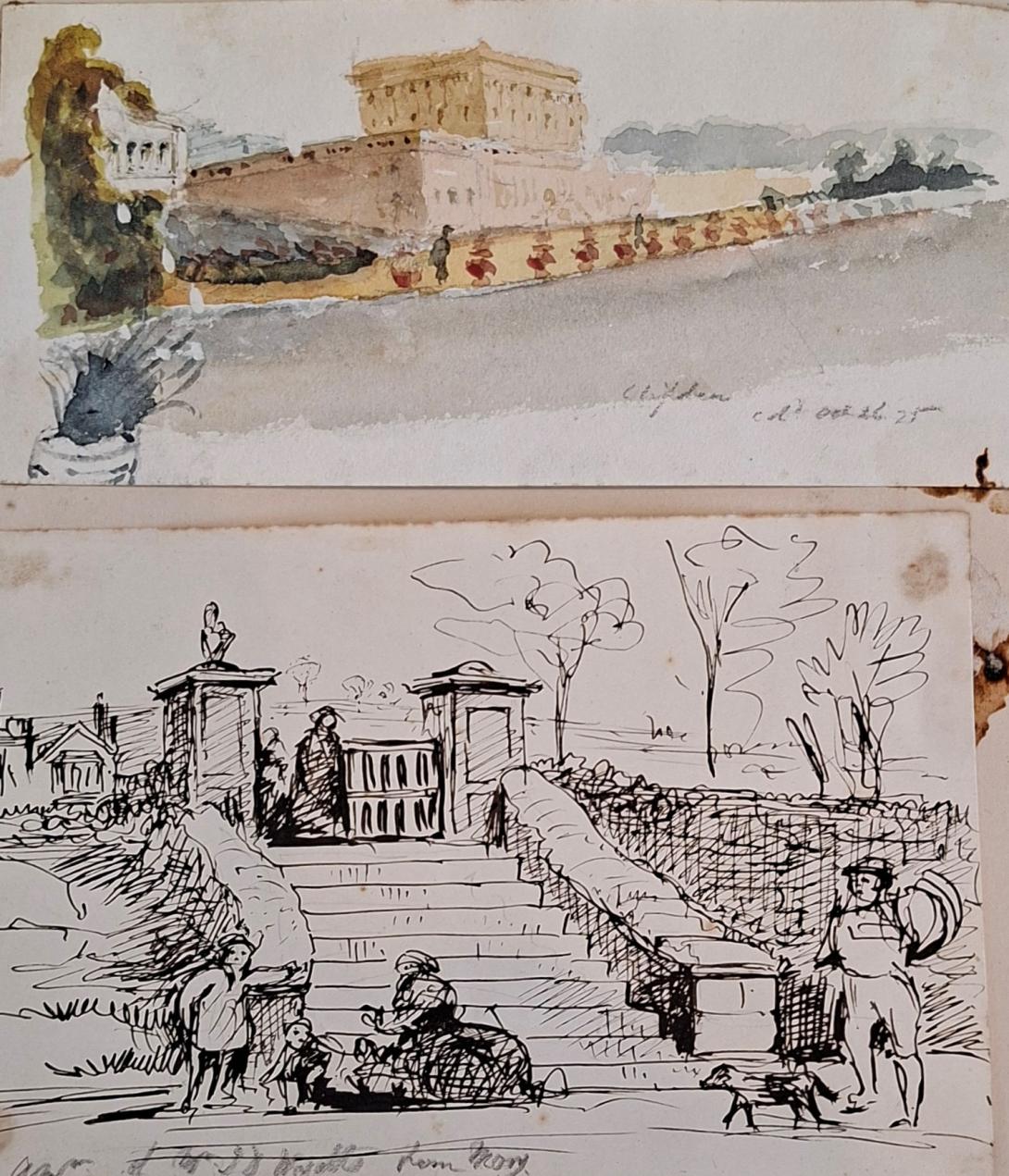
Cliveden coloured by candlelight Oct 26 1875
Cliveden is an English country house and estate in the care of the National Trust in Buckinghamshire, on the border with Berkshire. The Italianate mansion, also known as Cliveden House, crowns an outlying ridge of the Chiltern Hills close to the South Bucks villages of Taplow and Burnham. The main house sits 40 metres (130 ft) above the banks of the River Thames, and its grounds slope down to the river. There have been three houses on this site. The first was built in 1666 and burned down in 1795, while the second house was constructed around 1824 and was also destroyed by fire, in 1849. The present Grade I listed house was built in 1851 by the architect Charles Barry for the 2nd Duke of Sutherland.
Cliveden has been the home to a Prince of Wales, two dukes, an earl, and finally the Viscounts Astor. As the home of Nancy Astor, wife of the 2nd Viscount Astor, Cliveden was the meeting place during the 1920s and 1930s of the Cliveden Set, a group of political intellectuals. Later, during the early 1960s, when it was the home of the 3rd Viscount Astor, it became the setting for key events of the notorious Profumo affair. After the Astor family stopped living there, by the 1970s, it was leased to Stanford University, which used it as an overseas campus. It is now leased to a company that runs it as a luxury hotel.
The 375-acre (152 ha) gardens and woodlands are open to the public, together with parts of the house on certain days. Cliveden has been one of the National Trust's most popular pay-for-entry visitor attractions, hosting 524,807 visitors in 2019.
Cliveden means "valley among cliffs" and refers to the dene (valley) which cuts through part of the estate, east of the house. Cliveden has been spelled differently over the centuries, some of the variations being Cliffden, Clifden, Cliefden, and Clyveden.

Designed by Charles Barry in 1851 to replace a house previously destroyed by fire, the present house is a blend of the English Palladian style and the Roman Cinquecento. The Victorian three-storey mansion sits on a 400-foot (120 m) long, 20-foot (6.1 m) high brick terrace or viewing platform (visible only from the south side) which dates from the mid-17th century. The exterior of the house is rendered in Roman cement, with terracotta additions such as balusters, capitals, keystones, and finials. The roof of the mansion is meant for walking on, and there is a circular view, above the tree-line, of parts of Buckinghamshire and Berkshire including Windsor Castle to the south.
Below the balustraded roofline is a Latin inscription which continues around the four sides of the house and recalls its history; it was composed by the then prime minister William Ewart Gladstone. On the west front, it reads: POSITA INGENIO OPERA CONSILIO CAROLI BARRY ARCHIT A MDCCCLI, which translated reads: "The work accomplished by the brilliant plan of architect Charles Barry in 1851." Continuing clockwise, text on the other fronts translates as: "Constructed upon foundations laid long before by George Villiers Duke of Buckingham in Charles the Second's reign", "Completed in the year of Our Lord 1851 when Victoria had been Queen by God's grace for fourteen years" and "Restored by George Duke of Sutherland and Harriet his wife on the site where two houses had previously been burnt down". The main contractor for the work was Lucas Brothers.
In 1984–86, the exterior of the mansion was overhauled and a new lead roof was installed by the National Trust, while interior repairs were carried out by Cliveden Hotel. In 2013, further exterior work was carried out including the restoration of 300 sash windows and 20 timber doors.
Interior

The interior of the house today is very different from its original appearance in 1851–52. This is mainly due to the 1st Viscount Astor, who radically altered the interior layout and decoration c.1894–95. Whereas Barry's original interior for the Sutherlands had included a square entrance-hall, a morning room, and a separate stairwell, Lord Astor wanted a more impressive entrance to Cliveden, so he had all three rooms amalgamated to create the Great Hall.
Lord Astor's aim was for the interior to resemble an Italian palazzo, thus complementing the exterior. The ceiling and walls were panelled in English oak, with Corinthian columns and swags of carved flowers for decoration, all by architect Frank Pearson.The staircase newel posts are ornamented with carved figures representing previous owners (e.g. Buckingham and Orkney) by W.S. Frith.
Lord Astor installed a large 16th-century fireplace that was purchased from the Frederick Spitzer sale (lot 1273) in June 1893. To the left of the fireplace is a portrait of Nancy, Lady Astor, by the American portraitist John Singer Sargent. The room was and still is furnished with 18th-century tapestries and suits of armour.
Originally, the floor was covered with Minton encaustic tiles (given to the Sutherlands by the factory), but Nancy Astor had them removed in 1906 and the present flagstones laid. Above the staircase is a painted ceiling by French artist Auguste Hervieu, which depicts the Sutherlands' children painted as the four seasons, and it is the only surviving element of Barry's 1851–52 interior.
.jpg)
The French Dining Room is so-called because the 18th-century Rococo panelling (or boiseries) came from Château d'Asnières near Paris, a château which was leased to Louis XV and his mistress Madame de Pompadour as a hunting lodge. The panelling was sold in 1897 by Jules Allard to the 1st Viscount Astor, who had it installed at Cliveden.The gilded panelling on a turquoise ground contains carvings of hares, pheasants, hunting dogs and rifles. The console tables and buffet were made in 1900 to match the room.
The second-largest room on the ground floor, after the Great Hall, was the original drawing room, which is used as the hotel's main dining room. Also on the ground floor is the library, panelled in cedar wood, which the Astors used to call the "cigar box". Next door was Nancy Astor's boudoir, which is now used by the hotel as a meeting room.
Upstairs, there are a total of 10-bedroom suites divided equally over two floors. The East wing was and still is guest accommodation, whereas the West wing was domestic offices that were converted into more bedrooms in 1994.
Clock Tower
The nearby 100-foot (30 m) clock tower was added in 1861 and is the work of the architect Henry Clutton. As a functioning water tower, it still provides water for the house today. It is rendered in Roman cement like the rest of the house, and it features four clock faces framed by gilded surrounds and a half-open staircase on its north side. It was described by the architectural critic Nikolaus Pevsner as "the epitome of Victorian flamboyance and assertiveness."
The tower is topped with a modern reproduction of Augustin Dumont's 19th-century winged male figure Le Génie de la Liberté (the Spirit of Liberty). The original is atop the July Column in the Place de la Bastille, Paris. This replaces two earlier versions, the first having fallen from the tower during a storm in the 1950s. The new statue is made of bronze and was created using Dumont's original mould from the 1860s found in a museum in Semur-en-Auxois, France. It measures 2.2 m in height, is covered in two layers of 23.5 carat gold leaf and cost a total of £68,000. It is an allegorical sculpture which holds the torch of civilization in its right hand and the broken chain of slavery in its left. It was affixed to the tower in the spring of 2012.
Duke of Buckingham and early history

Cliveden stands on the site of a house built in 1666 designed by architect William Winde as the home of George Villiers, 2nd Duke of Buckingham. But before Buckingham's purchase the land was owned by the Mansfield family and before that to the de Clyveden family.
The details are recorded in a document compiled by William Waldorf Astor in 1894 called The Historical Descent of Cliveden. Derived from several historical sources including George Lipscombe's History of the County of Buckingham, the Lysons brothers Magna Britannia, and James Joseph Sheahan's History of Buckinghamshire, it shows that in 1237 the land was owned by Geoffrey de Clyveden and by 1300 it had passed to his son, William, who owned fisheries and mills along the Cliveden Reach stretch of the Thames and at nearby Hedsor.

In 1569 a lodge existed on the site along with 50 acres (20 ha) of land and was owned by Sir Henry Manfield; it was later owned by his son, Sir Edward. In 1573, there were two lodges on 160 acres (65 ha) of treeless chalk escarpment above the Thames. It was on this impressively high but exposed site that Buckingham chose to build the first Cliveden house.
Buckingham pulled down the earlier buildings and chose William Winde as his architect. Winde designed a four-storey house above an arcaded terrace. Today the terrace is the only feature of Buckingham's house to survive the 1795 fire. Although the Duke's intention was to use Cliveden as a "hunting box", it later housed Anna Talbot, Countess of Shrewsbury. In 1668 a duel between the Duke and his mistress's husband Lord Shrewsbury took place at Barn Elms near London and resulted in Shrewsbury dying of his wounds. A contemporary account of Buckingham's affair with Anna was written about by Samuel Pepys, in his diary of the period.
John Evelyn, another contemporary diarist, visited the Duke at Cliveden on 22 July 1679 and recorded the following impression in his Diary:
"I went to Clifden, that stupendous natural rock, wood, and prospect, of the Duke of Buckingham's, and buildings of extraordinary expense. The grots in the chalky rocks are pretty: it is a romantic object, and the place altogether answers the most poetical description that can be made of solitude, precipice, prospect, or whatever can contribute to a thing so very like their imaginations. The stand, somewhat like Frascati as to its front, and on the platform is a circular view to the utmost verge of the horizon, which, with the serpenting of the Thames, is admirable. The staircase is for its materials singular; the cloisters, descents, gardens, and avenue through the wood, august and stately; but the land all about wretchedly barren, and producing nothing but fern."
18th century
1st Earl of Orkney
After Buckingham died in 1687, the house remained empty until the estate was purchased in 1696 by George Hamilton, 1st Earl of Orkney, a soldier and colonial official. The Earl employed the architect Thomas Archer to add two new "wings" to the house, connected by curved corridors. Although an almost identical arrangement exists today, these are later reconstructions, the originals having been destroyed in the fire of 1795. All that remains of Archer's work inside the house today is a staircase in the West wing.
Orkney's contributions to the gardens can still be seen today, most notably the Octagon Temple and the Blenheim Pavilion, both designed by the Venetian architect Giacomo Leoni. The landscape designer Charles Bridgeman was also commissioned to devise woodland walks and carve a rustic turf amphitheatre out of the cliff-side.

sisters, c. 1733, by Philippe Mercier
Countesses of Orkney
Orkney died in 1737, and Cliveden passed to his daughter Anne O'Brien, 2nd Countess of Orkney in her own right. She immediately leased it to Frederick, Prince of Wales, eldest son of George II and father of George III. After Frederick fell out with his father, Kew and Cliveden became his refuge from life at the royal court, becoming family homes for his wife Augusta and their children. During the Prince's tenure of the house, on 1 August 1740, Rule, Britannia! (an aria by the English composer Thomas Arne with lyrics by Scottish poet James Thomson) was first performed in public in the cliff-side amphitheatre at Cliveden. It was played as part of the masque Alfred to celebrate the third birthday of the Prince's daughter Augusta.
Cliveden was also the location for the final illness of the Prince: it was believed that while playing cricket in the grounds at Cliveden in 1751 the Prince received a blow to the chest from a batted ball and that this had caused an infection which proved fatal; however, an alternative interpretation shows he died from a cold, followed by a pulmonary embolism. After his death, Frederick's family retained Kew and their townhouse, Leicester House, but gave up their lease on Cliveden. Anne and her family moved back into the house, passing it to her daughter, Mary O'Brien, 3rd Countess of Orkney and granddaughter, Mary FitzMaurice, 4th Countess of Orkney, who also lived there. On the night of 20 May 1795, the house caught fire and burned down. The cause of the fire was thought to have been a servant knocking over a candle. The 4th Countess moved out after the fire but retained the site, only selling it in 1824.
19th century
Sir George Warrender
After the fire of 1795 the house remained a ruin for the first quarter of the 19th century. In 1824, the estate was purchased by Sir George Warrender, 4th Baronet. To rebuild Cliveden, Warrender selected William Burn, a Scottish architect, and decided on a design for a two-storey mansion with entertaining on a grand scale in mind.
2nd Duke of Sutherland

Warrender died in 1849 and the house was sold to the Sutherland family, headed by the second Duke. Sutherland had been in possession of the estate for only a few months when the house burned down for the second time in its history. The cause this time appears to have been negligence on the part of the decorators.
The Duke was prompt in commissioning the architect Charles Barry to rebuild Cliveden in the style of an Italianate villa. Barry, whose most famous project is arguably the Houses of Parliament, Westminster, was inspired by the outline of the two earlier houses for his design. The third (and present) house on the site was completed in 1851–52, and its exterior appearance has little changed since then.
The 100-foot-tall (30 m) clock tower, which is actually a water tower (still working to this day) was added in 1861 by the architect Henry Clutton. During this period other additions were made to the estate, which included half-timbered cottages, a dairy, and a boathouse. Also around this time another architect, George Devey, was commissioned to build half-timbered cottages on the estate along with a dairy and boathouse.
After the Duke's death in 1861 his widow Harriet continued to live at the house for part of the year until her death in 1868, after which it was sold to her son-in-law Hugh Lupus, Earl Grosvenor, later 1st Duke of Westminster.
1st Duke of Westminster
When one lives in Paradise, how hard it must be to ascend in heart and mind to Heaven.
— Lady Frederick Cavendish on Cliveden, June 1863.
Westminster was one of the wealthiest Englishmen of the period. During his ownership of the estate (1868–93), he contributed significant additions to the house and gardens, including the porte cochère on the north front of the mansion, a new stable block and the dovecote, all designed by Henry Clutton.
20th and 21st century
Astor era

In 1893 the estate was purchased by an American millionaire, William Waldorf Astor (later 1st Viscount Astor), who made sweeping alterations to the gardens and the interior of the house. However, after the early death of his wife, he lived a reclusive life at Cliveden. He gave the house to his son Waldorf (later 2nd Viscount Astor) on the occasion of his marriage to Nancy Langhorne in 1906 and moved to Hever Castle.
The young Astors used Cliveden for entertaining on a lavish scale. The combination of the house, its setting, and leisure facilities offered on the estate – boating on the Thames, horse riding, tennis, swimming, croquet and fishing – made Cliveden a destination for film stars, politicians, world leaders, writers and artists. The heyday of entertaining at Cliveden was between the two World Wars when the Astors held regular weekend house parties. Guests at the time included: Charlie Chaplin, Winston Churchill, Joseph Kennedy, George Bernard Shaw, Mahatma Gandhi, Amy Johnson, Franklin D. Roosevelt, H. H. Asquith, T. E. Lawrence (Lawrence of Arabia), Arthur Balfour and the writers Henry James, Rudyard Kipling, and Edith Wharton.
There is a ghastly unreality about it all ... I enjoy seeing it. But to own it, to live here, would be like living on the stage of the Scala theatre in Milan.
— Harold Nicolson after a visit to Cliveden in 1936.
During the inter-war period the entertainer Joyce Grenfell, who was Nancy Astor's niece, lived in a cottage on the estate. In the preface to her memoir, James Roose-Evans stated that during the Second World War, Grenfell ran two wards of the hospital and worked as an informal welfare officer. This work included completing errands for patients, writing letters, shopping, teaching needlework, and organising social events, and informal concerts.
Richard Suter was born in Greenwich, Kent on 30th March 1798, to William Suter and his wife Sarah Knights. On 7th January 1825 he married Anne Ruth Burn.
English architect. As Surveyor to The Fishmongers' Company he designed the severe Presbyterian churches for Ballykelly (1825–7) and Banagher (1825) on the Company's Estate in County Londonderry, drawings of which were exhibited at the Royal Academy in 1827. He was also responsible for the Model Farm (1823–4), the Lancasterian Schools (1828–30), the Company Agent's House (1830–2—now a hotel, much altered), a range of houses on the south side of the main road (1823–4), the lodge in the Presbyterian churchyard (1828), and the Dispensary (1829), all at Ballykelly, and all Classical. As Surveyor to Trinity House Corporation, he designed houses that were erected by Thomas Cubitt in 1821–3 on a site adjoining Trinity House. For The Fishmongers' Company he designed St Peter's Almshouses, Wandsworth, London (1849–51), and The Old School-House, Gresham's School, Holt, Norfolk(1859), in an Elizabethan style.
On the 1841 Census Richard, an architect and lawyer, can be found living in London with his wife Ann (listed as Ruth) and their two children, Richard George and Andrew Burn. Living with them is Edward D Suter. 1851 finds the family living in Tottenham Court in London, by this time Andrew had left the home, but I am unable to trace him on the 1851 Census. In 1860 Andrew marries Amelia Damaris Harrison. Both Richard George and Andrew were to become ordained ministers, with Andrew later becoming a Bishop and emigrating to New Zealand. Sadly in 1854 Anne Ruth was to pass away. In 1861, widowed Richard, Justice of the Peace for Maidenhead, is living at Castle Hill, Maidenhead, Berkshire. In 1862 he married Elizabeth Anne Pocock. In 1871 and 1881 Richard and Elizabeth are still living in Castle Hill. Richard was to pass away on 1st March1883.
Richard Suter & Annesley Voysey, architects, had their office at number 35 Fenchurch Street, but they did not have it all to themselves as they shared the premises with W.C. Franks, a tea broker, who will get a separate post some other time. The earliest mention I found of Richard Suter in Fenchurch Street is in 1832 when he is listed at that address in a list of contributing members of the Society for the Propagation of the Gospel in Foreign Parts. It says that he had been a member since 1829, but that does not mean he was already at 35 Fenchurch Street in that year.(1) In fact, that seems unlikely as the Sun Fire Office records give Messrs. Short and Co., merchants, as paying the insurance premium on the premises in May 1830. The Directory of British Architects 1834-1914 give the year 1827, but I do not know on what evidence. When Suter and Voysey became partners is also uncertain, but they had known each other since at least 1825 as Suter is named as one of the executors of Voysey’s will which was dated 22 July, 1825. The address given for Suter in the will is Suffolk Street, Southwark. Voysey then lives at Conway Street, Fitzroy Square.