
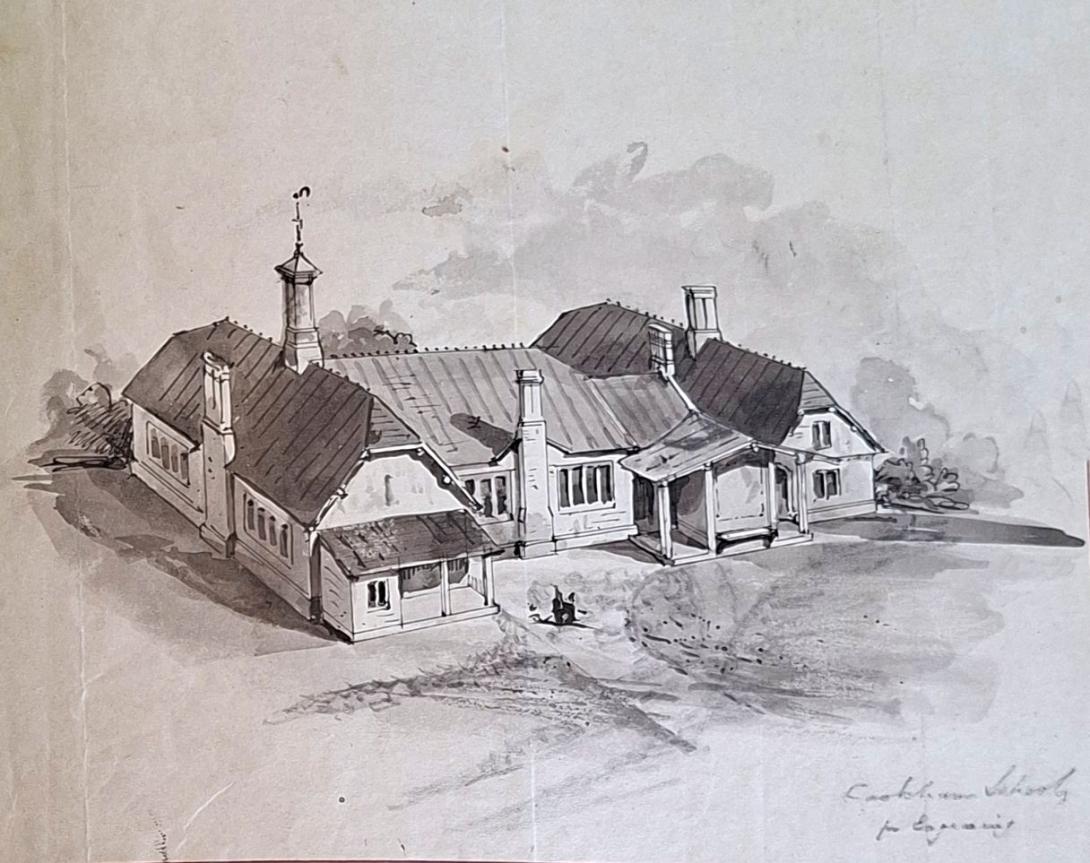
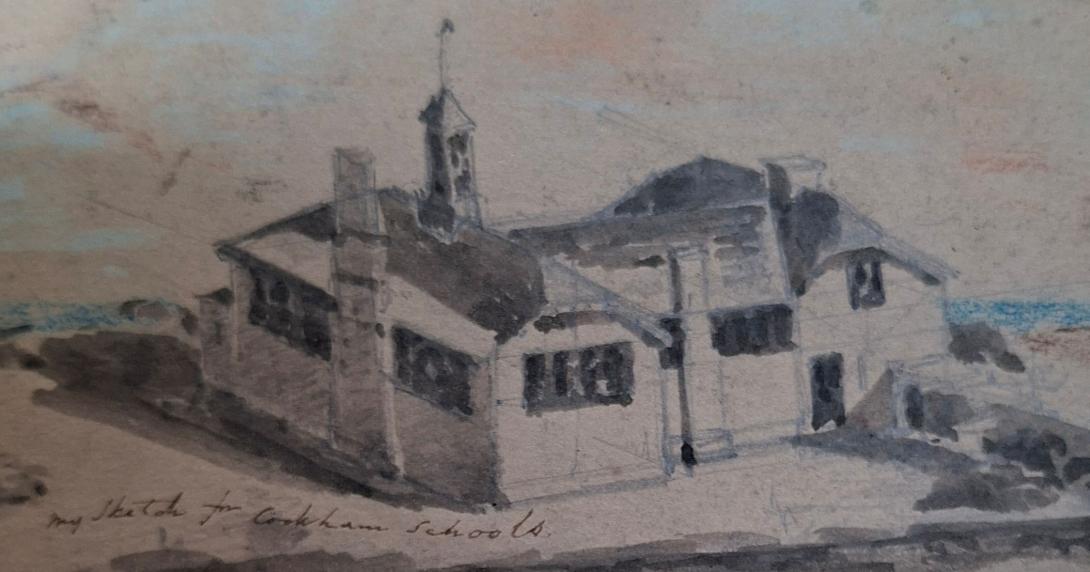
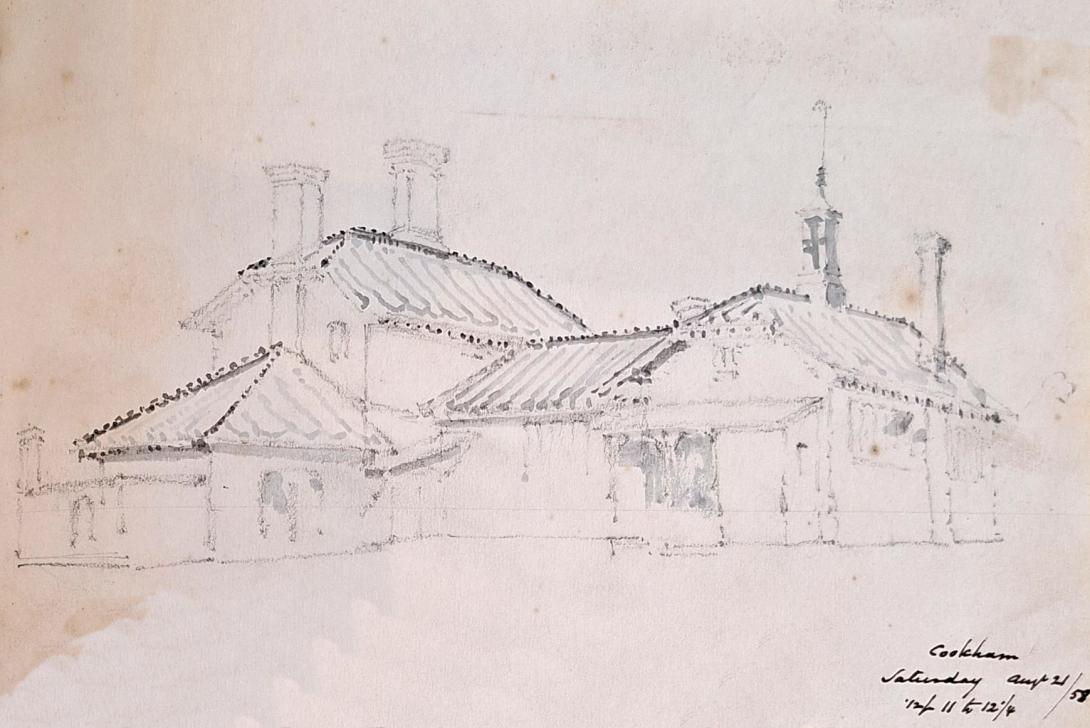
Cookham Saturday Aug 21 1858 and Cookham Schools for engraving and My skethc for cookham schools
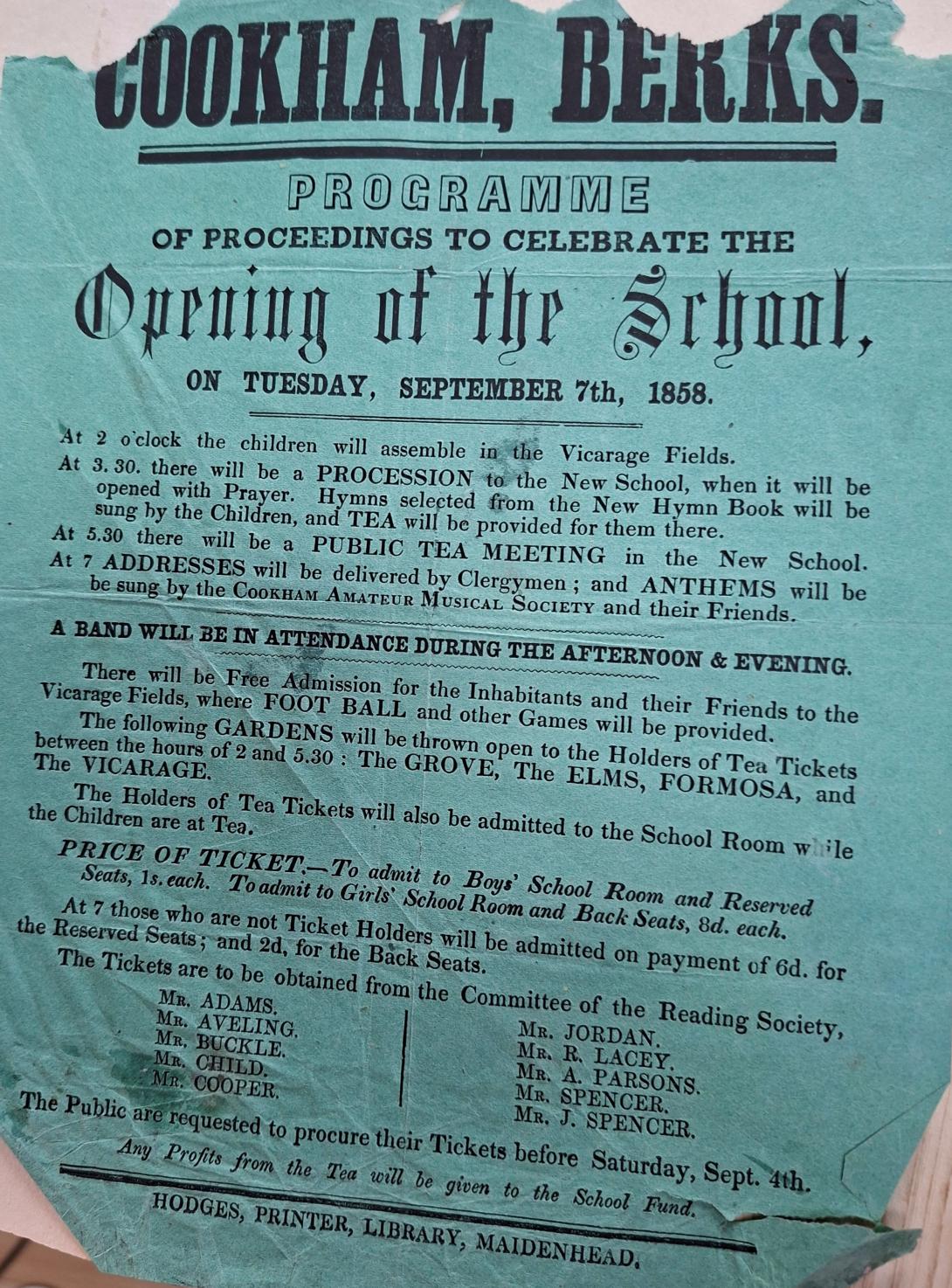
The main building of Holy Trinity CofE Primary School in Cookham was indeed built in 1858. It was part of the development of Cookham village and served to educate local children while also functioning as a community hall for events like concerts and meetings. Holy Trinity School in Cookham, linked to the historic Holy Trinity Church, has roots going back to the 1840s, with a formal founding around 1848 as a Sunday & Infants School next to the church, though details specifically for 1858 focus on the church's deep history and its role in village life, predating modern school structures but laying groundwork for its later development and presence in the famous village known for artist Stanley Spencer. The church itself dates back to Norman times (1140), with parts like the Lady Chapel from 1182, showing a long-standing religious and community presence in Cookham. While the school's official history mentions a founding around 1848, 1858 falls within this early period where church-run education began, though records might be sparse for that exact year. In 1858 Holy Trinity School was built, and not only educated the local children but provided a community hall for concerts and meetings.
The first stage of the Holy Trinity School was built in 1858. The brick buildings feature high roof pitches, and have some decorative windows, the surrounds of which are patterned with intermittent bands of blue and red brick in the form of a gothic arch. The darker blue brick can be seen elsewhere within the red brick that makes up the bulk of the buildings. Whilst several more recent extensions have been added to the school, it is still possible to make out these original elements.
Cookham is a historic Thames-side village and civil parish on the north-eastern edge of Berkshire, England, 2.9 miles (5 km) north-north-east of Maidenhead and opposite the village of Bourne End. Cookham forms the southernmost and most rural part of the High Wycombe urban area. With adjoining Cookham Rise and Cookham Dean, it had a combined population of 5,779 at the 2011 Census. In 2011, The Daily Telegraph deemed Cookham Britain's second richest village.
It is recorded in the Domesday Book of 1086 as Cocheham. The name may be from the Old English cōc + hām, meaning 'cook village', i.e. 'village noted for its cooks', although the first element may be derived from the Old English cōc(e) meaning 'hill'.
The parish includes three settlements:
- Cookham Village – the centre of the original village, with a high street that has changed little over the centuries
- Cookham Dean – the most rural village in the parish
- Cookham Rise – the middle area that grew up round the railway station
The ancient parish of Cookham covered all of Maidenhead north of the Bath Road until this was severed in 1894, including the hamlets of Furze Platt and Pinkneys Green. There were several manors: Cookham, Lullebrook, Elington, Pinkneys, Great Bradley, Bullocks, White Place and Cannon Court. The neighbouring communities are Maidenhead to the south, Bourne End to the north, Marlow and Bisham to the west and Taplow to the east.
The River Thames flows past Cookham on its way between Marlow and Taplow. Several Thames islands belong to Cookham, such as Odney Island, Formosa Island and Sashes Island, which separates Cookham Lock from Hedsor Water. The Lulle Brook and the White Brook are tributaries of the Thames that flow through the parish. Much common land remains in the parish, such as Widbrook Common, Cookham Dean Common and Cock Marsh. Winter Hill affords views over the Thames Valley and Chiltern Hills. Cock Marsh is a site of Special Scientific Interest (SSSI) just to the north of the village.
History
.jpg)
.jpg)
The area has been inhabited for thousands of years. Several prehistoric burial mounds on Cock Marsh were excavated in the 19th century and the largest stone axe ever found in Britain was one of 10,000 that has been dug up in nearby Furze Platt. The Roman road called the Camlet Way is reckoned to have crossed the Thames at Sashes Island, now cut by Cookham Lock, on its way from St. Albans to Silchester. By the 8th century there was an Anglo-Saxon abbey in Cookham, under the patronage of the Kingdom of Mercia, and one of the later abbesses was Cynethryth, widow of Offa of Mercia. It became the centre of a power struggle between Mercia and Wessex, with the Thames forming a boundary between the two.
In 2021 archaeological excavations by a team from the University of Reading discovered the site of the abbey, adjacent to Cookham's parish church, and items associated with it, while the following year additional excavations revealed extensive ancient infrastructure suggesting a larger settlement and trading centre. Later, Alfred the Great made Sashes Island one of his burhs to help defend against Viking invaders. There was a royal palace here where the Witan met in 997.
Although the earliest stone church building may have existed from 750, the earliest identifiable part of the current Holy Trinity parish church is the Lady Chapel, built in the late 12th century on the site of the cell of a female anchorite who lived next to the church and was paid a halfpenny a day by Henry II.
In the Middle Ages, most of Cookham was owned by Cirencester Abbey and the timber-framed Churchgate House was apparently the Abbot's residence when in town. The Tarry Stone – still to be seen on the boundary wall of the Dower House – marked the extent of their lands. In 1611 the estate at Cookham was the subject of the first ever country house poem, Emilia Lanier's "Description of Cookham", which pays tribute to her patroness, Margaret Clifford.
,_Our_Village_(Cookham),_1873.jpg)
The townspeople resisted many attempts to enclose parts of the common land, including those by the Rev. Thomas Whateley in 1799, Miss Isabella Fleming in 1869, who wanted to stop nude bathing at Odney, and the Odney Estates in 1928, which wanted to enclose Odney Common. The Maidenhead and Cookham Commons Preservation Committee was formed and raised £2,738 to buy the manorial rights and the commons which were then donated to the National Trust by 1937. These included Widbrook, Cock Marsh, Winter Hill, Cookham Dean Commons, Pinkneys Green Common and Maidenhead Thicket.
Holy Trinity parish church is a Grade II* listed building containing several monuments, including a Purbeck marble tomb for Robert Peeke, clerk of the spicery to Henry VI, (died 1517), and his wife; a tablet by Flaxman, to mariner Sir Isaac Pocock, uncle of dramatist Isaac Pocock, who drowned in the Thames in 1810; and a mural tablet to Arthur Babham (died 1560) with an entablature and a shield.
Cookham Wesleyan Methodist chapel was built in 1846 and extended in 1911. It now houses the Stanley Spencer Gallery.
Cookham village is on the A4094 between Maidenhead and Bourne End. The A404 from Maidenhead to High Wycombe is just to the west of Cookham Dean. Cookham railway station, at Cookham Rise, is on the Marlow branch line. There are half-hourly services to Maidenhead and Bourne End, with peak services extended to Marlow. An hourly bus service to Maidenhead, Bourne End and High Wycombe is provided by Arriva Shires & Essex six days a week. The river Thames has a long stretch of moorings above Cookham Bridge.
The village as a tourist destination is a convenient base for walks along the Thames Path and across National Trust property. There is a selection of restaurants and pubs in the High Street. The Stanley Spencer Gallery, based in the former Methodist chapel, has a permanent exhibition of the artist's works.

- Kenneth Grahame is said to have been inspired by the River Thames at Cookham to write The Wind in the Willows, as he lived at The Mount in Cookham Dean as a child and returned to the village to write the book. Quarry Wood in Bisham, adjoining, is said to have been the original Wild Wood.
- The English painter Stanley Spencer was born here and most of his works depict villagers and their life in Cookham. His religious paintings usually had Cookham as a backdrop and a number of the landmarks in his canvases can still be seen in the village. Several of his works can be seen in the gallery in the centre of the village, close to where he lived. He also painted frescoes in at least one of the private houses in Cookham; however, they are not open to public viewing. His ashes are buried in the churchyard in the village.
- In Noël Coward's play Hay Fever, retired actress Judith Bliss and her family live in Cookham.
- Cookham is mentioned in Harold Pinter's short play Victoria Station which premiered at the Royal National Theatre with Paul Rogers and Martin Jarvis.
Richard Suter was born in Greenwich, Kent on 30th March 1798, to William Suter and his wife Sarah Knights. On 7th January 1825 he married Anne Ruth Burn.
English architect. As Surveyor to The Fishmongers' Company he designed the severe Presbyterian churches for Ballykelly (1825–7) and Banagher (1825) on the Company's Estate in County Londonderry, drawings of which were exhibited at the Royal Academy in 1827. He was also responsible for the Model Farm (1823–4), the Lancasterian Schools (1828–30), the Company Agent's House (1830–2—now a hotel, much altered), a range of houses on the south side of the main road (1823–4), the lodge in the Presbyterian churchyard (1828), and the Dispensary (1829), all at Ballykelly, and all Classical. As Surveyor to Trinity House Corporation, he designed houses that were erected by Thomas Cubitt in 1821–3 on a site adjoining Trinity House. For The Fishmongers' Company he designed St Peter's Almshouses, Wandsworth, London (1849–51), and The Old School-House, Gresham's School, Holt, Norfolk(1859), in an Elizabethan style.
On the 1841 Census Richard, an architect and lawyer, can be found living in London with his wife Ann (listed as Ruth) and their two children, Richard George and Andrew Burn. Living with them is Edward D Suter. 1851 finds the family living in Tottenham Court in London, by this time Andrew had left the home, but I am unable to trace him on the 1851 Census. In 1860 Andrew marries Amelia Damaris Harrison. Both Richard George and Andrew were to become ordained ministers, with Andrew later becoming a Bishop and emigrating to New Zealand. Sadly in 1854 Anne Ruth was to pass away. In 1861, widowed Richard, Justice of the Peace for Maidenhead, is living at Castle Hill, Maidenhead, Berkshire. In 1862 he married Elizabeth Anne Pocock. In 1871 and 1881 Richard and Elizabeth are still living in Castle Hill. Richard was to pass away on 1st March1883.
Richard Suter & Annesley Voysey, architects, had their office at number 35 Fenchurch Street, but they did not have it all to themselves as they shared the premises with W.C. Franks, a tea broker, who will get a separate post some other time. The earliest mention I found of Richard Suter in Fenchurch Street is in 1832 when he is listed at that address in a list of contributing members of the Society for the Propagation of the Gospel in Foreign Parts. It says that he had been a member since 1829, but that does not mean he was already at 35 Fenchurch Street in that year.(1) In fact, that seems unlikely as the Sun Fire Office records give Messrs. Short and Co., merchants, as paying the insurance premium on the premises in May 1830. The Directory of British Architects 1834-1914 give the year 1827, but I do not know on what evidence. When Suter and Voysey became partners is also uncertain, but they had known each other since at least 1825 as Suter is named as one of the executors of Voysey’s will which was dated 22 July, 1825. The address given for Suter in the will is Suffolk Street, Southwark. Voysey then lives at Conway Street, Fitzroy Square.