
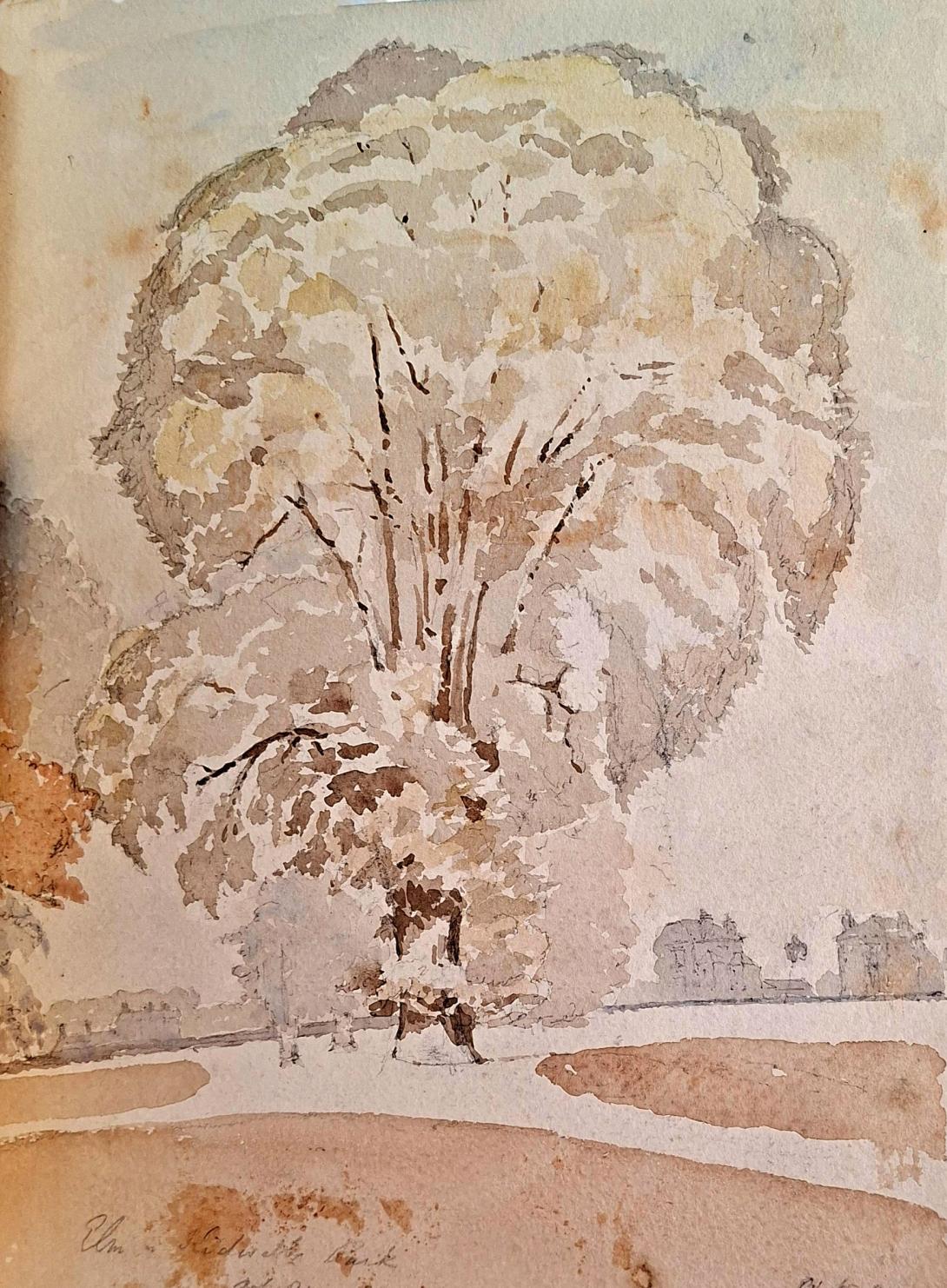
Elm Tree Kidwell Park Oct 24 1871
Kidwells Park, a municipal park of 3 hectares bordering Bad Godesberg Way (A4) in the centre of Maidenhead, is named after Nevill Kidwell who was a burgess of Maidenhead during the reign of Charles II and warden (equivalent of mayor) in 1674. Kidwells House stood at the corner of Marlow Road and West Street; it was also known as the Manor House, demolished in 1970 to make way for the inner relief road (A4 - Bad Godesberg Way).
The earliest record of Kidwells House is in 1705, three years after the death of Nevill Kidwell. Kidwells Park (the western half of the present municipal park) was a seven acre enclosure which was part of the Kidwells estate. In 1818 William Payn, mayor of Maidenhead in 1837 and County Treasurer for Berkshire from 1822, who lived in Kidwells House, extended Kidwells Park by 29 acres as a deer park, as far north as what is now Cordwallis Road. Stephen Darby (Cookham’s historian) recalled that:
‘It was a joke that I well remember that the park was so small that the deer would not lie in it but were continually escaping from it: no doubt its closeness to the town had something to do with it’
At that time the eastern half of present day Kidwells Park was an enclosure called ‘Home Close’, part of Swallow’s Farm in Market Street and in different ownership. William Payn died in 1840 and the general enclosure of Maidenhead Fields in Cookham Parish (of which the Kidwells estate formed a large part) was completed by 1852, enabling the development of most of the former deer park as the Norfolk Park estate, centred on St Luke’s Church (consecrated 1866). In the 1860s Home Close was incorporated into Kidwells Park and purchased by J D M Pearce in 1876, along with Kidwells House, though he never lived there (the 1874 first edition 25” Ordnance Survey names them ‘Kidwell House’ and ‘Kidwell Park’). J D M Pearce was five times mayor of Maidenhead and, although Kidwells Park was already in use for local gatherings and sporting events, in his last term of office in 1890 he presented it to the people of Maidenhead, with the stipulation that three-quarters of the trustees be total abstainers – J D M Pearce was a teetotaller. He died in 1898, when the ‘Maidenhead Advertiser’ wrote:
‘Few towns of Maidenhead’s size can boast so pleasant a park, dotted with such beautiful trees and so centrally situated’
However, the eastern half of the park was surrounded by a cycle track for many years and still has sports courts for tennis, netball and football, while the western half was used for football and rugby, with the result that most of the established trees were felled (though two old plane trees remain, and the Irish yew in the middle of the Castle Hill roundabout once stood in the Manor House garden). The trustees consented to the building of a Technical School (now a Youth and Community Centre) and Drill Hall (now replaced by the Commonwealth War Graves Commission) on the Marlow Road frontage. The Maidenhead Corporation acquired the park from the trustees in 1946.
During the 1950s and 1960s the Campaign for Nuclear Disarmament used Kidwells Park as a stopping place for refreshment on their annual Easter marches from Aldermaston to Hyde Park Corner. The rugby club later moved to Braywick Road and following the upheaval of the building of the inner relief road (Bad Godesburg Way) in the 1970s the park has largely been restored as parkland and ornamental garden. The gravel ridge in the centre of the park was once thought to be a Roman road, and is marked as such in early Ordnance Survey maps. The eastern end of the park now includes a skate park and young children’s play area. Maidenhead’s annual July Festival is centred on Kidwells Park.
Richard Suter was born in Greenwich, Kent on 30th March 1798, to William Suter and his wife Sarah Knights. On 7th January 1825 he married Anne Ruth Burn.
English architect. As Surveyor to The Fishmongers' Company he designed the severe Presbyterian churches for Ballykelly (1825–7) and Banagher (1825) on the Company's Estate in County Londonderry, drawings of which were exhibited at the Royal Academy in 1827. He was also responsible for the Model Farm (1823–4), the Lancasterian Schools (1828–30), the Company Agent's House (1830–2—now a hotel, much altered), a range of houses on the south side of the main road (1823–4), the lodge in the Presbyterian churchyard (1828), and the Dispensary (1829), all at Ballykelly, and all Classical. As Surveyor to Trinity House Corporation, he designed houses that were erected by Thomas Cubitt in 1821–3 on a site adjoining Trinity House. For The Fishmongers' Company he designed St Peter's Almshouses, Wandsworth, London (1849–51), and The Old School-House, Gresham's School, Holt, Norfolk(1859), in an Elizabethan style.
On the 1841 Census Richard, an architect and lawyer, can be found living in London with his wife Ann (listed as Ruth) and their two children, Richard George and Andrew Burn. Living with them is Edward D Suter. 1851 finds the family living in Tottenham Court in London, by this time Andrew had left the home, but I am unable to trace him on the 1851 Census. In 1860 Andrew marries Amelia Damaris Harrison. Both Richard George and Andrew were to become ordained ministers, with Andrew later becoming a Bishop and emigrating to New Zealand. Sadly in 1854 Anne Ruth was to pass away. In 1861, widowed Richard, Justice of the Peace for Maidenhead, is living at Castle Hill, Maidenhead, Berkshire. In 1862 he married Elizabeth Anne Pocock. In 1871 and 1881 Richard and Elizabeth are still living in Castle Hill. Richard was to pass away on 1st March1883.
Richard Suter & Annesley Voysey, architects, had their office at number 35 Fenchurch Street, but they did not have it all to themselves as they shared the premises with W.C. Franks, a tea broker, who will get a separate post some other time. The earliest mention I found of Richard Suter in Fenchurch Street is in 1832 when he is listed at that address in a list of contributing members of the Society for the Propagation of the Gospel in Foreign Parts. It says that he had been a member since 1829, but that does not mean he was already at 35 Fenchurch Street in that year.(1) In fact, that seems unlikely as the Sun Fire Office records give Messrs. Short and Co., merchants, as paying the insurance premium on the premises in May 1830. The Directory of British Architects 1834-1914 give the year 1827, but I do not know on what evidence. When Suter and Voysey became partners is also uncertain, but they had known each other since at least 1825 as Suter is named as one of the executors of Voysey’s will which was dated 22 July, 1825. The address given for Suter in the will is Suffolk Street, Southwark. Voysey then lives at Conway Street, Fitzroy Square.