
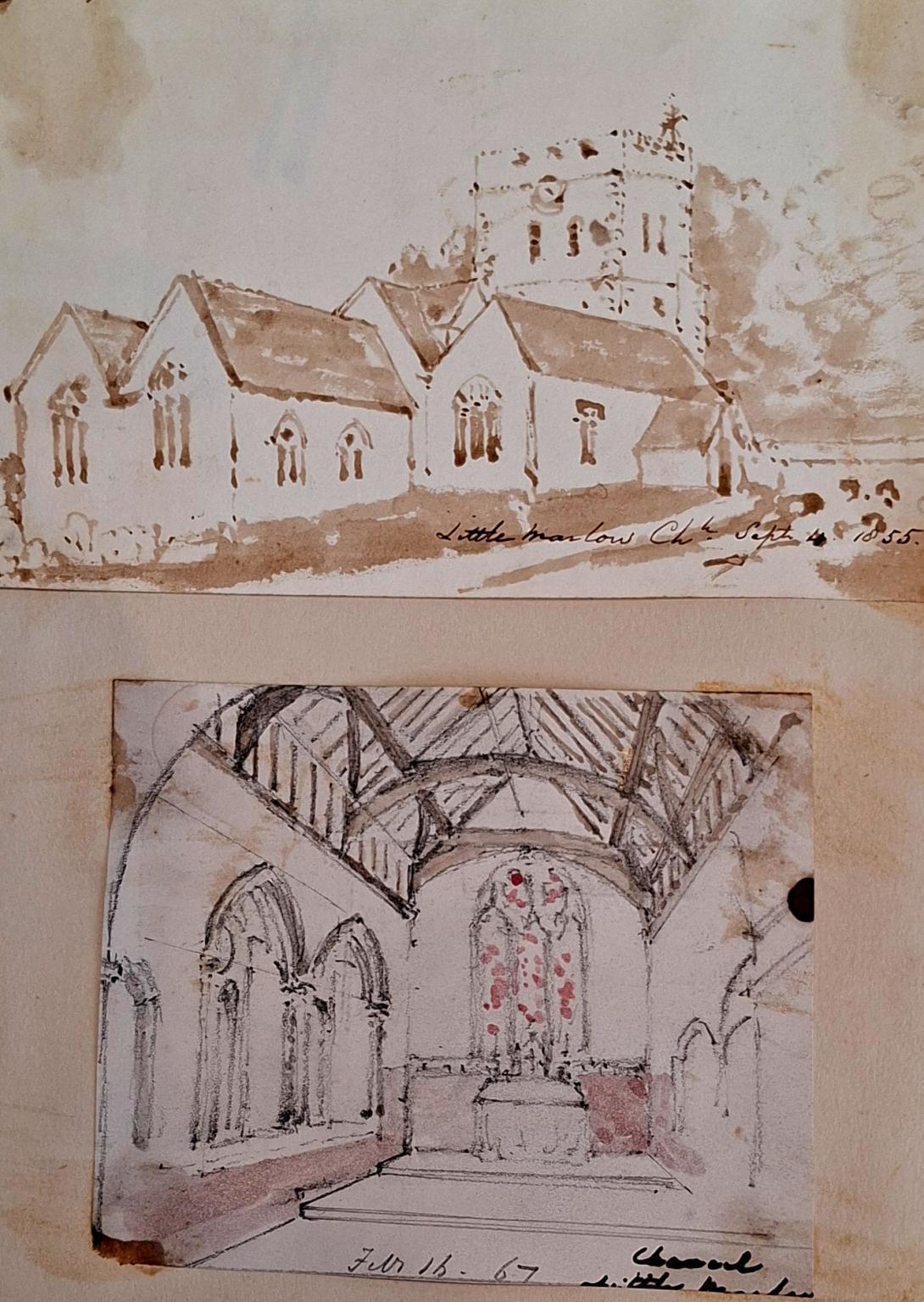
Little Marlow Church Sept 4th 1855 and Chancel Little Marlow feb 16 67
It is difficult to imagine a more quintessentially English scene, or one more satisfying to the imagination, than that which lies before the visitor pushing open the centrally pivoted swinging lych-gate leading to the small grey church of St John the Baptist. (The Ancient church of St John the Baptist Little Marlow by Patricia Burstall)
It would be easy to imagine that time has passed by this small corner of England, but this is far from the truth. The church, which was founded around 1190, (150 years after the Norman Conquest) is located close to the river Thames, a major route-way up to modern times. In the Covid years, the charm of the village and church have been popularised by the national media with their proximity to a beautiful nature reserve and scenic riverside walks.
The church was not originally built as a whole structure, but has been gradually enlarged, added to and altered, throughout succeeding centuries. The chancel (where the main altar is situated) dates from around the 12th century. The tower at the eastern end and the north aisle (where you enter), are both 14th century. The nave (central aisle) and south aisle (R as you face the altar) are both 15th. The church has also been changed internally too, in order to meet the religious and political requirements of the times, as well as those of changing tastes and priorities.
Opening onto the chancel is a quiet side chapel, built in 1430 for the repose of Nicholas Ledewich. His memorial and that of his wife Alice, lie beneath a shallow stone archway linked to the chancel. It is probable that walls of this chapel and the chancel would have originally been painted with colourful scenes from the bible and lives of the saints. It seems likely that these were obliterated under a coat of white wash, following the ‘Putting away of books and images Act' of 1549. They were obscured still further in the 18th to 19th centuries, when memorial plaques to the local gentry were attached to the walls.
Nicholas Ledewich retains a place in history as a soldier who fought at the battle of Agincourt in 1415. As a senior retainer to John de Mowbray, (Earl Marshall of England), Ledewich was part of the armed contingent provided by Mowbray to Henry Vth. for this battle. Sadly, the helmet, arms and brass plate that once decorated the tomb of Nicholas Ledewich, have long since disappeared. Fortunately the brass of his wife still remains intact, with her little dog lying peacefully at her feet. However, exactly why Nicholas and Alice came to choose the church at Little Marlow as their final resting place, is a mystery yet to be resolved.
Another intriguing feature of the Ledewich chapel is the East window with its patchwork of glass fragments. These include a dove and shield, all dating from the 15th century. The window may have been broken during the Reformation under the reigns of Henry V111 or Edward V1. After the break with the Pope and Rome, churches were 'simplified' following the Protestant model. Stained glass windows with holy scenes were removed (statues and other precious reliquaries too). Another possibility is that the window was smashed by Parliamentarians during the English Civil War 1642-46. During this time, the area of Little Marlow was a Parliamentary stronghold. Colonel Scott, who lived less than half a mile away at Westhorpe Manor was one of the signatories for the execution of Charles 1st.
Apart from the Ledewich, the colourful windows in the church today date from the mid-1800s. In 1866 our Victorian forebears undertook a major restoration of the church fabric. This included removing and replacing the box pews of the 18th century. The new pews that replaced them, were intended to seat a congregation of 276! Though now reduced in number, they are the very ones you see today. Part of the church floor was also retiled at this time.. Fortunately, a few of the original medieval tiles still remain in the porch of the North door. A fleur de Lys, is one of the designs, drawing us back to our distant links with Norman France.
Each generation has made its mark on the church and will continue to do so. With such an ancient building on-going renovation and restoration is as inevitable as it’s expensive. So far this small church has managed to survive war, plague, tempest and religious fanaticism. It has seen kings, queens and governments come and go. Though set in a backwater, it has somehow managed to retain a finger on the pulse of history. It has remained a valued symbol of Christian life throughout the centuries and with God’s blessing, will continue to do so for centuries to come.
Richard Suter was born in Greenwich, Kent on 30th March 1798, to William Suter and his wife Sarah Knights. On 7th January 1825 he married Anne Ruth Burn.
English architect. As Surveyor to The Fishmongers' Company he designed the severe Presbyterian churches for Ballykelly (1825–7) and Banagher (1825) on the Company's Estate in County Londonderry, drawings of which were exhibited at the Royal Academy in 1827. He was also responsible for the Model Farm (1823–4), the Lancasterian Schools (1828–30), the Company Agent's House (1830–2—now a hotel, much altered), a range of houses on the south side of the main road (1823–4), the lodge in the Presbyterian churchyard (1828), and the Dispensary (1829), all at Ballykelly, and all Classical. As Surveyor to Trinity House Corporation, he designed houses that were erected by Thomas Cubitt in 1821–3 on a site adjoining Trinity House. For The Fishmongers' Company he designed St Peter's Almshouses, Wandsworth, London (1849–51), and The Old School-House, Gresham's School, Holt, Norfolk(1859), in an Elizabethan style.
On the 1841 Census Richard, an architect and lawyer, can be found living in London with his wife Ann (listed as Ruth) and their two children, Richard George and Andrew Burn. Living with them is Edward D Suter. 1851 finds the family living in Tottenham Court in London, by this time Andrew had left the home, but I am unable to trace him on the 1851 Census. In 1860 Andrew marries Amelia Damaris Harrison. Both Richard George and Andrew were to become ordained ministers, with Andrew later becoming a Bishop and emigrating to New Zealand. Sadly in 1854 Anne Ruth was to pass away. In 1861, widowed Richard, Justice of the Peace for Maidenhead, is living at Castle Hill, Maidenhead, Berkshire. In 1862 he married Elizabeth Anne Pocock. In 1871 and 1881 Richard and Elizabeth are still living in Castle Hill. Richard was to pass away on 1st March1883.
Richard Suter & Annesley Voysey, architects, had their office at number 35 Fenchurch Street, but they did not have it all to themselves as they shared the premises with W.C. Franks, a tea broker, who will get a separate post some other time. The earliest mention I found of Richard Suter in Fenchurch Street is in 1832 when he is listed at that address in a list of contributing members of the Society for the Propagation of the Gospel in Foreign Parts. It says that he had been a member since 1829, but that does not mean he was already at 35 Fenchurch Street in that year.(1) In fact, that seems unlikely as the Sun Fire Office records give Messrs. Short and Co., merchants, as paying the insurance premium on the premises in May 1830. The Directory of British Architects 1834-1914 give the year 1827, but I do not know on what evidence. When Suter and Voysey became partners is also uncertain, but they had known each other since at least 1825 as Suter is named as one of the executors of Voysey’s will which was dated 22 July, 1825. The address given for Suter in the will is Suffolk Street, Southwark. Voysey then lives at Conway Street, Fitzroy Square.