
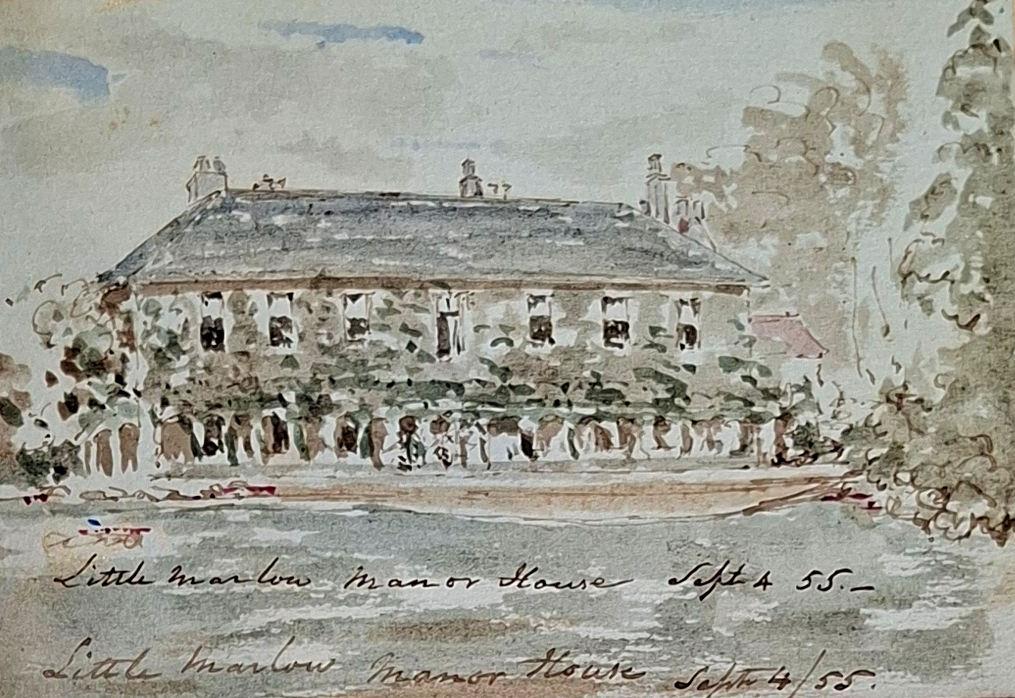
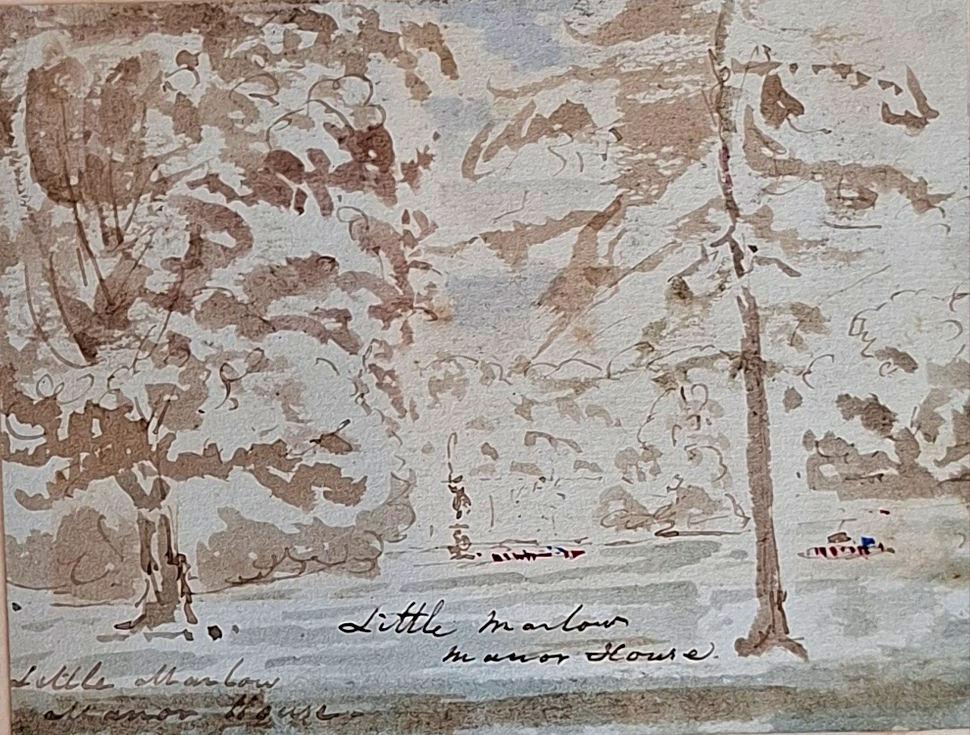
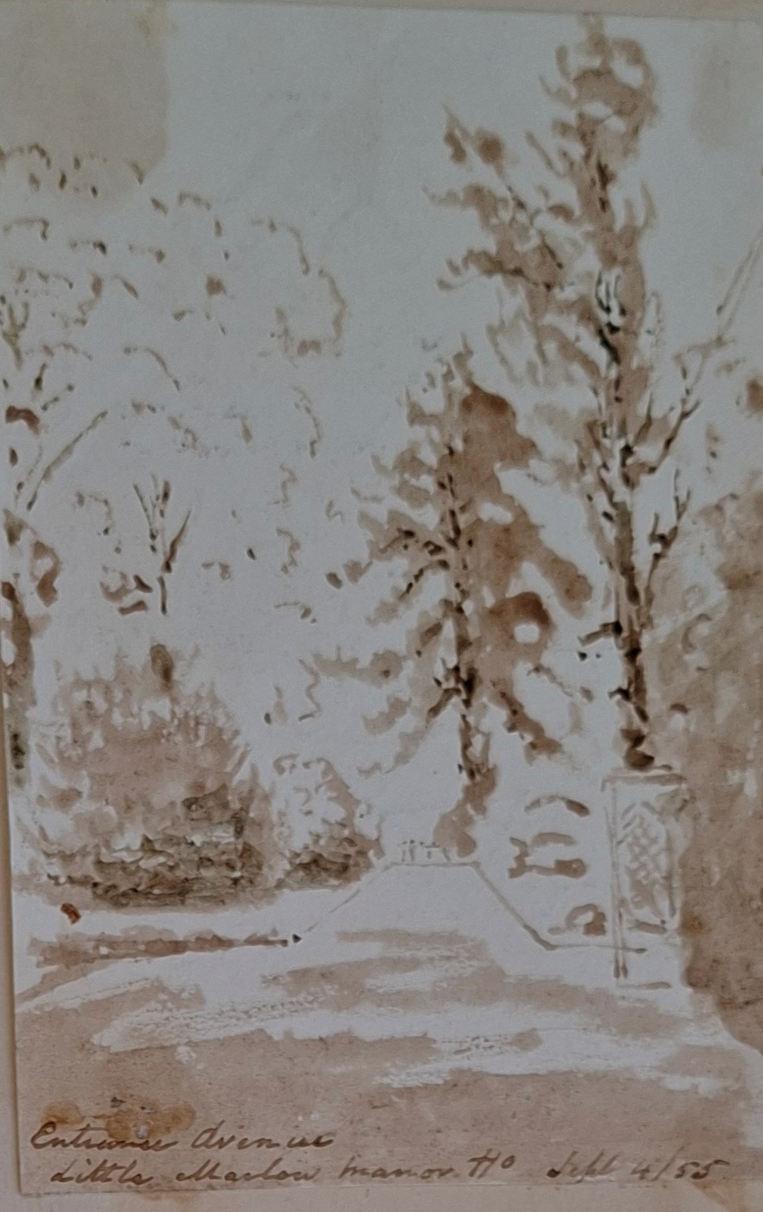
Little Marlow Manor House Sept 4th 1855 and Entrance Avenue Little Marlow Manor Ho Sept 4th 55
Higher up the street, on the left, an avenue of fine elms leads to the Manor House, the seat of Mrs. Bradish-Ellames. The house is an irregular building, with a modern front, though other parts date from the early 17th century. The staircase is original, and the hall is lined with panelling of the same date brought from elsewhere. The house stands in well-arranged gardens. Little Marlow Farm at the top of the street, with a group of cottages, the usual smithy, public-houses and post office complete the village. The Village, which is very small, lies in a Low Position, not far from the Thames Bank. The Church of St John Baptist stands in a Churchyard entered by a Lych-Gate at the Southern Entrance, with the Vicarage, a substantial late-18thC Building, opposite. Higher up the Street, on the left, was an Avenue of Fine Elms leads to the Manor House, the Seat of Mrs Bradish-Ellames. The House is an Irregular Building, with a Modern Front, though other parts date from the early- 17thC. The Staircase is Original & the Hall is Lined with Panelling of the same date brought from elsewhere. The House stands in well-arranged Gardens. Little Marlow Farm at the top of the Street, with a Group of Cottages, the usual Smithy, Public-houses & Post Office complete the village.
LITTLE MARLOW CHURCH ROAD SU 88 NE 5/68 Manor House 21.6.55 GV II House. Late C16 with early C19 wing along S. front, refurbished 1963-65. C16 parts have a ground floor rebuilt in brick, with a timber frame and rendered infill above. Plain tile roof. 2 tall storeys and attic, 5 bays. Large C20 barred wooden casements of 2-5 lights, 3 gabled dormers with 3-light casements. Lower bay possibly C17, projects to right, with slight timbers, similar C20 wooden casements, and door in a recessed porch. C20 brick outbuilding projects from the gable. To right of S. front C16 wing has an overhanging roughcast attic storey with an overhanging gable, both jetties coved with dogtooth moulding in roughcast. Early C19 wing along S. front is roughcast with flat eaves and hipped plain tile roof. 2 storeys, 7 bays. 2-pane sashes to ground floor, 3-pane sashes to first floor, all boxed with moulded frames. Central 6-panelled door with rectangular fanlight, shouldered wooden architrave frame and moulded pediment on carved scroll brackets. Over door is C20 rendered cartouche dated 1565 1965 EW. Small W. wing, altered and raised C20, with semi-circular projection. Interior: fine early C17 staircase with arcaded balustrade, heavily moulded handrail, moulded string and square newels; fine roof to C16 part with double purlins, arched wind-braces and heavy vertical struts supporting centre of each collar. Room to right of early C19 block has plaster frieze with a continuous bundle of lictors'rods. RCHM I p. 232 Mon. 3.
Situated in the quaint village of Little Marlow in Buckinghamshire, the history of The Manor House can be traced all the way back to the Domesday Book of 1086, and has since evolved to include a lodge, stables, modern spa complex, barn, greenhouse and orchard across its almost nine acres of land.
From serving as the headquarters for a British battalion during World War II to becoming the home of singer, songwriter and former Spice Girl Mel B in the 1990s, The Manor House is steeped in military, royal and pop culture history. And while the property has undergone a number of changes over the years, it has still managed to retain its original old-world grandeur and historical features, including original timber beams and an ancient secret passageway that connects the Elizabethan cellars below the manor to the river.
Little Marlow is a village and civil parish in Buckinghamshire, England. The Church of England parish church of Saint John the Baptist lies at the heart of the village, not far from the river and next to the Manor House. The original construction of the church is Norman, dating from the final years of the 12th century. Most of the building was built during the 14th and 15th centuries.
Little Marlow was once the site of a Benedictine convent dedicated to the Blessed Virgin Mary. The convent belonged to Bisham Abbey. It was seized by the Crown in the Dissolution of the Monasteries in 1547 and was eventually demolished in 1740. Today the village is in a scenic location on the River Thames, although home to a large sewage works, with exceptional birdwatching habitats on the lakes created from former gravel extraction sites.
There are two public houses in the village: the Kings Head and the Queens Head.
Little Marlow is located along the north bank of the River Thames, about a mile east of Marlow. The toponym "Marlow" is derived from the Old English for "land remaining after the draining of a pool". In 1015 it was recorded as Merelafan. Little Marlow is surrounded by the Little Marlow Lakes Country Park.
Hamlets in the parish of Little Marlow include Coldmoorholme, Fern, Handy Cross, Sheepridge, and Winchbottom.
The village cottages are set around a large space, surrounded by lime trees, that is used as a cricket ground and village green where an annual fête is held.
Little Marlow appears briefly in Mary Shelley's 1826 science fiction novel The Last Man, in a sequence where the novel's protagonist recounts how the village's residents went about trying to prevent themselves from falling ill with the plague. Mel B was a one-time resident of Little Marlow. In 2021, Little Marlow was used as a temporary filming location for the Star Wars series Andor.
Richard Suter was born in Greenwich, Kent on 30th March 1798, to William Suter and his wife Sarah Knights. On 7th January 1825 he married Anne Ruth Burn.
English architect. As Surveyor to The Fishmongers' Company he designed the severe Presbyterian churches for Ballykelly (1825–7) and Banagher (1825) on the Company's Estate in County Londonderry, drawings of which were exhibited at the Royal Academy in 1827. He was also responsible for the Model Farm (1823–4), the Lancasterian Schools (1828–30), the Company Agent's House (1830–2—now a hotel, much altered), a range of houses on the south side of the main road (1823–4), the lodge in the Presbyterian churchyard (1828), and the Dispensary (1829), all at Ballykelly, and all Classical. As Surveyor to Trinity House Corporation, he designed houses that were erected by Thomas Cubitt in 1821–3 on a site adjoining Trinity House. For The Fishmongers' Company he designed St Peter's Almshouses, Wandsworth, London (1849–51), and The Old School-House, Gresham's School, Holt, Norfolk(1859), in an Elizabethan style.
On the 1841 Census Richard, an architect and lawyer, can be found living in London with his wife Ann (listed as Ruth) and their two children, Richard George and Andrew Burn. Living with them is Edward D Suter. 1851 finds the family living in Tottenham Court in London, by this time Andrew had left the home, but I am unable to trace him on the 1851 Census. In 1860 Andrew marries Amelia Damaris Harrison. Both Richard George and Andrew were to become ordained ministers, with Andrew later becoming a Bishop and emigrating to New Zealand. Sadly in 1854 Anne Ruth was to pass away. In 1861, widowed Richard, Justice of the Peace for Maidenhead, is living at Castle Hill, Maidenhead, Berkshire. In 1862 he married Elizabeth Anne Pocock. In 1871 and 1881 Richard and Elizabeth are still living in Castle Hill. Richard was to pass away on 1st March1883.
Richard Suter & Annesley Voysey, architects, had their office at number 35 Fenchurch Street, but they did not have it all to themselves as they shared the premises with W.C. Franks, a tea broker, who will get a separate post some other time. The earliest mention I found of Richard Suter in Fenchurch Street is in 1832 when he is listed at that address in a list of contributing members of the Society for the Propagation of the Gospel in Foreign Parts. It says that he had been a member since 1829, but that does not mean he was already at 35 Fenchurch Street in that year.(1) In fact, that seems unlikely as the Sun Fire Office records give Messrs. Short and Co., merchants, as paying the insurance premium on the premises in May 1830. The Directory of British Architects 1834-1914 give the year 1827, but I do not know on what evidence. When Suter and Voysey became partners is also uncertain, but they had known each other since at least 1825 as Suter is named as one of the executors of Voysey’s will which was dated 22 July, 1825. The address given for Suter in the will is Suffolk Street, Southwark. Voysey then lives at Conway Street, Fitzroy Square.