
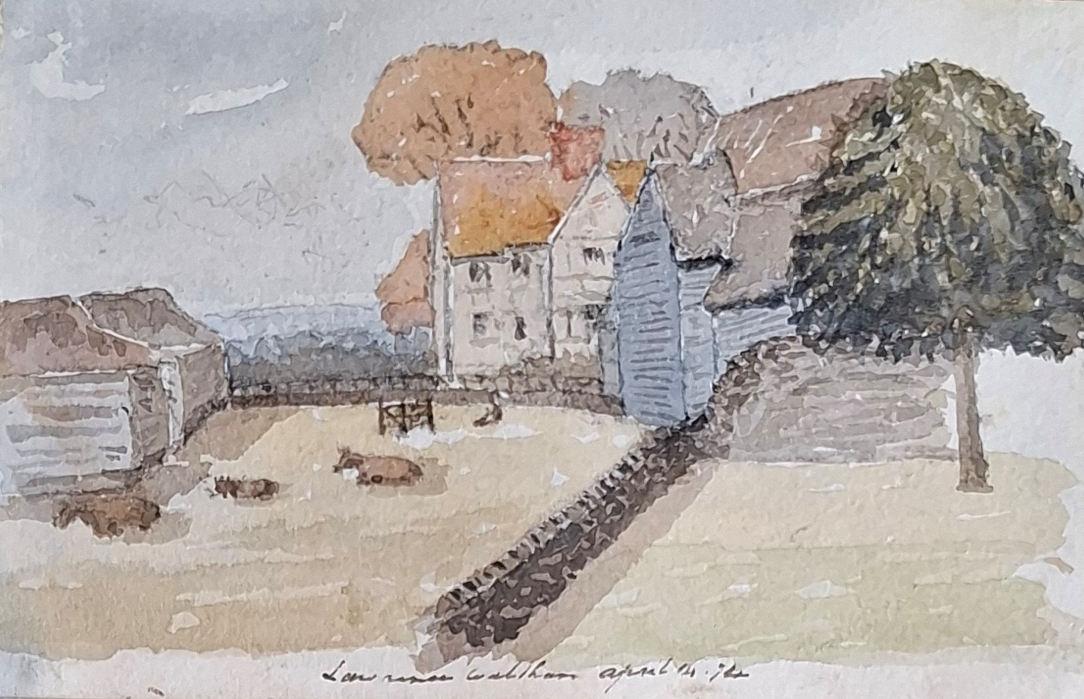
L… N…. Waltham April 14th 1874
Waltham St Lawrence is a village and civil parish in the English county of Berkshire.
The name 'Waltham' is believed to be derived from the Anglo-Saxon words Wealt and Ham, meaning 'homestead or village in a forest’ (probably indicating a royal hunting estate). The church is called St. Lawrence and thus gives the village its distinguishing affix.
.jpg)
There is evidence of the existence of a Roman temple in Weycock Field in the parish. Most of the coins found from the site are of the lower empire (except for a silver one of Amyntas, the grandfather of Alexander the Great) and the area was occupied until 270. The high-road to London formerly left the London to Reading main-road at the 29th milestone and ran across Weycock Field (often referred to as Weycock Highrood). The Priory of Hurley maintained a grange in the village on the site of what is now Church Farm (to the north-west of the present Church) and this is why the great tithes of the parish were formerly appropriated to the Prior of Hurley.
Until quite recent times a large lake separated Waltham St. Lawrence from Ruscombe (the name 'Stanlake' would seem to be a survival of this) and so the southern end of the parish was known as South Lake. The parish church was built where the ancient high-road entered the village. The manor is mentioned as early as 940 but its continuous appearance in historical records may be said to begin with its sale by Ethelred the Unready in 1006. His widow, Queen Emma, bestowed it upon Ælfwine, the Bishop of Winchester. The Domesday Book records: "The King holds Waltham in demesne" and it remained a royal manor until 1189 when Godfrey de Luci, Bishop of Winchester, purchased it from the Crown. It was retained by the bishops of Winchester until the Reformation.
Bishop Ponet of Winchester surrendered the manor of Waltham to King Edward VI in 1551, and the King donated it to Sir Henry Neville, one of the gentlemen of his Privy Chamber, but Queen Mary returned it to Bishop John White of Winchester. King Edward's grant was confirmed (and Queen Mary's annulled) by an Act of Parliament in the first year of Queen Elizabeth I. Billingbear House was built by Sir Henry Neville in 1567, and this Elizabethan mansion existed as the home of the Nevilles until it was pulled down after a fire in the early 20th century. His son was the early-17th-century diplomat, Sir Henry Neville, junior. The parish register records that:
"September 17th, 1667, King Charles 2nd, with his brother James Duke of Yorke, Prince Rupert Duke of Cumberland, James Duke of Monmouth and many more of the nobles dined at Bellingbear House in the great Parlour".
At that time, Richard Neville was Lord of the Manor. Henry Neville, the last heir of this branch of the family, who had assumed the name of Grey, as heir of his maternal grandfather, Baron Grey of Werke, died in 1740. On the death of his widow, who afterwards had married as her second husband the Earl of Portsmouth, the manor of Waltham St. Lawrence was inherited by Richard Aldworth of Stanlake, whose father had married the daughter and heir of Colonel Richard Neville. Mr. Aldworth, on his accession to this property, took the name of Neville. The village school—now a County Primary School—was originally a National School with an endowment of £35 by Lord Braybrooke, a Neville descendant. The first Dame School held in the parish was held at 'Honeys'. The village war memorial is at Paradise Corner, which takes its name from the nearby Georgian manor house, Paradise House, on The Street.
In 1920 Hal Taylor founded The Golden Cockerel Press, privately printing books from a surplus army hut he had erected in the village. The press continued to operate there under the later ownership of Robert Gibbings until, in 1933, economic circumstances forced its sale and production was relocated to London.
Waltham St Lawrence is located in a rural setting in East Berkshire, south of the A4 trunk road and north of the M4 motorway, between Maidenhead and Reading. The parish is bordered by those of Twyford and Hurst to the west and White Waltham and Maidenhead to the east. The population is around 1000 adults with an all-ages estimate of 1,500 living in approximately 550 households. Residents are mainly employed in local towns such as Reading or Bracknell, although a significant number also commute to London. Waltham St Lawrence used to have its own village shop (with a part-time post office), There is a public house, the Bell, while Shurlock Row, in the parish, has another, the Shurlock Inn. West End, between the two villages, is a residential area, where the local village school is located.
Richard Suter was born in Greenwich, Kent on 30th March 1798, to William Suter and his wife Sarah Knights. On 7th January 1825 he married Anne Ruth Burn.
English architect. As Surveyor to The Fishmongers' Company he designed the severe Presbyterian churches for Ballykelly (1825–7) and Banagher (1825) on the Company's Estate in County Londonderry, drawings of which were exhibited at the Royal Academy in 1827. He was also responsible for the Model Farm (1823–4), the Lancasterian Schools (1828–30), the Company Agent's House (1830–2—now a hotel, much altered), a range of houses on the south side of the main road (1823–4), the lodge in the Presbyterian churchyard (1828), and the Dispensary (1829), all at Ballykelly, and all Classical. As Surveyor to Trinity House Corporation, he designed houses that were erected by Thomas Cubitt in 1821–3 on a site adjoining Trinity House. For The Fishmongers' Company he designed St Peter's Almshouses, Wandsworth, London (1849–51), and The Old School-House, Gresham's School, Holt, Norfolk(1859), in an Elizabethan style.
On the 1841 Census Richard, an architect and lawyer, can be found living in London with his wife Ann (listed as Ruth) and their two children, Richard George and Andrew Burn. Living with them is Edward D Suter. 1851 finds the family living in Tottenham Court in London, by this time Andrew had left the home, but I am unable to trace him on the 1851 Census. In 1860 Andrew marries Amelia Damaris Harrison. Both Richard George and Andrew were to become ordained ministers, with Andrew later becoming a Bishop and emigrating to New Zealand. Sadly in 1854 Anne Ruth was to pass away. In 1861, widowed Richard, Justice of the Peace for Maidenhead, is living at Castle Hill, Maidenhead, Berkshire. In 1862 he married Elizabeth Anne Pocock. In 1871 and 1881 Richard and Elizabeth are still living in Castle Hill. Richard was to pass away on 1st March1883.
Richard Suter & Annesley Voysey, architects, had their office at number 35 Fenchurch Street, but they did not have it all to themselves as they shared the premises with W.C. Franks, a tea broker, who will get a separate post some other time. The earliest mention I found of Richard Suter in Fenchurch Street is in 1832 when he is listed at that address in a list of contributing members of the Society for the Propagation of the Gospel in Foreign Parts. It says that he had been a member since 1829, but that does not mean he was already at 35 Fenchurch Street in that year.(1) In fact, that seems unlikely as the Sun Fire Office records give Messrs. Short and Co., merchants, as paying the insurance premium on the premises in May 1830. The Directory of British Architects 1834-1914 give the year 1827, but I do not know on what evidence. When Suter and Voysey became partners is also uncertain, but they had known each other since at least 1825 as Suter is named as one of the executors of Voysey’s will which was dated 22 July, 1825. The address given for Suter in the will is Suffolk Street, Southwark. Voysey then lives at Conway Street, Fitzroy Square.