
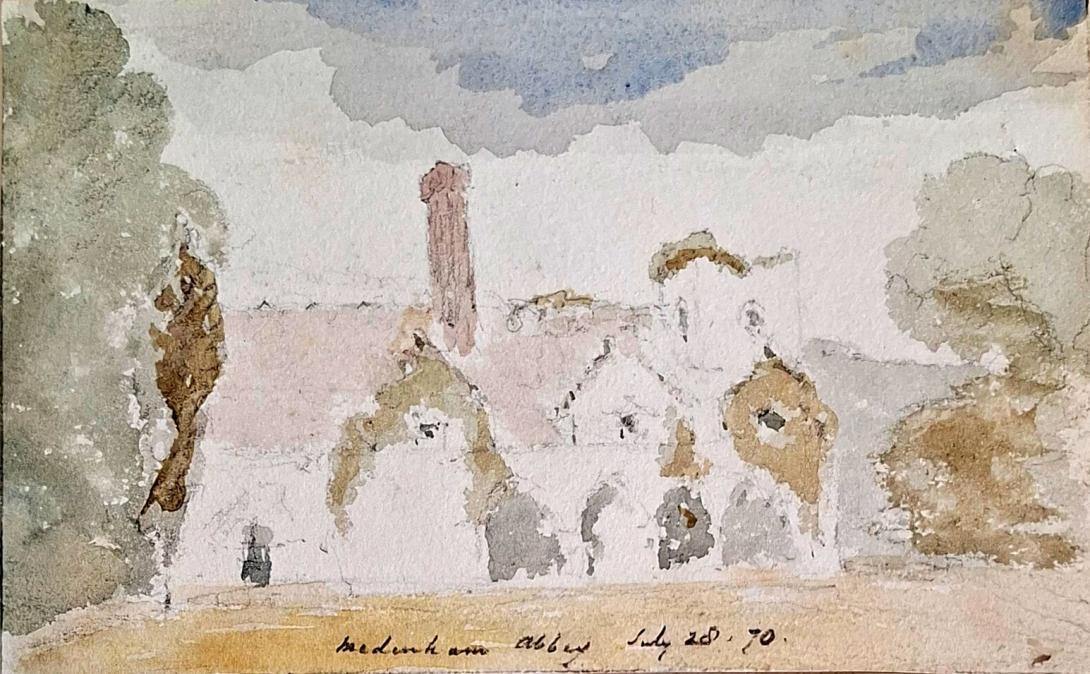
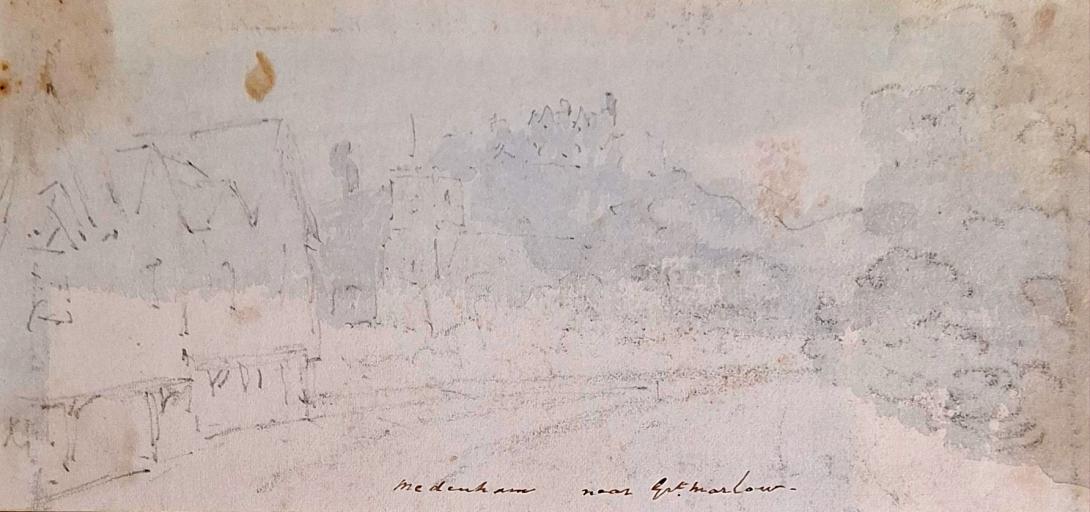
Medmenham Abbey, July 28 70 and Medenham near Great Marlow
I've written about abbeys both beautiful and sacred, with ivy-covered crumbling walls and skeletal spires. "In lone magnificence a ruin stands" is a line contained in The Ruins of Netley Abbey, by 18th century poet George Keate. The monasteries have been places of sacrifice and study, of drama and struggle, of sad abandonment.
But the story of Medmenham Abbey is, safe to say, this abbey is in a category all its own.
 |
| Painting of Medmenham Abbey, as seen from the Thames |
History does not record a single event of interest that took place within the abbey walls while Cistercian monks actually inhabited Medmenham between 1207 and 1536. It's what happened to a woman around the time of its founding and to a man two hundred years afters its dissolution that spark interest--and, in the case of what happened in the 18th century, an infamy that reverberates today.
THE FOUNDING: The person responsible for the abbey's existence was Isabel de Bolebec, a woman of strength who was determined to have a say in her own life. This was no small feat in the early 13th century, especially for an heiress.
The de Bolebecs were a family that possessed extensive land at the time of the Domesday Book in 1086, mostly in Buckinghamshire. Isabel was the daughter and co-heiress of Hugh de Bolebec--builder of a stone castle with a moat--and is believed to have been born shortly before his death in 1165. Her first husband was Henry de Nonant, Lord of Totnes; they had no children together.
At some point Isabel granted lands to the abbey of Woburn, an existing house of Cistercian monks, and they decided to expand, using those lands. Medmenham Manor had belonged to her father, and she decided to bestow the land between the manor and the Thames to the Cistericians. She was clearly a pious woman who believed in religious patronage--she is best known for being a major benefactress of the Dominican order in England. In 1204 a colony of Cistercians began to live in the newly constructed abbey on the Thames.
In 1206, Isabel's husband died, and she took the not-unusal step of petitioning King John for the right to not be married again or, if she did, to choose the man herself. She was about 40 years of age. Nearly all marriages of heiresses were arranged, with their fortunes as rich prizes for the king to bestow on men who he wished to favor. Some of these marriages were unhappy, even traumatic. Henry I is known to have charged rich widows for the privilege of remaining single. Sometimes the women had to pay the king in order for him to release back to them their own inheritances!
Isabel paid King John three hundred marks and three palfreys (horses) for the right to marry the man of her choice. He was Robert de Vere, a man her own age from a family as old and prestigious as the de Bolebec's. They had a son right away, naming him Hugh, and in 1214 her husband inherited from his brother the earldom of Oxford. The de Vere's managed to hold onto the the title of Earl of Oxford until 1703, all of them descended from Isabel. Many of her descendants also carried her family's title--either Baron, Viscount or Lord Bolebec.
On June 15, 1215, when King John signed the Magna Carta, Isobel's husband, the Earl of Oxford, was one of 25 barons elected to guarantee its observance. Clauses seven and eight protected widows, by forbidding forced marriages at the command of the king and exempting them from having to pay for their own inheritances and dower. Those reforms must have had special meaning for the Earl of Oxford. He died six years later; Isabel purchased the wardship of their son and the two of them went on a pilgrimage "beyond the seas."
Isabel died in 1245, around 80 years of age. When the Dominican friars of Oxford needed a larger priory in the 1230's, she and the bishop of Carlisle bought land south of Oxford and contributed most of the funds. She is buried in that church.
THE DISSOLUTION: When Henry VIII broke with Rome and began to dissolve the monasteries, the smaller ones were broken up first. Medmenham Abbey definitely fell under that category. In July 1536, the abbot and only one monk lived there--when they were evicted and pensioned off, the abbot received a pension of 10 marks. The Valor Ecclesiasticus put the abbey, the small village lying a quarter-mile away and the parish church at an estimated combined value of 20 pounds, 6 shillings.
An even graver tragedy struck at nearby Medmenham Manor. It had come into the possession of the Pole family, cousins to Henry VIII due to the bloodline of its matriarch, Margaret Plantagenet, daughter of the Duke of Clarence. In a fit of paranoia that those who possessed royal blood could try to overthrow him, the king lashed out at the Poles in the late 1530s. Margaret's son Henry Pole, Lord Montagu, who owned the manor, was beheaded for treason on Tower Hill, and his manor was claimed by the crown.
As for the abbey itself, Henry VIII granted the stone buildings and land to Thomas and Robert More; it passed to the Duffield family in the late 16th century. Two centuries later, Francis Duffield leased the abbey to one Sir Francis Dashwood. It was then that everything changed.
THE INFAMY: Sir Francis Dashwood was born in London in 1708, the only child of a baronet who made a fortune in trade with Turkey. Sir Francis inherited his estates, title and money at the age of 15. He went on the Grand Tour of Europe in high style. Gossip circulated that along with a passion for art and literature, the young baronet formed a fondness for brothels.
By the age of 18, Dashwood was a prominent member of the Dilletanti Society, devoted to celebrating the values of ancient Rome and Greece. He spent a great deal of money turning his father's country estate, West Wycombe Park, into an Italianate villa that eventually became known as one of the most beautiful houses in England.
He was obsessed with private societies, and in 1752 he formed what he dubbed the Brotherhood of St. Francis of Wycombe with likeminded friends such as the Earl of Sandwich. He soon decided a discreet location was needed, and Dashwood poured money into Medmenham Abbey, which was near West Wycombe Park. The abbey was easy to reach by boat from London.
The 13th century ruin was renovated to resemble a Gothic structure with this theme written in stained glass at the entrance: Do What Thou Will. Dashwood and his friends came up with a new name for themselves: the Monks of Medmenham. It was later that their most famous name sprang up: the Hellfire Club. Among its rumored members: the Earl of Bute, Frederick Prince of Wales, the Duke of Queensbury and even, as a visitor, Benjamin Frankin.
What transpired inside the onetime abbey of Cistercians? Did the "monks" merely read poems and get drunk? Or were these gatherings blasphemous and pornographic, with Georgian aristocrats performing anti-Christian rituals and entertaining prostitutes dressed as nuns? Another theory was that the debauchery was a guise for political discussions, since many were members of the government opposition. Although a well-known hater of the Catholic Church, Sir Francis was dogged by suspicion of being a secret Jacobite.
London gossiped about little else but the secret society until the scandal overwhelmed the Medmenham community. Although Dashwood employed many people in the area, he must not have been popular after he and the Earl of Sandwich released a monkey into the parish church during services, and watched the worshippers flee, screaming. Dashwood took the Hellfire Club underground--literally. He moved the gatherings out of the abbey and into a series of tunnels he'd had carved out of the chalk and flint of West Wycombe Hill. The reports of the members' misdeeds grew even more shocking there. Amazingly, Dashwood, who inherited the title 15th Baron Le Dispenser, served in Parliament and rose to Chancellor of the Exchequer although, as was agreed upon by all: "Of financial knowledge he did not possess the rudiments."
The Duffield family took back the abbey and sold it to the Chief Justice of Chester. It is unknown what the new owner did to Dashwood's Gothic creation. In 1898 the abbey was "restored" by a Mr. Hudson, and in the early part of the 20th century was owned by an army colonel. It is now the site of a prosperous waterfront property in private hands. Nothing of the abbey remains.
The Hellfire Club permeated the culture, popping up in new forms all over England and Ireland, and references can be found in novels, films, and songs. Often there is a whiff of blasphemy, of dark doings taking place in an abbey ruin. It didn't help that Alistair Crowley, the notorious occultist, adapted the Hellfire Club's "Do What Thou Wilt" to be a personal motto.
THE FILM SET: But it is Sir Francis Dashwood's undeniable taste that brings the story from hell back to a bit of heaven. West Wycombe Park, his estate, is owned by the National Trust, although the present head of the Dashwood family lives in part of it with his family. The interiors are used by many film and TV companies today, including Downton Abbey's. When fans look upon the aristocratic rooms inhabited by the show's characters, they are catching a glimpse of the man who shocked Georgian society to the core.
While the house I gazed upon some while earlier was a monument to the business acumen and entrepreneurial skills of the Smiths, the next estate, Medmenham Abbey, could not have a more different history.
The original Cistercian Abbey was founded in the 12th century and recognised by Royal Charter in 1200. It appears to have been a quiet place during its monastic existence (as these places were meant to be) until it was dissolved in 1547. It then passed through different family ownership until 1755, when all hell was let loose. To be precise “Hellfire†was let loose.
Medmenham Abbey became the headquarters of the notorious Hellfire Club.The club was founded in 1749 by Sir Francis Dashwood, and was one of many similar groups around the country. They attracted certain characters who we would mostly today refer to as Hooray Henries and enjoyed a reputation for drunkenness and debauchery. They were alleged to hold mock religious ceremonies and wear extravagant costumes and masks to conceal their identities when engaged in some of their more colourful proclivities. The exact activities of the club have never been established beyond the confines of rumour and vivid imagination.
Many of the Hellfire members were involved in politics and the membership allegedly included John Montague the Earl of Sandwich, William Hogarth, the Earl of Bute and the Prince of Wales. Benjamin Franklin was also a great friend of Dashwood and in all probability also took part in some of the sessions.
Eventually the Abbey became too notorious even for the Hellfire members, and Dashwood moved his club to the caves of West Wycombe that he had dug out for this very purpose. The caves are still there now, but I must push on and leave this den of iniquity behind.
Richard Suter was born in Greenwich, Kent on 30th March 1798, to William Suter and his wife Sarah Knights. On 7th January 1825 he married Anne Ruth Burn.
English architect. As Surveyor to The Fishmongers' Company he designed the severe Presbyterian churches for Ballykelly (1825–7) and Banagher (1825) on the Company's Estate in County Londonderry, drawings of which were exhibited at the Royal Academy in 1827. He was also responsible for the Model Farm (1823–4), the Lancasterian Schools (1828–30), the Company Agent's House (1830–2—now a hotel, much altered), a range of houses on the south side of the main road (1823–4), the lodge in the Presbyterian churchyard (1828), and the Dispensary (1829), all at Ballykelly, and all Classical. As Surveyor to Trinity House Corporation, he designed houses that were erected by Thomas Cubitt in 1821–3 on a site adjoining Trinity House. For The Fishmongers' Company he designed St Peter's Almshouses, Wandsworth, London (1849–51), and The Old School-House, Gresham's School, Holt, Norfolk(1859), in an Elizabethan style.
On the 1841 Census Richard, an architect and lawyer, can be found living in London with his wife Ann (listed as Ruth) and their two children, Richard George and Andrew Burn. Living with them is Edward D Suter. 1851 finds the family living in Tottenham Court in London, by this time Andrew had left the home, but I am unable to trace him on the 1851 Census. In 1860 Andrew marries Amelia Damaris Harrison. Both Richard George and Andrew were to become ordained ministers, with Andrew later becoming a Bishop and emigrating to New Zealand. Sadly in 1854 Anne Ruth was to pass away. In 1861, widowed Richard, Justice of the Peace for Maidenhead, is living at Castle Hill, Maidenhead, Berkshire. In 1862 he married Elizabeth Anne Pocock. In 1871 and 1881 Richard and Elizabeth are still living in Castle Hill. Richard was to pass away on 1st March1883.
Richard Suter & Annesley Voysey, architects, had their office at number 35 Fenchurch Street, but they did not have it all to themselves as they shared the premises with W.C. Franks, a tea broker, who will get a separate post some other time. The earliest mention I found of Richard Suter in Fenchurch Street is in 1832 when he is listed at that address in a list of contributing members of the Society for the Propagation of the Gospel in Foreign Parts. It says that he had been a member since 1829, but that does not mean he was already at 35 Fenchurch Street in that year.(1) In fact, that seems unlikely as the Sun Fire Office records give Messrs. Short and Co., merchants, as paying the insurance premium on the premises in May 1830. The Directory of British Architects 1834-1914 give the year 1827, but I do not know on what evidence. When Suter and Voysey became partners is also uncertain, but they had known each other since at least 1825 as Suter is named as one of the executors of Voysey’s will which was dated 22 July, 1825. The address given for Suter in the will is Suffolk Street, Southwark. Voysey then lives at Conway Street, Fitzroy Square.