
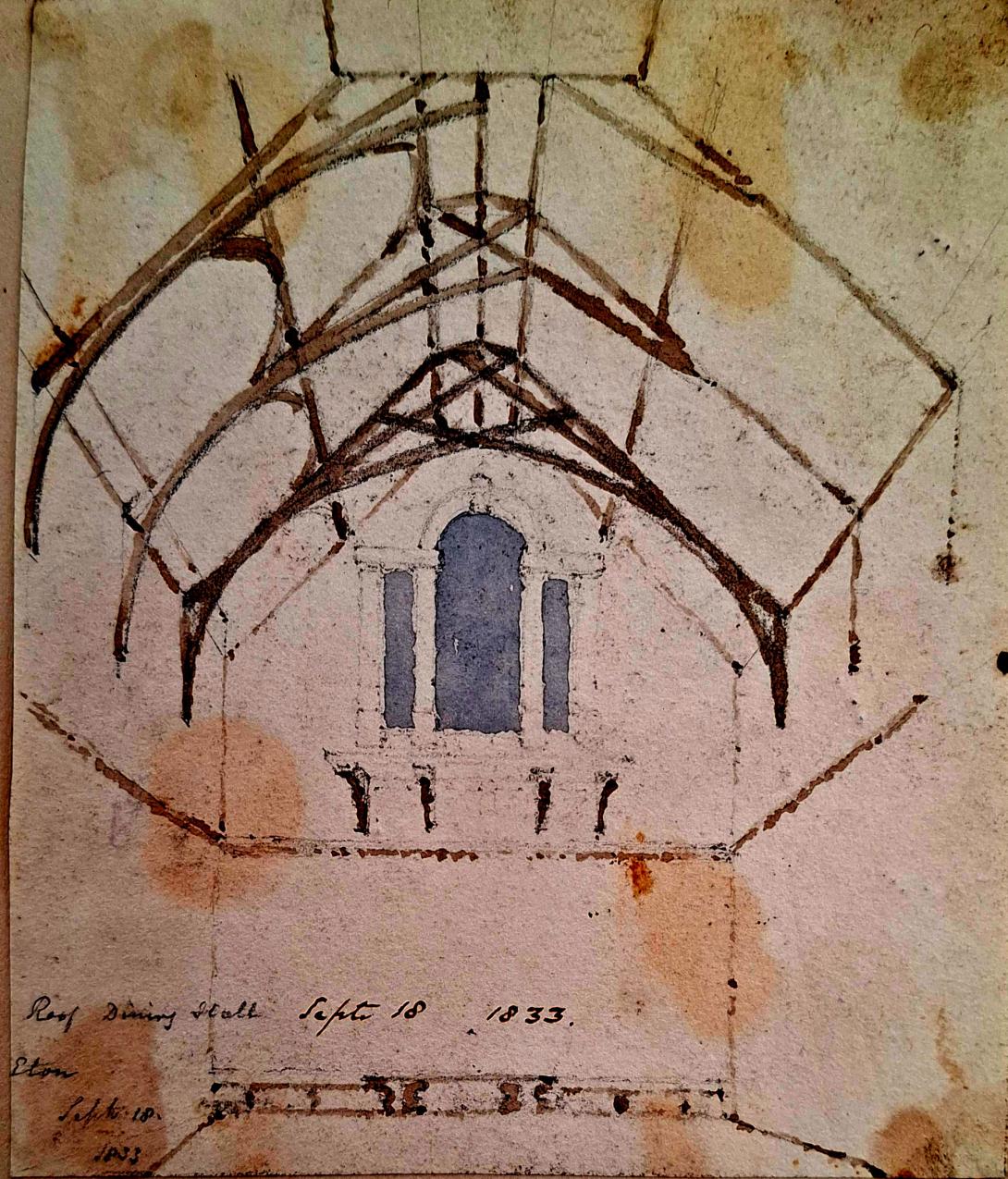
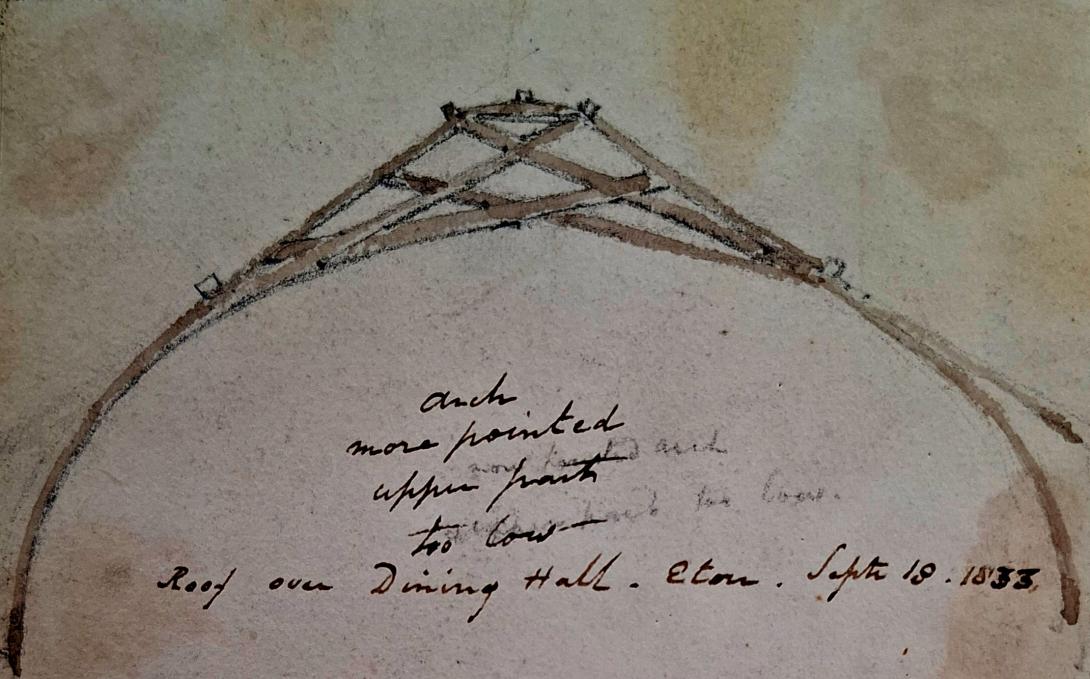
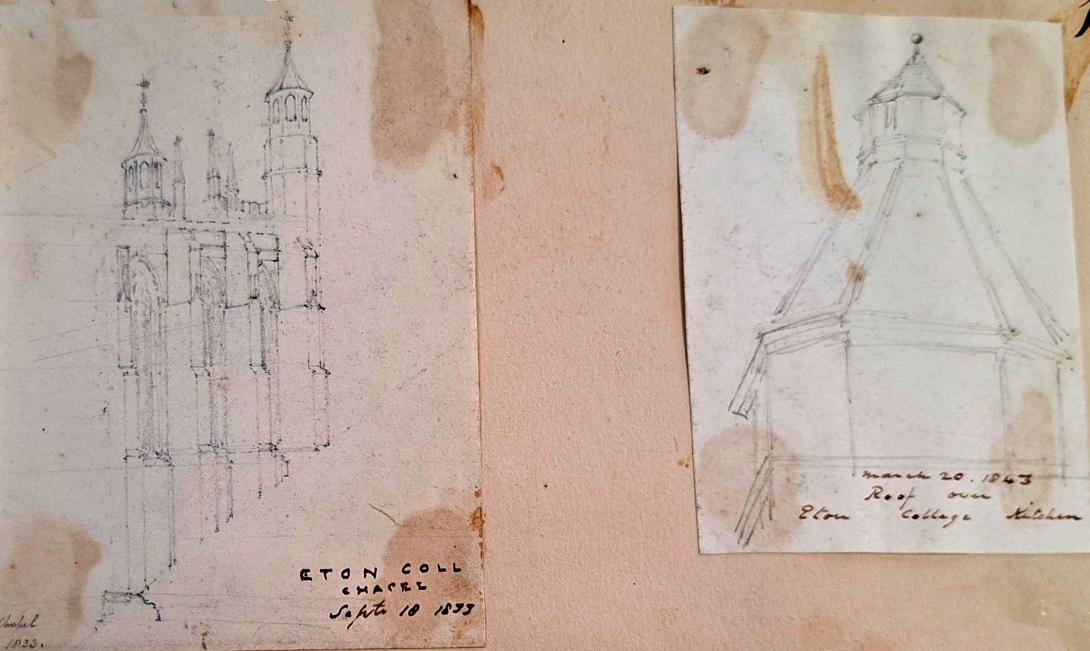
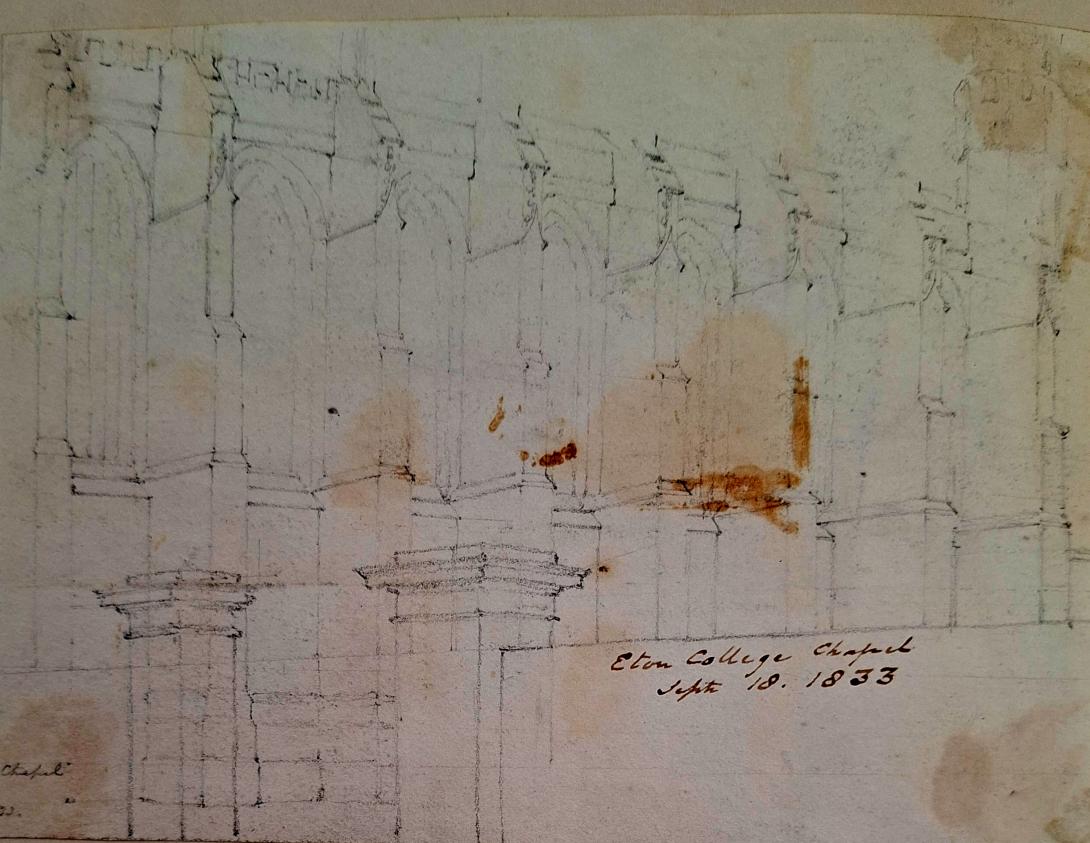
Roof of Dining Hall Eton Sept 18 1833 / Eton College Chapel
Eton College's College Hall, built around 1450, is the historic dining room for the King's Scholars, serving meals in the same monastic refectory style for over 500 years, featuring high tables, ornate paneling, and stained glass, used by historical figures like Queen Elizabeth I and Harold Macmillan, and connected to England's second oldest working kitchen, showcasing centuries of tradition. Built between 1441 and 1460, shortly after King Henry VI founded the college in 1440. Originally for the 70 founding scholars and still used for the same purpose today, maintaining its monastic refectory design.The Hall and the adjacent College Kitchens have served food continuously for over five centuries, making them significant historical spaces.Resembles a medieval great hall or Oxbridge college refectory, with high tables and ornate details. Queen Elizabeth I dined in the hall during a visit in the 1560s, and former Prime Minister Harold Macmillan, a King's Scholar, ate there daily. Includes ornate wood paneling, coats of arms, and stained glass, with the west window's glass dating from 1858. The hall embodies Eton's long-standing traditions, offering a direct link to its medieval origins and continuing to serve its King's Scholars, making it a focal point for the school's history and daily life.
If you enter the Hall from the Cloister below the Library, you will ascend a flight ofstairs constructed in 1691 which required the cutting away ofan arch to give head-room. Observe the diamond shaped stop to the hood mould which still remains, for this motif is characteristic of Henry Vi’s masons and can be seen elsewhere. The Hall is the only building other than the Chapel to be “enhanced” and is still on the same site as the Founder specified in the “Wille”, but here the extra height was obtained by raising the floor on a vaulted cellar. The size of the Hall (82 ft. by 32 ft.), is also in accordance with the “Wille”. Nevertheless, the actual building poses many puzzling questions: Did Henry VI intend to have another bay window to the north which was most probably never built? How is it that only part of the Hall is built ofstone? Why were three fireplaces without flues or stacks found in 1858 behind the old panelling? The major restorations of the Hall took place in 1720, when Mr. Rowland built the present Library, and in 1858, when there was a more complete restoration. The roof was entirely reconstructed (probably more or less as a replica of the original), the panelling restored or renewed, the floor tiles laid, and a screen and gallery erected at the west end. However much we may regret such extensive “restoration” we can still imagine Boswell dining at High Table and in his always revealing manner describing the event in a letter: “I certainly have the art of making the most ot what I have. How should one who has had only a Scotch education be quite at home atEton? I had my classical quotations very ready”. Does this extract not reveal in but a few words a whole book on both Boswell, society and eighteenth-century Eton?
Eton College is a private school providing boarding education for boys aged 13–18, in the town of Eton, Berkshire. The school is the largest boarding school in England, ahead of Millfield and Oundle.
Eton charges up to £52,749 per year (£17,583 per term, with three terms per academic year, for 2023/24). It was the sixth most expensive Headmasters' and Headmistresses' Conference boarding school in the UK in 2013–14.
It was founded in 1440 by Henry VI as Kynge's College of Our Ladye of Eton besyde Windesore, making it the 18th-oldest school in the Headmasters' and Headmistresses' Conference (HMC). Originally intended as a sister institution to King's College, Cambridge, Eton is known for its history, wealth, and notable alumni, known as Old Etonians. It has educated prime ministers, world leaders, Nobel laureates, Academy Award and BAFTA award-winning actors, and generations of the aristocracy, and has been referred to as "the nurse of England's statesmen".
Eton is one of four public schools, along with Harrow (1572), Radley (1847) and Sherborne, to have retained the boys-only, boarding-only tradition, which means that its boys live at the school seven days a week during term time.
See also: Latin school and Neo-Latin § Latin in school education 1500–1700
Establishment

Eton College was founded by Henry VI as a charity school to provide free education to 70 poor boys who would then go on to King's College, Cambridge, founded by the same king in 1441. Henry used Winchester College as a model, visiting at least six times (in 1441, 1444, 1446, 1447, 1448, 1449, 1451, 1452) and having its statutes transcribed. Henry appointed Winchester's headmaster, William Waynflete, as Eton's Provost, and transferred some of Winchester's 70 scholars to start his new school.
When Henry VI founded the school, he granted it a large number of endowments, including much valuable land. The group of feoffees appointed by the king to receive forfeited lands of the Alien Priories for the endowment of Eton were as follows:
- Henry Chichele, Archbishop of Canterbury (d. 1443)
- Thomas Spofford, Bishop of Hereford (d. 1456)
- John Low, Bishop of Rochester (d. 1467)
- William Ayscough, Bishop of Salisbury (d. 1450)
- William de la Pole, 1st Marquess of Suffolk (1396–1450) (later Duke of Suffolk)
- John Somerset (d. 1454), Chancellor of the Exchequer and the king's doctor
- Thomas Beckington (c. 1390–1465), Archdeacon of Buckingham, the king's secretary and later Keeper of the Privy Seal
- Richard Andrew (d. 1477), first Warden of All Souls College, Oxford, later the king's secretary
- Adam Moleyns (d. 1450), Clerk of the Council
- John Hampton (d. 1472) of Kinver, Staffordshire, an Esquire of the Body[14]
- James Fiennes, another member of the Royal Household
- William Tresham, another member of the Royal Household

It was intended to have formidable buildings; Henry intended the nave of the College Chapel to be the longest in Europe, and several religious relics, supposedly including a part of the True Cross and the Crown of Thorns. He persuaded Pope Eugene IV, to grant him a privilege unparalleled anywhere in England: the right to grant indulgences to penitents on the Feast of the Assumption. The college also came into possession of one of England's Apocalypse manuscripts.
However, when Henry was deposed by King Edward IV in 1461, the new King annulled all grants to the school and removed most of its assets and treasures to St George's Chapel, Windsor, on the other side of the River Thames. Legend has it that Edward's mistress, Jane Shore, intervened on the school's behalf. She was able to save a good part of the school, although the royal bequest and the number of staff were much reduced. Construction of the chapel, originally intended to be slightly over twice as long, with 18, or possibly 17, bays (there are eight today) was stopped when Henry VI was deposed. Only the Quire of the intended building was completed. Eton's first Head Master, William Waynflete, founder of Magdalen College, Oxford and previously headmaster of Winchester College, built the ante-chapel that completed the chapel. The important wall paintings in the chapel and the brick north range of the present School Yard also date from the 1480s; the lower storeys of the cloister, including College Hall, were built between 1441 and 1460.
As the school suffered reduced income while still under construction, the completion and further development of the school have since depended to some extent on wealthy benefactors. Building resumed when Roger Lupton was Provost, around 1517. His name is borne by the big gatehouse in the west range of the cloisters, fronting School Yard, perhaps the most famous image of the school. This range includes the important interiors of the Parlour, Election Hall, and Election Chamber, where most of the 18th century "leaving portraits" are kept.
"After Lupton's time, nothing important was built until about 1670, when Provost Allestree gave a range to close the west side of School Yard between Lower School and Chapel". This was remodelled later and completed in 1694 by Matthew Bankes, Master Carpenter of the Royal Works. The last important addition to the central college buildings was the College Library, in the south range of the cloister, 1725–29, by Thomas Rowland. It has a very important collection of books and manuscripts.
-

A 1690 engraving of Eton College by David Loggan
-

Eton College by Canaletto, 1754

_005.jpg)
19th century onwards

The Duke of Wellington is often incorrectly quoted as saying that "The Battle of Waterloo was won on the playing-fields of Eton." Wellington was at Eton from 1781 to 1784 and was to send his sons there. According to Nevill (citing the historian Sir Edward Creasy), what Wellington said, while passing an Eton cricket match many decades later, was, "There grows the stuff that won Waterloo", a remark Nevill construes as a reference to "the manly character induced by games and sport" among English youth generally, not a comment about Eton specifically. In 1889, Sir William Fraser conflated this uncorroborated remark with the one attributed to him by Count Charles de Montalembert's C'est ici qu'a été gagnée la bataille de Waterloo ("It is here that the Battle of Waterloo was won").
The architect John Shaw Jr (1803–1870) became a surveyor to Eton. He designed New Buildings (1844–46),Provost Francis Hodgson's addition to provide better accommodation for collegers, who until then had mostly lived in Long Chamber, a long first-floor room where conditions were inhumane.
Following complaints about the finances, buildings and management of Eton, the Clarendon Commission was set up in 1861 as a royal commission to investigate the state of nine schools in England, including Eton. Questioned by the commission in 1862, Head Master Edward Balston came under attack for his view that in the classroom little time could be spared for subjects other than classical studies.

As with other public schools, a scheme was devised towards the end of the 19th century to familiarise privileged schoolboys with social conditions in deprived areas. The project of establishing an "Eton Mission" in the crowded district of Hackney Wick in east London was started at the beginning of 1880, and it lasted until 1971 when it was decided that a more local project (at Dorney) would be more realistic. However over the years much money was raised for the Eton Mission, a fine church by G. F. Bodley was erected; many Etonians visited and stimulated among other things the Eton Manor Boys' Club, a notable rowing club which has survived the Mission itself, and the 59 Club for motorcyclists.

The large and ornate School Hall and School Library (by L. K. Hall) were erected in 1906–08 across the road from Upper School as the school's memorial to the Etonians who had died in the Boer War. Many tablets in the cloisters and chapel commemorate the large number of dead Etonians of the First World War.
Richard Suter was born in Greenwich, Kent on 30th March 1798, to William Suter and his wife Sarah Knights. On 7th January 1825 he married Anne Ruth Burn.
English architect. As Surveyor to The Fishmongers' Company he designed the severe Presbyterian churches for Ballykelly (1825–7) and Banagher (1825) on the Company's Estate in County Londonderry, drawings of which were exhibited at the Royal Academy in 1827. He was also responsible for the Model Farm (1823–4), the Lancasterian Schools (1828–30), the Company Agent's House (1830–2—now a hotel, much altered), a range of houses on the south side of the main road (1823–4), the lodge in the Presbyterian churchyard (1828), and the Dispensary (1829), all at Ballykelly, and all Classical. As Surveyor to Trinity House Corporation, he designed houses that were erected by Thomas Cubitt in 1821–3 on a site adjoining Trinity House. For The Fishmongers' Company he designed St Peter's Almshouses, Wandsworth, London (1849–51), and The Old School-House, Gresham's School, Holt, Norfolk(1859), in an Elizabethan style.
On the 1841 Census Richard, an architect and lawyer, can be found living in London with his wife Ann (listed as Ruth) and their two children, Richard George and Andrew Burn. Living with them is Edward D Suter. 1851 finds the family living in Tottenham Court in London, by this time Andrew had left the home, but I am unable to trace him on the 1851 Census. In 1860 Andrew marries Amelia Damaris Harrison. Both Richard George and Andrew were to become ordained ministers, with Andrew later becoming a Bishop and emigrating to New Zealand. Sadly in 1854 Anne Ruth was to pass away. In 1861, widowed Richard, Justice of the Peace for Maidenhead, is living at Castle Hill, Maidenhead, Berkshire. In 1862 he married Elizabeth Anne Pocock. In 1871 and 1881 Richard and Elizabeth are still living in Castle Hill. Richard was to pass away on 1st March1883.
Richard Suter & Annesley Voysey, architects, had their office at number 35 Fenchurch Street, but they did not have it all to themselves as they shared the premises with W.C. Franks, a tea broker, who will get a separate post some other time. The earliest mention I found of Richard Suter in Fenchurch Street is in 1832 when he is listed at that address in a list of contributing members of the Society for the Propagation of the Gospel in Foreign Parts. It says that he had been a member since 1829, but that does not mean he was already at 35 Fenchurch Street in that year.(1) In fact, that seems unlikely as the Sun Fire Office records give Messrs. Short and Co., merchants, as paying the insurance premium on the premises in May 1830. The Directory of British Architects 1834-1914 give the year 1827, but I do not know on what evidence. When Suter and Voysey became partners is also uncertain, but they had known each other since at least 1825 as Suter is named as one of the executors of Voysey’s will which was dated 22 July, 1825. The address given for Suter in the will is Suffolk Street, Southwark. Voysey then lives at Conway Street, Fitzroy Square.