
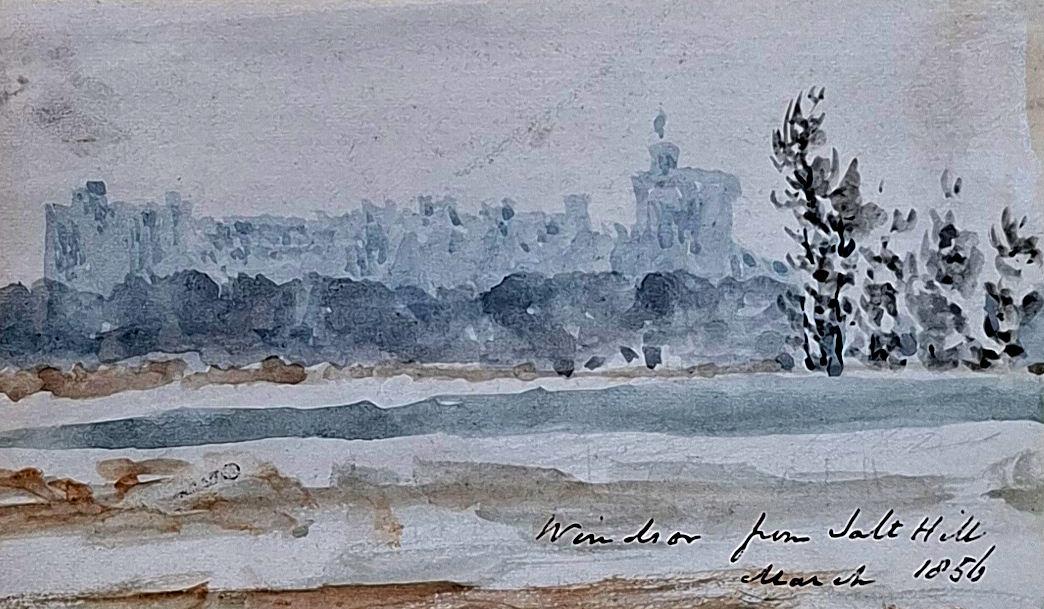

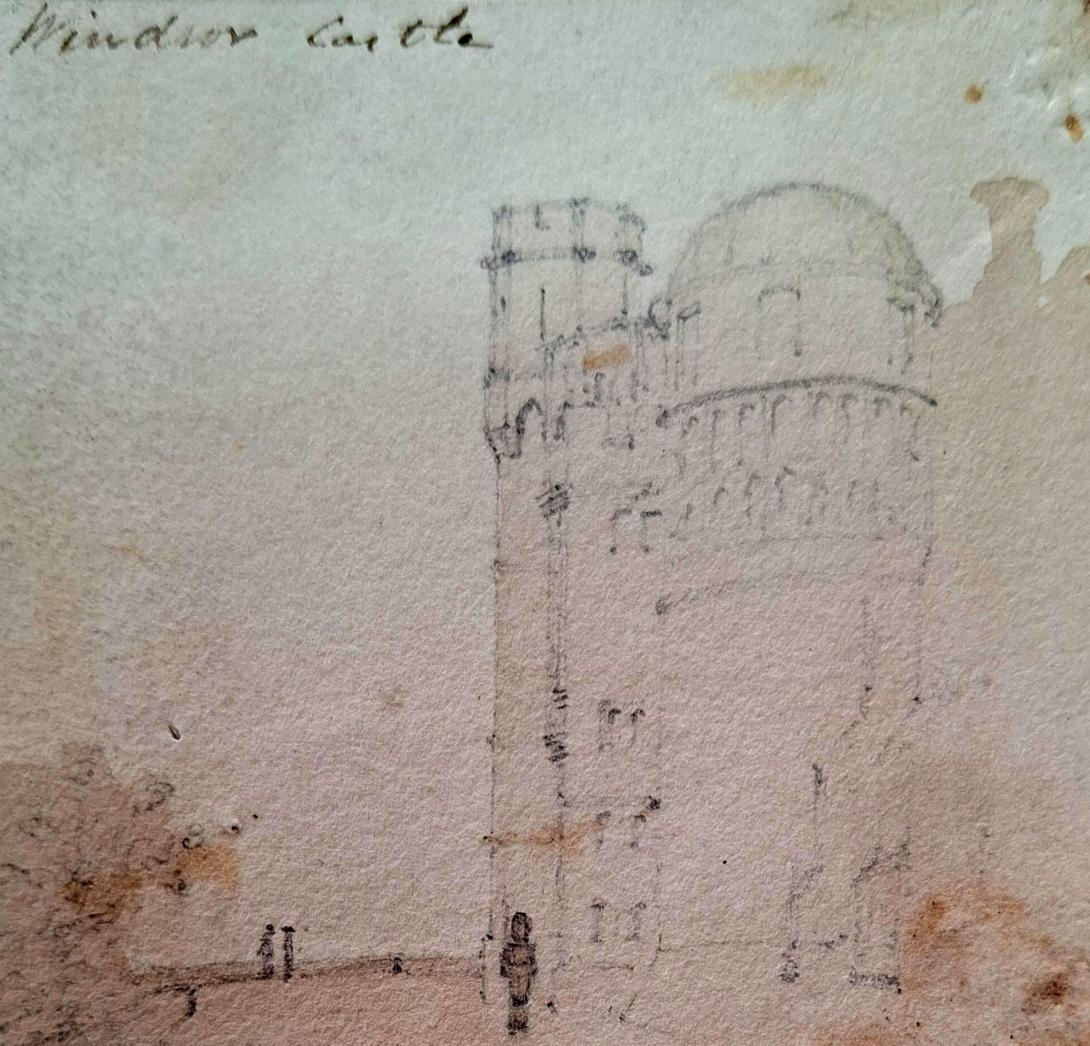
Windsor from Salt Hill March 1856
"Windsor from Salt Hill" is a popular vantage point for several artists in the 19th century who painted Windsor Castle in particular Joseph Mallord William Turner.
Salt Hill is a district within the unitary authority of Slough in Berkshire in the south of England, close to London. Before 1974, Salt Hill was part of Buckinghamshire. It is to the north of Chalvey and the Great West Road, surrounding Salt Hill Park.
The name Salt Hill is derived from Montem Mound in Chalvey, which was also known as Salt Hill, or Salts Hill. Salt Hill was originally a village approximately one mile west of Slough. Famous inns in Salt Hill included the Windmill Inn, visited by William Pitt the Younger and Samuel Taylor Coleridge, and the Castle Inn, which had a view of Windsor Castle.
In 1773, several commissioners of the Colnbrook Turnpike Trust died at Castle Inn due to food poisoning. They had eaten turtle soup.In 1807, the French nobleman Antoine Philippe, Duke of Montpensier died here of tuberculosis on the way from London to Devon.In 1814, the Prince Regent hosted breakfast at the Windmill Inn for the King of Prussia and his sons.
On 1 January 1845, John Tawell, who had recently returned from Australia, murdered his lover, Sarah Hart, at Salt Hill by poisoning her with prussic acid. With various officials in chase, Tawell fled to Slough railway station and boarded a train to Paddington. The electrical telegraph had recently been installed and so a message was sent ahead to Paddington with Tawell's details. Tawell was trailed and subsequently arrested, tried and executed for the murder at Aylesbury on 28 March 1845. This is believed to be the first time ever that the telegraph had been involved in the apprehension of a murderer.
On 6 February 1870 William MacBean George Colebrooke K.B. died at his home here. He, along with fellow Utilitarian Charles Hay Cameron had been responsible for the Colebrooke-Cameron Commission Help report, which brought constitutional government to Ceylon (later Sri Lanka) and marks the beginning of the modern era in that country. He had also presided over a constitutional crisis in New Brunswick and had been Governor of British Guiana.[dubious – discuss]
Salt Hill Park once boasted great iron gates, which were subsequently smelted as part of the war effort during World War II.
Richard Suter was born in Greenwich, Kent on 30th March 1798, to William Suter and his wife Sarah Knights. On 7th January 1825 he married Anne Ruth Burn.
English architect. As Surveyor to The Fishmongers' Company he designed the severe Presbyterian churches for Ballykelly (1825–7) and Banagher (1825) on the Company's Estate in County Londonderry, drawings of which were exhibited at the Royal Academy in 1827. He was also responsible for the Model Farm (1823–4), the Lancasterian Schools (1828–30), the Company Agent's House (1830–2—now a hotel, much altered), a range of houses on the south side of the main road (1823–4), the lodge in the Presbyterian churchyard (1828), and the Dispensary (1829), all at Ballykelly, and all Classical. As Surveyor to Trinity House Corporation, he designed houses that were erected by Thomas Cubitt in 1821–3 on a site adjoining Trinity House. For The Fishmongers' Company he designed St Peter's Almshouses, Wandsworth, London (1849–51), and The Old School-House, Gresham's School, Holt, Norfolk(1859), in an Elizabethan style.
On the 1841 Census Richard, an architect and lawyer, can be found living in London with his wife Ann (listed as Ruth) and their two children, Richard George and Andrew Burn. Living with them is Edward D Suter. 1851 finds the family living in Tottenham Court in London, by this time Andrew had left the home, but I am unable to trace him on the 1851 Census. In 1860 Andrew marries Amelia Damaris Harrison. Both Richard George and Andrew were to become ordained ministers, with Andrew later becoming a Bishop and emigrating to New Zealand. Sadly in 1854 Anne Ruth was to pass away. In 1861, widowed Richard, Justice of the Peace for Maidenhead, is living at Castle Hill, Maidenhead, Berkshire. In 1862 he married Elizabeth Anne Pocock. In 1871 and 1881 Richard and Elizabeth are still living in Castle Hill. Richard was to pass away on 1st March1883.
Richard Suter & Annesley Voysey, architects, had their office at number 35 Fenchurch Street, but they did not have it all to themselves as they shared the premises with W.C. Franks, a tea broker, who will get a separate post some other time. The earliest mention I found of Richard Suter in Fenchurch Street is in 1832 when he is listed at that address in a list of contributing members of the Society for the Propagation of the Gospel in Foreign Parts. It says that he had been a member since 1829, but that does not mean he was already at 35 Fenchurch Street in that year.(1) In fact, that seems unlikely as the Sun Fire Office records give Messrs. Short and Co., merchants, as paying the insurance premium on the premises in May 1830. The Directory of British Architects 1834-1914 give the year 1827, but I do not know on what evidence. When Suter and Voysey became partners is also uncertain, but they had known each other since at least 1825 as Suter is named as one of the executors of Voysey’s will which was dated 22 July, 1825. The address given for Suter in the will is Suffolk Street, Southwark. Voysey then lives at Conway Street, Fitzroy Square.