
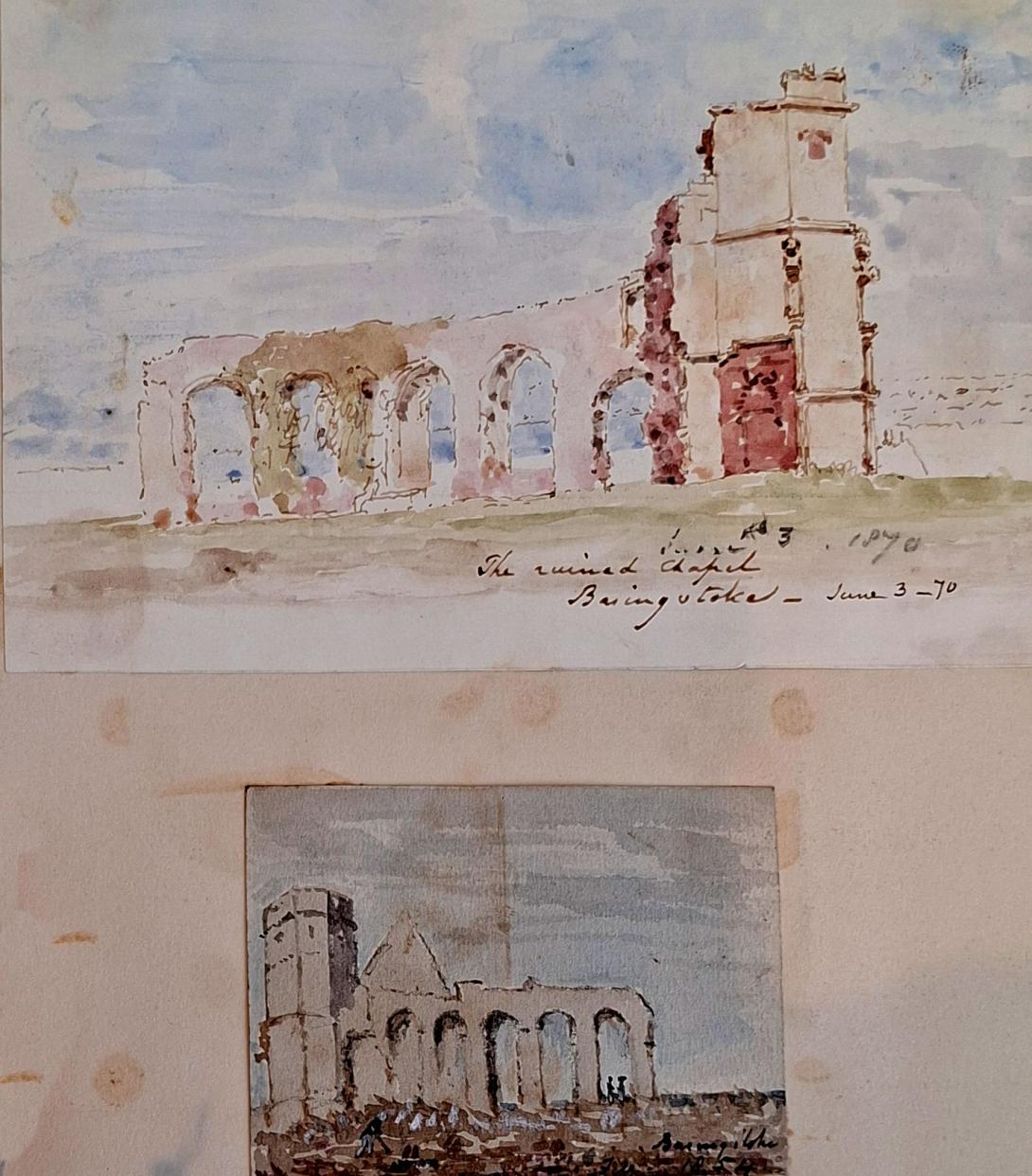
The Ruined Chapel Basingstoke June 3rd 1870
This 13th Century building was greatly enlarged in 1524 by Lord Sandys of The Vyne, when he added the Chapel of the Holy Trinity to the south side of the chancel as a private burial place for the Sandys family. Both Chapels are now Grade II listed buildings and scheduled ancient monuments.
In 1208, a dispute between King John and the Pope meant that burials in consecrated ground were forbidden for about 6 years. During this time, the townspeople buried their dead on the slope north of the town. Later, the ground was consecrated, and became the town’s burial ground for the next 700 years, until the new cemetery opened in Worting Road in 1913.
The first chapel was built by 1280, with a Guild of Townsmen to oversee the site and collect offerings of money and land, left as bequests in return for prayers for life after death. What we see of the earlier chapel today is part of the west wall.
The distinctive remains include the tower and window arches of another chapel, added to the original one and built around 1525 by William Lord Sandys of The Vyne as a grand burial place for his parents and family [see Ian Richard’s Flashback, Gazette 10/12/2020]. The chapel was widely known for its great beauty, for its roof and above all for its painted glass windows. It was dedicated to the Holy Trinity. Sandys’ family emblems are visible on the parapet and grave slabs. These include the hemp-breaker and cross raggulé.
Why did it fall into ruin? In the 1540s, Sandys’ chapel was caught up in the English Reformation, which saw the closure of all chantry chapels. Statues and other items used in worship were removed in what must have been a puzzling time for people. After the death of Edward VI, his sister Mary revived Catholic worship. In 1556 a charter was drawn up by Queen Mary, which established a school in the chapel. The schoolroom was attached to the west wall of the early chapel. Known as Queen Mary’s School, it survived as Queen Mary’s Grammar School for Boys and then, with comprehensive education, the name and endowment moved to Queen Mary’s College.
Associated with Lord Sandys (of the Vyna) in the time of Henry VIII, the chapel was attached to the south side of the chancel of the Holy Ghost Chapel. A rectangular plan of 4 bays, 3-sided apse and a hexagonal stair turret at the south-west corner. What survives is the main part of the south and east walls, and the Tower; the walling below the cills has gone and the whole is badly weathered. Externally the fine ashlar has large openings, with 4 central arches containing signs of cusping at the top of 3 light mullioned windows, thin edge mouldings lie between large hollows. Between the openings are the remains of canopied niches, with octagonal bosses, thin panels above a plain slender octa- gonal attached shaft, this design is repeated at the corners of the stair turret, which is otherwise plain, with some small plain windows beneath hood-moulds. The south door, beneath a smaller window, has disappeared. The interior walling is in red brickwork, English bond.
Richard Suter was born in Greenwich, Kent on 30th March 1798, to William Suter and his wife Sarah Knights. On 7th January 1825 he married Anne Ruth Burn.
English architect. As Surveyor to The Fishmongers' Company he designed the severe Presbyterian churches for Ballykelly (1825–7) and Banagher (1825) on the Company's Estate in County Londonderry, drawings of which were exhibited at the Royal Academy in 1827. He was also responsible for the Model Farm (1823–4), the Lancasterian Schools (1828–30), the Company Agent's House (1830–2—now a hotel, much altered), a range of houses on the south side of the main road (1823–4), the lodge in the Presbyterian churchyard (1828), and the Dispensary (1829), all at Ballykelly, and all Classical. As Surveyor to Trinity House Corporation, he designed houses that were erected by Thomas Cubitt in 1821–3 on a site adjoining Trinity House. For The Fishmongers' Company he designed St Peter's Almshouses, Wandsworth, London (1849–51), and The Old School-House, Gresham's School, Holt, Norfolk(1859), in an Elizabethan style.
On the 1841 Census Richard, an architect and lawyer, can be found living in London with his wife Ann (listed as Ruth) and their two children, Richard George and Andrew Burn. Living with them is Edward D Suter. 1851 finds the family living in Tottenham Court in London, by this time Andrew had left the home, but I am unable to trace him on the 1851 Census. In 1860 Andrew marries Amelia Damaris Harrison. Both Richard George and Andrew were to become ordained ministers, with Andrew later becoming a Bishop and emigrating to New Zealand. Sadly in 1854 Anne Ruth was to pass away. In 1861, widowed Richard, Justice of the Peace for Maidenhead, is living at Castle Hill, Maidenhead, Berkshire. In 1862 he married Elizabeth Anne Pocock. In 1871 and 1881 Richard and Elizabeth are still living in Castle Hill. Richard was to pass away on 1st March1883.
Richard Suter & Annesley Voysey, architects, had their office at number 35 Fenchurch Street, but they did not have it all to themselves as they shared the premises with W.C. Franks, a tea broker, who will get a separate post some other time. The earliest mention I found of Richard Suter in Fenchurch Street is in 1832 when he is listed at that address in a list of contributing members of the Society for the Propagation of the Gospel in Foreign Parts. It says that he had been a member since 1829, but that does not mean he was already at 35 Fenchurch Street in that year.(1) In fact, that seems unlikely as the Sun Fire Office records give Messrs. Short and Co., merchants, as paying the insurance premium on the premises in May 1830. The Directory of British Architects 1834-1914 give the year 1827, but I do not know on what evidence. When Suter and Voysey became partners is also uncertain, but they had known each other since at least 1825 as Suter is named as one of the executors of Voysey’s will which was dated 22 July, 1825. The address given for Suter in the will is Suffolk Street, Southwark. Voysey then lives at Conway Street, Fitzroy Square.