
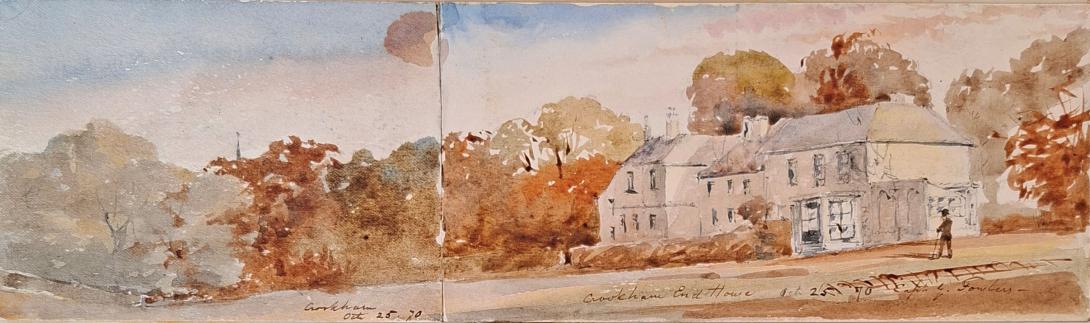
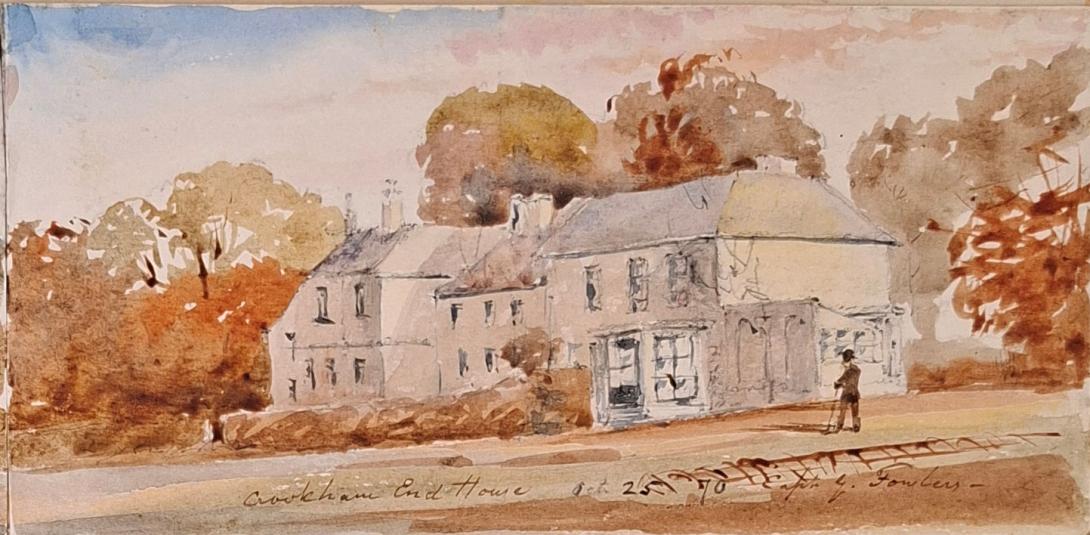
Crookham End House Oct 25 1870 Captain Geo Fowler coloured by Lieutenant Wm Fowler RA dec 10 1874 (2)
House. Early C19. Rendered with plinth, and deep eaves to tiled roof, hipped to left and gabled to right with stone coping. 2 stacks, end stack to right. 2 storeys. 5 bays. Glazing bar sashes, all with exposed wooden boxes and moulded surrounds except 3 to left on ground floor. Blank window in ground floor, second bay from left. Doorway in fourth bay from left with 6 panelled door, semi circular radial, fanlight, moulded surround and Doric porch with two columns without entasis and deep cornice. Crookham End House, Brimpton (MWB18861, NHLE 1303127) is a Grade II listed 19th century house, 412m southwest of the site. It’s neighbour, Little Court (MWB20488) is an early unlisted 19th century house (formerly Grade III), 399m southwest of the site. Both are seen in the 1880 Kingsclere map and the 1815 Enclosure Map, and it is possible that they are also present as the two buildings to the west of Brimpton on the 1761 Rocque map. It appears that Crookham End House may have been altered/extended between the 1808 and 1815 maps, however Little Court seems to have the same footprint throughout.
Crookham is a dispersed hamlet in the English county of Berkshire, and part of the civil parish of Thatcham.
The settlement lies near the A339 and A4 roads, and is located approximately 4 miles (6.4 km) south-east of Thatcham (where, according to the grid reference, the majority of the 2011 census population was included). Crookham - like the adjoining Crookham Common - is situated at the end of the former runway of RAF Greenham Common.
Immediately before 1066, Crookham was owned by Alwi Ceuresbert, a King's thane. Crookham appears in the Domesday Book under Thatcham Hundred. It was later, about 1125, granted to Reading Abbey. There was only one manor and this was sublet to various families, some of whom hosted Royal visits, including that of Henry III who visited the hamlet in 1229, most probably to engage in hunting in the rural areas. By 1299, Crookham Manor House had a chapel attached to it. On 29 and 30 August 1320, Edward II stayed there.
In 1445 the sub-manor of Chamberhouse was formed. Chamberhouse was the childhood home of the distinguished soldier and statesman Henry Docwra, 1st Baron Docwra of Culmore, who was born there in 1564. Anne of Denmark came to Chamberhouse for dinner with Nicholas Fuller on 4 September 1613. The original Crookham Manor and chapel appear to have been abandoned around 1542, and by about 1748, the estate had been purchased by George Amyand, a merchant and subsequently Member of Parliament for Barnstaple. A new manor house was built in the 18th century and this itself was demolished and rebuilt around 1850, Crookham House, in the mid-20th century, the building served as a junior school for the children of US Air Force personnel stationed at the nearby RAF Greenham Common airbase.
Thatcham is a market town and civil parish in West Berkshire, England. It is situated in the valley of the River Kennet 3 miles (4.8 km) east of Newbury, 14 miles (23 km) west of Reading and 54 miles (87 km) west of London. The town has a long history dating back to prehistoric times, a claimant to the title of oldest continuously inhabited place in Great Britain. As of 2021, it had a population of 25,464, though it is part of a built-up area comprising itself and neighbouring Newbury of over 70,000 residents. It is on the route of the A4 Bath Road, the historic main road between London and Bristol
Thatcham straddles the River Kennet, the Kennet and Avon Canal and the A4. The parish currently covers the town of Thatcham, with its suburb of Dunstan Park and the villages of Crookham, Henwick and Colthrop including Crookham Common and the eastern ranges of the old RAF Greenham Common airfield. The historic parish once also covered Midgham, Cold Ash, Ashmore Green and Greenham. Thatcham Reed Beds, just to the south of the town, is a site of Special Scientific Interest (SSSI).
The name may have been derived from that of a Saxon chief called Tace (or perhaps Tac or Tec), who established a village in around 500 AD. The settlement might have been known as Taceham - ham meaning village in Saxon. However, some of the earliest written references, in c.951 and c.975, records it as Thaecham. The Thaec comes from the Saxon þæc or thaec meaning roof-covering and the ham has been speculated to be a shortened hamm which would mean a river meadow. In Domesday Book of 1086, following the Norman Conquest, the name had altered slightly to Taceham before going through several minor changes until the current form was adopted in the 16th century.
The area has evidence of occupation dating from prehistoric times and was listed in the Guinness Book of Records as the strongest claimant to being the oldest continuously inhabited place in Britain. The well-preserved remains of a Mesolithic settlement, dating from 8400 to 7700 BCE, have been found in its vicinity. Evidence also exists of Bronze and Iron Age settlements and of Romano-British activity.

The town had a period of great prosperity around 1304, when the Chapel of St. Thomas the Martyr on the A4, now called the Old Bluecoat School, was granted permission to hold services. At that time the population was larger than that of Newbury. The chapel is a Grade I listed building.

There is a Norman parish church of St. Mary, which was largely reconstructed in 1857. This is believed to be built on the same site as an earlier Anglo-Saxon church. It was previously known as St. Luke's. The church is a Grade II* listed building.
In 1121, Henry I founded Reading Abbey and endowed it with many gifts of land, including the Manor of Thatcham. At the same time Thatcham Hundred ceased to exist: the western part was transferred to Faircross Hundred, and the remainder to the Hundred of Reading. In 1141 Thatcham church, previously the property of the Diocese of Salisbury, was granted to Reading Abbey by the Empress Matilda, who at the same time confirmed her father's gift of the manor to the abbey.
During World War II, Thatcham housed one of the biggest Prisoner of War camps in the South, known as camp 1001. Thatcham's population grew rapidly in the second half of the 20th century: from 5,000 in 1951 and 7,500 in 1961 to 22,824 in 2001.
Richard Suter was born in Greenwich, Kent on 30th March 1798, to William Suter and his wife Sarah Knights. On 7th January 1825 he married Anne Ruth Burn.
English architect. As Surveyor to The Fishmongers' Company he designed the severe Presbyterian churches for Ballykelly (1825–7) and Banagher (1825) on the Company's Estate in County Londonderry, drawings of which were exhibited at the Royal Academy in 1827. He was also responsible for the Model Farm (1823–4), the Lancasterian Schools (1828–30), the Company Agent's House (1830–2—now a hotel, much altered), a range of houses on the south side of the main road (1823–4), the lodge in the Presbyterian churchyard (1828), and the Dispensary (1829), all at Ballykelly, and all Classical. As Surveyor to Trinity House Corporation, he designed houses that were erected by Thomas Cubitt in 1821–3 on a site adjoining Trinity House. For The Fishmongers' Company he designed St Peter's Almshouses, Wandsworth, London (1849–51), and The Old School-House, Gresham's School, Holt, Norfolk(1859), in an Elizabethan style.
On the 1841 Census Richard, an architect and lawyer, can be found living in London with his wife Ann (listed as Ruth) and their two children, Richard George and Andrew Burn. Living with them is Edward D Suter. 1851 finds the family living in Tottenham Court in London, by this time Andrew had left the home, but I am unable to trace him on the 1851 Census. In 1860 Andrew marries Amelia Damaris Harrison. Both Richard George and Andrew were to become ordained ministers, with Andrew later becoming a Bishop and emigrating to New Zealand. Sadly in 1854 Anne Ruth was to pass away. In 1861, widowed Richard, Justice of the Peace for Maidenhead, is living at Castle Hill, Maidenhead, Berkshire. In 1862 he married Elizabeth Anne Pocock. In 1871 and 1881 Richard and Elizabeth are still living in Castle Hill. Richard was to pass away on 1st March1883.
Richard Suter & Annesley Voysey, architects, had their office at number 35 Fenchurch Street, but they did not have it all to themselves as they shared the premises with W.C. Franks, a tea broker, who will get a separate post some other time. The earliest mention I found of Richard Suter in Fenchurch Street is in 1832 when he is listed at that address in a list of contributing members of the Society for the Propagation of the Gospel in Foreign Parts. It says that he had been a member since 1829, but that does not mean he was already at 35 Fenchurch Street in that year.(1) In fact, that seems unlikely as the Sun Fire Office records give Messrs. Short and Co., merchants, as paying the insurance premium on the premises in May 1830. The Directory of British Architects 1834-1914 give the year 1827, but I do not know on what evidence. When Suter and Voysey became partners is also uncertain, but they had known each other since at least 1825 as Suter is named as one of the executors of Voysey’s will which was dated 22 July, 1825. The address given for Suter in the will is Suffolk Street, Southwark. Voysey then lives at Conway Street, Fitzroy Square.