
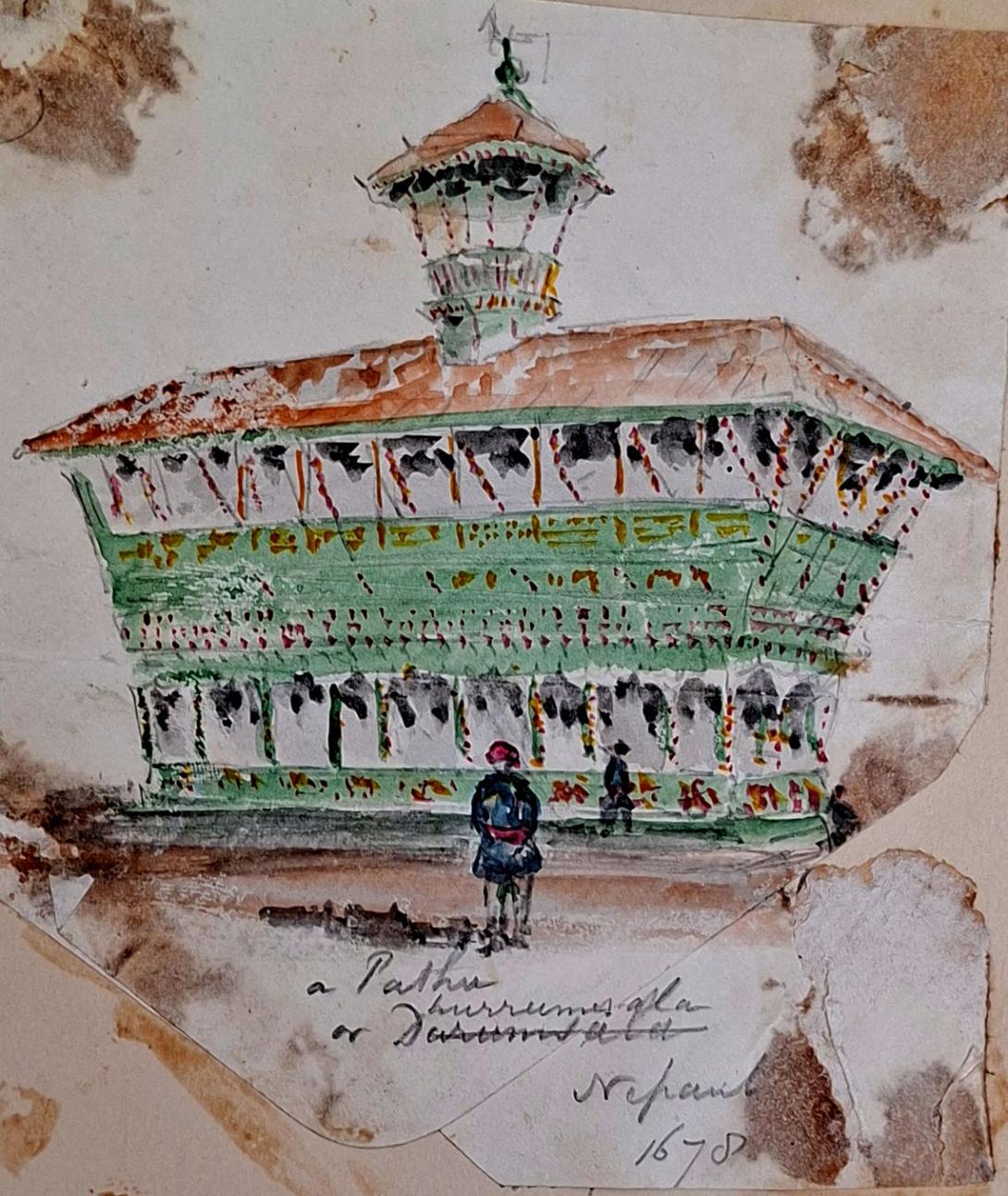
a pathu or Dharmasthala Nepal 1678 1872
Manakamana Temple Manakāmanā Mandira, lit. 'temple that grants wishes of its devotees') is a Hindu temple dedicated to goddess Bhagwati, an incarnation of Parvati and it is situated in the village of Manakamana in Gorkha District, Gandaki Province, Nepal founded by Arman Rayamajhi in 1678.
The Manakamana Temple is located 1,300 metres (4,300 ft) above sea level on the Kafakdada Hill which sits in the confluence between Trishuli and Marsyangdi in the Sahid Lakhan Rural Municipality in Gorkha, Gandaki Province, Nepal. It is approximately 106 kilometres (66 mi) west of Kathmandu, the capital of Nepal, and about 94 kilometres (58 mi) east of Pokhara. Many mountains can be seen from the hill including Annapurna II, Lamjung Himal, and Baudha which is part of Manaslu, the eighth-highest mountain in the world. By hiking from Anbu Khaireni Rural Municipality it takes about three hours to reach Manakamana which is about 1,000 metres (3,300 ft) away. Alternatively, pilgrims can take the Manakamana Cable Car which was built in 1998 for about US$7.5 million.
It is a two-story temple built in the traditional Nepalese pagoda style, features an ambulatory outside, and spans over 7,659 ropani (3.8930 Square kilometres) of land.
According to Nepali legend, Manakamana Temple was built in the 17th century during the reign of two Kings of Gorkha, Ram Shah or Prithvipati Shah. The Queen of Gorkha possessed "divine powers" of Manakamana which was only known by the priest Lakhan Thapa of Magar origin. One fine day, the king saw his wife in form of Goddess Manakamana, and priest as a lion, after he told her about this the king mysteriously died. Per historical Hindu practice of Sati, the queen sacrificed herself by sitting atop her deceased husband's funeral pyre. Prior to her death, she told St. Lakhan Thapa Magar that she would appear again, six months later, a farmer working on the field split a stone which apparently started a stream of blood and milk.After hearing about this, St. Lakhan Thapa Magar went to where the stone was located and started to do Hindu tantric rituals which halted the stream.
Later he built a shrine at the same spot so that their wishes can come true, and also the priest of the temple should necessarily be a descendant of Saint Lakhan Thapa Magar who is described as a spiritual guide for Ram Shah. In the Manakamana Temple, it is mandatory for a priest to be a Magar. Manakamana is thought to be Champawati, wife of Ram Shah, she reappeared during his son Dambar Shah's reign, and according to other sources indicate that she appeared during the reign of Prithvi Narayan Shah, founder of present-day Nepal. The temple is the holy site of Goddess Bhagawati devi, an incarnation of Lakshmi with Garud as protector. Mana translates as "heart" and "kamana" as "wish" and it is believed that the Bhagwati grants wishes of its devotees.
In 1764-65, Prithvi Narayan Shah began a trust to worship Manakamana, Bareyshwar Mahadev, and to feed the pigeons every day. Later, he made that vajracharya priests to worship the temple and donated a bronze bell, however, another source says that Girvan Yuddha Bikram Shah had donated it. According to another engraving, in 1802-3, four siblings: Sur Bir, Kar Bir, Fauda Singh, and Khagda Singh built the gold plated the main gate. In 1893-4, the bell was repaired by Kulman Thapa, and during the reign of Surendra Bikram Shah the top roof was built with corrugated copper sheets. King Mahendra replaced the roof and added copper roofing and later roof truss were engraved to feature images of Asta Matrikas: Brahamayani. Vaisanavi, Maheswari, Indrayani, and Kumari.
Manakamana Temple started to lean six inches towards south-west after the 1934 Nepal–India earthquake and 1988 Nepal earthquake. The April 2015 Nepal earthquake made cracks on the roof and titled the temple 9-12 inches in the direction of north-east. In June 2015, reconstruction began under the supervision of Department of Archaeology with the budget of 130-140 million Nepalese rupees (NPR), and it was finished in September 2018. Limestone, surkhi, bricks and wood were used in the restoration process, and the roof, the door, the finial, and windows were gold-plated with 14 kilograms of gold which costed about 90 million NPR.
Richard Suter was born in Greenwich, Kent on 30th March 1798, to William Suter and his wife Sarah Knights. On 7th January 1825 he married Anne Ruth Burn.
English architect. As Surveyor to The Fishmongers' Company he designed the severe Presbyterian churches for Ballykelly (1825–7) and Banagher (1825) on the Company's Estate in County Londonderry, drawings of which were exhibited at the Royal Academy in 1827. He was also responsible for the Model Farm (1823–4), the Lancasterian Schools (1828–30), the Company Agent's House (1830–2—now a hotel, much altered), a range of houses on the south side of the main road (1823–4), the lodge in the Presbyterian churchyard (1828), and the Dispensary (1829), all at Ballykelly, and all Classical. As Surveyor to Trinity House Corporation, he designed houses that were erected by Thomas Cubitt in 1821–3 on a site adjoining Trinity House. For The Fishmongers' Company he designed St Peter's Almshouses, Wandsworth, London (1849–51), and The Old School-House, Gresham's School, Holt, Norfolk(1859), in an Elizabethan style.
On the 1841 Census Richard, an architect and lawyer, can be found living in London with his wife Ann (listed as Ruth) and their two children, Richard George and Andrew Burn. Living with them is Edward D Suter. 1851 finds the family living in Tottenham Court in London, by this time Andrew had left the home, but I am unable to trace him on the 1851 Census. In 1860 Andrew marries Amelia Damaris Harrison. Both Richard George and Andrew were to become ordained ministers, with Andrew later becoming a Bishop and emigrating to New Zealand. Sadly in 1854 Anne Ruth was to pass away. In 1861, widowed Richard, Justice of the Peace for Maidenhead, is living at Castle Hill, Maidenhead, Berkshire. In 1862 he married Elizabeth Anne Pocock. In 1871 and 1881 Richard and Elizabeth are still living in Castle Hill. Richard was to pass away on 1st March1883.
Richard Suter & Annesley Voysey, architects, had their office at number 35 Fenchurch Street, but they did not have it all to themselves as they shared the premises with W.C. Franks, a tea broker, who will get a separate post some other time. The earliest mention I found of Richard Suter in Fenchurch Street is in 1832 when he is listed at that address in a list of contributing members of the Society for the Propagation of the Gospel in Foreign Parts. It says that he had been a member since 1829, but that does not mean he was already at 35 Fenchurch Street in that year.(1) In fact, that seems unlikely as the Sun Fire Office records give Messrs. Short and Co., merchants, as paying the insurance premium on the premises in May 1830. The Directory of British Architects 1834-1914 give the year 1827, but I do not know on what evidence. When Suter and Voysey became partners is also uncertain, but they had known each other since at least 1825 as Suter is named as one of the executors of Voysey’s will which was dated 22 July, 1825. The address given for Suter in the will is Suffolk Street, Southwark. Voysey then lives at Conway Street, Fitzroy Square.